The fighting usually ended around dusk. Trumpets, shouts, the screaming of horses, all of it died down, and what was left was a field of men. Some dead, some dying, some pretending to be either, so they wouldn’t be finished off.
This is the part medieval chroniclers tended to skim over, and we don’t see in Hollywood movies. They loved telling you about the cavalry charge, the king’s banner, and which earl killed which baron. What happened the morning after, when the field had to be cleared of thousands of corpses in summer heat or freezing mud, wasn’t glamorous enough to be written about.
Table of Contents
The logistics were grim, the labor brutal, and the fate of the dead depended almost entirely on who they were. A duke went home in a lead-lined coffin, a pikeman from Flintshire went into a pit with two hundred others, naked, missing his teeth.
The Medieval Battle Looters and Camp Followers
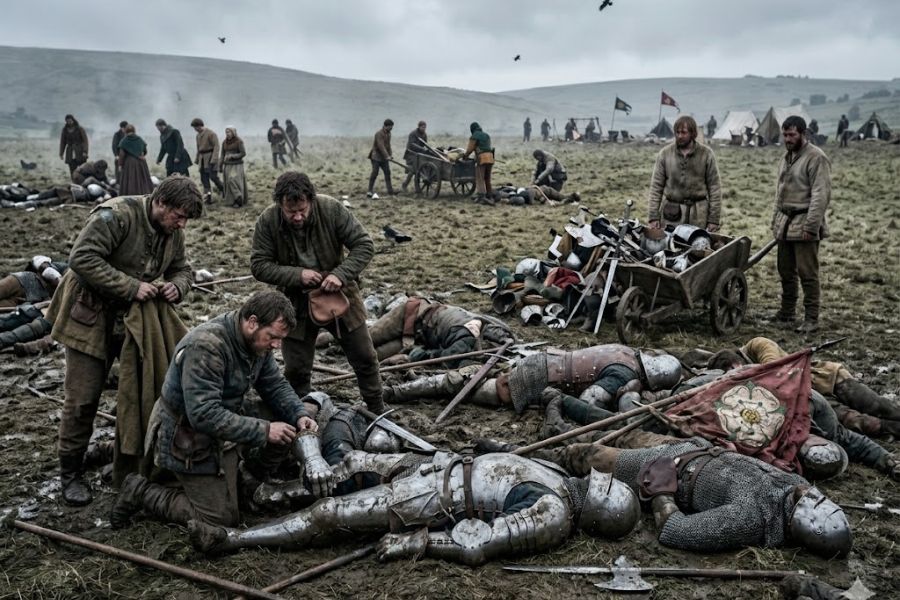
Within minutes of a battle ending, the field belonged to scavengers. Some were the victorious soldiers themselves, picking through the dead for coin, rings, and weapons. Others were camp followers, the women, boys, and hangers-on who trailed every medieval army, and who knew exactly where to look. A good sword could be worth a year’s wages, and a pair of boots was worth fighting another man over.
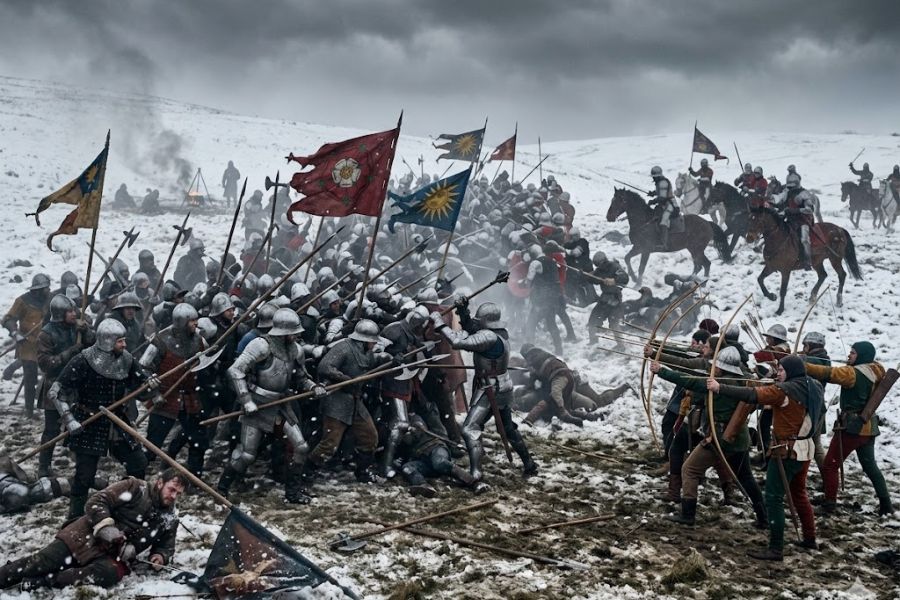
The dead were stripped with astonishing speed. Mail shirts, padded jacks, helmets, belts, and even underclothes were pulled off and bundled away. At Towton in 1461, fought in a snowstorm on Palm Sunday, the bodies recovered from the mass graves in the 1990s were almost all naked. No buckles, no buttons, no scraps of cloth. Everything had been taken.
One skeleton, known to the archaeologists as Towton 25, had been hit in the head at least eight times, his face essentially destroyed. Whoever stripped him did so while standing over what was left of him.
The wounded had their own grim hierarchy. A wealthy knight who could name his family and promise ransom would be carried off to a tent and seen by whatever physician was nearest. A common man with a gut wound was usually given a knife across the throat by a passing looter. There was no field hospital in any modern sense.
I’ve stood on the ridge at Towton in March, when the wind comes off the Yorkshire moors and goes straight through three layers of coat, and tried to picture men fighting hand-to-hand in horizontal snow for nearly ten hours. Then tried to picture the women and boys moving across the field afterward, in the dark, going from body to body with knives.
Sorting the Nobles From the Nobodies
The first job of the morning, assuming the victors had time, was finding the important dead. Heralds did this work. They knew the coats of arms, the badges, the personal devices of every man of standing on both sides, and they walked the field identifying corpses by what remained of their surcoats or their shields.
If a face was unrecognizable, which, after a battle, it very often was, the herald went by heraldry.
Knights and lords got the full treatment. Their bodies were washed, sometimes embalmed in a rough fashion using salt or spices, wrapped in waxed cloth or lead sheeting, and sent home for burial in family churches.
Richard III, killed at Bosworth in 1485, is the famous exception. The new king, Henry VII, had him stripped, slung over a horse, paraded back to Leicester, and dumped in a Greyfriars grave so cramped his spine was bent to fit. We know all this because they dug him up under a car park in 2012.
The lesser dead, gentry, esquires, men whose families might pay a small sum, sometimes got individual graves in nearby churchyards. Records from the village churches around Bosworth and Tewkesbury show small payments made for grave-digging and for masses said for unnamed soldiers. The local priest often ended up coordinating burials he had not asked for and was not paid enough to do.
Everything below that level was a problem of mass. After Towton, with possibly 28,000 dead, the victors faced a logistical nightmare. The same was true after Agincourt in 1415, after Verneuil in 1424, after Flodden in 1513. You cannot bury thirty thousand men in individual graves with a tired army and no equipment. You bury them in pits.
The Pits: How Mass Graves Actually Worked
Mass graves were dug by whoever was nearest and most coercible. Sometimes it was the surviving prisoners of the defeated army. Sometimes local villagers were pressed into service, with or without payment.
The grave-diggers at Towton seem to have been paid by Richard III decades later, when he was still Duke of Gloucester, in an effort to give the dead a more decent burial. The original pits had been hasty.
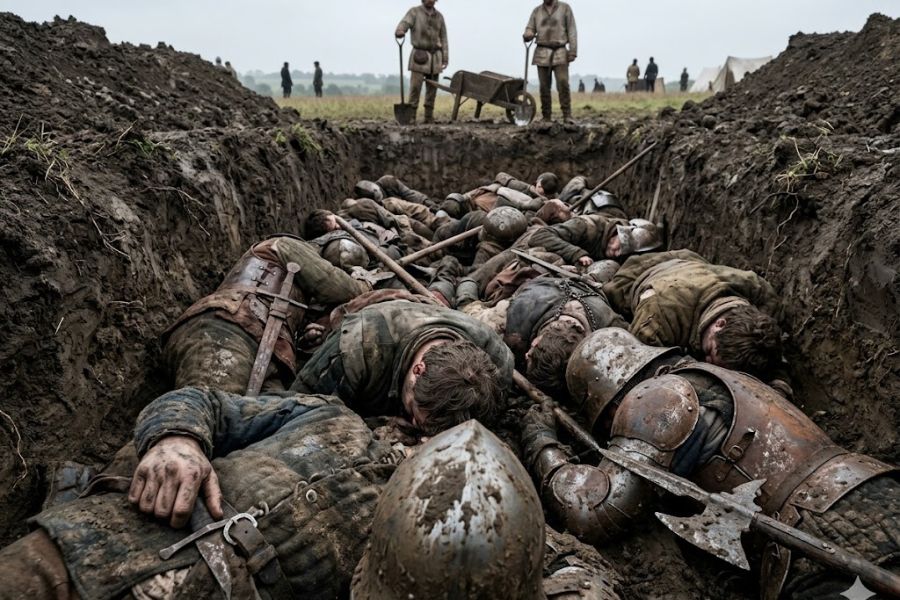
Bodies went in head to feet, alternating, to pack them tighter. At the Towton grave excavated at Towton Hall in 1996, archaeologists found 61 men crammed into a pit roughly six meters by two. They’d been arranged with some care, despite the speed, in neat rows.
Most were aged between 16 and 50, and many had old wounds, healed years earlier, suggesting these were not farmboys but men who had been fighting for some time. The Wars of the Roses chewed through professional soldiers as well as conscripts.
Depth mattered. A shallow pit meant foxes, dogs, and pigs would be at the bodies within a week. Chroniclers writing after Hastings complained that the English dead lay unburied for so long that the field stank for months.
After Visby in 1361, when a Danish army cut down the local militia outside the town walls on Gotland, the bodies were left in their armor in the July heat for three days before being shoveled into pits. The mail rotted onto the bones, and when the graves were excavated in 1905, the skeletons still wore their rusted mail coifs.
In theory, a priest blessed the ground. In practice, this often happened weeks or months later, if at all. Pope Innocent III had ruled in the early thirteenth century that consecrated burial was a right of the baptized dead, but a battlefield was rarely consecrated ground, and a victorious commander in a hurry did not always wait for a bishop.
The Ones Nobody Buried
Not every body made it into a pit. Sadly, some were never found. After a rout, men fled for miles and died in ditches, woods, and streams. The chronicler Jean de Wavrin, writing about Towton, described the River Cock running red with blood and bodies piling up at the crossings until the living were running over the dead.
Some of those drowned men washed downstream and were never recovered. Local farmers were still turning up bones in the fields around Saxton and Towton three centuries later.
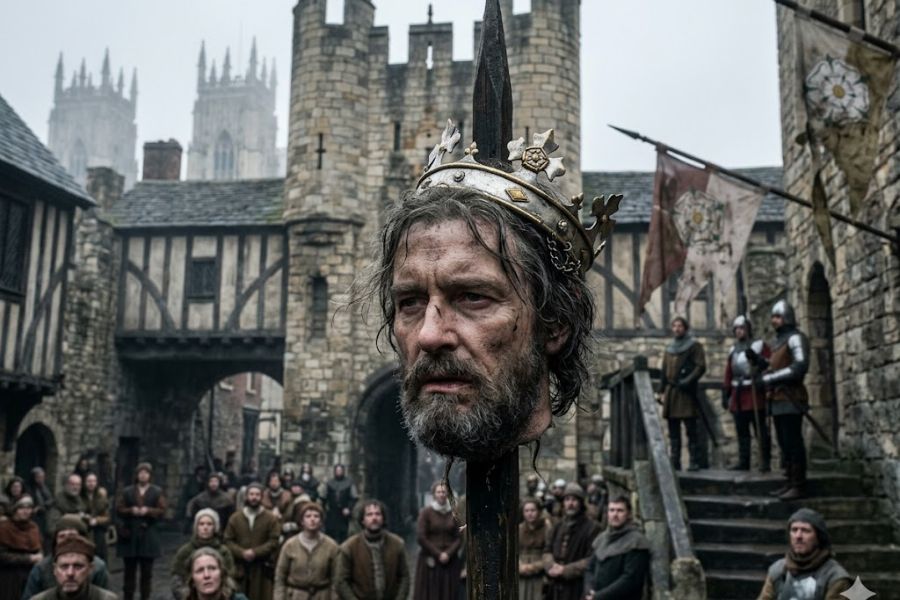
Heads went on spikes. This was standard for traitors and high-status enemies, and it served as both punishment and propaganda. After Wakefield in 1460, the Lancastrians put the head of Richard, Duke of York, on Micklegate Bar in York, with a paper crown nailed to it in mockery. His son Edmund’s head went up beside him.
Months later, after Towton, Edward IV had them taken down and replaced with the heads of the Lancastrian commanders who had killed his father and brother. The bar saw a lot of changing tenants in those years.
Limbs were sometimes scattered, too. The quarters of executed nobles were sent to four different cities to be displayed on gates, a practice that continued well into the Tudor period. After the Pilgrimage of Grace in 1537, Henry VIII ordered the bodies of the executed leaders hung in chains at the boundaries of the counties that had rebelled, to rot in public view. This was a deliberate refusal of burial. To deny a Christian death was to deny salvation, or at least to make the family work very hard for it.
And then there were the unclaimed common dead. Men whose villages were too far away to send for them, whose lords had also been killed, whose names nobody on the field knew. They went into the pits anonymously, and the surviving records often just say things like ‘and many others of the common sort.’
One ledger I read years ago, working through transcribed parish accounts, listed payments for shrouds in groups of fifty. Just the number. No names.
What the Bones Are Still Telling Us
Modern archaeology has changed what we know about medieval battle dead more than any chronicle ever did. The Towton excavation in the 1990s was a turning point. Forensic analysis of those 61 skeletons revealed details no medieval writer ever bothered to record: that many of the men had been killed by blows to the back of the head, suggesting they were running or kneeling when they died.
Some had defensive wounds on their forearms, and the killing blows were often delivered by multiple weapons in quick succession, the kind of frenzied finishing you’d expect from a rout.
Visby gave us something different. Because the bodies went into the pits still wearing their armor, archaeologists could see exactly how mail and padded protection failed.
Arrows had punched through mail at the throat. Sword cuts had severed legs below the knee, where armor ended. One skull had been cleaved from crown to jaw in a single stroke. The militia at Visby were older men, farmers, some with healed leprosy lesions, and they’d been butchered by professionals.
More recent finds keep turning up. In 2015, builders working on a bypass near Stoke Field, where the last battle of the Wars of the Roses was fought in 1487, uncovered what appeared to be battle-period remains.
Excavations at Aljubarrota in Portugal, Wisby again in fresh digs, and the ongoing work at various Hundred Years’ War sites continue to add to the picture. Isotope analysis can now tell us where a man grew up by the chemistry of his teeth.
We know that some of the dead at Towton had come from as far away as the German lands and possibly Scandinavia, mercenaries who died a long way from anyone who would have looked for them.
Related posts:
 The Best and Worst Kings of the Middle Ages That the History Books Rarely Talk About
 September 4, 925: The Day England’s First King, Æthelstan, Was Crowned, But Was He?
 William the Conqueror: Separating Fact from Fiction
 The Battle of Poitiers: The Black Prince’s Boldest Victory and the Capture Of a French King