Medieval battlefields were places where power was gambled in a single day. A king’s crown could be won in an afternoon, and a dynasty that ruled for centuries could collapse before nightfall. What happened on those fields still shapes the stories we tell about Medieval Europe.
Lines broke under the crush of horses, arrows darkened the sky, and strategy could matter just as much as luck. The outcome of a single charge or a king’s reckless decision often tipped the scales between triumph and ruin.
Table of Contents

9 Historic Medieval Battles
In this list, we’ll walk through nine battlefields where history shifted. Some gave birth to new rulers, some carved nations into shape, and others ended dynasties that thought themselves untouchable. Each one left a mark that echoed far beyond the field where men fought and fell.
Hastings, 1066
It still amuses me, as a born and bred Brit, that we English celebrate a loss, and that’s what Hastings was for the English, a loss. But we love to talk about it as if it were some huge victory. It wasn’t, but what it did do was shape England and get it ready for the Plantagenet rule that was to come.
The road to Hastings began with a succession crisis. When Edward the Confessor of England died childless in January 1066, his brother-in-law Harold Godwinson was crowned king. But William, Duke of Normandy, claimed Edward had promised him the throne years earlier. To William, Harold’s coronation was a betrayal. To Harold, it was his birthright.

Harold barely had time to wear the crown before the first challenge came. King Harald Hardrada of Norway invaded, forcing Harold to march his army north. At Stamford Bridge, Harold won a bloody victory, killing Hardrada and his own estranged brother Tostig, who had sided with the Norwegians. But it came at a cost. Harold’s men were exhausted when word came that William had landed in the south.
The two armies met near Hastings on October 14. Harold’s Anglo-Saxon force took the high ground, forming a shield wall of heavy infantry with axes and spears. William’s Normans relied on a mix of cavalry, infantry, and archers. The Normans hurled volleys of arrows uphill, followed by repeated cavalry charges, but the Saxon wall held firm through most of the day.
The turning point came when William ordered a feigned retreat. Harold’s men broke formation to pursue, only to be cut down when the cavalry wheeled back. Late in the fight, Harold was struck down, legend says, by an arrow in the eye, and his line collapsed.
William’s victory at Hastings changed England forever. He took the crown, redistributed land to his Norman followers, and built castles to cement his rule. The English language absorbed French words, the aristocracy was reshaped, and the Norman dynasty set the stage for centuries of conflict with France.
Manzikert, 1071
The Byzantine Empire of the 11th century was struggling to hold onto its eastern frontiers. For decades, the Seljuk Turks had been pressing into Anatolia, raiding towns and testing imperial strength. Emperor Romanos IV Diogenes set out to reassert Byzantine authority, leading a large army eastward. His goal was to push the Seljuks back and remind both allies and enemies that Constantinople still commanded power.
The two sides met near the fortress town of Manzikert in eastern Anatolia in late August. Romanos had assembled a mixed force: Byzantine regulars, European mercenaries, and allied troops from Armenia. Opposing him was Alp Arslan, the Seljuk sultan, who commanded swift cavalry archers skilled in hit-and-run tactics.
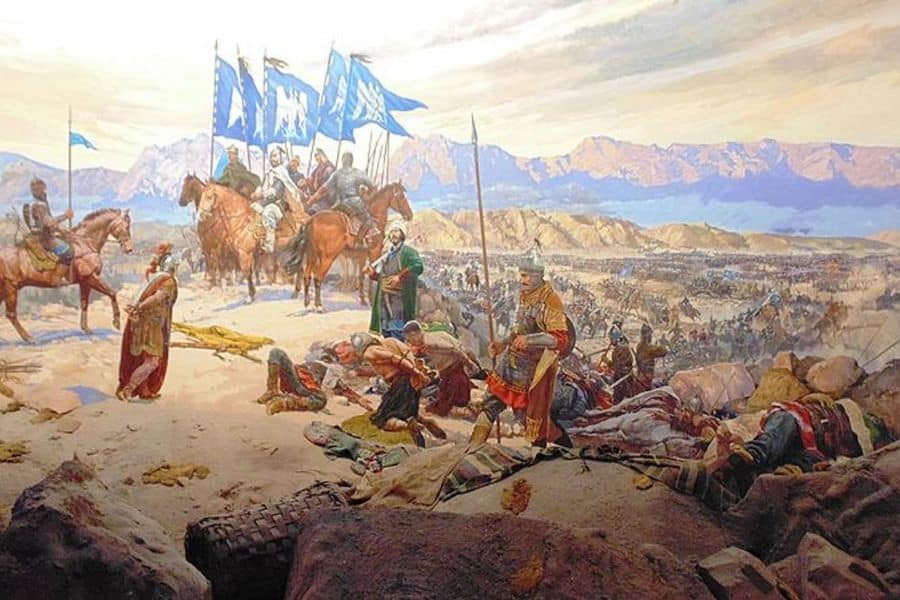
The battle itself was chaos from the start. Byzantine units advanced but struggled to keep formation under relentless harassment by Seljuk horse archers. Arrows rained down, and every time the Byzantines tried to engage, the Turks melted back into the open plain. As evening fell, Romanos tried to pull back and regroup, but miscommunication and betrayal unraveled his army. A key general, Andronikos Doukas, withdrew his men entirely, leaving the emperor exposed. Surrounded, Romanos was captured alive.
The defeat at Manzikert was catastrophic. While the empire did not collapse immediately, it lost much of Anatolia in the aftermath, a region vital for manpower and resources. The shock of seeing a Byzantine emperor taken prisoner shook the Christian world. Manzikert weakened Byzantium so severely that it never fully recovered its eastern strength, paving the way for Turkish dominance in the region and setting the stage for the First Crusade a generation later.
Bouvines, 1214
The early 13th century was a brutal chess match for power in Western Europe. King John of England had already lost most of his French lands to Philip II of France, and he was desperate to claw them back. John formed a grand alliance: the Holy Roman Emperor Otto IV, the Count of Flanders, and other discontented lords lined up against Philip. If they succeeded, France would be carved apart, and John could rebuild his empire.
The armies clashed on July 27, 1214, near the small town of Bouvines in northern France. Philip’s force was outnumbered, relying heavily on infantry and townsmen levied from across his kingdom. The coalition army fielded a larger mix of cavalry, Flemish infantry, and German knights.

The battle quickly turned into a grueling melee. Philip himself was dragged from his horse at one point but fought on, rallying his men. The French cavalry smashed into the allied knights, while crossbowmen and infantry held the line against waves of attacks.
The tide turned when the French knights broke through the enemy center and captured Emperor Otto’s standard. Otto fled the field, his army in tatters. The French swept the rest of the coalition away, capturing hundreds of high-ranking prisoners, including leading counts and knights.
Bouvines mattered far beyond the battlefield. For Philip, it confirmed France as a rising European power and secured his crown. For King John, it was a disaster. Defeat abroad weakened him at home, feeding discontent among his barons. Within a year, they forced him to sign the Magna Carta, reshaping English politics forever.
Hooked on the Middle Ages? Get more stories like this one in your inbox.
Bannockburn, 1314
For decades, Scotland fought to shake off English control. Edward I of England had claimed overlordship of the country, sparking a long and bitter struggle. By 1314, Robert the Bruce had risen as the Scottish king, but his hold on the throne was still fragile. The English crown, now under Edward II, was determined to crush him once and for all. The key was Stirling Castle, still in English hands. Robert knew that if he couldn’t take it, his kingship would collapse.

The English marched north with a massive army, far larger than Robert’s force of spearmen, archers, and light cavalry. The Scots chose their ground carefully near the Bannock Burn, a stream with marshy terrain that limited the effectiveness of English heavy cavalry. On the first day, a dramatic encounter set the tone: Robert himself killed the English knight Henry de Bohun with a single axe blow, lifting Scottish morale.
The main battle came the next day. English knights charged again and again but found themselves bogged down in the marshy ground, funneled into narrow fronts where the Scots’ schiltrons, dense formations of spearmen, held firm. English cavalry couldn’t break through, and their archers were blocked from finding clear shots. When the Scots counterattacked, the English lines crumbled. Edward II fled the field, leaving his men to slaughter.
Bannockburn secured Robert the Bruce’s position as king and gave Scotland a de facto independence that would last for years. Though formal recognition came later with the Treaty of Edinburgh-Northampton in 1328, Bannockburn became a symbol of national pride.
Crécy, 1346
The Hundred Years’ War had only just begun, but it was already a contest for survival. Edward III of England staked his claim to the French crown, sparking open conflict with King Philip VI of France. In the summer of 1346, Edward landed in Normandy, raiding deep into French territory. Philip gathered a massive army to crush the invasion before it could gain ground. The clash came near the small town of Crécy in northern France.
Edward’s army was smaller, but he prepared carefully. He positioned his men on a slope, organizing them into disciplined ranks of infantry and dismounted knights. Most crucial of all were his longbowmen, thousands of archers trained to unleash devastating volleys with speed and accuracy. Opposite them, Philip’s force was much larger and filled with heavily armored knights, backed by mercenary Genoese crossbowmen.

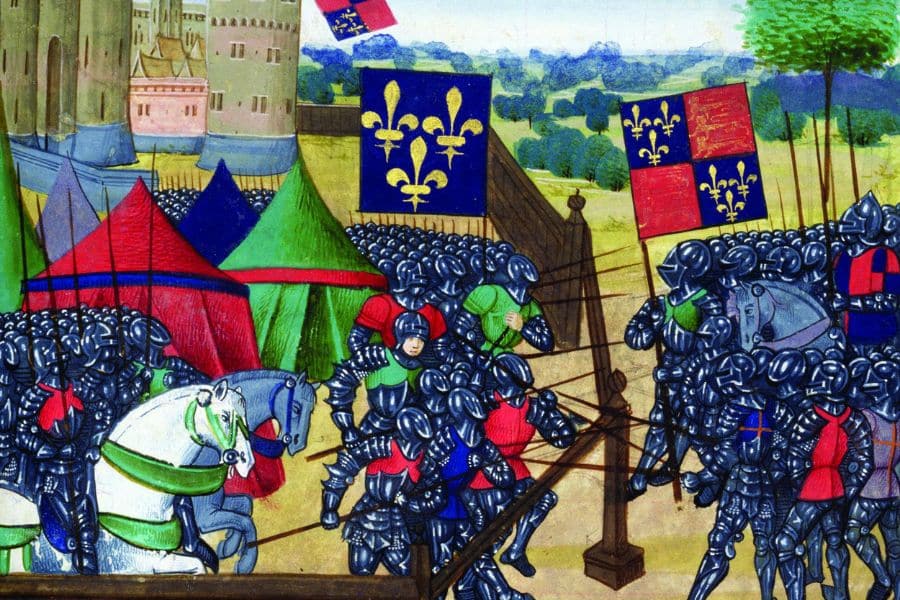
The battle opened with the Genoese advancing, but their crossbows lacked the range and rate of fire of the English longbows. Under a storm of arrows, the Genoese broke and fled, only to be cut down by their own French allies in frustration. Wave after wave of French cavalry charged uphill, but the longbowmen tore into them, horses collapsing under the hail of arrows.
Mud, confusion, and the narrow battlefield made it impossible for the French to coordinate their efforts. Edward’s men stood firm, repelling charge after charge until the French army was broken.
Crécy was a shock to Europe. The disciplined use of infantry and longbows had shattered the traditional dominance of the knightly charge. It marked the rise of a new style of warfare where firepower and positioning outweighed sheer numbers and chivalric glory. The victory also opened the way for Edward to besiege Calais, giving England a foothold on French soil that would last for more than two centuries.
Poitiers, 1356
A decade after Crécy, the English struck another heavy blow against France. Edward, known as the Black Prince, led a raiding campaign through French territory, burning towns and seizing supplies. King John II of France gathered a powerful army to trap him and end the threat once and for all. The two forces met outside the city of Poitiers in September 1356.
The English army was outnumbered, but they chose their ground wisely. Edward positioned his men in defensive lines protected by hedges and natural obstacles. Once again, the English longbowmen formed the backbone of his force. John’s French knights, eager for glory and ransom, launched frontal assaults on the English lines. The hedges broke up their formations, and the longbows cut them down before they could close.

After hours of failed attacks, the French were exhausted and disorganized. Edward saw his moment. He ordered a hidden reserve of mounted troops to sweep around and strike the French flank. Panic spread as the French realized they were surrounded. In the chaos, King John himself was captured, along with many of his nobles.
The defeat at Poitiers crippled France. With its king held hostage, the kingdom was forced into the Treaty of Brétigny, surrendering vast territories and paying a crushing ransom. The capture of a reigning monarch on the battlefield was a humiliation that echoed across Europe. Poitiers confirmed the effectiveness of English tactics and left France reeling, deepening the long and bitter struggle of the Hundred Years’ War.
Kosovo, 1389
The late 14th century was a time of mounting pressure on the Balkans. The Ottoman Empire had been pushing steadily westward, clashing with the fractured states of Serbia and its allies. Prince Lazar of Serbia gathered his forces to meet the advance, while Sultan Murad I led the Ottoman army. The confrontation took place on the plain of Kosovo in June 1389, a field that would become etched into legend.
The armies were evenly matched in terms of size, although they differed significantly in style. The Serbs relied on heavy cavalry and armored knights, supported by infantry. The Ottomans used flexible formations, with light cavalry, archers, and elite Janissaries.

When the battle began, the Serbs launched a powerful cavalry charge that shattered part of the Ottoman left flank. For a moment, it looked as though Lazar’s forces might win. But the Ottomans counterattacked, using their reserves to steady the line and gradually grind the Serbs down.
The fight was brutal and close. Both leaders were caught up in the struggle. Sultan Murad was killed during or after the battle, accounts differ, with some claiming a Serbian knight infiltrated his camp and struck him down. Prince Lazar was captured and executed. With both commanders dead, the battle ended in chaos; however, the Ottomans retained control of the field.
For the Serbs, Kosovo became a national myth, a symbol of sacrifice and defiance that lived on in poetry and song. Strategically, it marked the weakening of Serbian independence and the tightening grip of the Ottoman Empire in the Balkans.
Agincourt, 1415
The Hundred Years’ War flared back to life when Henry V of England crossed into France to press his claim to the throne. After a long and exhausting siege at Harfleur, his army was weakened by disease and short on supplies. Henry decided to march north toward Calais, hoping to reach English-held territory. The French gathered a far larger force to block him, and the two armies met near the village of Agincourt on October 25, 1415.
Henry’s army was severely outnumbered, with perhaps 6,000 men facing as many as 20,000 French. Most of his soldiers were longbowmen, backed by a core of dismounted knights and men-at-arms. The battlefield itself was narrow and bordered by woods, a natural bottleneck. Rain had turned the ground into thick mud. The French plan was straightforward: overwhelm the English with waves of heavily armored knights and infantry.

When the fighting began, English longbowmen loosed volleys into the advancing French. The knights struggled forward through the mud, their armor dragging them down as arrows cut through men and horses alike. Those who reached the English lines were exhausted and packed so tightly that they could barely fight.
The press of bodies became a slaughter as more French waves piled in, only to sink into the same mire. The English, though exhausted, held firm. By nightfall, the French army was shattered, and thousands of nobles and knights lay dead in the mud.
Agincourt was a shocking victory. Against impossible odds, Henry V’s smaller, weaker force had destroyed the cream of French nobility. It boosted English morale and secured Henry’s reputation as a brilliant commander. Politically, it compelled the French to negotiate, resulting in the Treaty of Troyes, which acknowledged Henry as the heir to the French throne. Agincourt remains one of the most famous medieval battles because it showed how terrain, discipline, and tactical choices could outweigh sheer numbers.
Castillon, 1453
By the mid-15th century, the Hundred Years’ War was staggering toward its end. England’s fortunes had collapsed after decades of struggle, and France, under Charles VII, was pushing hard to reclaim its lands. In July 1453, John Talbot, the veteran English commander known as the “Lion of the English,” led his troops to relieve the besieged town of Castillon in southwest France. It would be his final campaign.
Talbot marched with a smaller force than the French but trusted in his reputation for bold attacks. Outside Castillon, the French had dug in behind fortified earthworks and massed artillery, with hundreds of guns ranging from small hand cannons to heavy bombards. Talbot dismissed warnings and launched a direct assault, hoping to catch them off guard.
The result was devastating. French artillery opened fire as the English advanced, tearing through men and horses. The English pressed on, but the entrenched French position was nearly impregnable. Once the French cavalry counterattacked, the English line collapsed. Talbot himself was killed in the fighting, his army destroyed.
Castillon was the death blow to English power in France. Bordeaux fell soon after, ending nearly three centuries of English rule in the region. With it, the Hundred Years’ War came to a close. France emerged united under a stronger monarchy, while England, drained and humiliated, slid into its own civil conflict, the Wars of the Roses. Castillon marked the end of the medieval age of knightly battles and the dawn of a new era of gunpowder and fortifications.
Love a good medieval story?
Join our readers and get tales of kings, queens, castles and ordinary medieval lives straight to your inbox.

Kylie Lang is a nationally syndicated travel journalist with bylines on the Associated Press Wire & more, a medieval history writer, and the founder and lead author of Tales of the Middle Ages (talesofthemiddleages.com). She holds a BA (Honours) in History from the University of Kent and is a member of the British Guild of Travel Writers.
Related posts:
 12 Strange and Surprising Truths About Harold Godwinson, England’s Last Saxon King
 The Norman Conquest: How 1066 Changed England and the Last Anglo Saxon King Met His Death
 The Battle of Poitiers: The Black Prince’s Boldest Victory and the Capture Of a French King
 William the Conqueror: Separating Fact from Fiction