In the mid-14th century, something monstrous swept through Europe. It arrived without warning and killed without mercy. The death toll was so high that people stopped counting. They simply buried their dead and prayed they would make it through the night.
The Black Death tore through towns and villages, stripping them of their lifeblood. Families were destroyed overnight. Entire communities disappeared. In its wake, it left broken systems, fractured faith, and a world scrambling to understand what had just happened. But from all that death came something else. Something that would change the course of history.
Table of Contents
What happened after the plague passed is just as important as the devastation it caused. From the rise of the middle class to the early cracks in the church’s authority, the Black Death lit a fuse under a crumbling medieval world. And that spark still flickers today. Here’s how it all unfolded.

The Pandemic That Shook the Medieval World
Between 1346 and 1353, the Black Death killed millions across Europe. Estimates vary, but somewhere between 25 and 30 million people died. That was roughly one third of the population. The first confirmed cases hit the port of Kaffa on the Crimean coast in 1346, when Mongol forces laying siege to the city reportedly hurled infected corpses over the walls.
From there, Genoese traders fleeing the scene sailed west, carrying more than just spices and stories. By the time their ships reached Sicily in October 1347, the disease had already begun to spread. Within months, it had reached the Italian mainland. Then it moved north, racing through France, the Holy Roman Empire, and the Low Countries. By 1349, England, Scotland, and Ireland were overwhelmed. Norway, Sweden, and even parts of Iceland followed. No corner of Europe was safe.
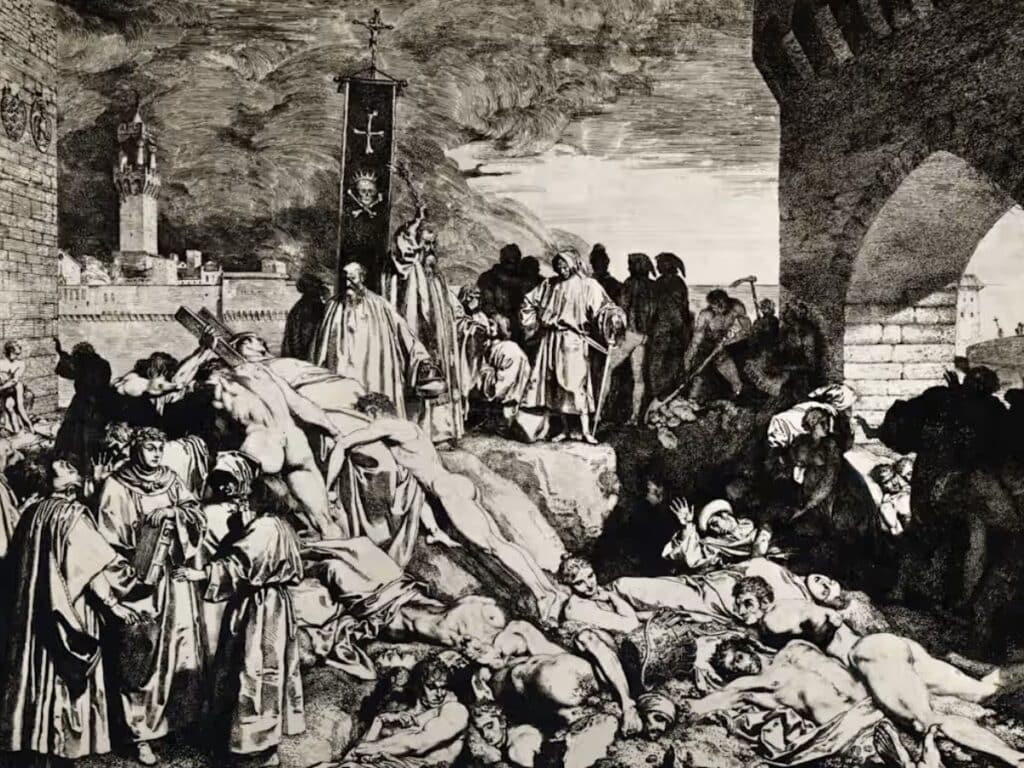
The disease moved fast. In Marseille, it’s believed that up to half the population died in a single month. In Paris, carts piled high with bodies trundled through the streets daily. Venice lost 60 percent of its people. In Florence, Boccaccio wrote of fathers abandoning their children, friends refusing to bury one another, and homes filled with corpses and silence. Entire villages vanished, and in rural areas, fields went unharvested, livestock wandered loose, and churches stood empty.
The cause was Yersinia pestis, a bacterium carried in the blood of rats and transmitted by the bite of infected fleas. However, medieval people had no understanding of what germs were. They blamed the alignment of the planets, the corruption of the air, or the wrath of God. Jewish communities were targeted and massacred in some cities, accused of poisoning wells. Others believed it was the end of days. Priests and physicians could offer no cure. Most simply fled.
The symptoms were terrifying. Within days of exposure, people developed high fever, weakness, vomiting, and painful swellings called buboes in the armpits, neck, and groin. These lumps turned dark and filled with blood and pus. Some victims spat blood and died within 24 hours. Others lingered in agony for days. The smell of death hung thick in the air. Bells tolled constantly. Bodies were dumped into mass graves, sometimes still twitching.
No one was untouched. Rich and poor died alike. In monasteries, whole orders were wiped out. In cities, authorities ordered houses boarded up, trapping families inside to die together. Survivors lived in a world that looked nothing like the one they had known just a year earlier.
And the worst part? No one knew if it was truly over. The plague would come back again and again for centuries, but nothing would match the devastation of those first seven years.
Hooked on the Middle Ages? Get more stories like this one in your inbox.
How the Black Death Cracked the System
Before the plague struck, Europe operated under a rigid hierarchy. Kings and nobles held power, bishops wielded influence, and peasants carried the weight of it all. The feudal system was built on labor, on millions of men, women, and children working the land for someone else’s profit.
Most peasants weren’t free. They were tied to the estate where they were born, bound by law and custom to serve the local lord. Wages, where they existed, were fixed. Mobility was rare. Life was predictable, but it wasn’t fair.
Then the Black Death tore through that world like a wildfire. With a third of the population dead, entire estates were left without workers. Whole families disappeared. Villages were abandoned. Lords who once commanded hundreds now had fields lying fallow and animals starving in their pens. Grain rotted where it had grown. No amount of wealth or title could bring back the labor force.
This sudden scarcity of workers upended everything. Survivors knew they were valuable, and they started to demand more. Landowners, desperate to harvest crops or maintain their income, offered higher wages, sometimes even small plots of land. People who had never held a coin in their hands began to negotiate. A new kind of worker was born, one who could walk away.
Ruling classes attempted to suppress this quickly. In England, the Ordinance of Labourers was passed in 1349, followed by the Statute of Labourers in 1351. These laws made it illegal for workers to ask for higher pay or relocate to another village offering better conditions. It didn’t work. People simply ignored the rules or slipped away in the night to work elsewhere. There were too many empty hands and too much work to be done.
The labor shortage also hit the Church hard. Monasteries lost entire communities of monks and nuns. Parish priests died in droves. Some areas went without religious services for months. Others saw untrained or corrupt men rush to fill the gap. For ordinary people, this decline in spiritual authority added to the sense that the old ways were breaking down.
Feudalism didn’t collapse overnight, but the cracks were now impossible to ignore. The foundation had shifted. Landowners could no longer take labor for granted. And peasants realized they had leverage. That shift in mindset would prove just as powerful as the plague itself.

The First Workers’ Revolution
In the decades before the plague, most peasants expected to live and die on the same patch of land. Labor was abundant, rights were minimal, and social status rarely changed. The idea of a worker having bargaining power was unthinkable. But the Black Death flipped that script. It created the first real crack in the idea that the rich held all the cards.
With so many dead, the lords found themselves in crisis. They needed men to till the fields, tend the animals, build the roads, and collect the rents. But the men were gone. Survivors suddenly found themselves in demand, and they knew it. Farmhands who once worked for scraps were offered meat, wool, and coin.
The frustration boiled over. In 1381, three decades after the first wave of plague, England saw its first large-scale peasant uprising: the Peasants’ Revolt. Workers marched on London, demanding an end to poll taxes and a rollback of the feudal laws that still bound them. They were angry, organized, and unafraid to stand against the crown. The revolt was crushed, and its leaders executed, but the message was clear: working people were no longer willing to accept the old order in silence.
This wasn’t a revolution in the modern sense. There were no formal unions or manifestos. But it was the first time the lower classes, en masse, realized their value and used it as leverage. The plague reset the social scale. In the aftermath, the very idea of who mattered and who had a voice began to change.

When Faith Wasn’t Enough
For centuries, people had believed that God controlled everything. So when death struck indiscriminately, it shattered that belief. If the good and bad died alike, what did that say about divine justice?
Some clung tighter to religion. Others turned away. New religious groups sprang up. Some were extreme, whipping themselves in public to atone for the world’s sins. Others turned to superstition, charms, and rituals that blended Christian beliefs with older pagan ideas.
The church had been the center of medieval life. After the Black Death, that center didn’t hold as firmly. People began to ask questions. And they started looking for answers elsewhere.
The Economy Reshaped
The workforce collapse caused by the Black Death forced major changes. Farms stood empty. Businesses shuttered. Trade slowed. But in the long term, it created space for something new. With fewer workers, wages rose. Peasants who had once been tied to the land found they could earn money and move. Social mobility, once impossible, became real.
Some industries adapted. Bigger businesses that could afford to pay workers survived. Others consolidated. The economy became less rigid. Old feudal practices began to fade, replaced by the early signs of a more capitalist approach.
Seeds of the Renaissance
The Black Death didn’t cause the Renaissance, but it helped clear the ground. Fields lay empty. Churches collapsed. Institutions that had once seemed unshakable looked suddenly fragile. Out of that wreckage came a new way of thinking. Not overnight, but piece by piece.
Before the plague, education had been the domain of the church and a handful of elite scholars. Latin was the language of learning. Books were rare and copied by hand. Most people never held one. But the pandemic broke that grip. When bishops, priests, and monks died in droves, replacements were often untrained.
Their authority weakened. In the confusion, other voices began to emerge. Laypeople, city councils, and merchant families started to invest in schools and private tutors. Literacy began to creep outward, especially in the growing cities of Italy and Flanders.
The trauma of the plague also left people questioning long-held beliefs. If divine punishment could strike so randomly, what else about the old worldview might be wrong?
Scholars started to look back, not just to scripture, but to the ancient world. Greek and Roman texts, once considered secondary to religious doctrine, gained new importance. Humanism began to take shape. It wasn’t anti-religious. It was about shifting focus, putting human experience, reason, and observation at the center of thought.
Art changed, too. In the years following the worst waves of the plague, European artists began painting people with greater detail, expression, and individuality. The flat saints and gilded icons of the medieval period slowly gave way to more lifelike portraits, landscapes, and scenes from everyday life. Death remained a constant theme, but it no longer belonged only to religious imagery. The macabre became personal, reflective, even philosophical.
Cities like Florence, which the plague had gutted, turned to rebuilding with vision. Wealthy families, such as the Medici, funded libraries, universities, and commissions for new artworks. They weren’t just showing off their money. They were investing in legacy. They wanted to leave their mark on a world that now felt uncertain and short-lived.
A Legacy That Still Echoes
The Black Death was a turning point. It reshaped society, cracked open rigid systems, and changed how people thought about life, death, and power. It also left behind scars that are still visible today.
From labor rights to public health systems, from questioning authority to valuing individual lives, the world we live in now carries traces of what happened in those plague years. The horror of the Black Death forced humanity to adapt. And in doing so, it opened the door to the modern age.
Love a good medieval story?
Join our readers and get tales of kings, queens, castles and ordinary medieval lives straight to your inbox.

Kylie Lang is a nationally syndicated travel journalist with bylines on the Associated Press Wire & more, a medieval history writer, and the founder and lead author of Tales of the Middle Ages (talesofthemiddleages.com). She holds a BA (Honours) in History from the University of Kent and is a member of the British Guild of Travel Writers.