
I’ll hold my hand up quite happily and say I’ve often wondered what it would really be like to live in a medieval castle. Living in France, I’ve seen many castles and chateaux, all stunning to look at with their huge fireplaces, rooms with impossibly high ceilings, and ornate furniture. But what was it like in reality?
Well, I’ve been doing quite a bit of research recently on this very topic as I’m in the middle of writing my first novel, part of which is set in 12th-century France. Now, I don’t want to burst your romantic bubble of medieval castles, but I’m afraid I may well do that.
Table of Contents
As fabulous as they look, there were some very real challenges that a modern-day guy or gal would find hard to get past. Apart from the obvious, such as a lack of toilet paper and basic 21st-century hygiene, just the sheer volume of people would make it very hard to get any type of privacy.
So I hope you’re ready for me to draw back the curtain on what it was really like to live in a castle in the Middle Ages.

Waking Up Inside the Walls of a Castle in the 12th Century
Waking up inside the stone walls of a 12th-century castle couldn’t be further from waking up in your cozy bedroom in the modern world. For a start, you’re not sleeping on a goose-feather mattress in your own bedroom. Most likely, you’re sharing your space with others, especially if you’re part of the staff. Even noble families didn’t get much alone time. Curtains around beds were about the best you could hope for in terms of privacy, and that was only if you ranked high enough.
It’s cold. Even in summer, stone keeps the chill. I know, as my house was built within the walls of an old castle, and we still have the original flagstone tiles. Fires were expensive to run and often reserved for the rooms that mattered most. You might sleep with your clothes on, wrapped in wool or fur, depending on what you could afford or your role in the household.
As for the morning routine, forget a quiet cup of coffee in the kitchen. The day started early, and everyone had their tasks. Servants were up before dawn, lighting fires, prepping bread dough, or cleaning the mess left from the night before.
If you were noble, your day might begin with a prayer and a light bite to eat, but it wasn’t all leisure. There were letters to dictate, disputes to settle, and land to manage. And if the lord was away, the lady of the castle would be running the whole show.
Castles were workplaces as much as homes. Loud, busy, full of people constantly moving. Guards patrolling, children squabbling, livestock braying in the courtyard. And always someone clattering up or down the stairs with something that needed to be done.

The Castle Community: Who Called It Home?
A castle was like a self-contained village with walls. At any one time, there could be anywhere from a few dozen to a few hundred people living or working inside. Some permanent, others passing through. And not everyone got a cozy bed or a seat at the lord’s table.
At the top were the nobles, of course. The lord might have been off fighting or riding between estates, so the lady often handled the daily business, hiring staff, organizing supplies, and keeping order. Below them were the stewards, chamberlains, and other senior household staff who kept things running. These were the ones who knew what was in the pantry, how much wax was left for candles, and which servant was sneaking extra rations.
Then there were the knights and squires. Some lived there full-time, others came and went. When they weren’t training or on campaign, they were part of the castle’s backbone—guarding the gates, settling disputes, or just making sure no one stole the chickens.
And below them, the real engine room: the servants. Cooks, cleaners, laundry workers, carpenters, blacksmiths, falconers, stable boys, you name it. Most worked long hours and slept where they could. In the kitchens, in shared quarters, in straw-stuffed nooks where the mice were free roommates. Some were born into service, others sent as children to train for future roles in noble households.
And it wasn’t all adults. Children ran around too, noble sons being groomed for knighthood, daughters learning how to run a household. And the servant kids? They started young. Turning spits, fetching water, or just trying to stay out of the way.
In quieter seasons, the place might feel roomy. But when there was a feast, or the lord’s entourage rolled in, or a band of traveling performers passed through, the castle filled fast. You’d find people bedding down in corridors, kitchens, and storerooms. Elbow room was a luxury, and privacy was a rare thing indeed.

Morning Light: A Typical Day Begins
There were no lie-ins in a medieval castle. The day started early and loudly. If the cockerels didn’t get you, the bells or the bustling servants would. Fires had to be lit, animals fed, water hauled up from the well, and meals prepared, all before most people had wiped the sleep from their eyes.
If you were a servant, your feet probably hit the floor well before dawn. Bread ovens needed to be fired up, chamber pots emptied, rushes swept, and fires coaxed back to life from whatever embers were left. And if there were guests in the castle, double the workload.
Nobles got up a bit later, but even they didn’t lounge around. A light breakfast might be served in their private chamber: bread, maybe a bit of cheese, sometimes ale or watered wine. After that came chapel. Religion was an integral part of daily life, and morning prayers were expected, especially for those in positions of authority.
The lord’s day would then move on to business. That might mean hearing disputes, managing estate finances, writing letters, or receiving visitors. The lady of the house had her own responsibilities, usually just as demanding. Managing food stores, overseeing staff, and keeping the place running smoothly while juggling the politics of noble life.
Younger boys training to be knights would already be in the courtyard, practicing with wooden swords or riding. Daughters of nobility were taught how to manage a household, keep accounts, and speak with just the right amount of courtesy, even when they wanted to scream.
Meanwhile, the castle itself was coming to life. Doors banging open, chickens squawking in the courtyard, smoke curling up from kitchens, and the clang of metal as blacksmiths got to work. For most people inside those walls, the day was already in full swing before the sun had climbed too high.

Rooms of the Castle: Architecture and Atmosphere
If you’re picturing a castle with roaring fireplaces in every room, let’s just hit pause. Castles weren’t designed for comfort. They were built to last, built to defend, and built to show power. Warmth, privacy, and convenience ranked much lower on the list.
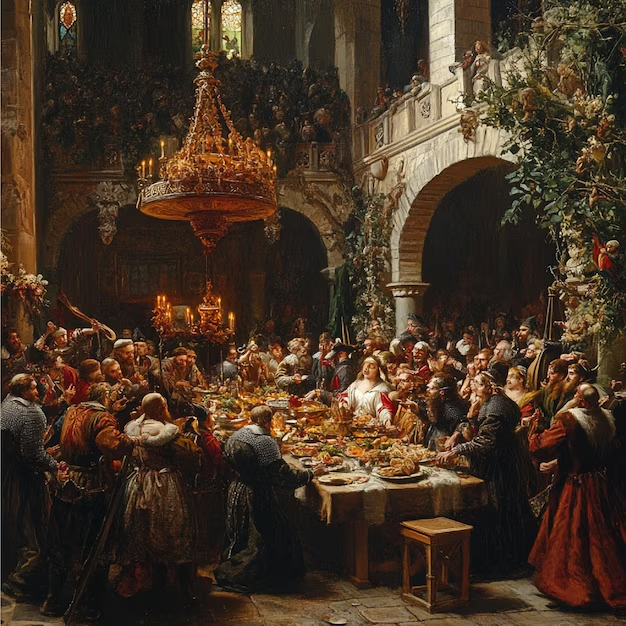
The heart of most castles was the great hall. This was the main gathering spot. Meals were eaten here, guests were entertained, announcements were made, and everyone knew their place based on where they sat. The lord and lady got the raised platform, and the further down the table you went, the lower your status. By the end, you were basically in the doorway.
Above or behind the hall, if you were lucky enough to be noble, you had a solar. That was your private chamber. Not huge, not plush by modern standards, but quieter and warmer than anywhere else. It was the closest thing to a living room or study, typically featuring a bed, a chest, and perhaps a few tapestries to ward off drafts.
Servants didn’t get rooms so much as spaces. They slept in corners, under stairwells, above the kitchens, or wherever there was room that night. Some had shared quarters, while others simply rolled up their cloaks and called it a day.
The kitchens were usually tucked away, often in a separate building, to stop fires spreading. They were hot, chaotic, and smoky. A good cook was worth their weight in silver, especially if they could make salt pork, pie, and dried peas feel like a feast.
Then there were the storerooms. Barrel after barrel of grain, ale, salted meat, fish, and wine; everything rationed and watched closely. No one wanted to run out of food in winter or during a siege. These rooms were dark, cool, and often guarded, especially the wine cellar.
And of course, there were the garderobes. Built into the outer walls, these were the castle’s toilets. Waste dropped down into pits or moats. The smell? Let’s just say even the thickest rushes couldn’t hide it. Still, they were better than a bucket in a corner.
Every castle layout was a little different, shaped by geography, wealth, and time period. But across the board, the spaces were practical first, grand second, and comfortable a very distant third.
Hooked on the Middle Ages? Get more stories like this one in your inbox.
Feasts and Kitchens: Heart of the Castle
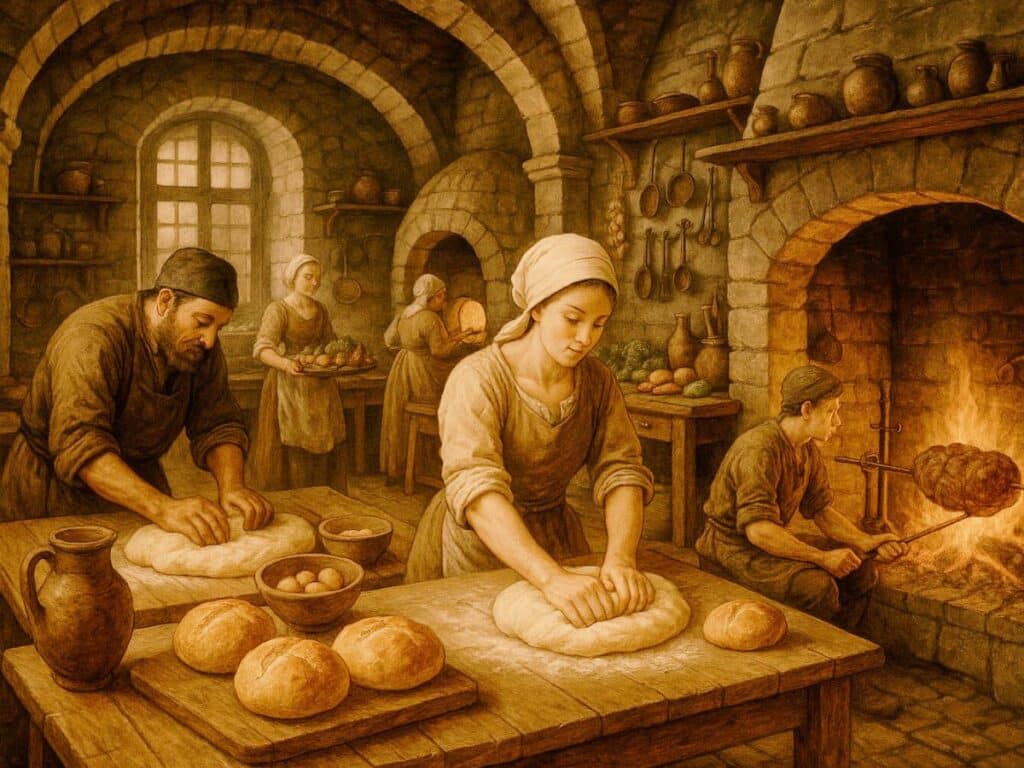
For all their stone and steel, medieval castles had one place that truly buzzed with life, the kitchens. They were hot, loud, and filled with smoke, especially in winter when fires raged nonstop. If you’ve ever worked in a modern restaurant kitchen, imagine that but with open flames, live animals, and no proper ventilation.
The cook ran the show. And in a big castle, that was no small job. Feeding the lord’s household, plus guests, guards, servants, and hangers-on, could mean preparing meals for a hundred people or more every single day. During feasts? That number shot up fast. You’d need spits turning constantly, ovens crammed with bread and pies, pots bubbling over with stew, and at least a dozen people running around trying not to spill, burn, or drop anything.
Food was seasonal and based on what could be stored or hunted. In winter, there was salted meat, dried legumes, and whatever had been preserved. In spring and summer, more fresh options became available, including greens, herbs, and fish if you were near a river. Meat was king, though. Boar, venison, beef, mutton, rabbit, birds. And the bigger the feast, the more exotic the options. Swan, peacock, porpoise, if you were really trying to show off.
Spices were a big deal. They didn’t just flavor the food; they showed off your wealth. Cinnamon, saffron, ginger, and cloves. These weren’t easy to get, and people noticed when you used them. Even something as simple as black pepper could cost a fortune.
The great hall was where it all ended up. Meals were served on wooden trenchers, sometimes stale bread, shared between two. Forks weren’t common, so it was mostly fingers, knives, and maybe a spoon. Wine and ale flowed freely. People talked, sang, bargained, laughed, and sometimes fought. A feast wasn’t just about eating. It was a blend of politics, theater, and celebration all rolled into one.
Afterwards, the mess was staggering. Bones on the floor, grease on the tables, scraps everywhere. Servants rushed in to clear it all before the next meal cycle started again. And below stairs, the kitchen fires never really went out. There was always something that needed to be prepped, boiled, roasted, or baked.

Smells, Sounds, and Hygiene
If you’re hoping castle life smelled like beeswax candles and freshly baked bread, you might want to take a deep breath, then hold it. Medieval castles were full of life, and life smelled.
Start with the basics. You’ve got open fires burning all day, every day. The air inside was thick with wood smoke, even in rooms with chimneys. Then there were the people. Bathing wasn’t daily. In fact, it wasn’t even weekly for most. Even nobles washed less than you’d think. A damp cloth and a bit of rose water often had to do the trick.
And when dozens or even hundreds of bodies were packed into the same space, that scent added up fast. And don’t get me started on teeth. Toothaches were common, and pulling a rotten one was about the only option, usually without much warning, and definitely without anything you’d call pain relief. Dental hygiene wasn’t a thing.
Now add in the animals. Horses in the stables, pigs in the yard, chickens everywhere. You didn’t have to walk far before stepping in something. Smells of hay, manure, wet fur, and rotting scraps hung in the air, especially near the kitchens or middens. Waste had to go somewhere, and if you were lucky, it dropped straight down from the garderobes into a pit or stream below. If you weren’t, it just sat around until someone carted it off.
As for sounds, peace and quiet were rare. Even at night, the castle wasn’t silent. You’d hear dogs barking, someone snoring nearby, a restless baby, the shuffle of guards’ boots on stone. By day, it was a constant chorus. Hooves on cobbles, metal on metal, children yelling, cooks shouting, bells ringing, servants calling out orders or warnings.
Cleaning occurred, but not in the way we think of it now. Floors were swept with bundles of twigs. Rushes were scattered to soak up mess and smell, though they rarely got changed as often as needed. Herbs like lavender or mint were thrown in to mask the stench. It helped a little.
People were aware of the risks of dirt and disease, but they lacked the tools and understanding to address them. You worked with what you had. And if you had servants, they were the ones hauling water, scrubbing clothes, and trying to keep things from sliding too far downhill.

Servants’ World: Invisible but Vital
It’s easy to imagine a castle as the domain of lords and ladies, but the truth is, none of it worked without servants. They were the ones who kept everything moving, quietly, constantly, and with very little reward.
Some were born into service. Others were sent off young to train as pages, maids, cooks, or stable hands. They worked long hours and slept wherever there was space. The lucky ones had shared quarters above the kitchens or tucked behind the great hall. The unlucky ones grabbed what straw they could and hoped no one stepped on them in the night.
Jobs were split by skill and trust. At the top were the stewards, butlers, and chamberlains who handled money, supplies, and important logistics. Below them were the cooks, scullions, grooms, falconers, laundresses, and spit-turners, each with their own corner of the castle to manage. You also had people like the gong farmers, who cleared out the cesspits. Nobody wanted their job, but everybody needed it done.
Work started before dawn and didn’t really stop. Despite the grind, service in a large household wasn’t the worst life available. It came with food, a roof, clothing, and in some cases, a path to something better. A clever servant might catch the right attention, learn a trade, or marry well. Others simply kept their heads down and did their job. They kept the fires lit, the bread rising, the armor polished, and the wheels turning. Invisible, maybe, but absolutely essential.

Lessons, Leisure, and Defense
Life in a medieval castle wasn’t all hard graft and cold floors. There was learning, there was fun, and there was always the looming possibility that someone might try to attack the place. So education, entertainment, and defense were all baked into daily life, each playing its part in the rhythm of the castle.
If you were the child of a noble, your education started early. Boys destined for knighthood learned to ride, fight, hunt, and handle weapons before they hit their teens. They also learned Latin, religion, and how to run an estate. Girls from noble families were taught how to manage a household, read religious texts, and make sure their stitching and manners were sharp enough to match their marriage prospects.
Servant children picked things up on the job. There weren’t lessons in a formal sense. You learned how to knead bread by watching your mother. You learned to hold a tray steady, muck out a stall, or polish a sword by doing it badly once and getting told off. Quick learners did well. Slow ones usually didn’t last long.
When there was time off, you’d see games played in the courtyards. Board games like nine men’s morris or chess for the lucky ones, or more physical games that usually ended in a few bruises. There was music too. Minstrels played during feasts, and traveling performers sometimes came through. People told stories, sang ballads, or played dice by firelight.
And always, there was the training. A castle might look peaceful, but it was built for war. Soldiers drilled in the yard. Archers practiced with straw targets. Defenses were checked, weapons sharpened, armor maintained. Even in peacetime, a smart lord kept his men in shape. Trouble could arrive without much warning—rival nobles, bandits, or the odd peasant revolt if things got tense.
Fun had its place. But survival came first. And in a world where borders shifted, alliances broke, and power was everything, you didn’t get to relax for long.

The Noble Life: Luxury vs Reality
Being a noble came with perks, no doubt. You weren’t hauling firewood or scrubbing pots. You had people to dress you, cook for you, and fetch whatever you needed. But even the highest-ranked lord or lady couldn’t escape the limitations of medieval life.
Your chamber might be the warmest in the castle, but that didn’t mean it was cozy. Tapestries helped with drafts, and a fire helped take the edge off the cold, but winters were still brutal. Windows were small, glass was rare, and furniture was functional.
You ate better than most. Your meals had more variety, more spice, and more ceremony. You drank the best wine and had the finest cut of meat. There were luxuries. Fine fabrics, imported goods, trained falcons, musicians, and books, if you were wealthy enough. But wealth came with pressure. You had to maintain appearances, forge alliances, and host lavish feasts whether you could afford them or not. And there was always someone watching, waiting for a misstep or weakness.
Daily life was filled with obligations. Marriages were arranged for power, not love. You had to manage your lands, protect your holdings, and make sure your household didn’t collapse under its own weight. Everything had to look seamless, even when it was barely holding together.
Yes, nobles lived better than most. But they also lived with constant expectations, constant risk, and very little privacy. Comfort was relative. Power didn’t buy peace.
Evening and Nightfall
As the sun dipped below the walls and the light faded from the great hall, the castle took on a different rhythm. Work didn’t stop entirely, but things slowed. Fires were stoked for the night, doors were barred, and servants rushed to finish their last tasks before the evening bell rang.
Dinner came early by modern standards. It was smaller than the midday meal, often leftovers or something simple. The nobility might eat in their chambers or gather again in the hall, but without the full ceremony of a feast. Servants ate when and where they could, usually once everyone else had been fed and cleared away.
After supper, the atmosphere shifted. This was when stories were told, instruments came out, and people relaxed, if they were allowed to. Lords might talk politics or hear petitions. Ladies might embroider by candlelight or walk the galleries with companions. For some, it was the only part of the day that felt even slightly their own.
But darkness brought its own challenges. Lighting was limited. Candles were expensive, rushlights smoky and dim. Shadows moved across cold stone floors, and every creak or echo carried a little more weight at night. Outside the walls, things felt even more uncertain. Wild animals, thieves, or worse. Most people stayed indoors once the gates were shut.
Bedtime came early. Not because people were especially well-rested, but because there wasn’t much else to do. You curled up under furs if you had them, straw if you didn’t, and hoped the rats wouldn’t scurry too close. Servants slept in shifts if they were needed through the night, especially if the household had guests or an ailing noble to tend.
The castle at night was a quieter place, but not a peaceful one. Even in sleep, it was a place of duty, hierarchy, and watchfulness. The day might be over, but life inside the walls never really paused.
Behind the Stone Walls
Living in a medieval castle meant adapting to a world that was never still. It meant learning to live with noise, cold, smells, and people, lots of people. It meant duty, structure, and routine layered over chaos, discomfort, and the occasional burst of glory.
From the outside, castles still look powerful. But on the inside, they were homes, workplaces, fortresses, and survival machines all rolled into one. Hard, beautiful, loud, and full of contradictions. They were built to endure and weather whatever storms came their way.
Love a good medieval story?
Join our readers and get tales of kings, queens, castles and ordinary medieval lives straight to your inbox.

Kylie Lang is a nationally syndicated travel journalist with bylines on the Associated Press Wire & more, a medieval history writer, and the founder and lead author of Tales of the Middle Ages (talesofthemiddleages.com). She holds a BA (Honours) in History from the University of Kent and is a member of the British Guild of Travel Writers.
Related posts:
 Why You’d Regret Moving Into a Real Medieval Castle. Horror Stories From the Middle Ages
Why Medieval Castles Were Filthy Places You’d Never Want to Live In
Were Medieval Castles Really That Stinky Or Was It Not Really That Bad (Behind the Scenes of Life in the Middle Ages)
 Untold Tales of Medieval Food, Kitchens and Meal Prep