There’s an old stone bread oven on our land here in the Charente, one of the few bits left of the castle that once stood here. I’ve often wondered who stood in front of it with a long wooden peel, and what sort of bread came out. I can tell you now it wasn’t a nice white baguette.
Medieval peasants in England ate mainly coarse bread made from barley, rye, oats, or a mix of grains, thick vegetable stew called pottage, ale, and cheese and other dairy. Meat was a treat, usually bacon from the family pig. The diet improved noticeably after the Black Death of 1348, but every year still had hungry months before the harvest came in.
Table of Contents
A lot of what you read about peasant food online is a mix of half-truths and things nobody can back up. So I’ve gone to the sources, from a 14th-century poem to the grease left inside cooking pots, to find out what ordinary people really put on the table.
The table below pulls together the staples of the English peasant diet, how often each one made it to the table, and where we know it from. It’s a rough guide, not a rulebook, and a family with a cow and a pig ate better than one without.
| Food | How Often Eaten | Source |
|---|---|---|
| Dark bread (barley, rye, oats, or maslin) | Daily, at every meal | Christopher Dyer, *Standards of Living in the Later Middle Ages*; Langland, *Piers Plowman* |
| Pottage (vegetables, grains, sometimes a scrap of bacon) | Daily, often twice | University of Bristol lipid analysis of West Cotton pots, 2019 |
| Cheese, butter, curds, whey (the “white meats”) | Several times a week where a cow, sheep or goat was kept | *Piers Plowman*; manorial accounts cited by Dyer |
| Ale (unhopped, weak, brewed at home) | Daily | Assize of Bread and Ale, 13th century; Ælfric’s *Colloquy*, c. 1000 |
| Bacon and salt pork | Weekly in winter, scarce by spring | Manorial harvest-worker rations, 13th and 15th centuries |
| Fresh beef or mutton | A few times a year, usually from an old working animal | West Cotton pot residues; harvest-worker accounts |
| Salted herring | On fast days through Lent and most Fridays | Monastic and manorial purchase records |
| Eggs | Through spring and summer when hens were laying | Household accounts cited by Dyer |
What Did Medieval Peasants Eat?
The best place to start is William Langland’s poem Piers Plowman, written in the late 1300s. Piers is a plowman, and in one famous scene, he tells Hunger what he has in the house to see his family through to the harvest.
There are no chickens, no geese, and no pork. Instead, he has two green cheeses, some curds and cream, an oatcake, and two loaves of beans and bran baked for his children. He also has parsley, leeks, and plenty of cabbages, plus a cow and a calf.
That’s it. That’s what has to last him until Lammas, the start of the harvest in early August. It’s fiction, of course, but Langland knew exactly what a poor household looked like, and his readers would have recognized it straight away.
Bread: Brown, Heavy, and Rarely Wheat
Bread was the backbone of the peasant diet. In the 13th century, harvest workers on English manors were given much bread and some cheese, with smaller amounts of ale, fish, and meat, according to the historian Christopher Dyer.

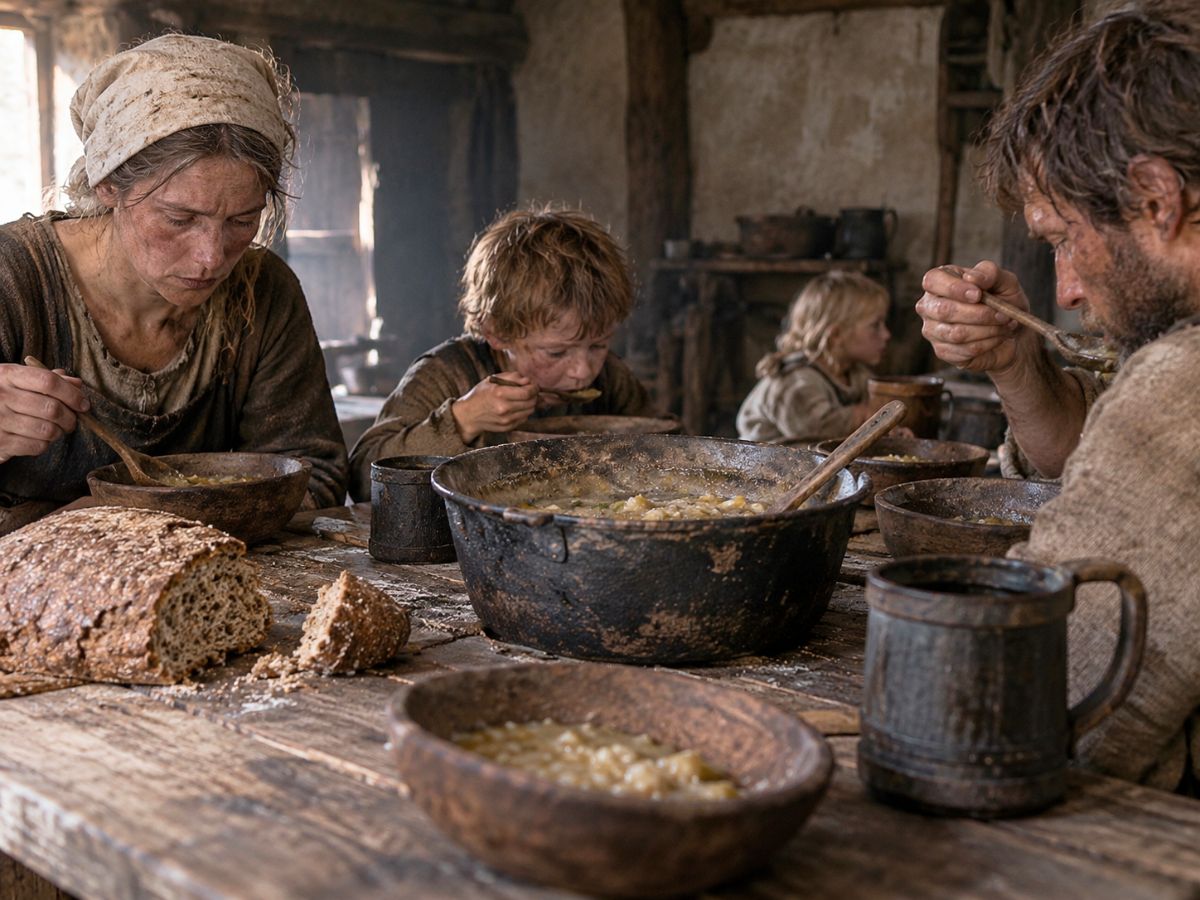
If you could afford it, you bought wheat. Most peasants couldn’t, so they made do with barley, rye, or oats, or grew wheat and rye together in one field and baked the lot into a loaf called maslin. Think of the heaviest rye loaf you’ve ever bought, then make it heavier. Plenty of people didn’t even try chewing it dry. They broke it into their pottage or dunked it in ale to soften it up.
Even back then, there were rules about bread. Under the Assize of Bread and Ale, which goes back to the 1200s, a loaf got bigger or smaller depending on what wheat cost that year. Any baker caught selling short could expect a fine the next time the manor court sat.
What Went Into Bread When Times Were Hard
When the flour bin was getting low, you bulked out your bread with anything you could grind up. The bean and bran loaves Piers bakes for his children are one example.
Another is horsebread, which, as the name suggests, was baked for horses. It was made from peas, beans, bran, oats, rye, and sometimes acorns. Nobody wanted to eat it, but in a siege or a bad famine year, poor families did.
You’ll often read that medieval peasants put sawdust in their bread. I looked hard for proof of this and couldn’t find any. Peas, beans, bran, and acorns are well recorded. Sawdust isn’t, so I’d leave that one alone.
Pottage, and What the Pots Tell Us
If bread was the backbone, pottage was the heart of every meal. It was a thick stew cooked in one pot over the fire, made from whatever was in the garden, such as leeks, cabbage, onions, peas, and beans, thickened with oats or barley. A bit of bacon went in when there was some to spare.

In 2019, scientists at the University of Bristol tested the remains of cooking pots from West Cotton, a deserted medieval village in Northamptonshire. Trapped in the clay were traces of fat from the food cooked in them.
The pots showed that stews of beef and mutton with cabbage and leek were a mainstay, along with plenty of dairy. So meat went into the pot more often than people tend to assume, even if it was only a little at a time.
I find that sort of thing fascinating. The cooks are long gone, but the grease from their dinners is still there, 700 years later. It doesn’t seem possible.
Hooked on the Middle Ages? Get more stories like this one in your inbox.
Cheese, Milk, and the “White Meats”

Dairy was so important that people called it “white meat.” Milk didn’t keep, so most of it was turned into butter and cheese. The “green cheeses” Piers mentions weren’t moldy. Green just meant fresh, eaten young before it had time to ripen. Hard cheese could be stored for months, and the whey left over from cheesemaking was drunk or fed to the pig.
A family with a cow, or even a few sheep or goats, ate far better than one without. That’s why losing an animal to disease could be such a disaster.
Meat: Rarer, But Not Unheard Of
Most peasant families kept a pig. It ate scraps and foraged in the woods, and in November, they killed it and salted it for the winter. Bacon was the meat most families could count on.
Families kept chickens mainly for their eggs, and fresh beef and mutton usually meant an old animal that could no longer work or breed.
Hunting deer in the lord’s forest was strictly off limits, and poachers faced heavy punishments. Rabbits were mostly farmed in warrens owned by the lord, too.
Peasants were allowed to fish in some streams, though, and on the Church’s many fasting days, when meat was banned, salted herring was the cheap option.

Peasants occasionally consumed meat, but it was often limited to special occasions or feast days. When they did have access to meat, it was usually salted pork or dried fish, which were more affordable and had longer shelf lives. Fresh meat was a rarity and often unattainable due to cost and legal restrictions.

Hunting laws were strict, and forests were often designated as royal hunting grounds. Poaching was considered a serious offense, with severe punishments including fines, imprisonment, or even death. Despite the risks, some peasants resorted to poaching to supplement their meager diets, highlighting the desperation and hunger that many faced.
Ale, and Yes, Water Too
Ale was part of daily life, and women brewed much of it at home, selling the extra to their neighbors. These brewsters had to follow the Assize too, and every manor chose ale-conners each year to taste the ale and report anyone selling a poor brew.
Medieval English ale had no hops. They made it from malted barley, sometimes flavored with herbs, and it went sour within days. Hopped beer arrived from the Low Countries around 1400, and England didn’t plant hops until about 1428. Even then, people treated ale and beer as two different drinks for years afterward.
You’ve probably also heard that peasants never drank water because it was too dirty. That’s a myth. People knew perfectly well which water was safe, and they drank from wells, springs, and clear streams.
Around 1000, Ælfric’s Colloquy has a boy saying he drinks ale if he has it and water if he doesn’t.

Most peasants brewed their own. It was cheaper than buying from a tavern, and ingredients like barley and hops were sometimes grown nearby or substituted with herbs.
Brewing days were long, messy, and took up precious firewood, but having a jug of weak ale on the table meant one less thing to worry about. You’d water down what little ale you had left to make it last.
The Hungry Gap and the Great Famine
Spring and early summer were the hardest time of year. Last year’s grain was running out, the new crop wasn’t ready, and the garden had little to offer. This is exactly where Piers Plowman finds himself, waiting for Lammas with his bean bread and cabbages.
When a harvest failed, things got much worse. During the Great Famine of 1315 to 1317, endless rain ruined crops across northern Europe. Desperate families ate their seed grain and slaughtered their plow animals, and people foraged for roots and bark in the woods.
The chronicle of Bristol recorded that “horse flesh and dogs flesh was accounted good meat.” Even Edward II struggled to find bread for his household at St Albans in August 1315.
Harvest Suppers and Feast Days
It wasn’t all misery. At harvest time, a lord often had to feed the workers who brought in his crops, and those meals could be generous. Christmas, Easter, and the village’s own saint’s day were times for meat, pies, and plenty of ale, and the end of the harvest was marked with a big shared supper, one of the happiest of all the medieval festivals in the farming year.

How the Black Death Changed the Peasant Diet
The Black Death killed somewhere between a third and half of England’s people in 1348 and 1349. For the survivors, there was more land, and workers could demand better pay and better food.
Christopher Dyer compared what harvest workers were given in the 13th century with what they got two centuries later. By the 15th century, bread was much less important, and meat and ale made up a far bigger part of their meals.
Wheat bread replaced barley and rye, and fresh beef replaced bacon. It’s one of the few good things to come out of the Black Death, and it shows how quickly diets could change when ordinary people had a bit more bargaining power.
Peasants never ate like their lords, of course, and you only have to look at the foods only the rich could afford to see the gap. But the image of a peasant living on nothing but gruel isn’t the whole story. They ate plainly, they ate seasonally, and in a good year, with a pig in the sty and a cow in the field, they ate reasonably well.
FAQs About Medieval Peasant Food
What did medieval peasants eat every day?
Medieval peasants in England ate dark bread made from barley, rye, oats, or a mix of grains baked together as maslin, along with pottage, which is a thick vegetable and grain stew, cheese and other dairy, and weak ale. Meat, usually bacon from the family pig, appeared less often and was most reliable in winter.
Did medieval peasants eat meat?
Medieval peasants did eat meat, though not in the quantities their lords did. Most families kept a pig and salted it for the winter, and residues inside cooking pots from the deserted village of West Cotton show that beef and mutton went into the stew pot too, if only a little at a time.
Did medieval peasants only drink ale?
Medieval peasants drank both ale and water. They took water from wells, springs, and clean streams, and Ælfric’s Colloquy, written around the year 1000, has a boy saying he drinks ale when he can get it and water when he can’t. The idea that all medieval water was undrinkable is a myth.
Did medieval ale contain hops?
Medieval English ale was brewed without hops. It was made from malted barley, sometimes flavored with herbs, and went sour within a few days. Hopped beer arrived from the Low Countries around 1400, and hops were first planted in England around 1428.
What was pottage made of?
Pottage was a thick one-pot stew of garden vegetables such as leeks, cabbage, onions, peas, and beans, thickened with oats or barley and simmered over the fire. A scrap of bacon or a bit of mutton went in when the family had some to spare, and leftover bread was often broken into the bowl.
Love a good medieval story?
Join our readers and get tales of kings, queens, castles and ordinary medieval lives straight to your inbox.

Kylie Lang is a nationally syndicated travel journalist with bylines on the Associated Press Wire & more, a medieval history writer, and the founder and lead author of Tales of the Middle Ages (talesofthemiddleages.com). She holds a BA (Honours) in History from the University of Kent and is a member of the British Guild of Travel Writers.