
You know the drill. Wake up. Work. Maybe take a short break. Then work some more.
If you’re lucky, you might get a week or two off in the summer, assuming you don’t check your email.
But here’s the twist: a medieval peasant, scraping by in a thatched hut with dirt floors and no running water, may have had more free time than you do.
Table of Contents
It sounds like a joke, but it’s not.
Let’s Do the Math
The average American clocks around 1,800 to 2,000 work hours per year. That’s based on a 40-hour workweek, no major gaps in employment, and maybe a two-week vacation if you’re lucky. Some industries push it even higher. And that doesn’t count unpaid overtime, side gigs, or mental load.
By comparison, historian Juliet Schor, author of The Overworked American, estimated that medieval peasants in England worked between 1,000 and 1,200 hours a year. Yes, their work was hard and physical, but there was a lot less of it.
In fact, a 14th-century record from a village in England indicates that agricultural laborers worked approximately 150 days per year. That breaks down to roughly 3 days a week.
And they weren’t lazy. It just wasn’t possible, or necessary, to work more than that.
Work Followed the Seasons
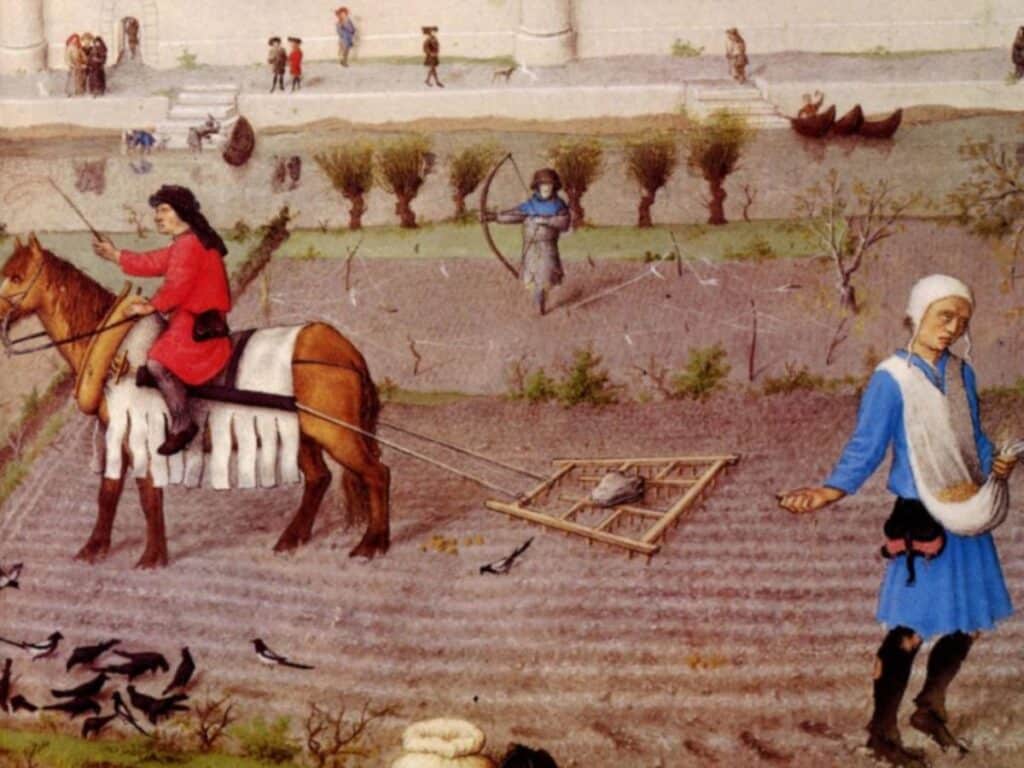
In medieval Europe, everything revolved around the land and the weather. You couldn’t plow frozen ground or harvest wheat in January. The agricultural calendar was broken into busy periods and natural downtimes.
- Spring: plowing, sowing, lambing
- Summer: weeding, mowing, haymaking
- Autumn: harvesting, storing grain, slaughtering animals
- Winter: mostly mending, feeding livestock, and waiting
During winter, there were long stretches with little to do outside. Nobody expected laborers to invent work to fill the time. This was when people caught up on repairs, rested, and celebrated holy days.

Feast Days Were Legally Enforced Breaks
Religious holidays weren’t just spiritual, they were built-in time off. In Catholic Europe, the Church calendar was packed with feast days that forbade work.
Some regions had more than 100 days of mandatory rest per year, not including Sundays. These included:
- Major holy days like Easter, Christmas, and Pentecost
- Dozens of saints’ feast days
- Local festivals, harvest fairs, and community events
- Rogation Days and other rural processions that often meant walking fields, not working them
On many of these days, labor was not only discouraged but punishable. Lords and clergy could fine workers who showed up in the fields. Even hired help were given time off.
These weren’t holidays in the modern sense. Some involved fasting or church attendance. But others were joyous, social, and filled with food, music, and dancing. People didn’t just take a break, they celebrated.
Sundays Were Off-Limits Too
It’s easy to forget, but for most of medieval Europe, Sunday was sacred. Work was strictly banned. It wasn’t until the Industrial Revolution that this started to erode.
In 10th- and 11th-century records, landowners are repeatedly told not to demand labor on Sundays. The same goes for church mandates. Sunday was for worship, rest, and family.
Even in tough years, this day of rest was protected. That alone gave peasants 50-plus days off annually.
Hooked on the Middle Ages? Get more stories like this one in your inbox.
Working Hours Were Shorter To
Even on days they worked, peasants didn’t labor from sunrise to sunset year-round.
- In summer, the days were long, and work started early. But midday breaks were common to avoid heatstroke.
- In winter, light was limited, so people worked less. Darkness was not productive.
Monastic rules, which often served as a model for medieval timekeeping, included up to eight hours of work, eight hours of rest, and eight hours for prayer and reading. Peasant life wasn’t this structured, but it gives a sense of what was expected.
No one was working 12-hour days, five or six days a week, year-round. That’s a modern invention.
Community and Custom Helped Set Limits
There was no Human Resources department in a medieval village, but there were customs, and people paid attention to them. A lord who pushed his workers too far risked rebellion or desertion.
Local traditions played a huge role:
- Villages had communal plowing days with food and drink.
- Harvest feasts marked the end of hard work.
- Shared customs like “plow Monday” or “sheep-shearing day” had celebratory elements.
Everyone knew what was expected and what was too much.
Labor Laws Did Exist
Even without unions, the Middle Ages saw attempts to protect workers from exploitation.
- Charlemagne’s laws in the 8th century reinforced the observance of Sunday rest.
- In England, King Alfred issued edicts limiting forced labor during feast weeks.
- Monasteries kept detailed calendars that balanced prayer, work, and leisure.
By the 13th and 14th centuries, urban workers also benefited. In places like Paris, guilds regulated working hours, apprentice holidays, and days when shops were closed.
The idea of legally protected time off isn’t new. Medieval society just used religion and custom to enforce it.
What About All the Other Work?
Yes, peasants had to cook, sew, mend tools, and care for animals. But these domestic tasks were typically shared. Families worked together, and older people passed down knowledge as they supervised the work.
Women’s labor is often overlooked in these comparisons, but it followed the same rhythms. And unlike modern households, there was no split between job and home. You didn’t spend hours commuting or stressing over unpaid bills. You lived where you worked, and rested where you lived.

Was it More Difficult to Work in Medieval Times?
Short answer: yes and no.
Long answer: It depends on what you mean by “difficult.”
Medieval work was physical. You were out in the fields with your hands in the dirt. No machinery. No weather apps. Just you, a wooden plow, and the mercy of the sky. If the harvest failed, you didn’t go to the supermarket, you starved. So in terms of survival stakes, yes, it was tougher.
But that doesn’t mean people were dragging themselves through 12-hour shifts every day. Most peasants had built-in rest periods tied to the seasons. Winters were slower. Religious holidays offered enforced breaks. Even the busiest times, like harvest, came with community support, shared meals, and the knowledge that once it was done, there’d be time to recover.
In contrast, modern work is often less physically demanding but more mentally exhausting. You might be sitting at a desk, but your brain never stops. Emails, deadlines, meetings, targets, plus the emotional toll of always being reachable. Work creeps into evenings, weekends, even holidays. And there’s no natural “off” season anymore. Everything runs all year long.
Then there’s the pressure. In the Middle Ages, social roles were fixed. A peasant wasn’t expected to rise through the ranks or constantly improve themselves. That idea of needing to “hustle” didn’t exist. Today, there’s this constant undercurrent of guilt if you’re not being productive every waking moment.
Yes, medieval life was more challenging in terms of survival. But modern life demands a different kind of endurance, one that wears you down slowly and invisibly.
Maybe peasants worked with their bodies, but we work with our nerves. And nerves don’t heal as quickly.
The Economist Who Helped Prove It: Juliet Schor’s Take on Our Vanishing Leisure
In 1992, economist Juliet Schor published “The Overworked American: The Unexpected Decline of Leisure.” You wouldn’t expect a book from the early ’90s to help explain how medieval peasants might’ve had more downtime than you, but that’s exactly what it does.
Schor delved into labor statistics and discovered something many of us instinctively feel. Americans were already working around 1,949 hours a year by the late 1980s. That’s about one full month more per year than they worked just two decades earlier. The kicker? It wasn’t just factory or retail jobs. It was across the board, office workers, professionals, men, women, everyone.
Meanwhile, the medieval peasants Schor referenced were working roughly 1,000 to 1,200 hours a year. That’s nearly half. Let that sink in.
Modern work culture has turned long hours into a badge of honor. However, in the Middle Ages, a different rhythm prevailed. Work rose and fell with the seasons. Days off weren’t a luxury; they were built in, expected, even enforced by law or religion. Nobody was squeezing in Zoom calls at sunset or checking their inbox before bed. When the fields were quiet, so were you.
Schor also pointed out that modern workers aren’t just overworked; they’re also over-consumed. The more money we earn, the more we tend to spend. And the more we spend, the more we have to work to keep up. It’s a cycle. One the average 14th-century peasant didn’t have to worry about. They weren’t chasing productivity. They were just living.
Her book makes it clear: we didn’t get here by accident. It’s the result of economic choices, shifting values, and a growing disconnect from the natural cycles that once guided everyday life. Medieval folk didn’t work less because they were lazy. They worked less because they weren’t expected to be “on” all the time.
So the next time someone rolls their eyes when you talk about taking time off or slowing down, just tell them you’re getting back to your medieval roots.
So Why Do We Work So Much Now?
Modern capitalism rewards constant productivity. Medieval society did not. You were valued for surviving, contributing to your village, and adhering to social customs, rather than maximizing profit.
After the Industrial Revolution, things shifted. Machines could operate 24/7, and factory owners expected the same from their employees. By the 19th century, the average laborer in Britain worked over 3,000 hours per year.
That’s more than twice what many medieval peasants worked.
Today, despite labor laws and workplace protections, American workers have some of the worst vacation policies in the developed world. Many receive no paid leave at all.
Maybe the Middle Ages Had It Right
No one is saying medieval life was easy. There were famines, plagues, and no antibiotics. But when it came to balance, they might have understood something we’ve forgotten.
- Time off wasn’t a luxury; it was a necessity.
- Rest days were enforced by law, religion, and custom.
- People worked with the seasons, not against them.
Ultimately, the average peasant may have spent more time at home, with family, and celebrating than the average office worker does today.
It’s not that we should go back to living in mud huts, but we could learn a thing or two about taking a proper break.

Love a good medieval story?
Join our readers and get tales of kings, queens, castles and ordinary medieval lives straight to your inbox.

Kylie Lang is a nationally syndicated travel journalist with bylines on the Associated Press Wire & more, a medieval history writer, and the founder and lead author of Tales of the Middle Ages (talesofthemiddleages.com). She holds a BA (Honours) in History from the University of Kent and is a member of the British Guild of Travel Writers.


