So many things in life are subjective, and ranking the greatest medieval monarchs is definitely one of them. What I think of as great might not be what you think is great. It means different things to different people.

However, I’m sure you’ll agree with me that there are some absolute standouts for one reason or another.
Table of Contents
For some, it’s the battles they fought, while for others it was their ability to stabilize a country in a tumultuous period.
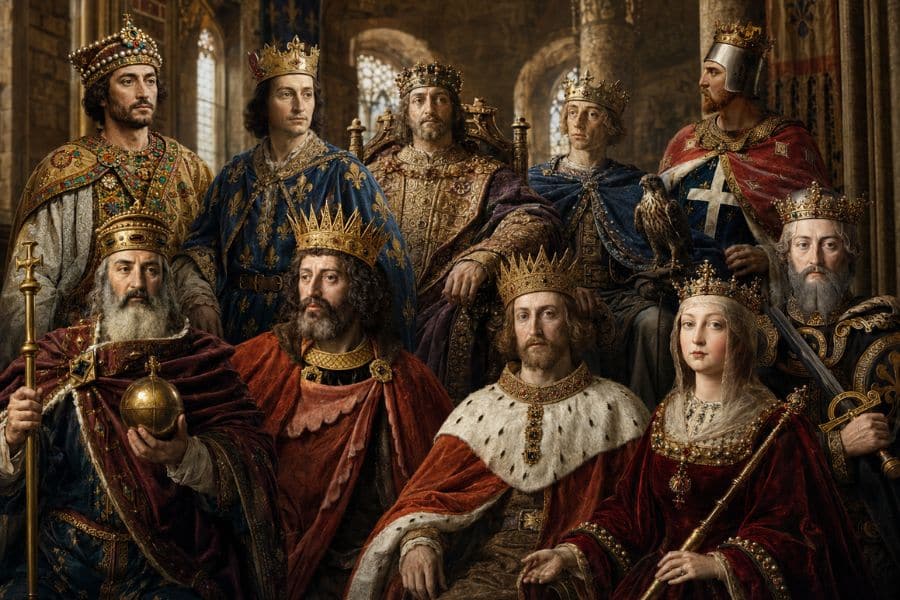
The 10 Greatest European Medieval Monarchs
While you may not agree with my order, I think you’ll completely agree with the amazing achievements of the monarchs I’ve chosen.
10. Richard I of England, the Absentee Lionheart

Born in 1157 at Beaumont Palace in Oxford, Richard came to the English throne in 1189 and held it until his death in 1199. That is a 10-year reign, and he spent roughly 6 months of it in England. So that is clearly not a winning achievement, but bear with me here.
The rest of the time he was on crusade, in captivity, or fighting in his French possessions, which stretched from Normandy down to the Pyrenees through his mother Eleanor of Aquitaine’s inheritance.
His headline achievement is the Third Crusade, during which he captured Acre in 1191, defeated Saladin at Arsuf, and negotiated a truce that granted Christian pilgrims access to Jerusalem without taking the city.
The chronicler Ambroise, who was there with the army, left a verse account, the Estoire de la Guerre Sainte, that is one of our best eyewitness sources for the campaign. Richard comes out of it looking every bit the soldier the nickname suggests.
On his way home in 1192, he was captured by Duke Leopold V of Austria, whose banner he had insulted at Acre, and handed over to the Holy Roman Emperor Henry VI.
The ransom was 150,000 marks, roughly two to three times England’s annual royal income. His mother, Eleanor, then in her seventies, personally organized its collection. Every free man in England paid a quarter of his income.
Richard came home, spent a few more weeks there, and then left again for France, where he died besieging a minor castle at Chalus over what may have been buried Roman treasure. A crossbowman got him in the shoulder, and the wound turned septic.
9. Justinian I of the Byzantine Empire, the Codifier
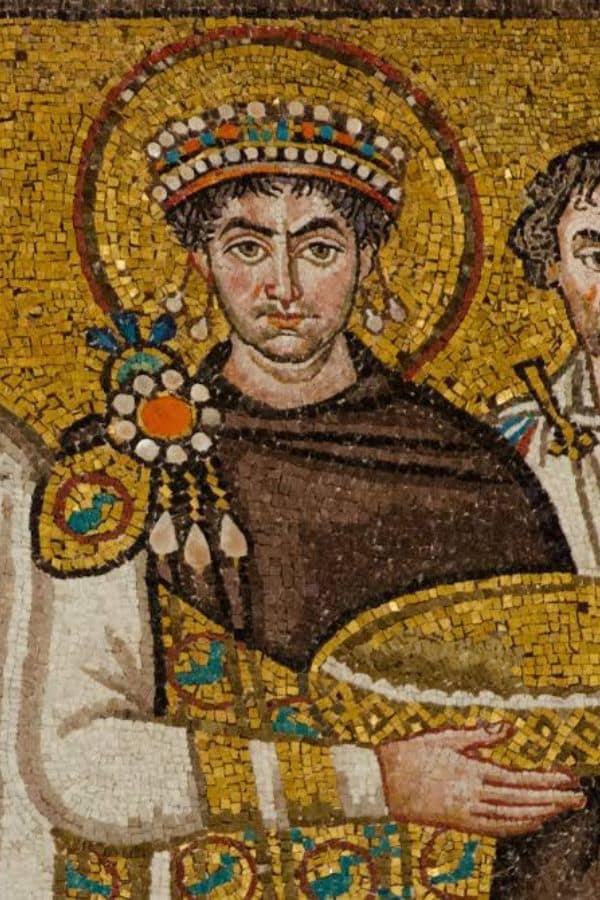
Born around 482 in the Latin-speaking province of Dardania, Justinian ruled the Eastern Roman Empire from 527 to 565. That is a 38-year reign, and it covered most of what we now call the transition from late antiquity to the early Middle Ages.
His territory at its height ran from the Straits of Gibraltar to the Euphrates, taking in Italy, North Africa, and much of Spain after his general Belisarius reconquered them.
His greatest achievement is the Corpus Juris Civilis, the compilation of Roman law completed between 529 and 534 by a commission led by the jurist Tribonian. It gathered a thousand years of imperial edicts, jurist opinions and legal reasoning into a coherent system, and it became the basis for civil law across most of continental Europe for the next 1,500 years.
If you’ve ever signed a contract in France or Germany, you’re still standing on Justinian’s ground.
In January 532, the Nika riots in Constantinople came close to overthrowing him. The chariot-racing factions of the Blues and Greens united against him, burned much of the city, and proclaimed a rival emperor.
Justinian was ready to flee when his wife Theodora, a former actress from the Hippodrome, told him she would rather die in the purple than live as a fugitive. The historian Procopius, who worked in the imperial administration, records her speech in his Wars, and it is one of the most quoted passages in Byzantine history.
Justinian stayed. Belisarius trapped 30,000 rioters in the Hippodrome and killed them there. The Hagia Sophia, which Justinian rebuilt after the riots destroyed the earlier church, still stands in Istanbul.
8. Henry II of England, the Man Who Built the Common Law

Born in 1133 at Le Mans, Henry took the English throne in 1154 and held it until 1189. A 35-year reign, over an Angevin empire that ran from the Scottish border to the Pyrenees, held together by his own tireless riding between its parts. Gerald of Wales, who knew him, said he was almost never off a horse.
His achievement is the framework of English common law. The Assize of Clarendon in 1166 established the grand jury, the practice of local men presenting suspects to royal justices. Trial by jury for property disputes came in through the possessory assizes, novel disseisin and mort d’ancestor, which took land cases out of the hands of local barons and put them in front of the king’s judges.
The legal treatise attributed to his justiciar Ranulf de Glanvill, written around 1188, is the first serious account of English law as a system.
The detail everyone remembers wrong is Thomas Becket. Henry did not order the murder in Canterbury Cathedral on 29 December 1170. He shouted something in a Christmas court at Bures in Normandy, and 4 knights, Reginald FitzUrse, Hugh de Moreville, William de Tracy and Richard le Breton, took it as a commission.
What Henry actually said is disputed by the sources. Edward Grim, the biographer of Becket who was in the cathedral and was wounded in the arm trying to shield him, does not give us the Bures words.
Henry’s public penance in July 1174, walking barefoot through Canterbury and being scourged by the monks, was real and politically brutal. He never fully recovered his moral authority, and his sons rebelled against him for the rest of his life.
7. Frederick II Hohenstaufen, Stupor Mundi
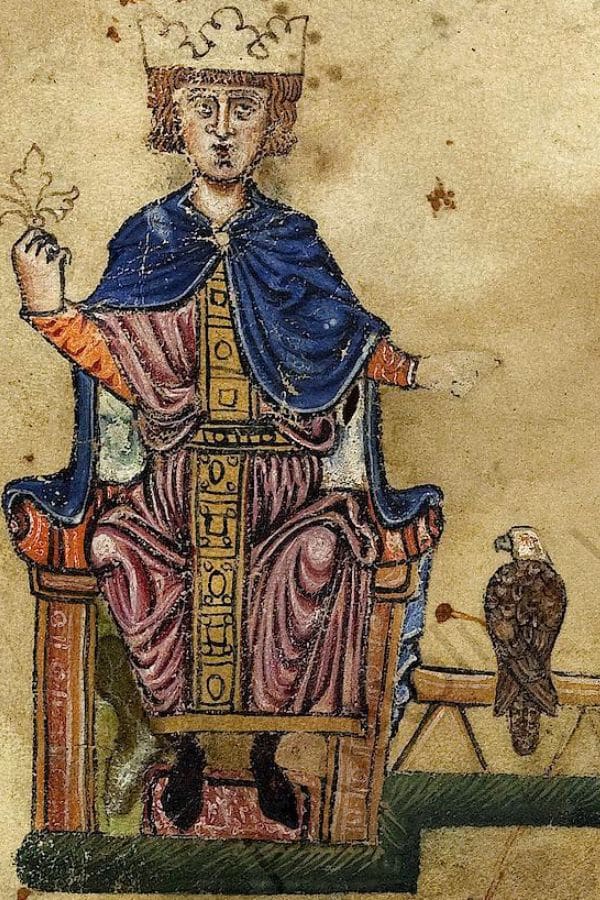
Born in 1194 in a market square in Jesi, Italy, where his mother, the empress Constance, gave birth in a tent to prove the child was hers, Frederick was Holy Roman Emperor from 1220 to 1250 and King of Sicily from 1198.
A 30-year reign as emperor over Germany, northern Italy and the kingdom of Sicily. His contemporaries called him Stupor Mundi, the wonder of the world.
He went on the Sixth Crusade in 1228 under sentence of excommunication from Pope Gregory IX and, instead of fighting, negotiated a treaty with the Ayyubid sultan al-Kamil that handed over Jerusalem, Bethlehem and Nazareth to Christian control for ten years.
He spoke Arabic. He crowned himself king of Jerusalem in the Holy Sepulchre because no cleric would perform the ceremony for an excommunicate. The pope declared it a scandal that a Christian holy city had been recovered without bloodshed by a heretic.
What you might know is that he wrote a book, De Arte Venandi cum Avibus, On the Art of Hunting with Birds, a two-volume treatise on falconry he wrote himself over 30 years. It contains careful observations on bird anatomy, migration and breeding that were not surpassed in Europe until the 18th century.
He kept a menagerie of leopards, camels, an elephant and a giraffe, employed Muslim and Jewish scholars at his court in Palermo, and founded the University of Naples in 1224. When he died at Castel Fiorentino in December 1250, the papal party celebrated.
Matthew Paris, the English chronicler at St Albans who had no love for him, wrote that the greatest of the princes of the earth was dead.
6. Isabella I of Castile, the Queen Who Built Spain

Born in 1451 at Madrigal de las Altas Torres, Isabella ruled Castile from 1474 to her death in 1504. A 30-year reign, in partnership with her husband Ferdinand II of Aragon, whom she married in 1469 in a ceremony that required a forged papal dispensation because they were second cousins.
Together their crowns covered roughly the territory of modern Spain minus Portugal and Navarre.
The headline achievements come in a single year, 1492. In January, Granada, the last Muslim kingdom on the peninsula, surrendered after a ten-year war, ending nearly 800 years of al-Andalus. In March, the Alhambra Decree gave Castilian Jews four months to convert or leave, expelling somewhere between 40,000 and 100,000 people according to modern estimates by historians like Henry Kamen.
In August, Christopher Columbus sailed from Palos with three ships and Isabella’s backing after Ferdinand had turned him down. It is difficult to name another 12-month period in medieval history with that density of consequence.
But Isabella was not supposed to be queen. She was the daughter of John II of Castile by his second marriage, and her half-brother Henry IV had a daughter, Joanna la Beltraneja, whom many considered the legitimate heir.
Isabella took the throne in a civil war against her own niece, backed by Ferdinand’s Aragonese troops and by Castilian nobles who preferred her. The chronicler Andrés Bernáldez, parish priest of Los Palacios, left an account of her reign that is one of the main narrative sources.
She was, by any measure, formidable, and she was also the woman who signed the order that founded the Spanish Inquisition in 1478. She was also the mother of Catherine of Aragon, who went on to become Henry VIII’s first of six wives.
5. Louis IX of France, the King Who Became a Saint
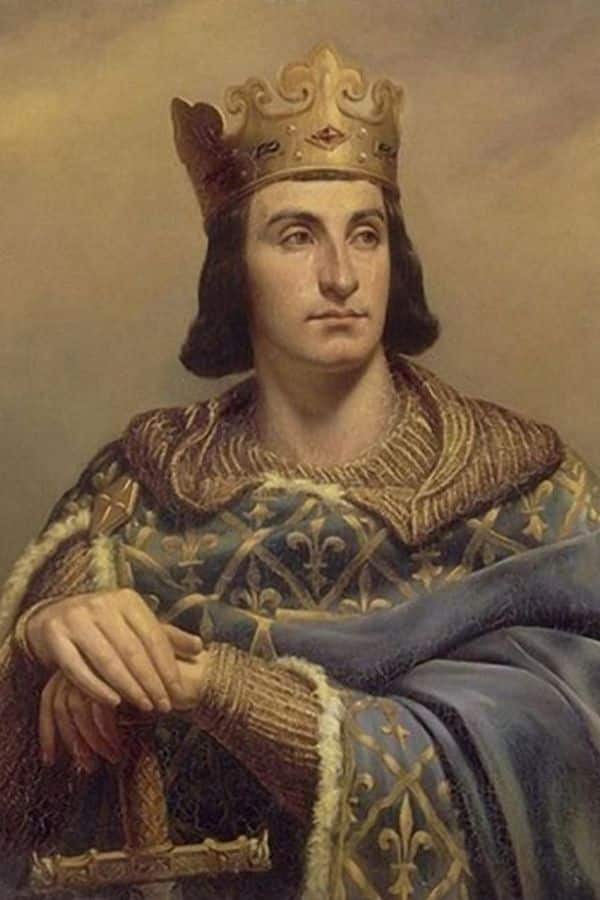
Born in 1214 at Poissy, Louis took the French throne as a 12-year-old boy in 1226 under his mother Blanche of Castile’s regency, and ruled personally from 1234 until his death on crusade in 1270.
A 44-year reign, over a kingdom that under him became the dominant power in western Europe. He was canonized in 1297, the only French king to be made a saint, on the strength of testimonies collected by a commission that included Geoffrey of Beaulieu, his confessor of 20 years.
His achievement was less about conquest than about the machinery of justice. Louis established the parlement of Paris as a permanent royal court, banned trial by battle in cases before royal judges, and issued ordinances against private warfare between his nobles.
His biographer Jean de Joinville, seneschal of Champagne, went with him on the Seventh Crusade and wrote a Life of Saint Louis around 1309 that is one of the great medieval memoirs. Joinville describes the king sitting under an oak tree at Vincennes to hear cases from any subject who wanted to bring one directly to him.
Louis wore a hair shirt, ate coarse bread with his meat soaked in water, and had himself scourged with small iron chains by his confessor. He also bought what he believed to be the Crown of Thorns from the impoverished Latin emperor of Constantinople, Baldwin II, in 1239 for 135,000 livres, roughly half the annual royal income, and built the Sainte-Chapelle in Paris to house it.
The Sainte-Chapelle was built between 1242 and 1248. The relic is now in Notre-Dame. Louis died of dysentery outside Tunis in August 1270 during his second and disastrous crusade.
4. Otto I of Germany, the Founder of the Holy Roman Empire
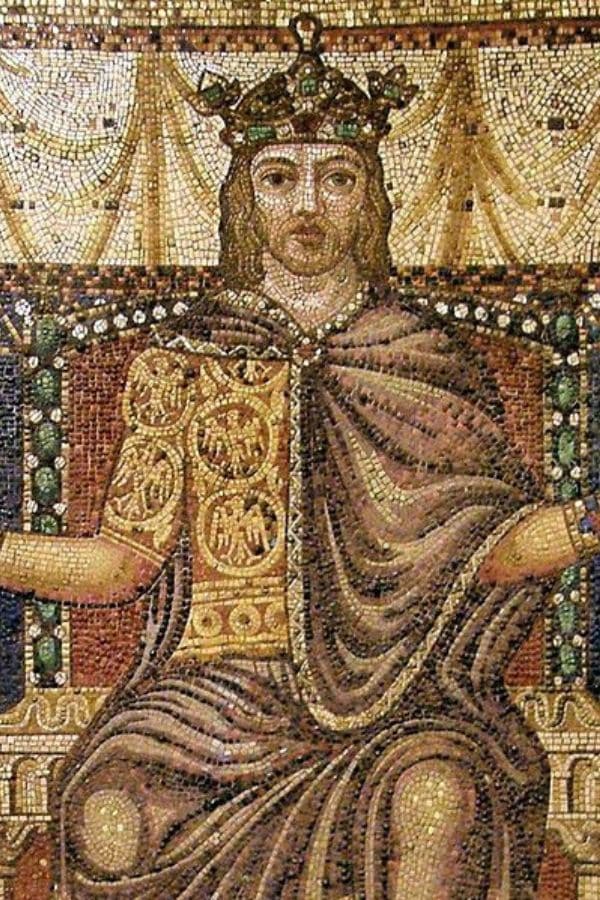
Born in 912, Otto ruled the East Frankish kingdom from 936 and was crowned Holy Roman Emperor in Rome by Pope John XII on 2 February 962. He died in 973. A 37-year reign as king, 11 as emperor, over the German duchies and much of northern Italy.
Widukind of Corvey, a Saxon monk writing in the 960s, is our main source for his early reign, and the Gesta of Liutprand of Cremona covers the Italian campaigns.
His headline achievement is the Battle of Lechfeld on 10 August 955, when he broke a Magyar invasion force outside Augsburg with a combined army drawn from all the German duchies.
The Magyars had been raiding into Germany, France, and Italy for 60 years. After Lechfeld, they stopped, settled, and eventually became the Christian kingdom of Hungary under Stephen I.
Otto’s coronation in Rome 7 years later revived the imperial title in the west for the first time since the Carolingians and established the pattern that lasted, in one form or another, until Napoleon dissolved the empire in 1806.
Otto systematically appointed bishops and abbots to positions that came with royal lands and troops, so-called imperial churches, and used them as a counterweight to the secular dukes.
Bishops were celibate and could not found dynasties. The system, later called the Ottonian church system by historians such as Timothy Reuter, lasted until the Investiture Controversy blew it up under his great-great-grandson Henry IV in the 1070s.
His son and grandson, Otto II and Otto III, held the empire together, and Otto III grew up dreaming of restoring Rome itself as the imperial capital.
3. Edward I of England, the Hammer
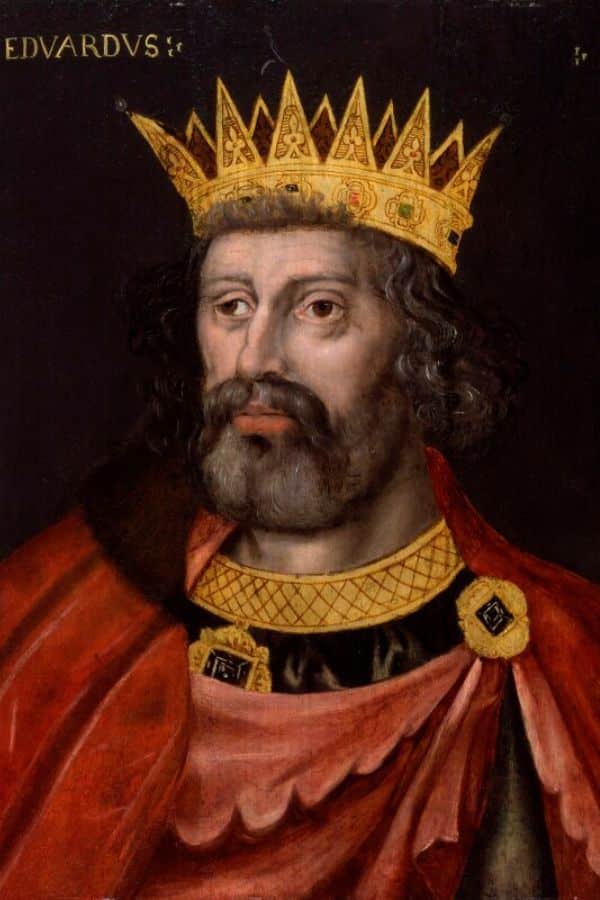
Born in 1239 at Westminster, Edward I was the son of Henry III and Eleanor of Provence, and ruled England from 1272 until 1307. A 35-year reign, over a kingdom he then extended by conquering Wales in a war that ended in 1283 and by trying, and largely failing, to conquer Scotland from 1296 onward.
He was 6 feet 2 inches tall, which is why his contemporaries called him Longshanks, and he was, by every account we have, a formidable and frightening man.
His achievement in Wales was total. After the death of Llywelyn ap Gruffudd at Cilmeri in December 1282 and the execution of his brother Dafydd at Shrewsbury in 1283, Edward built the ring of castles that still stands: Conwy, Caernarfon, Harlech, Beaumaris.
The master mason was James of Saint George, brought from Savoy, and the building accounts survive in the Public Record Office. Caernarfon’s polygonal towers and banded masonry deliberately echoed the walls of Constantinople, because Edward wanted his new Welsh capital to look imperial.
During the Edict of Expulsion of 1290, Edward expelled the entire Jewish population of England, roughly 2,000 to 3,000 people, on 18 July of that year. They were not readmitted until Cromwell’s time in the 1650s.
The expulsion followed decades of increasingly punitive legislation, the Statute of the Jewry in 1275, and it was popular with the barons whose debts to Jewish moneylenders were effectively canceled.
It also produced a healthy tax grant from Parliament. Edward was a state-builder, and his state-building included this. He died at Burgh by Sands in July 1307 on his way to yet another Scottish campaign, having told his son to boil his bones and carry them at the head of the army until Scotland was subdued. His son ignored him.
2. William the Conqueror, the Duke Who Took a Kingdom

Born around 1028 at Falaise in Normandy, William was the illegitimate son of Duke Robert I and a tanner’s daughter named Herleva.
He became Duke of Normandy at about 8 years old in 1035, ruled it through a violent minority in which several of his guardians were murdered, and took the English throne on 25 December 1066 after killing Harold Godwinson at Hastings on 14 October. He died in 1087. A 21-year reign over England, 52 years as duke of Normandy.
The headline achievement is the invasion itself. The Ship List of William the Conqueror, a document preserved in a 12th-century manuscript at Bayeux, records that his magnates contributed roughly 776 ships.
Modern historians, working with the list and the Bayeux Tapestry, generally estimate that the fleet that actually sailed from Saint-Valery-sur-Somme in late September comprised around 600 transport vessels carrying perhaps 7,000 men and 2,000 to 3,000 horses.
Getting warhorses across the Channel and disembarking them ready to fight was a logistical feat that had not been attempted on that scale since the Romans.
And then, of course, there is the Domesday Book. William ordered it at his Christmas court at Gloucester in 1085. The Anglo-Saxon Chronicle describes commissioners riding out to every shire to record who held what, how much land there was, how many plows, how many pigs, and what it was all worth.
The survey was completed in 1086. It survives in two volumes at the National Archives at Kew, and it is the most detailed record of any medieval kingdom. William was, in the words of the Chronicle’s obituary of him, a stern and violent man, and no man dared to do anything against his will. The obituary was written by an Englishman who had lived under him.
1. Charlemagne, the Emperor Who Made Europe

Born in 748, Charles ruled the Franks from 768 and was crowned emperor by Pope Leo III at St Peter’s in Rome on Christmas Day 800. He died at Aachen in January 814.
A 46-year reign, over a territory that stretched from the Pyrenees to the Elbe and from the North Sea to central Italy, the largest political unit in western Europe since the Roman Empire and the largest that would exist there until Napoleon.
His achievement is the Carolingian Renaissance and the shape of the medieval West. He gathered scholars at Aachen, most famously Alcuin of York, who ran the palace school and pushed a reform of Latin that standardized the script we now call Carolingian minuscule. Every lowercase letter you are reading descends from it.
He established a network of missi dominici, royal envoys who traveled in pairs, one lay and one clerical, to inspect his counts and enforce his capitularies. His biographer Einhard, who knew him personally for over 20 years, wrote the Vita Karoli Magni in the 820s, modeled on Suetonius, and it is our closest portrait of any medieval ruler.
Einhard claims Charles did not know the Christmas Day coronation was coming and wouldn’t have entered the church that day had he known. Most modern historians, including Rosamond McKitterick in her work on the Carolingians, think this is Einhard’s careful staging: neither Charles nor Leo could afford to look as though the other was making him.
What is clear is that a Frankish king had accepted the title of Roman emperor from a Roman pope, in Rome, on the anniversary of Christ’s birth. The Byzantines were furious.
The idea that western Europe had its own emperor, crowned by its own bishop, distinct from Constantinople, was born in that ceremony.

Kylie Lang is a nationally syndicated travel journalist with bylines on the Associated Press Wire & more, a medieval history writer, and the founder and lead author of Tales of the Middle Ages (talesofthemiddleages.com). She holds a BA (Honours) in History from the University of Kent and is a member of the British Guild of Travel Writers.
Related posts:
 10 Rulers of the Middle Ages Who Led with Wisdom, Compassion, and Power
 The Best and Worst Kings of the Middle Ages That the History Books Rarely Talk About
 The Mad Monarchs of the Middle Ages: 7 Royals Who Lost Their Minds
 Matilda of Tuscany: The Warrior Countess Who Brought an Emperor to His Knees