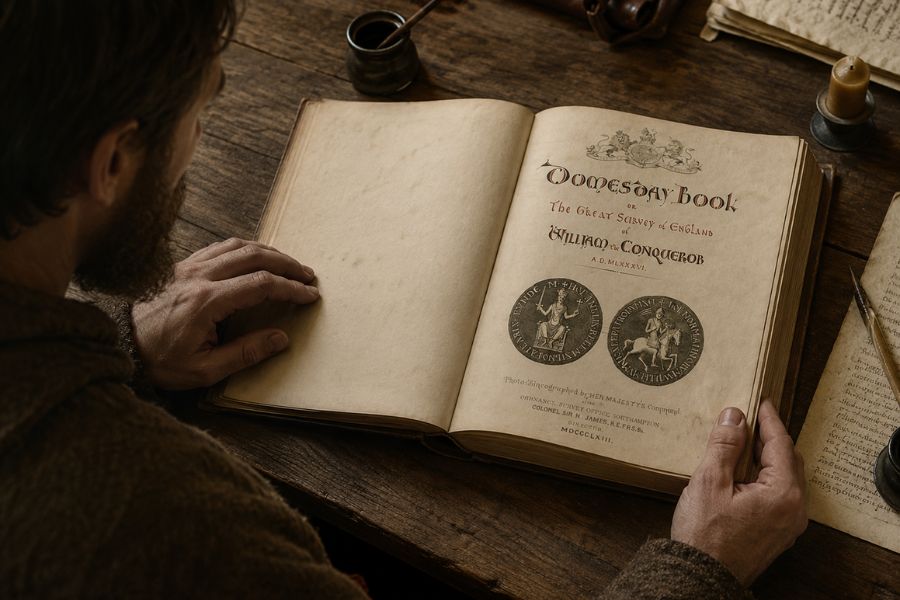
We talk about the Domesday Book as if it were a complete inventory of England, and in some ways, it was the most ambitious bureaucratic exercise medieval Europe had ever seen. William’s clerks rode out, asked questions under oath, and came back with the ploughs, the pigs, the mills, and the men.

The chronicler at Peterborough famously grumbled that not an ox nor a cow nor a pig was left out. But actually, plenty was left out. Whole counties barely surveyed, half the population unnamed, and entire categories of people recorded only as economic units attached to someone else’s manor.
Table of Contents
The gaps in the book tell you more about the Norman Conquest than most of the entries do, and once you start looking for them, you’ll see exactly what I mean.
The North That Wasn’t There
If you flip to the Yorkshire folios, the change in tone hits you immediately. Where Lincolnshire is dense with detail, packed with hides and ploughlands and the names of tenants and their oxen, Yorkshire reads like a different book written by a tired clerk who has given up.
Page after page, the same word appears in the margin: wasta. Waste. Sometimes it’s a single manor, sometimes it’s a whole stretch of land marked the same way, with no plough teams, no population, no value at all.
But why? Well, in the winter of 1069 to 1070, William responded to a northern rebellion by sending his army through Yorkshire, Durham, and parts of Cheshire and Staffordshire with orders to destroy everything.
Crops were burned, livestock slaughtered, salt poured into the soil in some accounts, and the people who survived the soldiers were left to die in the famine that followed. The chronicler Orderic Vitalis, writing decades later and no friend to William’s enemies, said the king had done a thing he couldn’t defend, and put the death toll at around 100,000.
By 1086, 16 years on, the Domesday clerks rode through the same country and wrote wasta beside the names of villages that no longer paid anything because there was no one left to pay. Some historians have argued that the word covers a range of meanings, from properly depopulated to administratively inconvenient, and that’s a fair caution.
The Domesday clerks weren’t always lying when they wrote wasta, but they weren’t telling the whole story either. The book records the result and skips the cause, and the Harrying of the North survives in the survey as a column of blank values.

What About the Women?
Try to count the women in the Domesday Book, and you run into a problem fast. The survey records around 268,000 heads of household, and the population of England at the time was probably somewhere between 1.5 and 2 million, depending on which historian you trust.
The arithmetic alone tells you most people in the country were folded into someone else’s entry, and the great majority of those folded-in people were women and children.
A handful of women do appear by name, and they tend to be the ones who couldn’t be ignored. Edith the Fair, who had been Harold Godwinson‘s handfast wife and one of the richest landowners in pre-Conquest England, shows up because her holdings were too vast to write around.
Judith of Lens, William’s niece and the widow of the executed Earl Waltheof, appears as a tenant-in-chief in her own right. A scattering of widows, abbesses, and English noblewomen survives in the entries because the land they held had to be accounted for somehow.
Other than that, it’s pretty much empty of women. A serious chunk of England’s economy, midwifed the babies, and worked the fields at harvest, don’t have names in the book because they didn’t need them.
They were counted, if at all, as part of a husband’s household or a lord’s labor force. The result is a survey of an agricultural country that barely registers half the people doing the agriculture, and any modern reading of medieval rural life has to do a lot of inferring around what the clerks were instructed not to write down.

Counted as Cattle: The Slaves of 1086
One of the more uncomfortable things the Domesday Book does record is the number of slaves on each manor, and even here, the entries hide more than they reveal. The clerks counted servi, men and women who were legally unfree in a way distinct from the various grades of villein and bordar around them.
The totals add up to roughly 10 percent of the recorded population in 1086, with much higher concentrations in the west country. Cornwall, Gloucestershire, and parts of Worcestershire had manors where servi made up a quarter of the listed workforce.
The survey gives you a number and nothing else. You learn how many slaves worked a given estate and what the manor was worth, without learning a single name, a single origin, or a single word about how those people came to be there.
Some were descendants of slaves who had been part of English society for generations, since Anglo-Saxon England had a thriving slave trade with Dublin and the Mediterranean well into the 11th century.
Others were almost certainly people enslaved in the chaos of the Conquest itself, since prisoners taken in war and famine were a recognized source of unfree labor.
Within a couple of generations after Domesday, the servi, as a legal category, had largely vanished from English records, absorbed into the broader peasantry as villeinage became the dominant form of unfreedom.
We don’t know whether their conditions improved, whether the church’s growing campaign against Christian-on-Christian slavery did the work, or whether the label simply shifted while the lives behind it stayed much the same. The book that counted them the most precisely is the same book that gives us no way to follow them after.

The Cities the Clerks Skipped
Towns are the other great gap. London, the biggest city in the country and almost certainly the richest, has no entry at all. Winchester, the old West Saxon capital and the place where the survey was probably compiled, isn’t surveyed either.
Both omissions are usually explained by the special status of the places, the awkwardness of fitting urban property into a rural manorial framework, and possibly the sheer political difficulty of telling the burgesses of London what they owed.
The towns that do appear are often handled awkwardly, with property and rents listed in ways that don’t match the categories used for the countryside. Bristol is barely there. Bury St Edmunds got a famously detailed entry only because the abbot wanted his rights pinned down on parchment.
The clerks struggled with anything that wasn’t a manor producing grain and livestock, and the more a place looked like a town, the more it slipped out of focus.
This is a problem because urban England in 1086 was already substantial. Perhaps 10 percent of the population lived in towns of some size, working as smiths, dyers, weavers, shoemakers, brewers, butchers, and the dozens of other specialized trades that supported a market economy.
The survey records the agricultural base that fed those towns and almost nothing of the towns themselves, which is one reason historians of medieval urban life lean so heavily on later sources and on archaeology rather than on the great book that was supposed to record everything.
Reading Between the Domesday Lines
The survey was as much a political instrument as a financial one, and the categories it used were doing the work of the new regime. Every entry follows the same small ritual: there was an Englishman holding this in the time of King Edward, and there’s a Frenchman holding it now.
The book is an inventory of the Conquest as a completed fact, and the names of the dispossessed are listed only to mark the moment they ceased to matter.
What the book declines to record is how that transfer actually happened. The legal disputes, the violent dispossessions, the marriages forced on English heiresses to legitimize Norman claims, the monasteries stripped of land, and the abbots replaced under threat.
The disputes that the clerks did record, often in tense little side-notes about who claims what against whom, give you a glimpse of a country still arguing over the takeover 20 years on. Set those alongside the silence about everything else, and you can see the choice the clerks were making about which arguments to preserve and which to bury.
The pieces that are missing have shape and intent. A north emptied by William’s army and described in a single repeated word, a workforce of women absorbed into household totals so they wouldn’t have to be named, a class of slaves counted with brutal precision and then left to disappear from the record within two generations, and the cities that didn’t fit the template at all.
Read it that way, and Domesday stops being an inventory of England in 1086 and starts looking like a portrait of who the new owners were willing to see, and a list of everyone they preferred to leave in the margin.
Kylie Lang is a nationally syndicated travel journalist with bylines on the Associated Press Wire & more, a medieval history writer, and the founder and lead author of Tales of the Middle Ages (talesofthemiddleages.com). She holds a BA (Honours) in History from the University of Kent and is a member of the British Guild of Travel Writers.


