
In a world where men claimed power as a birthright, Matilda of Tuscany carved out her own authority and held it with an iron grip. She ruled vast lands in northern and central Italy, commanded armies, and shaped the outcome of one of the most bitter struggles in medieval Europe: the clash between pope and emperor.
Her story is packed with high-stakes drama. A girl who grew up amid power and politics, she became a warrior countess, a strategist, and a trusted ally of popes during the Investiture Controversy.
Table of Contents
When Henry IV knelt barefoot in the snow at Canossa in 1077, it was Matilda’s castle he stood before. From failed marriages to fierce battles and bold political maneuvers, Matilda left a trail that rewrote the role of women in power. Let’s step into her world and uncover how she became the Great Countess who defied every expectation of her time.

Noble Origins and Early Life (c. 1046–1055)
Matilda was born around 1046 into the House of Canossa, one of the most influential dynasties in northern Italy. Her father, Boniface of Canossa, held the title of margrave, which meant control over a vast stretch of land across Tuscany, Lombardy, and Emilia-Romagna. This gave the family enormous wealth and military power in a region that often saw emperors and popes locked in a tug-of-war for dominance.
Her mother, Beatrice of Lorraine, brought another layer of prestige. She came from the powerful Lotharingian line, tying Matilda to both Italian and German aristocracy. These connections would shape her life and give her a role in conflicts that stretched far beyond Tuscany. For the first few years of her life, Matilda lived in the security of her family’s strongholds, surrounded by the symbols of authority: castles, courts, and armored men loyal to her house.
Everything changed when tragedy struck. In 1052, Boniface was killed, likely ambushed during a hunting trip by rivals who saw his power as a threat. Three years later, Matilda’s older brother Frederick died as well, leaving her the sole surviving heir. At barely nine years old, she inherited an empire of lands and obligations that would have been overwhelming for most adults.
Under the guardianship of her mother, she was thrust into the world of diplomacy and military strategy, a world that expected her to defend what was hers or lose it to men eager to tear it apart.
Formative Years and Education
After the deaths of her father and brother, Matilda’s life became anything but quiet. Her mother, Beatrice, understood the weight of the Canossa legacy and wasted no time preparing her daughter for it. This wasn’t the usual education expected of noblewomen, limited to piety and embroidery.
Matilda learned Latin and the legal traditions that governed church and empire. She studied scripture deeply, but her education went far beyond prayer books. Beatrice ensured her daughter understood politics, negotiation, and the delicate dance of power between pope and emperor.
Religion was at the core, but so was war. Beatrice brought in seasoned commanders to train her daughter in practical skills. Among them was Arduino della Palude, a name that still echoes in Italian chronicles. He was a soldier through and through, and he taught Matilda how to ride, handle a sword, and command troops. These lessons were not for show. Northern Italy was a dangerous place, and without military strength, the Canossa lands would crumble.
By her teenage years, Matilda could read the subtleties of papal decrees and swing a sword with equal confidence. She grew up in a world where loyalty was bought with steel, and survival meant being as sharp in mind as in battle. This blend of intellect and martial skill would set her apart from almost every other woman of her time, and most men, too.
First Marriage and Co-Rule
Matilda’s early years were shaped by alliances that could mean survival or disaster. After her father, Boniface, was murdered in 1052, her mother, Beatrice, acted fast. She married Godfrey the Bearded, the powerful Duke of Lower Lorraine.
This was not a love match but a lifeline. Beatrice needed an ally strong enough to protect her daughter’s inheritance from rivals and imperial interference. Godfrey the Bearded was a formidable figure in imperial politics and a staunch supporter of reform within the Church, which later brought the Canossa family close to the papal cause.
This marriage, however, provoked Emperor Henry III, who considered it a betrayal because Beatrice married without his consent. His response was swift. Beatrice and young Matilda were arrested and taken to Germany in 1055, held under imperial control for nearly a year.
This experience left a mark on Matilda. It showed her how fragile power could be when emperors decided to enforce their will, and it introduced her to the brutal politics she would later master. Their release came only after Henry III died in 1056, when his son, Henry IV, ascended to the throne as a minor, creating a power vacuum that Beatrice and Godfrey the Bearded exploited to regain influence.
By the time Matilda reached adulthood, the stage was set for another strategic union. In 1069, she married Godfrey the Hunchback, Duke of Lower Lorraine, and nephew of her stepfather. The match was designed to reinforce ties with the Lotharingian nobility and bolster her position as ruler of the Canossa territories.

Godfrey was no minor noble. He controlled lands stretching from the Low Countries into Germany and carried significant weight in imperial politics. But the marriage was far from easy. The two lived mostly apart, Matilda in Italy, Godfrey in Lorraine, bound more by political necessity than personal affection. It was not so dissimilar to the relationship of Empress Matilda and Geoffrey Plantagenet.
Their union produced one child, but tragedy struck when the infant died soon after birth. With no heir, Matilda faced growing pressure from all sides. The marriage itself deteriorated and ended abruptly when Godfrey was assassinated in 1076, stabbed to death while answering the call of nature.
It was a humiliating end for a man of his stature and a stark reminder of the dangers of medieval politics. His death freed Matilda from the constraints of the marriage, leaving her sole mistress of the Canossa inheritance. It also came at a time when her influence was about to reach its peak.
In these years, Matilda co-ruled with her mother, Beatrice, who remained a political powerhouse until she died in 1076. Together, they maintained a court that was both a refuge and a command center. Letters from this period show them corresponding with popes, bishops, and princes, offering troops and resources to secure alliances.
They were not passive guardians of land but active players shaping the balance of power in Italy and beyond. When Beatrice died, Matilda stood alone, armed with wealth, soldiers, and a will as strong as iron. The Great Countess was about to take center stage in one of the fiercest power struggles of the Middle Ages.
Hooked on the Middle Ages? Get more stories like this one in your inbox.
Rise to Power – Margravine of Tuscany
When Beatrice died in 1076, Matilda became the most powerful secular ruler in Italy, controlling an expanse of land that stretched from Lombardy through Emilia-Romagna into Tuscany.
Her territories were the key to everything that mattered in the struggle between pope and emperor: the roads linking Rome to the north, the strongholds that secured passes through the Apennines, and the fertile plains that fed armies. Whoever held this land could decide who won the war of influence that was consuming Europe.
Matilda knew this, and so did everyone else. From the moment she assumed full authority, she became the target of imperial ambitions. Emperor Henry IV considered her holdings critical to his power, and his enemies saw her as their strongest ally. It was not an easy position.

She faced a world where noblemen questioned a woman’s ability to rule, where every promise of loyalty was as thin as parchment, and where armies could appear at her borders with little warning. Yet Matilda held her ground. She fortified her castles, strengthened ties with reformist church leaders, and began shaping a network of alliances that made her one of the most formidable political figures of the eleventh century.
Her court at Canossa became the nerve center of the papal cause during the escalating conflict known as the Investiture Controversy, a war over who held the ultimate authority to appoint bishops and control the Church’s wealth and influence. Pope Gregory VII and Henry IV were locked in a bitter contest that would shape medieval Europe, and Matilda threw her weight behind the pope. She provided Gregory with soldiers, resources, and safe refuge when he needed it most. In return, she secured spiritual backing that strengthened her position against the emperor and his supporters.

By aligning herself so closely with the papacy, Matilda turned her lands into a sanctuary for reformers and a rallying point for those who opposed imperial interference in church affairs. It was a dangerous gamble. Every step deeper into the papal camp made her a greater threat to Henry IV.
It ensured that the struggle between them would not be settled with letters and councils alone. It would be fought in sieges, battles, and bold acts of defiance. The first of those bold acts was about to unfold in the snow at Canossa.
The Investiture Controversy and the Walk to Canossa
By the late 1070s, Europe was tearing itself apart over the question of authority. Who had the right to invest bishops with their office, the pope or the emperor? The stakes could not have been higher. Bishops controlled vast lands, commanded wealth, and held political clout that could tip kingdoms into peace or war. Whoever controlled their appointments controlled the backbone of medieval power.
Pope Gregory VII was determined to break imperial dominance over the Church, and Emperor Henry IV was equally determined to keep it. In 1076, when Gregory declared Henry excommunicated, the emperor’s authority collapsed almost overnight. His nobles revolted, forcing him to act fast.
To salvage his crown, Henry needed forgiveness, and that meant standing before the pope in person. But Gregory wasn’t in Rome; he was in northern Italy, under the protection of Matilda of Tuscany.
The scene that followed became one of the most iconic episodes in medieval history. In January 1077, Henry crossed the Alps in the dead of winter, his retinue reduced, his power shattered. He trudged through snow and ice to Canossa, Matilda’s hilltop fortress. For three days, the Holy Roman Emperor stood barefoot outside the gates, wearing a penitent’s robe, fasting, and begging for absolution.

Inside, Pope Gregory and Matilda watched the drama unfold. Was she the mediator? The strategist? The gatekeeper? In truth, she was all three. Without Matilda’s protection, Gregory could never have staged this act of triumph.
On the fourth day, the gates opened. Henry was admitted, and the pope lifted the sentence of excommunication. It looked like a victory for Gregory and, by extension, for Matilda. But appearances were deceptive. Canossa did not end the conflict. It was a pause in a war that would rage on for decades.
Still, the image of an emperor humbled in the snow outside her fortress burned Matilda’s name into the memory of Europe. She had turned her castle into the stage for a political theater that shook the foundations of medieval power.
Later Years: War, Second Marriage, and an Unyielding Rule
The truce was short-lived. Within two years, the emperor was back in Italy with an army, determined to break the papal alliance and crush the woman who stood in his way. Matilda faced invasion after invasion across the 1080s and 1090s. Chroniclers record her riding into battle clad in armor, rallying her troops, and directing sieges with the precision of a seasoned commander.
Her military skill was tested at the Battle of Volta Mantovana in 1080, where her forces fought fiercely against Henry’s supporters. She lost that day, but defeat only hardened her resolve. Rather than retreat into obscurity, she dug in for a long fight. Matilda transformed her fortresses into near-impenetrable strongholds and turned the rugged Apennines into a weapon.
She mastered defensive warfare, forcing Henry’s armies into grueling campaigns that drained their strength without delivering decisive victories. It was this relentless resistance that kept the papal cause alive in Italy even when fortunes turned bleak.
Amid the chaos of war, Matilda entered a second marriage in 1089 to Welf V, heir to the powerful Bavarian dynasty. The union shocked Europe. Welf was decades younger than Matilda, and their alliance looked like a bold play to reinforce papal support and isolate Henry IV.
But the marriage was a failure from the start. Welf was ambitious, but the realities of sharing power with a woman who commanded armies and lands on her own terms were too much for him. By 1095, the marriage collapsed, and Welf returned to Germany, leaving Matilda free once again, but now without the political cover he had provided.
Yet she did not falter. In the years that followed, Matilda continued to back the papacy, offering men and money to support reformist popes like Urban II. When the First Crusade was called in 1095, her territories provided safe passage for armies moving south.
Even in her later years, when age and illness crept in, she remained a formidable force in Italian politics. Rivals learned the hard way that the Great Countess did not yield her authority easily. Every fortress she held, every battle she fought, reaffirmed her place as one of the most resilient leaders of the Middle Ages.
Final Years, Death, and an Unusual Honor
By the early twelfth century, Matilda’s health was failing, but her grip on power never loosened. Decades of war had drained her resources and reshaped alliances across Europe, yet she still held her Canossa lands and remained one of the pope’s staunchest supporters.
Her territories provided vital logistical support during the First Crusade, and her court continued to serve as a refuge for reformers and scholars. Even as her body weakened, her influence endured.
In 1111, a remarkable twist occurred. Henry IV had died in disgrace, excommunicated and abandoned, and his son Henry V now sat on the imperial throne. Unlike his father, Henry V chose diplomacy over relentless war. Matilda, in her sixties and worn from years of conflict, negotiated peace with the emperor who had once been her enemy. They reached a settlement that left her lands largely intact and reaffirmed her authority, at least for the remainder of her life.
Matilda died in 1115 at her fortress in Bondeno di Roncore. She left no children, but her legacy was monumental. In her will, she made a donation of her lands to the papacy, a gift that would spark disputes long after her death but also cement her place as one of the greatest defenders of Church reform.

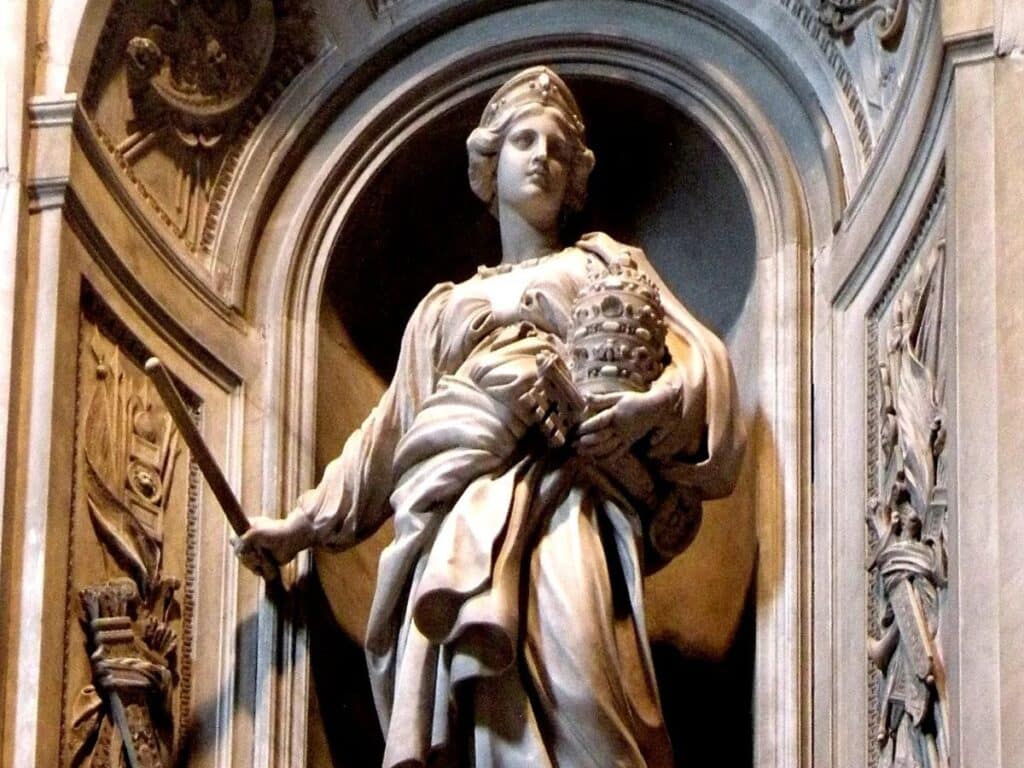
Nearly five centuries later, in 1633, Pope Urban VIII had her remains moved to St. Peter’s Basilica in Rome. Her tomb, designed by Bernini, still rests there among popes and saints, a rare honor for a laywoman and a lasting symbol of the woman who transformed Canossa into the center of Europe’s fiercest power struggle.

Love a good medieval story?
Join our readers and get tales of kings, queens, castles and ordinary medieval lives straight to your inbox.

Kylie Lang is a nationally syndicated travel journalist with bylines on the Associated Press Wire & more, a medieval history writer, and the founder and lead author of Tales of the Middle Ages (talesofthemiddleages.com). She holds a BA (Honours) in History from the University of Kent and is a member of the British Guild of Travel Writers.
Related posts:
 Empress Matilda: The Crown, the Betrayal, and the Fight of Her Life
 Empress Matilda: Lady of the English and Queen of Ice and Snow. But Should She Have Been England’s First Queen?
 The Battle of Crécy 1346: How a Teenage Prince and a Wall of Arrows Brought France to Its Knees
 Six Women Who Dodged a Bullet, or Axe, by Not Marrying Henry VIII