Here’s a subject the history books skip right over, and it’s one that half the population dealt with every single month for their entire adult lives. Whatever you picture when you imagine how medieval women managed their periods, I’d put a small wager on it being wrong, because most of what gets repeated online is a myth.
So let’s set the record straight. Medieval women did not simply bleed into their skirts and get on with their day. The evidence, including a rather remarkable recent dig in Norway, shows they used folded cloth rags and absorbent moss, held in place with a belt or girdle, then washed and reused month after month.
Table of Contents
They also had far fewer periods than we do, and believed some strange things about what was happening to them, and handled the whole business with a resourcefulness that deserves a lot more respect than a snigger.
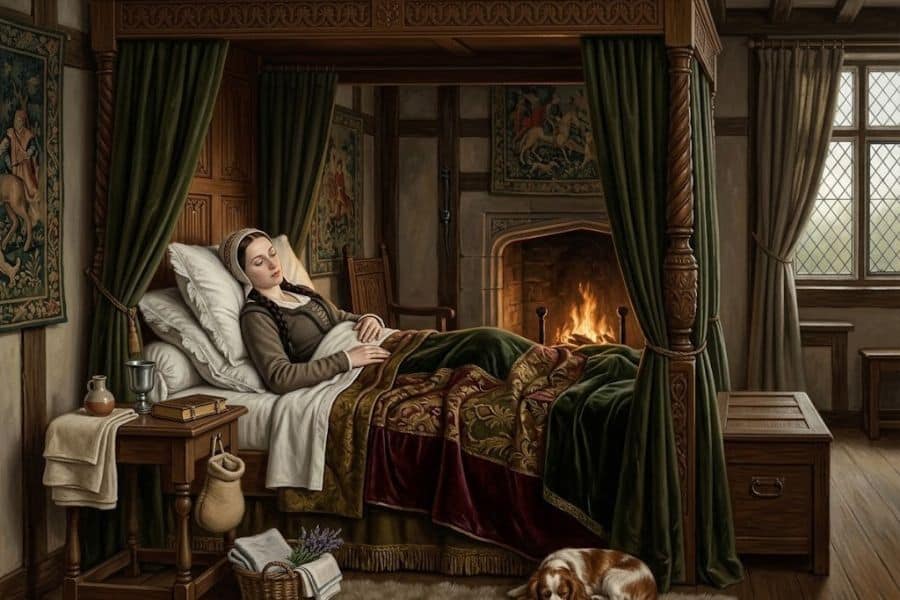
So, Did Medieval Women Just Bleed Freely?
You’ll have seen the claim that medieval women simply free-bled, letting it run into their clothes because they had nothing else. They did not.
A Norwegian researcher named Sunniva Wilberg Halvorsen studied a 13th-century latrine in the town of Tønsberg and found strips of textile that had been deliberately torn, folded, and pleated, one of which tested positive for human blood, alongside sphagnum moss, which is naturally absorbent.
The physical evidence of homemade period protection, sitting in a medieval toilet where you’d expect to find it. Cloth in the Middle Ages was staggeringly precious. A single plain wool dress could take up to a thousand hours of labor to produce, and women did most of that work themselves.
The idea that these same women would happily ruin their clothing and pile up extra washing every month, in a world that was already deeply squeamish about menstruation, just doesn’t add up.
What Did They Actually Use?
So if not free-bleeding, then what? The mainstay was cloth. Women used rags of old linen and worn-out clothing, folded into pads, which is exactly the “on the rag” that survives in our language today.
Linen was prized for the job because it’s soft and absorbent and washes well. For the heavier days, they reached for sphagnum moss, the same bog moss that was used for centuries to dress wounds, because it soaks up many times its own weight in liquid and has natural antiseptic properties.
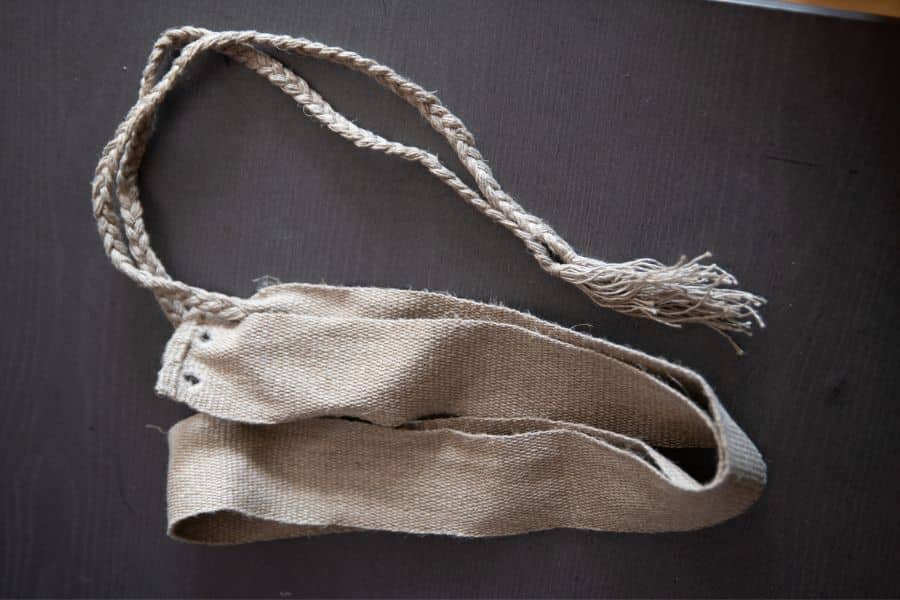
Holding it all in place was a belt or girdle around the waist, often woven from hemp or linen, and tied or pinned her cloth to it, front to back, a bit like a loincloth. A modern reconstruction of a 1350s setup found that a narrow, doubled strip of linen with ties worked far better than a broad band, staying discreet and secure through walking and housework.
It wasn’t comfortable by our standards. But it worked, and a woman could go about her day in it.
Did They Wear Anything Underneath?
Medieval women, by and large, did not wear knickers. Men wore linen braies, a kind of underpant, but women’s underwear as we’d recognize it simply wasn’t a standard thing for most of the medieval period.
Part of the reasoning was medical. The physicians of the day, following ancient theory, held that a woman’s nether regions needed air circulating freely to stay healthy, so covering them up was thought unwise.
What a woman did wear was a long linen shift or chemise next to the skin, under her gown, and that shift caught a good deal of anything the cloths missed. It could be washed, which the expensive outer gown could not.
So the humble under-shift was the last line of defense, and it explains why a menstrual belt tied to the waist, rather than tucked into underwear, was the practical way to keep a pad where it needed to be.
Hooked on the Middle Ages? Get more stories like this one in your inbox.
Medieval Women Had Far Fewer Periods Than You Do
A medieval woman spent far less of her life menstruating than a modern woman does. Some estimates suggest a woman today has around 400 periods over her lifetime. A medieval woman’s life looked nothing like that.
Poorer diets and harder living meant girls often started their periods later than they do now. Then, once married, a woman was frequently pregnant, and each pregnancy and the long recovery around childbirth meant nine months and more with no period at all.
After the birth she would breastfeed, often for two years or longer, and extended breastfeeding naturally suppresses menstruation for months on end. Stack up a first pregnancy in her teens, a decade or two of babies and breastfeeding, a generally earlier menopause, and shorter, lighter periods from a leaner body, and you have a woman who might have menstruated only a fraction as often as we do.
It was still a monthly reality for the years in between. But it was a smaller part of the whole than our own experience would lead us to assume.
What They Believed Was Really Going On
Medieval ideas about menstruation were a proper tangle of ancient superstition, some strange medical beliefs and religious guilt. The mainstream medical view, inherited from the Greek physician Galen, ran on humoral theory, the belief that the body was governed by four fluids that had to be kept in balance.
Women were thought to be colder and wetter than men and to build up an excess of blood, and menstruation was simply the body’s monthly way of purging that surplus and staying well. By this logic a period was healthy and necessary, and a woman whose cycle stopped was the one in danger.
The great women’s medical text of the age, the Trotula, written at Salerno around the 12th century, treated menstruation in exactly this way, as did the abbess and polymath Hildegard of Bingen in her own medical writings.
Classical writers like Pliny had insisted menstrual blood was actively dangerous, claiming it could sour wine, kill crops, blunt blades, and dull mirrors, and these lurid ideas were copied faithfully into medieval texts and taken as fact.
Religion piled on the shame, tying menstruation to the curse of Eve and treating menstruating women as unclean, a stigma stretching back to the Book of Leviticus. At its worst, this thread turned poisonous. A notorious later text called On the Secrets of Women stewed medical misogyny into something truly nasty, and ideas like it helped feed the paranoia that would later fuel the witch trials.
So a medieval woman might be told in the same lifetime that her period was keeping her healthy, and that her body was shameful and faintly dangerous. No wonder nobody wrote clearly about the practical side.
Remedies, Herbs, and the Fear of a Missing Period
Cramps and heavy bleeding are not modern inventions, and medieval women had a whole herbal toolkit for them. Manuscripts called herbals listed plants to ease period pain and to calm heavy flow, and a woman would have brewed these into drinks, poultices, and baths.
The bigger medical worry, though, was the opposite problem. Because a period was seen as the body flushing out bad blood, a missing period was cause for real alarm, believed to leave that corrupt blood trapped inside to fester and sicken a woman.
So a great deal of medieval women’s medicine was devoted to bringing on a late or absent period, using herbs known as emmenagogues, things like mugwort, pennyroyal, and tansy.
Keeping It Clean and Discreet
Reusable cloth means washing, and washing in the Middle Ages was hard graft. The menstrual rags were scrubbed by hand in hot water with soap and lye, the same harsh cleaning agents used for the general wash, then dried and folded away for next month.
A modern reconstruction found this worked better than you’d think, lifting the stains with only faint marks left behind on the linen.
Discretion mattered enormously, given the shame heaped on the whole subject, so this was women’s work done discreetly among women, passed from mother to daughter and never spoken of to men or written into their records.
Frequently Asked Questions
How Did Medieval Women Manage Their Periods?
Medieval women managed their periods mainly with folded rags of linen or old cloth, and pads of absorbent sphagnum moss for heavier days, held in place by a belt or girdle tied around the waist rather than tucked into underwear.
Did Medieval Women Just Bleed Freely into Their Clothes?
Medieval women did not simply bleed freely into their clothes, despite the popular myth. Cloth was extremely valuable and time-consuming to make, and the era’s heavy stigma around menstruation makes deliberate soiling unlikely. Archaeologists have found deliberately folded and pleated cloths, one testing positive for blood, plus absorbent moss, in a medieval latrine, strong evidence that women used homemade protection rather than nothing at all.
Did Medieval Women Wear Underwear?
Medieval women generally did not wear underwear as we know it, for most of the period. Men wore linen underpants called braies, but women wore a long linen shift or chemise next to the skin under their gowns instead. Medieval medical theory even held that the genital area needed fresh air to stay healthy.
Did Medieval Women Have Fewer Periods Than Women Today?
Medieval women did have far fewer periods than women today. Girls often started menstruating later because of poorer nutrition, and grown women spent much of their fertile years either pregnant or breastfeeding, both of which pause menstruation. Combined with a generally earlier menopause and lighter flow, a medieval woman may have menstruated only a fraction as often as a modern woman, who has an estimated 400 or so periods in a lifetime.
What Did Medieval People Believe About Menstruation?
Medieval people held mixed beliefs about menstruation. Mainstream medicine, following the Greek physician Galen, saw it as healthy and necessary, the body purging excess blood to stay in balance, a view reflected in women’s medical texts like the Trotula. But older superstitions claimed menstrual blood could sour wine or kill crops, and religious teaching tied menstruation to shame and the curse of Eve, so attitudes swung between practical and fearful.
How Did Medieval Women Deal with Period Pain?
Medieval women dealt with period pain using herbal remedies recorded in manuscripts called herbals. Plants were brewed into drinks, poultices, and warm baths to ease cramps and calm heavy bleeding. Medieval medicine was also very concerned with a missing period, thought to trap harmful blood inside, so herbs known as emmenagogues, such as mugwort and tansy, were used to bring on a late or absent flow.

Love a good medieval story?
Join our readers and get tales of kings, queens, castles and ordinary medieval lives straight to your inbox.

Kylie Lang is a nationally syndicated travel journalist with bylines on the Associated Press Wire & more, a medieval history writer, and the founder and lead author of Tales of the Middle Ages (talesofthemiddleages.com). She holds a BA (Honours) in History from the University of Kent and is a member of the British Guild of Travel Writers.
Related posts:
 How Women Managed Their Periods Through History, From Moss to Menstrual Belts
 How Did Tudor People Brush Their Teeth and Deal With Hygiene in General?
 Did Medieval People Smell That Bad? The Truth About Hygiene in the Middle Ages
 Ancient Methods of Birth Control Included Weasel Testicles and Fish Bladder Condoms: The History of Contraception in the Middle Ages