
I was halfway through a chapter on medieval midwifery the other afternoon, tea going cold beside me, when I came across a casual reference to women tying a weasel’s testicle to their thigh to avoid pregnancy. It kinda stopped me in my tracks. Surely not.
But then, I couldn’t help thinking that if I were a woman living in the Middle Ages and my body was being used as a baby production line, I’d probably give anything a go as well. You’d be willing to try anything if it meant getting through the next year without another pregnancy that might kill you.
Table of Contents
The options on offer ranged from useless to dangerous, and most of what could be done had to be done in secret. All of this simply reinforces how little control women had over the one thing that shaped their entire lives.
Contraception in Medieval Europe
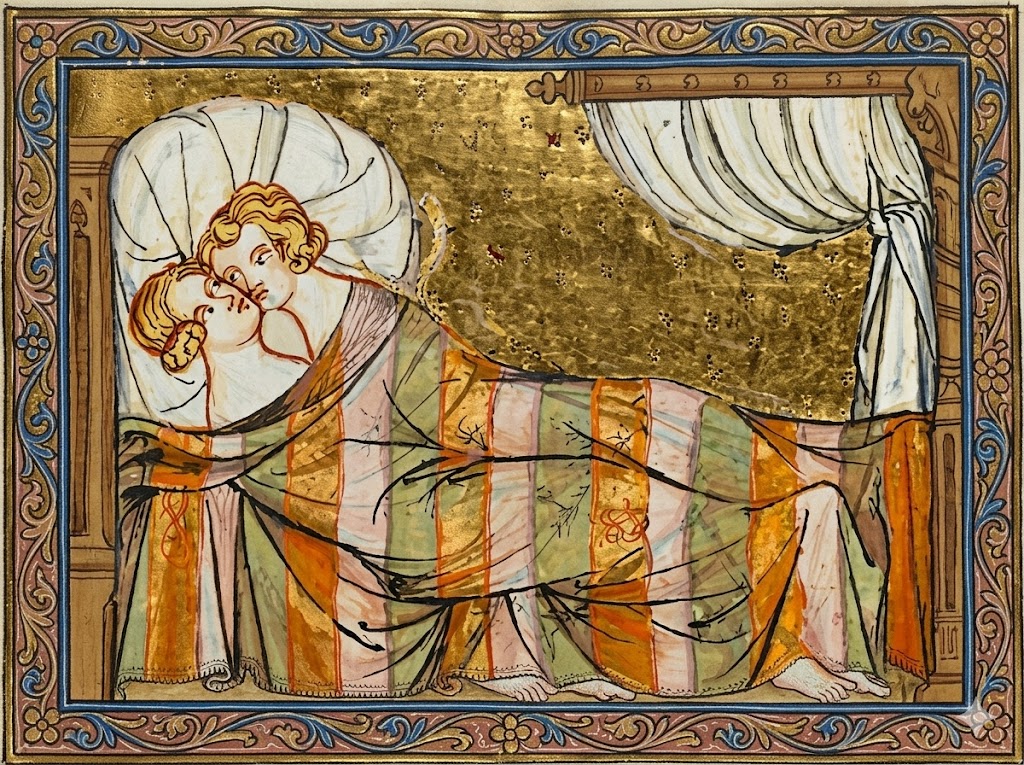
Officially, contraception didn’t exist in medieval Europe because it wasn’t allowed to. The Church’s position, hammered out by theologians from Augustine onward, was that the only legitimate purpose of sex was procreation within marriage, and that any attempt to separate the two was a sin somewhere between fornication and murder.
Burchard of Worms, writing his Decretum around 1010, listed specific penances for women who took herbs to prevent conception or cause abortion, distinguishing carefully between the two, which tells you the priests hearing confessions needed the distinction often enough to want it spelled out.
Burchard was writing pastoral guidance based on what women were actually telling their confessors. The penance for contraception by potion was 10 years on bread and water, dropping to seven if the woman was poor and trying to avoid feeding more mouths than she could manage.
That sliding scale is one of the more humane things you’ll find in a medieval penitential, and it gives the game away: everyone knew women were doing this, and the Church was trying to manage the practice rather than pretend it didn’t happen.
What survives comes mostly from male physicians and clerics who disapproved of it, which means we’re reading the history of medieval contraception through the eyes of the men trying to stop it.
The women themselves left almost no written record. What they did, they did in kitchens and bedchambers, passed mother to daughter, midwife to bride, in conversations that nobody was going to write down for fear of what might happen to them if anyone found their scribblings. Plus, many wouldn’t have been able to read or write.

Amulets, Weasel Testicles, and Other Things You Tied to Your Thigh
The weasel testicle method appears in several medieval sources, originally attributed to the 1st-century writer Aetius of Amida and copied through centuries of medical compendia. The instructions vary slightly.
Some say to wrap the testicles in the skin of a mule, some specify a goose, and at least one version insists you must catch the weasel alive, remove the testicles, and let the weasel go. The amulet was then tied to the woman’s thigh during intercourse.
Other recommended charms included the right foot of a vulture, a piece of catgut soaked in menstrual blood, and a pouch containing the ashes of a burned mule’s hoof. Albertus Magnus, the 13th-century scholar, repeated some of these in his writings on natural philosophy, recording them as folk knowledge alongside everything else he was cataloging.
The line between medicine and magic in this period was thin to nonexistent, and a learned physician saw nothing odd about prescribing both a herbal pessary and a charm in the same breath.
None of this worked, obviously. But the prevalence of amulet contraception across centuries and across class lines tells you something about how desperate the demand was. A woman who already had six children, whose body was worn out, whose husband wouldn’t abstain, and whose Church told her she had no right to refuse him, was reaching for whatever she could.
If a midwife told her a weasel testicle might help, she’d try the weasel testicle. The cost of being wrong was another pregnancy, and the cost of doing nothing was the same.

Hooked on the Middle Ages? Get more stories like this one in your inbox.
What Actually Worked: Pessaries, Herbs, and the Withdrawal Problem
Some of what medieval women used did have a real effect, even if nobody quite knew why. The Trotula, a 12th-century collection of women’s medicine associated with the medical school at Salerno, recommended pessaries soaked in various substances, including vinegar, lemon juice, and a mixture of honey and cedar resin.
Vinegar and lemon juice are mildly spermicidal because of their acidity. Honey, used as a barrier, slows sperm down. Soranus of Ephesus, writing in the 2nd century and copied diligently throughout the medieval period, recommended olive oil for the same purpose, and modern testing has confirmed that olive oil does, in fact, considerably slow sperm motility.
Herbal contraceptives and abortifacients were the other major category, and the distinction between the two was blurry in practice. Pennyroyal, rue, savin, tansy, and silphium (which the Romans drove to extinction through overharvesting) all appear in medieval herbal manuscripts as remedies to induce a delayed period, which was the polite way of saying to terminate an early pregnancy.
Some of these herbs do work, but most of them are also poisonous in the doses required, and the line between an effective dose and a fatal one was a guess made by a midwife who’d seen it go both ways.
Withdrawal, called coitus interruptus or the sin of Onan in the theological literature, was probably the most widely practiced method of all, despite being condemned from every pulpit in Christendom. The Church hated it so much that confessors were instructed to ask about it specifically, which is itself evidence of how common it was.
Prolonged breastfeeding was another workaround, since it suppresses ovulation for some months after birth, and medieval women often nursed for two or three years, partly for this reason, though they wouldn’t have phrased it in those terms.
Fish Bladders, Linen, and the Slow Arrival of the Condom
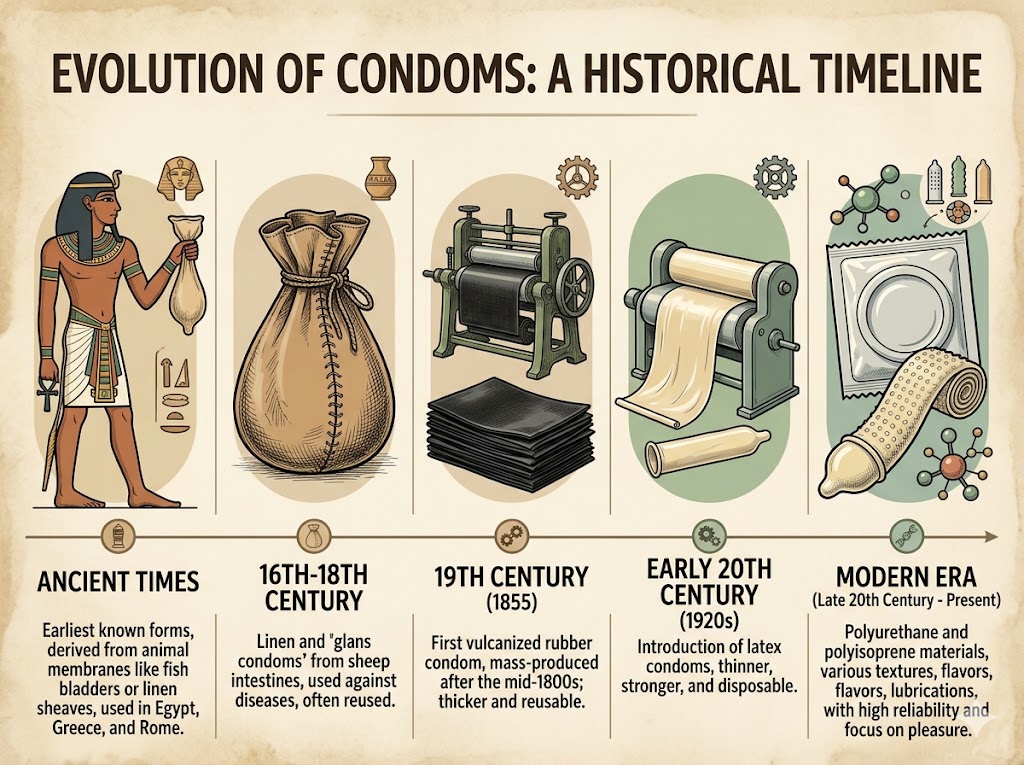
The condom is older than most people realize, though it took a long time to become anything you’d recognize. References to sheaths made from animal intestines and bladders appear in classical sources, disappear almost entirely throughout the early medieval period, and resurface in the 16th century in a context unrelated to contraception.
Gabriele Falloppio, the Italian anatomist who gave his name to the fallopian tubes, described in his 1564 treatise De Morbo Gallico a linen sheath soaked in a chemical solution and tied on with a ribbon, designed to protect men from syphilis.
He claimed to have tested it on 1,100 men, none of whom contracted the disease, which is a number to take with however large a pinch of salt you prefer.
The syphilis epidemic that swept Europe from the 1490s onward changed the conversation about sex in ways that the Church couldn’t fully control. A disease that ate your face off and killed you slowly was a more immediate concern than the theology of procreation, and men who could afford it began buying sheaths from specialist makers.
By the 17th century, condoms made from sheep gut or fish bladder were available in London, sold in brothels and by individual makers whose names appear in court records and personal correspondence. James Boswell mentions buying them in his diaries, calling them armor.
For most of the Tudor period, though, this was barely a factor in ordinary women’s lives. A linen sheath was expensive, available only in certain places, and used overwhelmingly by men visiting prostitutes rather than by married couples trying to space their children. The condom, such as it was, depended entirely on the man’s willingness to use it, and the men who frequented brothels weren’t always the men who cared.
Inside marriage, where most reproductive life was lived, the condom played almost no role at all.
What This Meant for the Woman in the Bed
Pull back from the recipes and the theology for a moment and think about what this looked like in practice. A woman in 1450 or 1550 married in her late teens or early twenties, became pregnant within a year, and could expect to be pregnant or nursing for most of the next two decades.
Maternal mortality estimates for this period vary widely, but somewhere between one and two percent of births killed the mother, and a woman who gave birth eight times was running that risk eight times.
Add infant mortality, which took perhaps a quarter of children before their first birthday, and you have a picture of reproductive life that was relentless and often grief-stricken.
This is the context in which the weasel testicle stops being funny. A wife was expected to render what the canon lawyers called the marital debt, meaning she couldn’t refuse her husband sex without sinning against him. She had no legal right to her own body inside marriage. And you think we have it bad now.
Her one religiously sanctioned option for limiting pregnancy was abstinence, which required her husband’s cooperation and was actively discouraged by the same Church that forbade everything else. Everything she actually had, the pessaries and the herbs and the amulets and the whispered advice from her mother, existed in a grey zone of sin and secrecy.
Queens faced the same biology in gilded rooms. Catherine of Aragon was pregnant at least six times that we know of and buried five of those children, and her failure to produce a surviving son was framed as her failure rather than as a tragedy of maternal medicine.
Anne Boleyn miscarried what was probably a male fetus in January 1536 and died by May. Jane Seymour died of childbed fever 12 days after giving birth to Edward.
The same gap between what women’s bodies were asked to do and what medicine could actually help them with ran straight through every social class, from the palace down to the laborer’s cottage.
What we have, when we look at medieval and Tudor contraception, is a record of women working with almost nothing, in conditions designed to prevent them from working with anything at all, and managing despite it.
Birth intervals in well-studied parish records are often longer than pure biology would predict, which suggests something was being done.

Love a good medieval story?
Join our readers and get tales of kings, queens, castles and ordinary medieval lives straight to your inbox.

Kylie Lang is a nationally syndicated travel journalist with bylines on the Associated Press Wire & more, a medieval history writer, and the founder and lead author of Tales of the Middle Ages (talesofthemiddleages.com). She holds a BA (Honours) in History from the University of Kent and is a member of the British Guild of Travel Writers.
Related posts:
 Untold Tales of Medieval Food, Kitchens and Meal Prep
 How Did Women Give Birth in the Middle Ages? The Ceremonies, Rituals, and Strange Goings On
 7 Strange Rituals People Practiced In the Middle Ages to Ward Off Evil Spirits
 Did Medieval People Smell That Bad? The Truth About Hygiene in the Middle Ages