A medieval woman in labor entered a room that had been sealed off from the outside world. Windows were shuttered, keyholes were plugged, and tapestries were hung over the walls to block any draft of cold air. Even the candles were sometimes covered. The world she’d known was, for the next few weeks, reduced to a single hot chamber and the women inside it.
No man entered. Not her husband, not the priest, not the physician who might have treated her for any other ailment. Childbirth was women’s territory, and the men of the household paced elsewhere or worked or drank or prayed.
Table of Contents
What happened inside that room is one of the better-documented aspects of medieval daily life, and one of the most unsettling. We have midwives’ manuals, prayers, charms, recipes for caudles and ointments, and the grim mortality records that show how often it ended badly. The story of medieval childbirth is the story of women trying every tool they had against a process that killed roughly one mother in fifty.
The Sealed Chamber and Who Was Allowed Inside
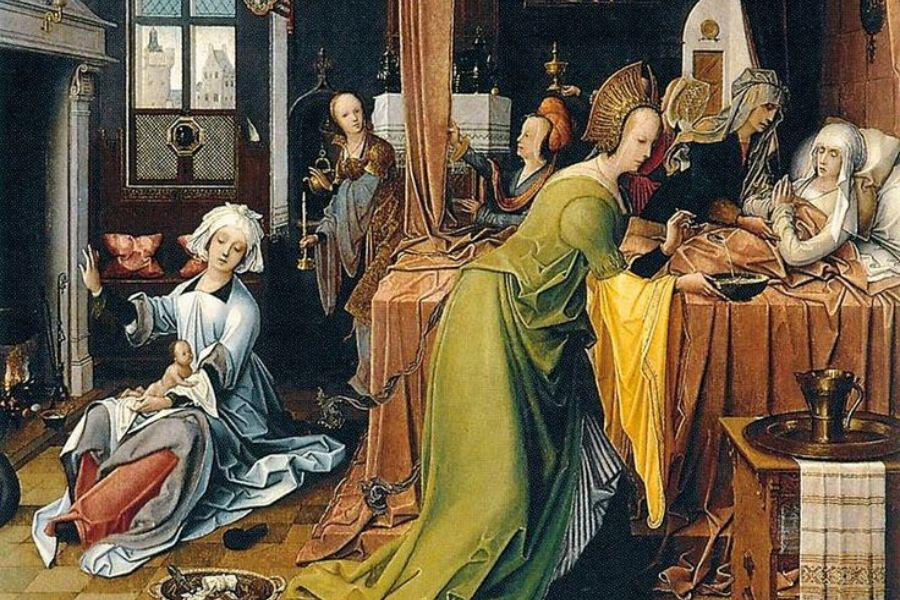
The practice of sealing the birthing room came from a mix of medical theory and ritual. Medieval medicine, drawing on Galen and the four humors, held that cold air and bright light could harm a laboring woman, knocking her body out of balance at the worst possible time. The chamber was meant to imitate the womb itself: dark, warm, quiet, enclosed.
For royal and noble women, this could be taken to startling extremes. Margaret Beaufort, mother of Henry VII, drew up ordinances in the 1480s that set out exactly how a queen’s lying-in chamber was to be prepared.
The walls and ceiling were to be hung entirely with blue arras, leaving only one window unblocked so the woman could have light when she wanted it. The floor was carpeted. A bed of estate stood in the corner for ceremony, though the actual birth often happened on a smaller pallet or birthing stool.
The women allowed inside were the midwife, her assistants, and the laboring woman’s female relatives and gossips. The word gossip, by the way, comes from godsib, meaning a woman’s close female friends who attended her in childbirth and later stood as godmothers to the child.
Men were excluded by long custom. When the physician Eucharius Rösslin published his birthing manual Der Rosengarten in 1513, he had to rely on female informants for much of his information, because he couldn’t actually watch a birth himself.
I’ve stood in reconstructed birthing chambers at a couple of historic houses in England, and the thing that strikes you is how small and hot they would have been. Pack six or seven women into that space for a labor lasting two days, with a fire going and no fresh air, and you start to understand why exhaustion alone could be fatal.
Hooked on the Middle Ages? Get more stories like this one in your inbox.
The Midwife and What She Actually Did
The midwife was usually an older woman from the local community, trained by years of attending births rather than by any formal qualification. In towns, she might be licensed by the church, which cared less about her medical knowledge than about whether she was of good character and could perform an emergency baptism if the baby looked likely to die.
A child who died unbaptized was, in medieval theology, locked out of heaven, and this was a heavier worry for many families than the survival of the mother.
A competent midwife knew a great deal. She could assess the position of the baby by external examination, turn a breech presentation by manipulation, recognize the signs of obstructed labor, and use herbal preparations to speed contractions or ease pain.
She had ointments of lily oil and almond oil to rub on the belly. She knew how to support the perineum to reduce tearing. She might have the laboring woman walk, squat, kneel, or use a birthing stool, a low wooden seat with a crescent cutout that allowed gravity to help.
When things went wrong, the limits of her skill were brutal. If the baby was lodged sideways and couldn’t be turned, or if labor stretched into a third day with no progress, there was very little anyone could do.
Cesarean section in the Middle Ages was almost always a posthumous operation, performed to extract a live baby from a dead or dying mother so the child could be baptized. The first documented case of a mother surviving a cesarean comes from Switzerland in 1500, when a sow gelder named Jakob Nufer reportedly operated on his own wife. Whether the story is true is debated.
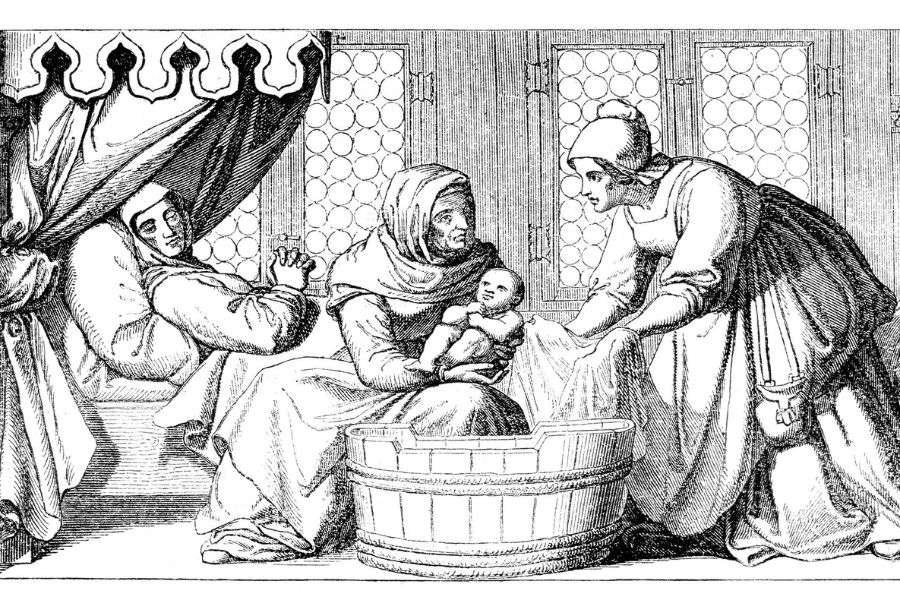
Midwives also handled what came after. They cut the cord, washed the baby, swaddled it tightly so its limbs would grow straight (or so people believed), and presented it to the family. They stayed with the mother through the dangerous days that followed, watching for fever, hemorrhage, and the infections that killed so many women in the week after a successful birth.
Prayers, Charms, and the Things Tied to a Laboring Woman
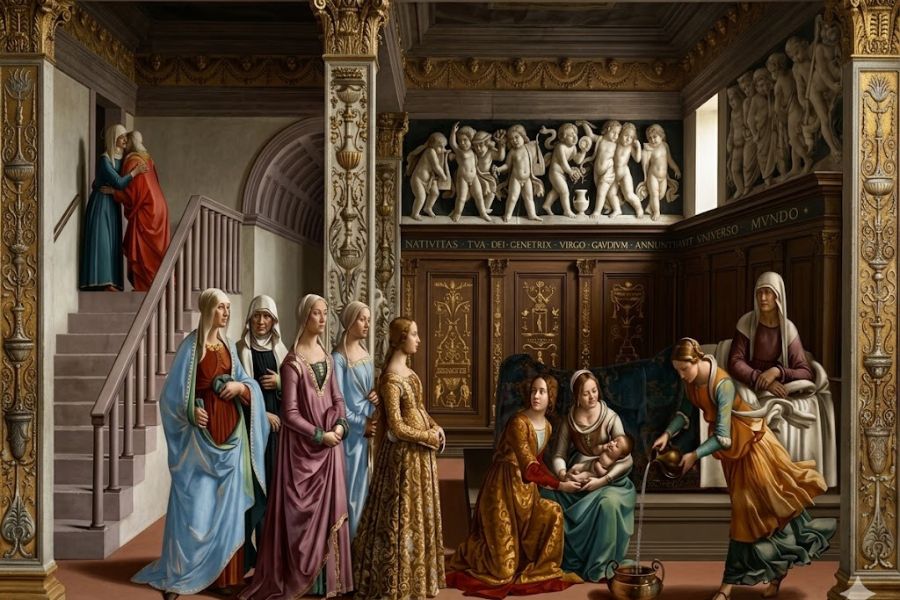
Medieval religion and medieval magic were tangled together in the birthing chamber, and nobody at the time saw a contradiction. A woman in labor might have a relic placed on her belly, a prayer roll laid across her body, and a herbal poultice applied all at once. Each was thought to do something, and you used what worked.
Saint Margaret of Antioch was the patron saint of childbirth, on the strength of a legend in which she was swallowed by a dragon and burst out alive. Her prayers were copied onto long parchment rolls, sometimes several feet long, and wrapped around the laboring woman’s body or laid across her belly.
One surviving roll, now in the Wellcome Collection, promises that any woman who carries it or reads it will be delivered safely. Henry VIII’s first wife, Catherine of Aragon, is recorded as having borrowed a girdle of the Virgin Mary from Westminster Abbey during her confinements. Plenty of other queens did the same.
The charms ranged from the orthodox to the wildly folk. An eagle stone, a hollow geode that rattled when shaken, was strapped to the thigh of a laboring woman to draw the baby out, then moved to the belly to stop bleeding. Coral beads, jasper, and amber were all credited with protective powers.
Some midwives recited Latin charms over the woman, mixing scripture with older formulas. Others recommended unloosing every knot in the room, including the woman’s hair, her shoelaces, the cords of her chemise, on the principle that bound things bound the body.
Herbal medicine sat alongside the prayers. Pennyroyal, mugwort, and birthwort (the plant was literally named for the purpose) were used to bring on contractions. Caudle, a warm drink of spiced wine, eggs, and bread, kept the woman’s strength up. Pain relief was in short supply. Opium was known but rarely used in childbirth, partly because the church had absorbed the idea from Genesis that women were meant to bring forth children in sorrow. Easing the pain too aggressively edged into theological trouble.
Mortality, and What Killed So Many of Them
Estimates of maternal mortality in the Middle Ages vary by region and century, but the figures historians work with tend to land somewhere around one to two percent of births ending in the death of the mother.
Across a woman’s reproductive life, with perhaps six or eight pregnancies, the cumulative risk climbed toward one in ten. Among queens and noblewomen, the rate was often worse, partly because they were married younger and pressured into having children sooner.
The killers were usually three. Obstructed labor, where the baby simply could not be delivered, killed both mother and child slowly and painfully.
Hemorrhage after birth, often from a retained placenta, could empty a woman in minutes. And puerperal fever, the bacterial infection of the uterus that we now know spread on the unwashed hands of attendants, often arrived a few days after a successful delivery, when everyone thought the danger had passed.
A woman could nurse her newborn on Tuesday and be dead by Friday.
The roll call of deaths in the English royal family alone tells you how flat the playing field was. Elizabeth of York, wife of Henry VII, died in 1503 of complications after childbirth, on her 37th birthday.
Jane Seymour, Henry VIII’s third wife, died in 1537, twelve days after giving birth to the future Edward VI, almost certainly of puerperal fever. Katherine Parr, who survived Henry, died of the same thing in 1548 after bearing a daughter to Thomas Seymour.
Wealth, status, and the best attendants’ money could buy made surprisingly little difference once infection set in.
Infant mortality was even higher. Roughly a quarter to a third of children died before their first birthday, and many of those deaths happened in the first week. The baptism that the midwife was licensed to perform in emergencies was the most urgent piece of business in the room after the baby drew breath.
Churching, and the Long Road Back
If both mother and child survived, the woman remained in her chamber in seclusion for a period of around a month. She was considered ritually unclean during this time, a holdover from the Levitical purification laws, and she did not attend church or appear in public.
Her gossips visited, her household carried on without her, and she rested in a way that women of her class rarely got to rest otherwise. For peasant women, the seclusion was much shorter, because the cows still needed milking and the bread still needed making, but the principle held where it could.
The period ended with a ceremony called churching, in which the woman walked to her parish church, often carrying a lit candle, and was formally received back by the priest. Psalm 121 was read, prayers of thanksgiving were said, and she returned to ordinary life.
Churching has been argued about endlessly by historians: was it a punishment, a purification, or a celebration? The evidence suggests women themselves valued it, often paying for it out of their own pockets and treating it as their own occasion. The feast that followed, attended only by women, could be a serious party.
Reading the household accounts of a wealthy 15th-century woman like Margaret Paston, you get a sense of how this rhythm shaped a life. Pregnancy, lying-in, churching, then a few months or a year of relative freedom, then another pregnancy. Margaret had seven children who survived to adulthood, which means she likely went through the cycle ten or more times. Each one a roll of the dice.

Love a good medieval story?
Join our readers and get tales of kings, queens, castles and ordinary medieval lives straight to your inbox.

Kylie Lang is a nationally syndicated travel journalist with bylines on the Associated Press Wire & more, a medieval history writer, and the founder and lead author of Tales of the Middle Ages (talesofthemiddleages.com). She holds a BA (Honours) in History from the University of Kent and is a member of the British Guild of Travel Writers.