
You’ve seen the picture a hundred times. The knight on his warhorse, banner up, visor down, charging into the line without a flicker of doubt. It’s one of the most persistent images we have of the Middle Ages, and it’s almost the opposite of what the men inside the armor were actually feeling.

Medieval knights were terrified in battle, and the thing that scared them most wasn’t the sword coming at the visor. A knight feared going down in the mud and being unable to stand, feared capture and a ransom that could ruin his family for a generation, and feared public dishonor more than a clean death. Those fears shaped when he charged, when he held, and when he pulled off a gauntlet and handed it to the man standing over him.
Table of Contents
What follows is the evidence behind that picture. The named chronicles, the numbers, the arguments historians are still having, and the writing of a knight who died at Poitiers in 1356 and left behind a book about what his profession actually demanded of him.
What Were Medieval Knights Actually Most Afraid Of?
If you’d asked a working knight in the 14th century what kept him awake the night before a battle, the answer wouldn’t have been the killing blow. Ranked roughly in order, his worst fears would most likely be capture, financial ruin by ransom, public dishonor, and going down in the churned ground under horses and men.
A straight sword blow that took him cleanly was almost the least of it, because a clean death on horseback with a witness present was, by the standards of his class, a good end.
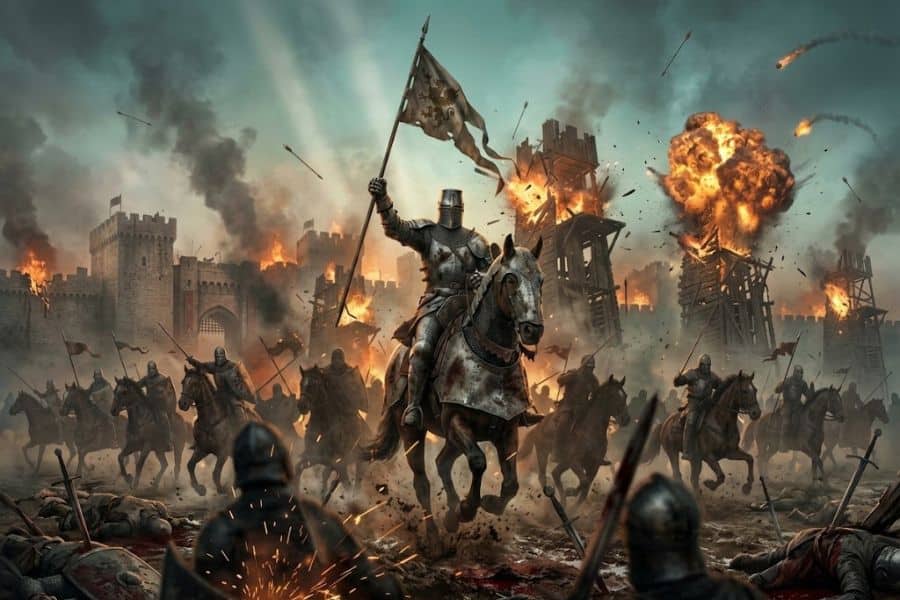
Geoffroi de Charny, the French knight who carried the Oriflamme at Poitiers and was killed there in 1356, wrote in his Book of Chivalry that a knight was expected to endure greater hardship, exertion and anxiety than other men.
He didn’t say the fear wasn’t there. He said it had to be swallowed, and that a man who could swallow it was worth more than one who felt nothing at all.
Then there were the Burgundian chroniclers Jean Waurin and Jean le Fevre for the mud and prisoners at Agincourt, Enguerrand de Monstrelet for the wider Hundred Years War, and the modern work of Thomas Heeboll-Holm at the University of Copenhagen on whether knights carried something we might now call trauma.
Why Falling Off the Horse Was the Nightmare, Not the Weight
The reader’s mental image of an unhorsed knight completely helpless and unable to move is a Victorian invention. Surviving 15th-century field harnesses weigh roughly 45 to 55 pounds, distributed across the whole body, and reconstructions have shown that a fit man in one can run, mount without help, and get up from the ground.
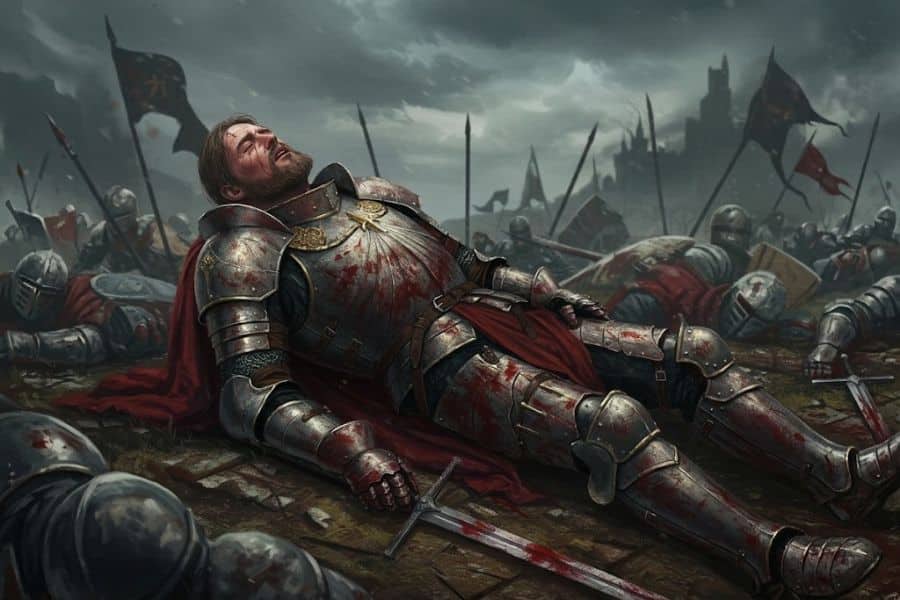
A knight in the mud wasn’t trapped by his armor. He was trapped by everything else.
Imagine a fully armored man face down in wet clay, someone he can’t see kneeling on his back and working a thin dagger through the eye slit of his helmet. That’s the misericorde, the mercy blade, and it’s designed for exactly that use.
Infantry swarmed downed knights and went for the gaps: visor, armpits, groin, the back of the knee, the join at the neck. A rondel or misericorde slid in where the steel wasn’t. Getting up from the ground took seconds, and in a press of men and horses, seconds were the whole margin.
Tournament armor was a different animal, thicker and heavier because it was built to stop a lance at speed in a controlled setting, but that’s not what you wore into a war.
Field plate was made to be lived in for a day, and the men wearing it knew the real danger was the moment the horse went, or the line broke, or the ground gave, and they found themselves down among the boots.
Why Was Being Captured More Feared Than Being Killed?
Capture terrified a knight because it was, in a specific and calculable way, worse than dying. A dead knight cost his family a funeral.
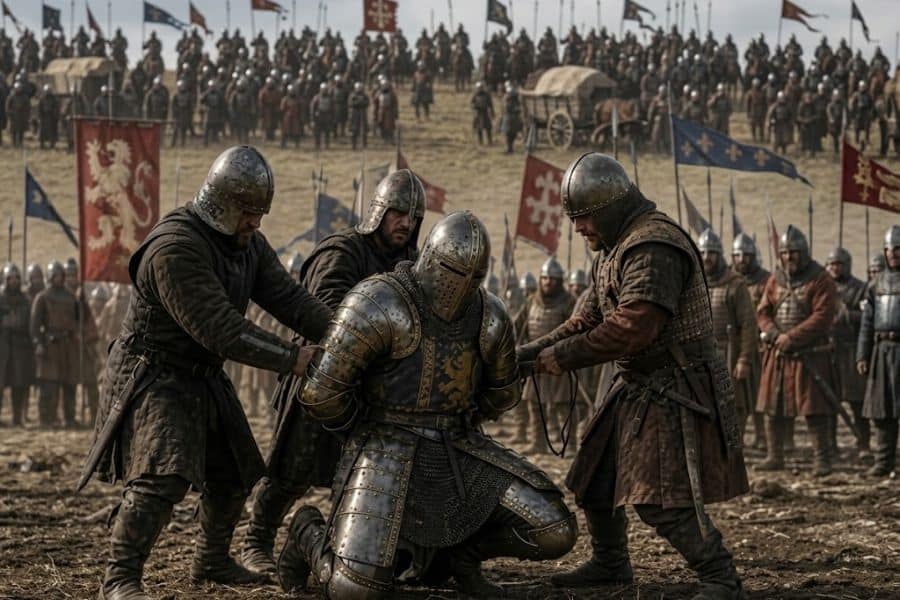
A captured knight was property. His captor held him for months or years while his wife, his heir, and his steward sold land, borrowed against harvests, and squeezed tenants to raise a ransom set at whatever the market and the captor’s greed would bear.
The headline example is King John II of France, taken by the English at Poitiers in 1356 and eventually ransomed under the 1360 Treaty of Bretigny for 3 million gold ecus, a sum reckoned at roughly two years of the entire French royal revenue.
That’s what ransom could do to a king. For a lesser man it worked the same way, scaled down: a captured banneret could be priced at a level that would eat his estates for a decade, and his cousins and in-laws were expected to pay in.
The paradox of the whole system was that a knight was safer on the field than a peasant with a bill hook, because he was worth more alive. Recognizable arms and a good horse marked you as a paying prisoner, and men who might have finished off an infantryman would pull a knight to his feet and start negotiating on the spot.
When the money never came, though, the arrangement soured; some hostages were held for years while their families stalled, some were mutilated to focus minds back home, and some simply died in a tower waiting for a payment that had been abandoned.
Why Did Knights Fear Dishonor More Than Death?
Chivalry was a working social and economic system, and a knight’s honor was the ledger it ran on. His reputation determined his standing at court, his ability to command other men, the marriages he could arrange for his daughters, and the credit his name could raise on a loan.
Lose that, and you lost the material scaffolding of your life.
Charny writes that a knight who fled the field was worse than dead, that hardship endured was the whole point of the profession, and that a good death in the line was preferable to a long life bought by shame.
And yet, and this is the paradox at the heart of the chivalric world, most knights still surrendered when the moment came. Yielding to a fellow knight, in the correct form, with the right words and a gauntlet handed over, wasn’t the same category of shame as fleeing, and men who’d rather die than run were still willing to accept capture and walk to the baggage train.
The line between honorable surrender and dishonorable flight was thin, was policed by other knights, and was one of the things a career soldier learned to read in the noise and dust of a broken line.
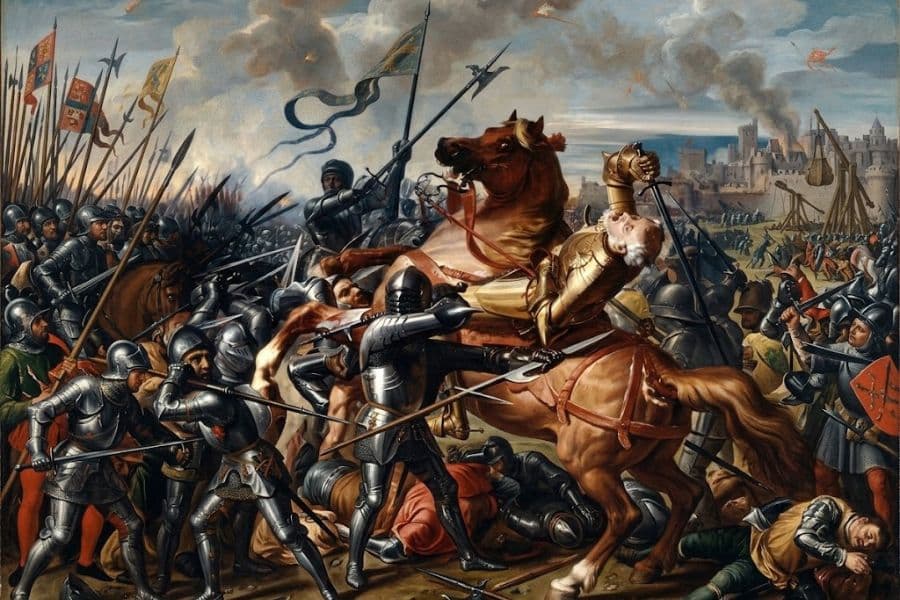
The Weapons Built Specifically to Kill an Armored Knight
Plate armor didn’t exist in a vacuum. The men who couldn’t afford it spent generations working out how to kill the men who could, and the arms race produced a specific toolkit.
The crossbow, powerful enough to punch a bolt through mail and, at short range, through weaker plate, was terrifying enough that the Church tried to ban its use against Christians at the Second Lateran Council in 1139.
The English longbow put massed archery into the hands of trained yeomen. Polearms of every kind, halberds, pollaxes, bills, gave a foot soldier reach and a mechanical advantage a knight couldn’t match once he was on the ground.
And the thin misericorde dagger sat on a knight’s own belt precisely because the men fighting him had one too.
At Crecy in 1346, at Poitiers ten years later, and above all at Agincourt in 1415, the longbow did its most famous work against dismounted French knights struggling forward across bad ground.
The arrows didn’t need to punch clean through breastplates to do the work. They killed horses, they found the gaps and the unarmored limbs, and they forced men to advance with their heads down and visors closed, which meant they couldn’t see well, couldn’t breathe well, and couldn’t spread out.
Historians still argue about penetration and the range at which a bodkin point could defeat good Milanese plate, with reconstructions pointing in different directions depending on the assumed draw weight and the armor tested.
What isn’t in dispute is what happens to a formation being shot at from the flanks while wading through mud. The men in it slow down, they bunch, and the ones at the front carry the ones behind straight into the enemy’s polearms.
The war hammer and the pollaxe were designed for what came next: hitting through the plate rather than around it, denting steel into skulls, breaking joints, dropping the wearer so the daggers could finish the work.
Did Medieval Knights Suffer Something Like PTSD?
Thomas Heeboll-Holm, working at the University of Copenhagen, has argued from medieval sources that some knights carried psychological wounds we’d now recognize as trauma. His evidence is from the language medieval writers used about veterans of long campaigns, describing despair, fear, powerlessness, sleeplessness, and in some cases delusions and visions of the dead.
The vocabulary isn’t modern, and yet the picture in the primary material is recognizable to anyone who’s read a 20th-century soldier’s account of coming home.
A campaigning knight went weeks on bad food and thin sleep, marched in wet steel, watched friends killed at arm’s length, and did the killing himself. He did it repeatedly, over years, and he was expected to ride home and take up his estates as though nothing had shifted.
You can’t cleanly apply a 21st-century clinical diagnosis to a 14th-century monk’s description of a knight who couldn’t sleep and dreamed of the dead. What you can say is that the medieval writers who knew these men weren’t describing invulnerable heroes. They were describing people.
Charny was writing about men who already knew what battle felt like from the inside, and the private wound a knight was forbidden to name in public sits under the surface of a lot of chivalric literature if you know to look for it.
What Really Happened in the Mud at Agincourt?
On 25 October 1415, in a narrow field between two woods near the village of Azincourt, the French army advanced on foot toward Henry V’s smaller English force. It had rained for days. The ground was heavy plowed clay.
The French men-at-arms, most of them in full plate, walked several hundred yards through it under longbow fire, and they packed themselves so tight in the front ranks that, according to the contemporary chroniclers, some men couldn’t raise their arms (Agincourt600 – 25 October 1415).
Estimates of French dead most often run to around 6,000, against roughly 400 English, though the numbers are argued and the sources don’t agree.
What happened in the front line was the nightmare Charny’s readers had spent their lives preparing not to think about. Men went down under the press of their own side, faces in the mud, weight of armored bodies on top of them, and the English archers, having emptied their quivers, came in with mallets and knives.
Some of the French dead at Agincourt weren’t killed by weapons at all. They suffocated in the crush, anonymous inside identical steel, exactly the inglorious end the chivalric ideal most dreaded. This was the opposite of a clean death on horseback with a witness present.
Later in the day, with prisoners already taken and a second French force apparently regrouping, Henry V ordered the killing of French prisoners. The Burgundian chroniclers Jean Waurin and Jean le Fevre, both writing from close to events, put the number killed as high as 2,200, and Enguerrand de Monstrelet’s chronicle covers the same ground with variations in detail.
Henry’s contemporaries didn’t condemn him, and the killing was read as a hard military necessity in the moment; later writers, working from a different set of assumptions about the rules of war, have called it a war crime.
Frequently Asked Questions
What were medieval knights most afraid of in battle?
Medieval knights feared capture, financial ruin through ransom, and public dishonor far more than a clean death by the sword. Going down in the mud and being unable to rise ranked near the top too, since a fallen knight was easy prey for infantry with daggers. The polished fearless-hero image hides how much these very human fears shaped when a knight charged, held back, or surrendered.
How heavy was a medieval knight’s armor, and could he move in it?
A medieval knight’s armor was surprisingly manageable, as a full suit of 15th-century field plate weighed roughly 45 to 55 pounds, spread across the whole body, light enough that a fit man could run, jump, and mount a horse unaided. The idea of knights being craned onto their horses is a Victorian invention. Tournament armor ran heavier, but battlefield harness was built for mobility, not just protection, because a slow knight was a dead one.
Why did knights fear capture more than death?
Knights feared capture because a ransom could ruin an entire family. King John II of France was ransomed for 3 million gold ecus under the 1360 Treaty of Bretigny, a sum equal to about two years of French tax revenue. Ordinary knights could spend months or years in captivity while relatives sold land and borrowed to free them, and if the money never came, captivity could turn deadly.
How many French knights died at Agincourt?
French dead at Agincourt on 25 October 1415 are commonly estimated around 6,000, against roughly 400 English, though contemporary chronicles vary widely. Many knights suffocated or were crushed in the packed mud rather than dying by the blade. Henry V then ordered captured French prisoners killed, with estimates running as high as 2,200, an act his own contemporaries recorded without much objection.
Did medieval knights get PTSD?
Medieval knights may well have suffered trauma resembling PTSD, argued by University of Copenhagen historian Thomas Heeboll-Holm from medieval texts describing despair, fear, powerlessness, and delusion after combat. Knights lived sleep-deprived, hungry, and exposed, killing repeatedly and watching friends die. A modern clinical label cannot be applied cleanly to 14th-century sources, but the writing suggests the psychological cost was real and largely unspoken.
Why did knights surrender if dishonor was so shameful?
Knights surrendered despite the shame because ransom culture gave capture a survivable, even routine, outcome that death did not. Chivalry made reputation a knight’s real currency, tied to his standing, his command, and his marriage prospects, so flight was catastrophic. Surrender on the field, by contrast, was a recognized transaction between social equals, which is why most knights raised their visors and gambled on their captor’s mercy.
## Sources
Primary sources
Charny, Geoffroi de. The Book of Chivalry of Geoffroi de Charny: Text, Context, and Translation. Philadelphia: University of Pennsylvania Press, c.1350.
Jean Waurin and Jean le Fevre (Burgundian chroniclers of Agincourt).
Monstrelet, Enguerrand de. “La Chronique d’Enguerrand de Monstrelet.” Bibliotheque nationale de France, MS Francais 2680. 15th century.
Secondary sources
Heeboll-Holm, Thomas. “Medieval knights may have suffered post-traumatic stress.” NBC News. 2011.
Agincourt600 – 25 October 1415.

Kylie Lang is a nationally syndicated travel journalist with bylines on the Associated Press Wire & more, a medieval history writer, and the founder and lead author of Tales of the Middle Ages (talesofthemiddleages.com). She holds a BA (Honours) in History from the University of Kent and is a member of the British Guild of Travel Writers.
Related posts:
 9 Historic Medieval Battles that Reshaped Kingdoms and Destroyed Dynasties
 The Hundred Years War Battles That Broke France: Mud, Blood, Dysentery, and a King Taken Hostage
 The 5 Most Brutal Battles Between England and France in the Middle Ages
 The Battle of Poitiers: The Black Prince’s Boldest Victory and the Capture Of a French King