He’s remembered as a war hero with a reputation for fierce victories and battlefield glory. His tomb lies in Canterbury Cathedral, decked in full armor, hands in prayer, his helmet and shield displayed like trophies. But the story of Edward of Woodstock, better known as the Black Prince, is a lot more complex once you strip back the bronze and banners.

He never sat on the throne, though he was first in line. He commanded troops at Crécy and Poitiers, but his later years were marked by illness, debt, and political strain. His life was full of contradictions; respected yet feared, admired yet avoided.
Table of Contents
Most people know the highlights. The victories. The nickname. The golden-boy status of Edward III’s eldest son. But hidden in the margins of medieval records are the stranger details and the messier truths. That’s where things get interesting.
Who Was the Black Prince?
Edward of Woodstock was born in 1330, the eldest son of King Edward III of England and heir to the throne. From the start, his life was steeped in expectation. He carried the weight of a dynasty that aimed to claim not just England, but large parts of France through the Hundred Years’ War.
He earned his reputation young. At just sixteen, Edward led troops at the Battle of Crécy in 1346, a brutal clash that left French knights dead in the mud while English longbows turned the tide of medieval warfare. It was the kind of victory that built legends, and Edward became a symbol of English power, though the reality was blood and chaos.
Despite his fame, he never became king. Illness dogged him in later life, cutting short his strength and ambition. He died in 1376, one year before his father, leaving the crown to his son, the boy who would become Richard II.
10 Things You Didn’t Know About the Black Prince

He Was Never Called the Black Prince in His Lifetime
The name that made him famous came long after he was gone. During his life, Edward of Woodstock was known simply as the Prince of Wales or sometimes just Edward. There are no contemporary records calling him the Black Prince. That label only appeared in the 16th century, more than a century after his death.
Historians still argue about where the name came from. Some believe it referred to the color of his armor, though there’s no proof he wore anything other than what most nobles wore in battle. Others think it might have come from the way his enemies viewed him after his campaigns in France and Spain, where his raids left scorched earth and empty villages. Whatever the reason, the name stuck, turning him into something close to a myth.
His Famous Black Armor Might Be a Myth
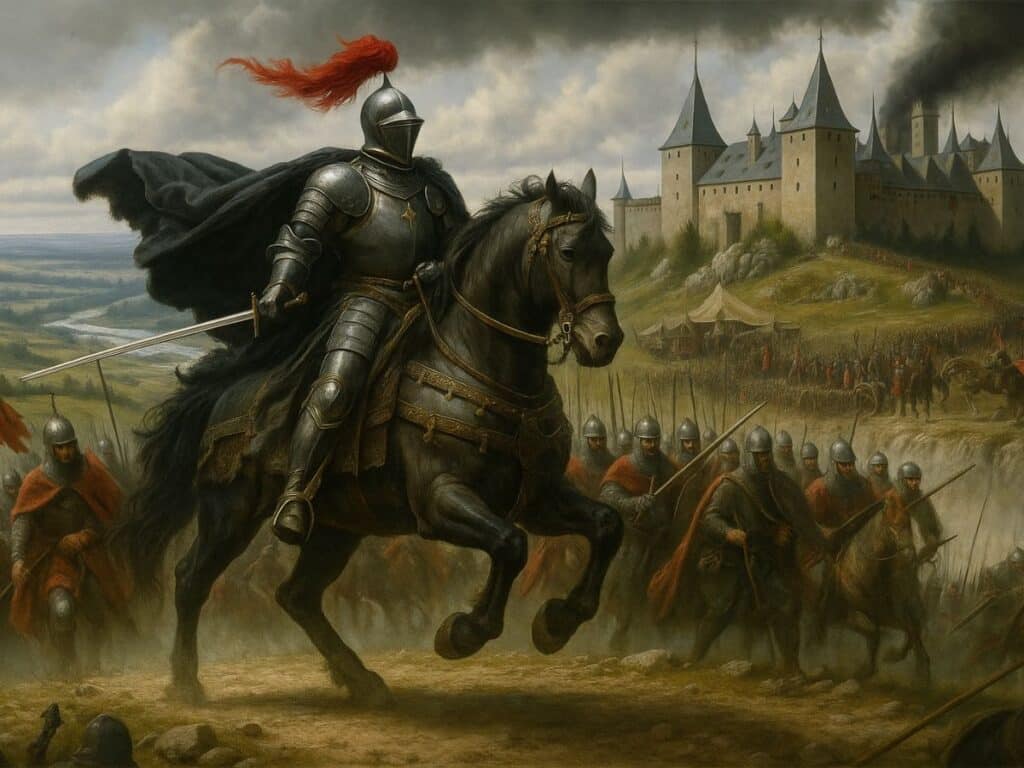
The image of Edward riding into battle clad in black steel is powerful, but it probably never happened. There is no evidence in any contemporary account that he wore full black armor on the battlefield. What he did have were ceremonial pieces, likely darkened for jousts or funerals, not for war.
The connection between the armor and his nickname is one of those stories that grew over time. Later writers tied the two together, turning him into a shadowed figure leading men to victory. It sounds dramatic, but medieval chroniclers made no mention of it. What we do know is that his real armor was practical and ornate, much like that of other high-ranking nobles of the time.
His Badge Came from a Fallen King
The three white ostrich feathers on a black background became one of his most recognizable emblems, along with the German motto Ich dien, meaning “I serve.” Today, it’s still the badge of the Prince of Wales. But the story behind it is tangled in legend.
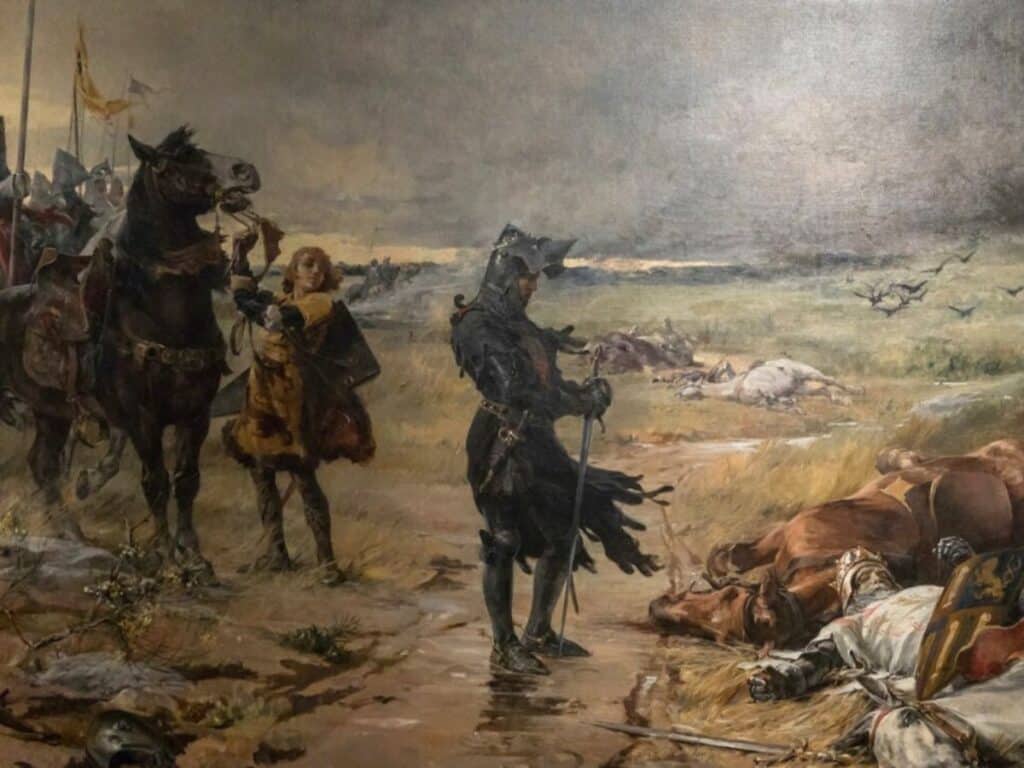
One popular tale claims Edward took the feathers from the blind King John of Bohemia, who died at the Battle of Crécy. The story goes that Edward admired his courage and adopted the feathers as a tribute. It’s a romantic image, but historians have never found solid proof that it happened that way.
He Ruled Aquitaine Like a King and Paid the Price
After the Treaty of Brétigny in 1360, Edward was granted control of a vast region in southwest France. As Prince of Aquitaine, he ruled almost like an independent monarch, holding court at Bordeaux and surrounding himself with nobles and knights. It looked like a reward for years of service in war, but the reality was far more complicated.
Maintaining his new principality cost money, and Edward’s court lived on a scale that drained resources fast. When he tried to raise a hearth tax to cover expenses, it sparked anger among the Gascon lords. Their discontent soon turned into open rebellion, dragging Edward into another brutal conflict that damaged his reputation and weakened English power in France.
His Marriage Was Risky Business
In 1361, Edward married Joan of Kent, a woman famous for her beauty and the tangle of her past relationships. She was a royal cousin and a widow, but more controversially, she had been married before, possibly still legally so when Edward began courting her. That earlier union wasn’t annulled at the time, which could have turned their match into a scandal of epic proportions.
The pope eventually granted a dispensation, smoothing things over, but it shows how close Edward came to trouble. Marriages among nobles were political tools as much as personal choices, and his decision to wed Joan raised eyebrows at court. It wasn’t the safe, strategic alliance people expected from a future king. In the end, their union lasted, and they had two sons together.
He Had Illegitimate Children Before Marriage
Before settling down with Joan of Kent, Edward fathered several children out of wedlock. This was not unusual for a man of his rank, but it complicates the image of the dutiful prince often shown in paintings and effigies. These children were acknowledged in records, though their lives were far removed from royal privilege.
One of the best-known was Sir Roger Clarendon, who lived long after Edward’s death. Roger even became tangled in politics during the reign of Henry IV, eventually meeting a grim end when he was executed for treason in 1402.
He Died Owing a Fortune
Edward’s image is all power and splendor, but his finances tell a different story. When he died in June 1376, the prince was buried with honor at Canterbury Cathedral, yet he left behind debts of almost £3,000 owed to nearly a hundred creditors. In today’s terms, that would run into millions.
The reasons were simple. War drained his resources. His years ruling Aquitaine only made things worse, with lavish spending at court and the cost of fighting rebellions. Even a prince with lands and titles couldn’t escape the financial strain of constant campaigns and political ambitions. His father, Edward III, had to cover the unpaid bills from the estate.
He Designed His Own Tomb
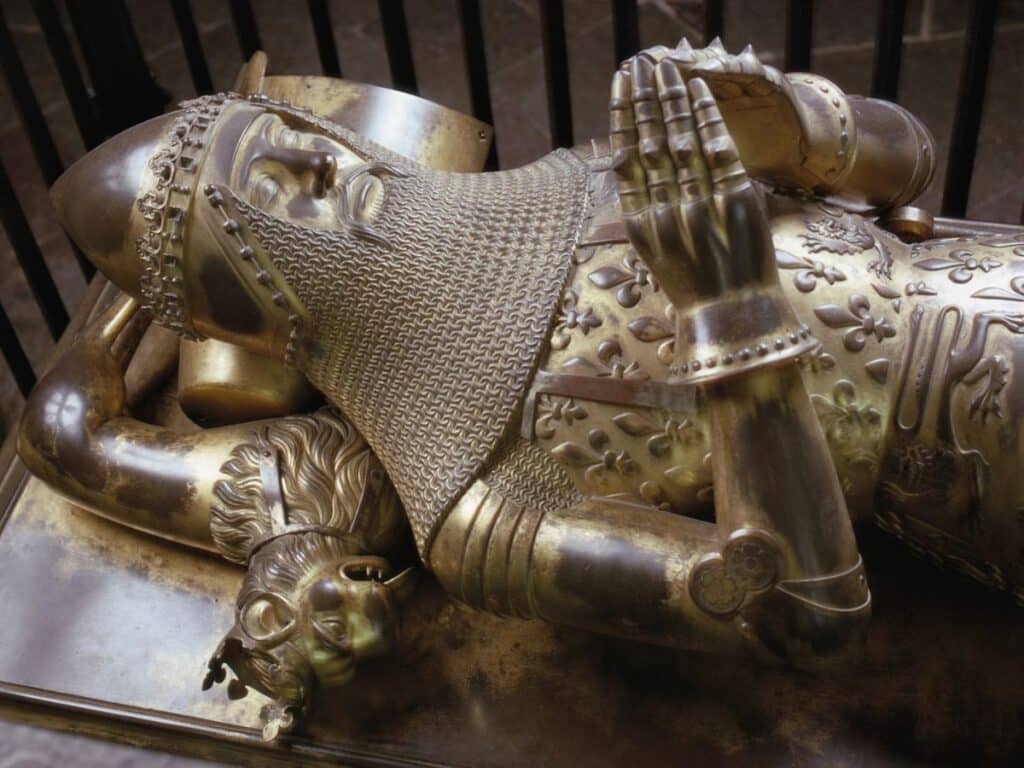
Edward didn’t leave his burial to chance. The day before he died, he dictated a will that laid out every detail of his funeral and tomb. He wanted two warhorses, draped in his arms, to lead the procession. His body was to be dressed in full armor, as if ready for battle, and his tomb chest covered with alternating panels of his royal arms and ostrich feathers.
The effigy you see today in Canterbury Cathedral is part of that vision. It shows Edward as he wanted to be remembered: a warrior prince, armored and unyielding, even in death. He planned it at a time when he was weakened by years of illness, a stark contrast to the image he created in stone.
His instructions were exacting and theatrical, the final command of a man who understood the power of legacy. If he could not wear the crown, he would make sure his memory wore glory forever.
We Still Don’t Know What Killed Him
Chroniclers wrote that Edward died of dysentery, but the truth is murkier. Whatever struck him lingered for years, sapping his strength long before his death at forty-five. Some modern historians think it was chronic dysentery. Others point to malaria, kidney disease, or even a combination of ailments picked up during campaigns abroad.
What is certain is that his decline was slow and brutal. He fought his last major battle in 1370 and never fully recovered. By the time he returned to England, he was a shadow of the commander who once led men to crushing victories in France and Spain.
His early death changed the course of English history. If Edward had lived to be king, the story of the Plantagenets might have been very different. Instead, the crown passed to his ten-year-old son, Richard II, and the kingdom spiraled toward crisis.

He Took a King Prisoner and Treated Him Like Royalty
After the Battle of Poitiers in 1356, Edward captured King John II of France, a prize that shook Europe. Instead of humiliating him, the Black Prince gave the defeated king a lavish welcome. John dined at Edward’s table, traveled in comfort, and was treated with the kind of honor few prisoners ever saw.
It was a clever strategy. By showing courtesy to his captive, Edward reinforced his own prestige and strengthened England’s bargaining power for ransom negotiations. That ransom would later be set at an astronomical sum, a burden that crippled France for years.

Kylie Lang is a nationally syndicated travel journalist with bylines on the Associated Press Wire & more, a medieval history writer, and the founder and lead author of Tales of the Middle Ages (talesofthemiddleages.com). She holds a BA (Honours) in History from the University of Kent and is a member of the British Guild of Travel Writers.
Related posts:
 The Battle of Poitiers: The Black Prince’s Boldest Victory and the Capture Of a French King
 Sweyn Forkbeard: The First Viking King of England
 The Battle of Crécy 1346: How a Teenage Prince and a Wall of Arrows Brought France to Its Knees
 10 Rulers of the Middle Ages Who Led with Wisdom, Compassion, and Power