I have a medieval crush on William Marshal and have read a few books about him, too. He’s the quintessential knight in shining armor, and, by all accounts, a nice bloke into the bargain, although I wouldn’t want to argue with him as he was a skilled negotiator.
However, before he became the knight who served the Young King, he made his living in a very different way. For about fifteen years, roughly between 1167 and 1183, he made his living by knocking other knights off their horses in muddy fields across northern France and the Low Countries, then taking their horses, their armor, and as much of their cash as they could be made to hand over.
Table of Contents
And he was very good at it. By the time he stopped, he was one of the wealthiest tournament fighters in Europe, and he hadn’t yet inherited a single acre. The tournament circuit is where Marshal built the reputation, the network, and the war chest that made everything else possible. And it tells you a great deal about how a landless younger son could turn a violent sport into a career.
A Younger Son with Nothing to Inherit
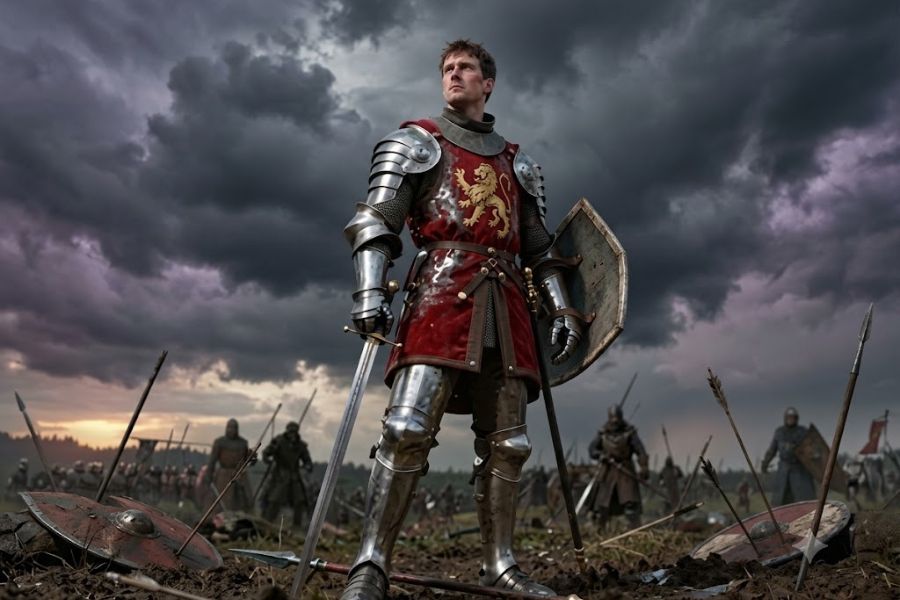
William was the 4th son of John Marshal, a minor baron of the Anarchy whose chief talent was switching sides at the right moment. Younger sons in the 12th century had a thin set of options. The Church was one, as was a good marriage to an heiress, if you could land one. Knighthood paid for by someone else was the 3rd, and that was William’s route.
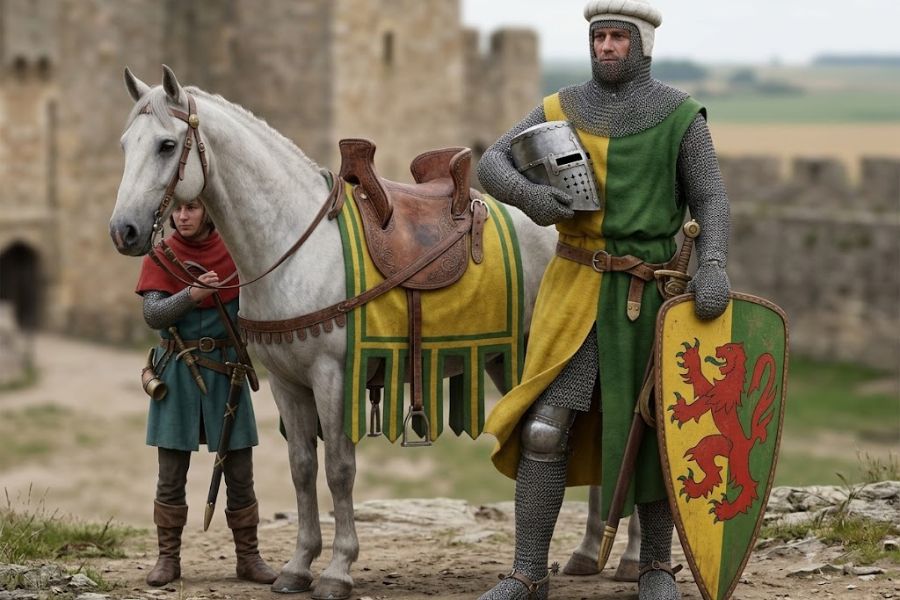
He was sent in his early teens to be raised in the household of his mother’s cousin, William de Tancarville, chamberlain of Normandy. There he learned the things a knight needed to know: how to ride in armor, how to handle a lance at a gallop, how to use a sword from horseback and on foot, and how to read a fight in seconds.
He was knighted in 1166, around the age of twenty, on the eve of a campaign in Upper Normandy. What he didn’t receive was land, an income, or any kind of safety net.
Within a year, he’d lost his warhorse in a skirmish and was reduced to selling his cloak for a packhorse so he could keep moving. That’s how thin the margin was for a young knight without an estate. The tournament circuit existed precisely for men in his position, and Marshal walked into it because he had to.

What a 12th-Century Tournament Actually Looked Like
A 12th-century tournament was closer to a controlled war. Two teams of mounted knights, sometimes a few hundred a side, met in the open country between two villages. There were boundaries, more or less, and designated safe areas called recets where a knight could pause, rearm, or hide while catching his breath. Everything else was fair game.
The fighting moved across miles of fields, vineyards, ditches, and orchards. Knights charged in formation with couched lances, then broke into melee with swords and maces. Footsoldiers and squires followed behind to drag captured knights and horses off the field.
Spectators, when there were any, stood on hillsides or church walls. Villages were trampled, crops were ruined, local lords sometimes complained, and the Church repeatedly tried to ban the whole business. Popes Innocent II, Eugene III, and Alexander III all issued condemnations. But nobody listened.
The rules, such as they were, centered on capture rather than killing. You won by forcing another knight to yield, at which point he owed you a ransom. Deaths happened, plenty of them, including Geoffrey of Brittany, son of Henry II, who was trampled to death in a Paris tournament in 1186. But killing your opponent wasn’t the goal. A dead knight couldn’t pay.
Hooked on the Middle Ages? Get more stories like this one in your inbox.
How the Ransom Economy Worked
The financial structure of a tournament was the thing. When you unhorsed and captured an enemy knight, you took his horse on the spot, often his armor, and you negotiated a cash ransom for the man himself.
The amounts varied with the knight’s rank and resources. A modest knight might owe a few pounds. A wealthy lord could owe sums that would have bought a small manor. Marshal’s biography, the Histoire de Guillaume le Marechal, commissioned by his family after his death and based on the recollections of his squire John of Earley, records ransoms and counts of captures in detail.
Horses were the real currency. A trained warhorse, a destrier, was worth more than most knights earned in a year of normal service. Capturing one and selling it on, or keeping it for the next tournament, compounded quickly.
Marshal kept careful track. At one point, his clerk and a Flemish knight named Roger de Gaugi, with whom he formed a two-man partnership in the 1170s, recorded that the pair had captured 103 knights in a single ten-month stretch. That’s roughly one every three days, across the tournament season.
The partnership model was clever. Marshal and Roger pooled their winnings, watched each other’s backs in the melee, and split the take. It reduced the risk of being swarmed and increased the haul.
They weren’t the only ones doing this, but they were among the most successful. By the early 1180s, Marshal had a reputation that preceded him onto the field, and ambitious young knights paid to ride in his retinue the way modern fighters pay to train at a famous gym.

The Famous Capture Counts and the Blacksmith Story
There’s a scene in the Histoire I keep coming back to. After one tournament, Marshal couldn’t lift his head. His squire and another knight had to take him to a blacksmith, where he laid his head on the anvil so the smith could hammer his battered helmet back into a shape that would then come off without taking his skull with it.
He’d been hit so many times the metal had crumpled around him. He still had two captured knights waiting to pay their ransoms.
The numbers across his career are hard to verify with full precision because the Histoire was written to glorify him, but the order of magnitude is supported by the chronicle’s specifics. The figure most often cited is around 500 knights captured over roughly 15 years on the circuit. Even if you halve that for biographer’s enthusiasm, it’s a staggering record.
The tournaments named in the text run across a recognizable geography: Sainte-Jamme, Anet, Pleurs, Joigny, Eu, Ressons, Gournai, Epernon. The same towns appear in other 12th-century sources as known tournament sites.
What Marshal seems to have understood, more than most of his contemporaries, was that the tournament was a market. You could fight for honor and prizes, sure, but the men who actually got rich treated each event as a business day.
Where was the enemy lord positioned? Which knights in his retinue were wealthy enough to ransom? Could you let a poor knight go to chase a richer one? Marshal made those calculations constantly. The chivalry was real, in the sense that he kept his word and didn’t cheat. But the accounting was real, too.

How the Money Built the Man
By the early 1180s, Marshal had accumulated horses, armor, plate, fine cloth, and cash. He could equip a small retinue of his own, which meant he could be useful to greater lords, which meant he got pulled into the household of Henry the Young King, eldest son of Henry II, as tutor in arms and chief tournament companion.
The Young King loved tournaments and was bad at them. Marshal protected him on the field, won prizes in his name, and shared in the prestige of being attached to a future king of England.
That connection nearly cost him everything in 1182, when rivals in the Young King’s household accused him of sleeping with Queen Margaret. The charge was almost certainly an attempt to break up a friendship that excluded them, and Marshal demanded trial by combat against any accuser. None came forward.
He left the household for a time, traveled to Cologne and the court of the Count of Flanders, and was eventually called back to the dying Young King’s side in 1183. The prince made him promise to carry his crusader’s cloak to Jerusalem. Marshal did.
When he returned from the Holy Land around 1186, the tournament fortune was what made him plausible at court. Henry II gave him the keeping of an heiress, Isabel de Clare. After Henry’s death, Richard I confirmed the match.
Isabel brought him lordship of Striguil, vast estates in south Wales, lands in Ireland, and a claim that would eventually make him Earl of Pembroke. He was about 43 years old when he married her, and she was around 17. The age gap was normal, but the giant leap in status wasn’t. Without the warhorses, the ransoms, the partnership with Roger de Gaugi, and the years in the Young King’s retinue, none of it would have happened. The Striguil marriage rewarded a man who’d made himself worth rewarding.

The Tournament Knight Inside the Old Regent
As the regent of England, in 1217, leading the charge at the Battle of Lincoln at the age of about 70, he’d ridden out so fast he forgot his helmet and had to be sent back for it. When the lines closed, he was at the front, hacking his way through French knights in narrow streets near the cathedral.
The chronicler Roger of Wendover described him fighting like a young man. He’d been doing exactly this, in muddy fields outside Norman villages, for half a century. The skills hadn’t gone anywhere.
Near the end of the Histoire, the dying Marshal, in his seventies, is being lectured by a clerk about the souls of the men he’d killed and the goods he’d taken in tournaments. He’s told he ought to make restitution if he wants to be saved. Marshal answers that he took five hundred knights and their gear by force of arms, and if God can’t accept that as a knight’s honest living, then the kingdom of heaven is closed to him, and there’s nothing more to discuss.
He died on May 14, 1219, and was buried in the Temple Church, where the effigy still lies.
The stone version of Marshal looks composed and pious. The man underneath made his first fortune on horseback in the rain, splitting ransoms with a Flemish partner and counting captured destriers by the dozen.
Love a good medieval story?
Join our readers and get tales of kings, queens, castles and ordinary medieval lives straight to your inbox.

Kylie Lang is a nationally syndicated travel journalist with bylines on the Associated Press Wire & more, a medieval history writer, and the founder and lead author of Tales of the Middle Ages (talesofthemiddleages.com). She holds a BA (Honours) in History from the University of Kent and is a member of the British Guild of Travel Writers.
Related posts:
 William Marshall, the Greatest Knight Who Ever Lived. But Who Was the Man Behind the Legend?
 What Made William Marshal the Greatest Knight in History?
 Mahelt, First Daughter of William Marshal, the Greatest Knight in History
 September 4, 925: The Day England’s First King, Æthelstan, Was Crowned, But Was He?