
Women really did get a raw deal in the Middle Ages, but just how bad was it? Most of us have always believed that as a medieval woman, you couldn’t own as much as a hen coop, let alone a field.
But that is completely wrong, and the paperwork to prove it has been sitting in French archives for centuries. Medieval women in France did inherit land, and plenty of them held it in their own name.
Table of Contents
In most of France, a daughter inherited land and property when she had no living brothers, took a dower share of her husband’s estate as a widow, and brought land into marriage as her dowry, though customary law varied wildly from one region to the next and a husband usually ran the property day to day.
The famous Salic law barred women from the throne, not from the ground under an ordinary manor. But how did it work in reality, and how much power did a medieval woman really have?
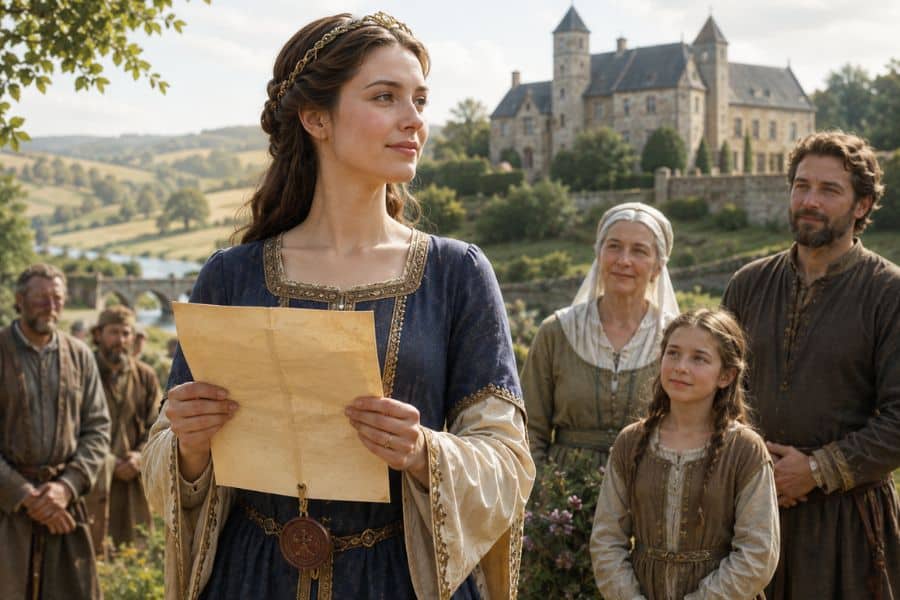
How Medieval Women in France Actually Inherited Land
Medieval French women could and did inherit land, most reliably when no living brother stood ahead of them, and many held estates in their own name as heiresses or widows.
The distinction the whole subject rests on is the difference between the crown and the countryside.
Inheriting the throne of France was eventually closed to women through arguments jurists built on the old Salic law. However, inheriting an ordinary fief, a bourgeois plot, or a peasant holding was a different matter entirely, governed by local custom and worked out family by family in local courts.
Here’s the caveat: there was no single French law of inheritance.
What people called coutumes, the customary laws of each region, split the country into dozens of overlapping systems, with historians mapping out ten or more distinct inheritance patterns across Ancien Régime France.
Our best window into how one of those systems actually worked is Philippe de Beaumanoir’s Coutumes de Beauvaisis, written around 1283, with whole chapters devoted to dower and to inherited real property.
Beaumanoir was a royal official who recorded what he saw in the Beauvais region, and he’s the historian’s best friend for this whole question.
How Did Customary Law Decide Who Got the Land?
Customary law determined inheritance on a region-by-region basis, so a daughter’s chances depended heavily on where her family’s land lay.
A woman whose father held a manor near Beauvais faced a different set of rules from one whose family owned vineyards in Burgundy, and neither of them lived under the same system as an heiress in Normandy or Occitania.
The biggest divide ran between partible and impartible inheritance. Some regions split estates more or less equally among all the children, which gave daughters a real share alongside their brothers.
Others funneled the bulk of the land to a single heir under primogeniture, and a handful even worked by ultimogeniture, where the youngest inherited. Some customs included daughters in the division; others pushed them aside in favor of any male relative within reach; and the practical effect on any given family could swing wildly depending on which side of a regional boundary they lived on.
Beaumanoir’s Coutumes de Beauvaisis is the clearest surviving guide to how one of these systems worked in practice, and the Custom of Paris, later codified for the Paris basin, includes notarial records showing that sons and daughters were treated differently within the same household. The picture we can piece together is real but fragmentary.
Whole regions have left us thinner records than others, and honest scholarship on this subject spends a lot of time saying so.
What Happened When There Were No Sons?
When a French landholder died without sons, daughters generally inherited before more distant male relatives, and this is how the great heiresses of the medieval world were made.
A cousin or an uncle couldn’t simply walk in and take the estate because the dead man’s only child was a girl; the custom stood in the way, and so did the family’s own interest in keeping the land close.
The default order in a noble household ran eldest son, then younger sons, then daughters only when the male line had run out. Sylvie Steinberg’s work on aristocratic women, published in the Annales, laid out how this actually operated at the top of society: daughters inherited fiefs when no male heir survived, and the royal courts recognized their rights, at least until later jurisprudence started chipping away at the edges.
Where multiple daughters inherited together, treatment again depended on custom. Normandy, for instance, split the inheritance among sisters without applying primogeniture, so several women might end up holding pieces of a single estate.
The consequences were far-reaching, shaping the political map of Europe. An heiress became a marriage prize because her land was the reason powerful men wanted her, and dynasties rose and fell on which lord managed to marry which orphaned daughter.
Sons, of course, inherited more automatically, but the sonless household is where the medieval record shows women stepping fully into ownership, and it happens often enough that anyone claiming they couldn’t hasn’t looked at the charters.
Dowry and Dower: The Two Words People Always Mix Up
Dowry and dower sound almost identical, and readers constantly muddle them, but they were opposite transfers moving in opposite directions.
The dowry, the dot in French, was land or goods a bride brought into her marriage from her own family.
The dower was the share of her husband’s estate reserved to support her if she outlived him. One came from her side, one came from his, and the two together formed the financial spine of a medieval marriage among people who had anything worth writing down.
The dowry was typically a daughter’s slice of her natal family’s property, often given at marriage in place of a later inheritance. If she took her dowry in land, that land was legally hers, though it went with her into the marital household and, as we’ll see in a moment, into her husband’s day-to-day management.
The dower was widow’s security, a life interest in a portion of the husband’s land that would keep her fed and housed until her own death. Beaumanoir devoted an entire chapter of the Coutumes de Beauvaisis to dower, spelling out how the share was calculated, who owed her what, and what happened when the husband’s heirs tried to shortchange her.
The catch with dower was that a widow held it for her lifetime and no longer. She didn’t inherit it outright to pass on as she pleased; the land reverted to her husband’s heirs when she was gone.
Even so, dower could be substantial, sometimes a third or half of the husband’s estate, and a widow with a good dower was a woman with real means, real credit, and real presence in local courts.
Hooked on the Middle Ages? Get more stories like this one in your inbox.
If She Owned the Land, Why Did Her Husband Control It?
A married woman could own land and still watch her husband run it, because customary law treated the husband as head of the marital household even where the wife held property in her own right.
This is the paradox that trips people up, with the wife’s name on the land and the husband’s hand on the reins, both facts true at the same time. He collected the rents, answered for the estate in court, and appeared in the documents, while she was the one from whom the property had come and to whom, in strict legal terms, it belonged.
Widowhood changed everything. A widow generally recovered direct control of her dowry and took possession of her dower, and that’s why widows show up so much more visibly than wives in the surviving records of land transactions, lawsuits, and grants to religious houses.
Theodore Evergates and the contributors to Aristocratic Women in Medieval France pulled example after example of widows litigating over property, endowing chapels, and running estates for years or decades on their own account.
There’s a catch, and it’s a big one: ownership and control weren’t the same thing, and marriage contracts existed largely to ensure the difference could be enforced if the marriage fell apart or the husband’s family tried to swallow her property whole.
The Great Heiresses: Women Who Held Land and Power
Some medieval Frenchwomen held vast estates outright, exchanged oaths for fiefs, fortified castles, and settled vassal disputes as feudal lords in their own right.
Theodore Evergates’s collection traces the wives of countesses and knights from Blois-Chartres, Champagne, Flanders, and Occitania who did all of these things.
They received homage from men who held lands of them, sat in judgment, endowed monasteries, and, when the moment demanded it, put their castles on a war footing.
Eleanor of Aquitaine is the headline example, and rightly so.
She inherited the duchy of Aquitaine from her father in 1137, ruled it as duchess in her own name, carried it first into her marriage with Louis VII of France and then, after that marriage was annulled, into her marriage with Henry II of England, redrawing the political map of western Europe as she went.
Eleanor was singular, but she wasn’t alone. Whole regions of France ran, for stretches at a time, under the lordship of countesses and heiresses whose names show up in charter after charter.
The older scholarship, particularly Georges Duby’s work from the mid-20th century, tended to paint medieval noblewomen as decorative and marginal.
Evergates and his contributors showed that the record doesn’t support that view; the women who ran the honors of Champagne and Flanders were doing the same work as their male counterparts and were being obeyed.
Kathleen Wellman’s Queens and Mistresses of Renaissance France later traced how attitudes toward women’s public power hardened at the top of the political system, even as women below the crown continued to hold land and lordship.
So Where Does the ‘Women Couldn’t Inherit’ Myth Come From?
The myth grows out of two distinct things that have become intertwined over time. The first is Salic law, which was reinterpreted in the 14th century to bar women from the crown. The second is the slow spread of primogeniture, which squeezed daughters’ shares in noble families over the course of the earlier Middle Ages.
The political trigger was the 1328 succession crisis. When Charles IV of France died without a male heir, the crown was claimed by his cousin, Philip of Valois, rather than by the son of Charles’s sister, Isabella, who was Edward III of England.
In the decades that followed, French jurists reached back to a passage in the old Salic law and argued from it that women couldn’t inherit the crown, and couldn’t even pass a claim through the female line.
Kathleen Wellman traces how that argument was built and rebuilt across the following centuries, and it was always specifically about the throne, never about the manor next door.
Then there’s the other half of the story. Between roughly the 10th and 12th centuries, primogeniture spread through the French nobility and squeezed the inheritances of daughters and younger sons alike, so that a single eldest son ended up with the bulk of the estate where earlier custom might have shared it out.
Even at its tightest, that squeeze didn’t erase women from the land records; it narrowed the shares and shifted the balance. The rules tightened and loosened by era, region, and rank, and reducing all of that to ‘women couldn’t inherit’ erases most of what actually happened in the muniment rooms of medieval France.
Frequently Asked Questions
Could women inherit land in medieval France?
Women in medieval France could inherit land, most reliably when they had no living brothers, and many held estates in their own name as heiresses or widows. Customary law varied enormously by region, so a daughter’s rights depended on where the land sat. The Salic law that famously barred women from the crown of France did not apply to ordinary fiefs and holdings.
What is the difference between a dowry and a dower?
A dowry and a dower moved in opposite directions. A dowry, the French dot, was the land or goods a bride carried into her marriage from her own family. A dower was the portion of her husband’s estate set aside to support her if she was widowed. Philippe de Beaumanoir gave dower its own chapter in his Coutumes de Beauvaisis around 1283, which shows how routine the arrangement was.
Why couldn’t women inherit the French throne?
Women couldn’t inherit the French throne because of the reasoning later called Salic law, which French jurists revived during the succession crisis of 1328 to argue the crown could not pass through a female line. When Charles IV died, leaving only daughters, the throne went to a male cousin instead. That bar applied specifically to the monarchy, not to the land an ordinary French noblewoman might inherit.
Did daughters inherit if they had brothers in medieval France?
Daughters with living brothers usually took a smaller share than a son in medieval France, often a dowry given at marriage rather than a full portion of the family land. Where noble estates followed primogeniture, the eldest son took the bulk and daughters inherited land only when no sons survived. Some regions split property more equally among all children, so the answer really depended on local custom.
Who controlled a married woman’s land in medieval France?
A married woman’s land in medieval France was usually controlled by her husband day-to-day, even where she legally owned it, because customary law treated the husband as head of the household. Widows often regained direct control of their property, which is why they appear so frequently in the records as landholders and litigants. Marriage contracts existed partly to shield a wife’s property from her husband’s family.
Did medieval French noblewomen ever hold power in their own right?
Medieval French noblewomen did hold real power in their own right when they inherited land. Countesses and the wives of knights swore oaths for fiefs, fortified castles, settled disputes among vassals, and occasionally led troops. Historians studying regions like Blois-Chartres, Champagne, and Flanders have shown that landed women exercised lordship, overturning the older idea that well-born women were powerless.
## Sources
Primary sources
Beaumanoir, Philippe de. The Coutumes de Beauvaisis of Philippe de Beaumanoir. Philadelphia: University of Pennsylvania Press, 1992. https://www.jstor.org/stable/j.ctt173zmn7
Custom of Paris. https://en.wikipedia.org/wiki/CustomofParisinNew_France
Secondary sources
Aristocratic Women in Medieval France. https://muse.jhu.edu/book/3656
Steinberg, Sylvie. “In the Absence of Males: Gender, Feudal Succession, and Nobiliary Ideology in Sixteenth- and Seventeenth-Century France.” Annales. Histoire, Sciences Sociales (English edition). Cambridge University Press, 2017. https://cambridge.org/core/journals/annales-histoire-sciences-sociales-english-edition/article/abs/in-the-absence-of-males/DEAA1DAEAEDE7DA64DAE63BE145F90BA
Wellman, Kathleen. Queens and Mistresses of Renaissance France.
Wikipedia: Philip VI of France. https://en.wikipedia.org/wiki/PhilipVIof_France
Love a good medieval story?
Join our readers and get tales of kings, queens, castles and ordinary medieval lives straight to your inbox.

Kylie Lang is a nationally syndicated travel journalist with bylines on the Associated Press Wire & more, a medieval history writer, and the founder and lead author of Tales of the Middle Ages (talesofthemiddleages.com). She holds a BA (Honours) in History from the University of Kent and is a member of the British Guild of Travel Writers.
Related posts:
 What Happened to the Widows of the Wars of the Roses: The Women Left Behind When the Men Died on the Wrong Side
 Medieval Women Weren’t Damsels in Distress; They Were Defenders, Strategists & Lifesavers
 How Did People Get Divorced in Medieval England, and Did Kings and Queens Have It Easier?
 Margaret Beaufort vs Elizabeth Woodville: Who Was More Powerful?