Names carry weight. A baby in 1290 might be named for a saint, a grandmother, or a queen, and that choice told the village exactly where the family stood. When a name went sour, it went sour fast. One trial, one bedroom scandal, one whispered accusation, and suddenly, nobody wanted their daughter sharing a name with that woman.
Medieval baptism records show certain names completely disappearing. And when you trace the timing, you often find a specific woman at the bottom of the fall, usually with her reputation in pieces and sometimes with her body in pieces too.
Table of Contents
These 9 girls’ names more or less disappeared in the medieval and early modern world, each paired with the woman who poisoned the well. Some you’ll know, and some you’ll probably never have heard of, but all of them carried a story.
1. Mahaut
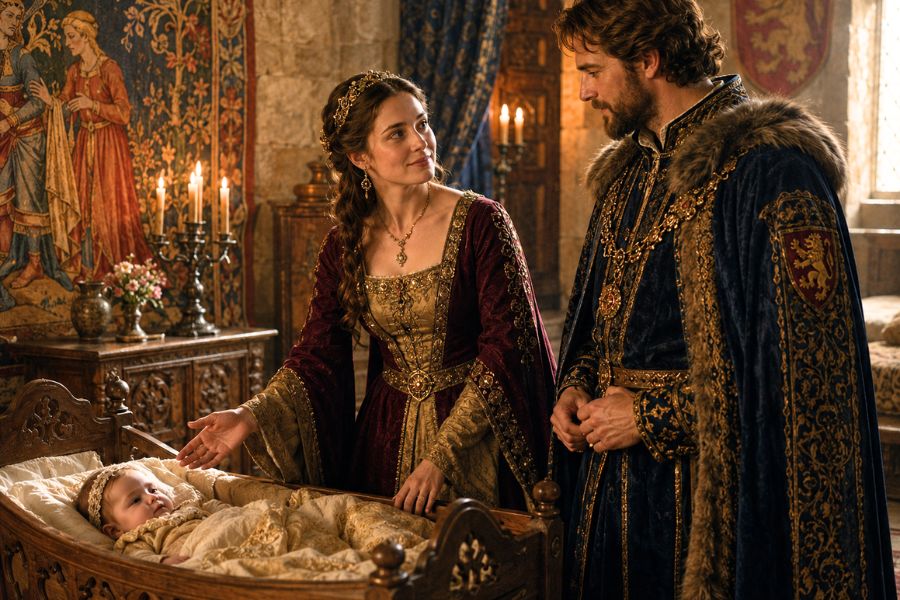
Mahaut was a common northern French name in the 12th and 13th centuries, a variant of Matilda that stood on its own. Countesses, abbesses, and farmers’ daughters all used it. Then came Mahaut of Artois, and the name took a hit it never recovered from.
Mahaut of Artois was at the center of the Tour de Nesle affair in 1314, the scandal that broke open the French royal family. Her two daughters, Jeanne and Blanche, were married to two of Philip IV’s sons.
Both were accused of adultery with knights in a Paris tower. The knights were tortured, castrated, and executed. The daughters were imprisoned, and Blanche’s hair was shaved off before she was sent to Château Gaillard.
Mahaut herself was later accused of poisoning King Louis X in 1316 and his infant son the year after, to put her son-in-law on the throne. She was tried and acquitted, though most contemporaries thought she’d done it.
By the late 14th century, Mahaut had fallen out of fashion in the regions where it had been strongest. Matilda survived. Mahaut, the form associated with the Artois countess, drifted out of baptism records and never came back.
2. Iseult
Iseult, sometimes spelled Isolde or Yseut, was a name with serious courtly cachet in the 12th century. The romance of Tristan and Iseult was one of the great hits of medieval literature, recited in halls from Cornwall to Sicily. For about a hundred years, naming your daughter Iseult was a sign that you’d read the right books and kept the right company.
Then the moralists got hold of the story. By the 13th century, churchmen were pointing out that Iseult was, plainly speaking, an adulteress. She was the wife of King Mark of Cornwall and the lover of his nephew Tristan.
The love potion excuse didn’t hold up under scrutiny by confessors who had to deal with real-life adultery cases. Sermons began to use Iseult the way they used Jezebel, as a stock figure of the unfaithful wife.
The name held on longest in Brittany and Cornwall, where the legend was local. Everywhere else, it disappeared. By 1400, it’s rare in baptism records, and by 1500, it’s effectively gone. The Victorians dug it up again, but the medieval Iseult was killed off by the same romance that had made it popular.
3. Petronilla
Petronilla was a respectable name throughout most of the early Middle Ages, associated with a legendary daughter of Saint Peter. Then, in 1324, in Kilkenny, Ireland, a woman called Petronilla de Meath was burned alive.
She’d been the maid of Alice Kyteler, a wealthy widow accused of witchcraft, heresy, and murdering several husbands. Alice escaped, but Petronilla didn’t.
Under torture, she confessed to flying, sacrificing animals at crossroads, and being a go-between for Alice and a demon called Robin, son of Art. She was the first person burned for witchcraft in Ireland, and the case was sensational enough to spread across the British Isles within a year. The chronicles repeated it for generations.
In Ireland, especially, Petronilla fell off sharply over the following century. The name didn’t sit well on a baby when the most famous Petronilla in living memory had screamed on a pyre in Kilkenny. It survived in pockets on the continent but lost its place as a mainstream Christian name in the English-speaking world.
Hooked on the Middle Ages? Get more stories like this one in your inbox.
4. Gormlaith
Gormlaith was a powerful Irish name in the early medieval period, worn by queens and abbesses. It means something like ‘splendid sovereignty’. Three high-profile Gormlaiths in succession turned the name into a synonym for trouble, and by the late medieval period, it had lost its shine.
The most damaging was Gormlaith ingen Murchada, who died in 1030. She was the sister of the king of Leinster, married three kings in a row, including Brian Boru, and was widely blamed for pushing her brother and son into the rebellion that led to the Battle of Clontarf in 1014.
Medieval Irish chroniclers wrote her up as a manipulative, ambitious woman who set kingdoms against each other from her bed. The Cogadh Gáedel re Gallaibh paints her in particularly unflattering terms.
The name didn’t vanish entirely; the Irish are stubborn about names, but it dropped out of the royal and aristocratic pool where it had thrived. By the 14th century, it was rare.
5. Agnetta
Agnetta, a diminutive form of Agnes, was popular in northern Italy and parts of southern Germany in the 13th and 14th centuries. Its decline lines up almost exactly with the career of Agnetta the Bavarian bath-maid, better known to history as Agnes Bernauer.
Agnes was the daughter of a barber-surgeon in Augsburg and worked in a bathhouse, a profession that, in 1428, hovered uncomfortably close to prostitution in the public mind. Albert, son and heir of Duke Ernest of Bavaria-Munich, fell for her and married her in secret.
They lived together for several years. Albert’s father wouldn’t tolerate a bath-maid as the mother of the next generation of Wittelsbachs. In 1435, while Albert was away hunting, Ernest had Agnes seized and drowned in the Danube near Straubing on charges of witchcraft.
The scandal echoed across the German-speaking lands. Agnes became a folk heroine, the subject of ballads and later plays. Parents who’d cheerfully christened girls Agnetta in 1420 weren’t doing it in 1450.
6. Eleanor (the Cobham variant)
Eleanor itself survived, obviously. But there’s a specific story worth telling about how the name took a hit in 15th-century England, enough that some parents went looking for alternatives in the second half of the century. The culprit was Eleanor Cobham, Duchess of Gloucester.
Eleanor was the second wife of Humphrey, Duke of Gloucester, the uncle of the young Henry VI and, at one point, heir presumptive. In 1441, she was accused of consulting astrologers and a ‘witch’, Margery Jourdemayne, to predict whether the king would die and her husband would inherit.
The case turned into a full treason-and-sorcery trial, and Margery was burned. Eleanor was forced to do public penance, walking through London barefoot carrying a candle on three separate days, then imprisoned for life. She died in Beaumaris Castle around 1452.
The public penance was the part that stuck in people’s heads. A duchess in her shift, walking the streets of London for the crowd to gawk at. English baptism records from the 1440s through 1470s show a noticeable dip in Eleanor in gentry families, particularly, and contemporary commentators used her as a warning. The name recovered, but slowly, and never quite with the same aristocratic confidence it had carried before.
7. Brunhilda
Brunhilda was a serious Germanic name in the early medieval period, worn by Frankish queens and Visigothic princesses. By the time the Middle Ages were properly underway, it was already in trouble, and the woman responsible was the 6th-century queen Brunhilda of Austrasia.
Brunhilda was a Visigothic princess who married into the Merovingian dynasty and spent fifty years in the bloodiest feud Frankish politics ever produced, mostly against her sister-in-law, Fredegund.
She held real power as regent for her son and grandsons. When she finally lost in 613, King Chlothar II had her tortured for three days, then tied by her hair, one arm, and one leg to the tail of a wild horse and dragged to death. She was around 70 years old.
The horror of the execution, combined with later Carolingian propaganda that painted her as a serial murderer and tyrant, killed the name in the Frankish lands. By the 9th century, it had become rare. By the 12th century, it was a literary name, kept alive by the Nibelungenlied rather than by any actual baby. The Brunhilda who appears in that poem is a fearsome warrior queen, not a saint you’d name a child after.
8. Joan (in specific French contexts)
Joan, Jeanne, Johanna, is one of the great survivor names of European history. But there’s a slice of 14th-century French aristocratic naming where it took a real beating.
The Tour de Nesle affair from item 2 caught Jeanne of Burgundy, wife of the future Philip V, in its net. She was acquitted, while her sister-in-law Blanche, was condemned. The other Jeanne in the case, Jeanne of Burgundy, Countess of Artois, was Mahaut’s daughter and likewise tainted by association.
Then in the next generation came Joan II of Navarre, daughter of Louis X, whose legitimacy was openly questioned because of her mother Margaret’s conviction in the same scandal. Three Jeannes, all linked to the worst royal sex scandal of the century.
For about two generations after 1314, the high French aristocracy used Jeanne noticeably less often as a name for legitimate daughters. The name was too entangled with the Tour de Nesle, with bastardy rumors, with the question of which children were really their fathers’.
Then Joan of Arc came along in 1429, was burned at Rouen in 1431, and was rehabilitated by Rome in 1456. The name was rescued by a peasant girl in armor. Without her, the medieval Jeanne might have gone the way of Mahaut.
9. Jezebel
Jezebel isn’t strictly medieval in origin, but she’s the perfect example of how a single woman can kill a name for a thousand years. The biblical queen of Israel, wife of Ahab, was accused of pushing Baal worship, framing an innocent man for blasphemy to steal his vineyard, and dying when her own servants threw her out a window, and the palace dogs ate what was left of her.
Medieval preachers loved her. She was the go-to sermon villain whenever a clergyman wanted to warn against painted women or scheming wives.
By the 12th century, calling a girl Jezebel in Christian Europe was unthinkable. The name had become shorthand for a treacherous, sexually dangerous woman, and it appears in medieval moral literature as an insult rather than a name. Chaucer uses it as a slur. Mystery plays trotted her out as a stock villain.
The interesting thing is how thoroughly the original Phoenician princess vanished underneath the smear. Whatever her actual politics had been, by the Middle Ages, she existed only as a warning. No parent in medieval England was going to call their child Jezebel.
Love a good medieval story?
Join our readers and get tales of kings, queens, castles and ordinary medieval lives straight to your inbox.

Kylie Lang is a nationally syndicated travel journalist with bylines on the Associated Press Wire & more, a medieval history writer, and the founder and lead author of Tales of the Middle Ages (talesofthemiddleages.com). She holds a BA (Honours) in History from the University of Kent and is a member of the British Guild of Travel Writers.