
On the morning of May 30, 1431, Joan of Arc was tied to a stake in the market square at Rouen and burned alive. The verdict that put her there ran to dozens of articles, accused her of heresy, witchcraft, and the strange sin of dressing in men’s clothing, and carried the full weight of an ecclesiastical court. She was 19.
25 years later, in the same city, a different set of churchmen sat down to undo that verdict. They called witnesses who had known Joan as a child in Domrémy, men who had ridden beside her at Orléans, clerks who had been in the room when she was interrogated.
Table of Contents
Over the course of months, they built a case against the case. In July 1456, they declared the 1431 trial null, the sentence wiped away, and Joan’s name restored.

Why the Verdict Had to Be Overturned
Charles VII had a problem. He was king of France because a teenage peasant girl had told him he was, then marched an army to Reims so he could be crowned in the proper cathedral with the proper oil.
That girl had since been condemned as a heretic by a Church court. Which meant, by uncomfortable extension, that his crown had been placed on his head by an instrument of the devil.
For most of the 1430s and 1440s, Charles could afford to leave the question alone. The war with England was still grinding on, and raising the matter of Joan would have meant reopening a humiliation. By 1450, the English had been pushed out of Normandy, Rouen was back in French hands, and the archives of the original trial were suddenly available.
The political calculation flipped. A king crowned by a convicted heretic looked weak, but a king vindicated by a reversal in the Church looked chosen by God.
Charles ordered a preliminary inquiry in 1450, led by Guillaume Bouillé, a theologian at the University of Paris. Bouillé interviewed seven witnesses, mostly clerics who had been present at the Rouen trial, and produced a report arguing the original proceedings had been riddled with procedural abuse.
That report didn’t have the legal force to undo a Church verdict. Only Rome could do that, so the next move belonged to the pope.
Isabelle Romée and the Petition to Rome
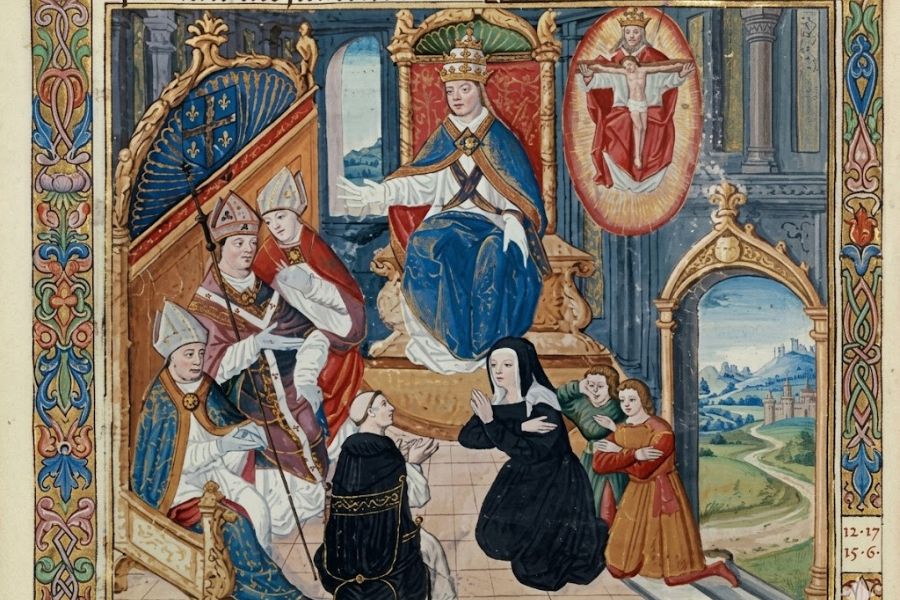
In November 1455, an elderly woman walked into the cathedral of Notre-Dame de Paris and presented a petition. Isabelle Romée, Joan’s mother, was by then in her seventies, frail, and supported on either side by her surviving sons.
She spoke, according to the surviving record, of the daughter she had raised in the Catholic faith, of the judges who had condemned that daughter through fraud and malice, and of her own grief.
Isabelle was the legal hinge the case needed. Under canon law, a posthumous appeal had to come from a family member with standing, not from the crown. Charles could fund the proceedings, supply the political pressure, and stack the witness list with sympathetic veterans, but the petition itself had to be a mother asking for her daughter’s name back.
Pope Callixtus III, newly elected and looking for ways to assert Roman authority in France, agreed to appoint a commission of inquiry.
The commission was led by Jean Jouvenel des Ursins, archbishop of Reims, Richard Olivier de Longueil, bishop of Coutances, and Jean Bréhal, the Grand Inquisitor of France. Putting the Inquisitor in charge of dismantling a heresy conviction meant the Church was effectively investigating itself, and doing so under its own most senior anti-heresy officer. It gave the eventual verdict an authority no civil court could match.

Hooked on the Middle Ages? Get more stories like this one in your inbox.
The Witnesses From Domrémy
The commission began taking testimony in early 1456, and the first depositions came from Joan’s home village of Domrémy. These were people who had known her before any of it started. Hauviette, a childhood friend roughly Joan’s age, said she had been one of the best girls in the village, devout, hardworking, often at confession.
Mengette, another friend, remembered Joan spinning wool and going to church. Jean Morel, her godfather, described her as obedient to her parents.
In the legal context of 1456, these statements carried weight. The 1431 trial had insinuated that Joan’s visions came from witchcraft, that she had danced around a fairy tree near Domrémy, and that she had been a strange child marked for trouble.
The villagers were called precisely to dismantle that picture. Yes, there was a tree, they said, and children played around it. Joan went sometimes, like everyone else, but there was no sorcery. She made garlands for the statue of the Virgin in the local chapel.
Many of the villagers who testified would have been middle-aged when Joan left for Vaucouleurs in 1429, and now they were being asked, decades later, to describe a girl they had watched grow up. They talked about her sewing, her piety, and her kindness to the poor of the village. The 1431 trial had built a sorceress out of her, but the 1456 testimony took her back.
The Soldiers, the Clerks, and the Rouen Insiders
The next layer of testimony came from men who had served with Joan during the campaigns of 1429 and 1430. Jean d’Aulon, her squire, gave one of the longest depositions of the entire proceeding.
The Duke of Alençon, who had fought beside her at Jargeau, testified that she was a skilled tactician with artillery and that he had never seen her behave with anything but modesty in camp. Jean Pasquerel, her confessor, described her daily devotions on campaign.
The military witnesses were doing two jobs at once. They were defending Joan’s character, particularly against the charge that a woman living among soldiers in men’s clothing must have been morally compromised. And they were reinforcing the idea that her victories had been real, divinely assisted, and politically legitimate.
Every man who said Joan had predicted the relief of Orléans, or that she had been wounded and kept fighting, was also saying that the king who rode behind her had been the rightful one.
The most damaging testimony for the original trial came from the Rouen insiders.
Guillaume Manchon, the notary who had recorded the 1431 proceedings, described how the English had pressured the judges, how questions had been twisted in transcription, how Joan had been denied counsel and confined in a secular prison with male guards rather than the ecclesiastical prison her status required.
Jean Massieu, the bailiff who had escorted her to her interrogations, gave similar evidence. Isambart de la Pierre, a Dominican who had attended the trial, said openly that he believed Joan had been condemned out of hatred for the French. These were men who had been in the room. Their accounts cut the legs out from under the original verdict.
How the Church Unmade Its Own Verdict
Jean Bréhal’s job, as Grand Inquisitor, was to take all this testimony and turn it into a legal argument the pope could approve. He produced a document called the Recollectio, a summary of the procedural and theological errors of the 1431 trial.
He identified the abuse of the prison conditions, the denial of legal representation, the leading questions, the manipulation of the abjuration Joan had been pressured into signing, and the bias of Pierre Cauchon, the bishop who had presided and who, Bréhal argued, had been acting as an English partisan rather than an impartial judge.
On July 7, 1456, the verdict was delivered in the archbishop’s palace at Rouen, with a public reading the next day in the Place du Vieux-Marché, the same square where Joan had been burned. The articles of the 1431 trial were declared null, the sentence reversed, and Joan’s name cleared.
A copy of the original trial document was torn up in public. Crosses were ordered to be erected at Rouen and at the place of execution in memory of her.
Nothing about this verdict was uncontroversial in 1456. Pierre Cauchon was dead by then, which made attacking him easier, but several of the assessors who had voted for Joan’s condemnation were still alive, and the rehabilitation effectively branded them as participants in a judicial murder.
None of them were prosecuted; the point of the trial was never the punishment of the original judges, but rather political and theological cover for the French crown and the French Church, and on that count, it succeeded completely.
Charles VII could now point to a papal commission as proof that he reigned by legitimate, God-sanctioned authority.
What the Rehabilitation Did Not Do
The 1456 verdict cleared Joan’s name, but it didn’t make her a saint. That step took another 464 years, through a beatification in 1909 and a canonization in 1920, driven by very different political and religious currents in a France that had just come through the First World War.
The 15th-century rehabilitation tribunal wasn’t asked to declare her holy or that she hadn’t been a heretic, and that was enough for the people who needed it.
It also didn’t bring her back, obviously, and it didn’t compensate her family in any material way. Isabelle Romée had her daughter’s name restored and died not long after, in 1458. Joan’s brothers, Jean and Pierre, had already received noble status and the surname du Lys from Charles VII years earlier, a reward that predated the rehabilitation by decades.
What the trial gave them was the public erasure of the heretic verdict, in the same square where their sister had been killed.

Love a good medieval story?
Join our readers and get tales of kings, queens, castles and ordinary medieval lives straight to your inbox.

Kylie Lang is a nationally syndicated travel journalist with bylines on the Associated Press Wire & more, a medieval history writer, and the founder and lead author of Tales of the Middle Ages (talesofthemiddleages.com). She holds a BA (Honours) in History from the University of Kent and is a member of the British Guild of Travel Writers.
Related posts:
 Joan of Arc Was a Trailblazer of the Middle Ages, But Here’s What They Don’t Teach You About Her
Joan of Arc Was Burned at 19, But Here’s What History Left Out
Joan of Arc Was a Trailblazer of the Middle Ages, But Here’s What They Don’t Teach You About Her
Joan of Arc Was Burned at 19, But Here’s What History Left Out
 How Did People Get Divorced in Medieval England, and Did Kings and Queens Have It Easier?
 France’s Warrior Saint: 7 Surprising Facts About Joan of Arc