A Plantagenet wedding looked, to all intents and purposes, like the prize of a lifetime. A young woman, sometimes barely past childhood, would be escorted across the Channel or up from a noble estate in a litter trimmed with cloth of gold. There would be feasts, gold, fine dresses and, if she was lucky, a coronation if she was lucky. Bishops blessed her. Crowds gawped at her gowns.
What the bride didn’t see, at least not yet, was the small print. Marrying a Plantagenet meant marrying into a family that ate itself for sport. Husbands turned on wives, sons turned on fathers, and queens who had been useful one year were inconvenient the next. The crown sat heavy, and it sat heaviest on the women brought in to produce its heirs.
Table of Contents
Some of these women ended their lives in convents, some died in childbirth before they were 25, and a few were locked away, written out of records, or quietly poisoned by rumor if not by actual hand. This is what the dynastic brides of the Plantagenets actually got in exchange for that walk up the aisle.
Eleanor of Provence and the Mob at the Bridge

Eleanor of Provence married Henry III in 1236, a slip of a girl barely 12 years old, packed off from a sunlit southern court to a damp English one. Her uncles came with her, and that was the start of the trouble. The English barons hated foreigners at court, and Eleanor brought them by the cartload. Savoyards in every chamber, getting bishoprics and pensions and lands the English nobility thought should be theirs.
Henry adored her, which was nice for Eleanor and ruinous for everyone else. He gave her uncle’s power, gave her money, and let her meddle in policy. By the 1260s, when Simon de Montfort’s rebellion broke out, Eleanor had become the most hated woman in England.
Trying to flee London by river in 1263, her barge was pelted with rotten eggs, mud, and stones by Londoners screaming abuse from London Bridge. They wanted to drown her.
She survived that day, but the marriage that had once felt like a fairytale curdled into civil war, the capture of her son, and years of exile in France, raising mercenaries to claw back her family’s throne.
She outlived Henry by nineteen years and ended her days as a nun at Amesbury. The girl who arrived in cloth of gold died in a veil, having watched her adopted country try to murder her on a bridge.
Isabella of France and the Husband Who Preferred Other Men

Isabella was 12 when she married Edward II in 1308. She was the daughter of Philip IV of France, a king so formidable he was called the Iron King, and she arrived in England expecting to be treated like the prize she was. Instead, she watched her husband hand her wedding jewels to his favorite, Piers Gaveston, before the celebrations were even finished.
Edward’s preference for male favorites was not the scandal it might be painted as today. The scandal was political. Gaveston and later the Despensers were given lands, titles, and influence that belonged by right to the queen and the great magnates. Isabella was sidelined, humiliated, and at one point left behind in a Scottish campaign while Edward fled with Hugh Despenser the Younger. Her income was stripped. Her children were taken from her care.
But in 1325, she got her revenge when she sailed to France on a diplomatic mission and simply refused to come back, gathering an army and a lover, Roger Mortimer, and invading England in 1326.
Edward was deposed, imprisoned, and almost certainly murdered at Berkeley Castle. Isabella ruled as regent for her son until he was old enough to overthrow her, too. She ended her life under genteel house arrest at Castle Rising, neither queen nor prisoner, a woman who had won her war and lost her place all the same.
Anne of Bohemia, Mary de Bohun, and the Brides Who Died Young
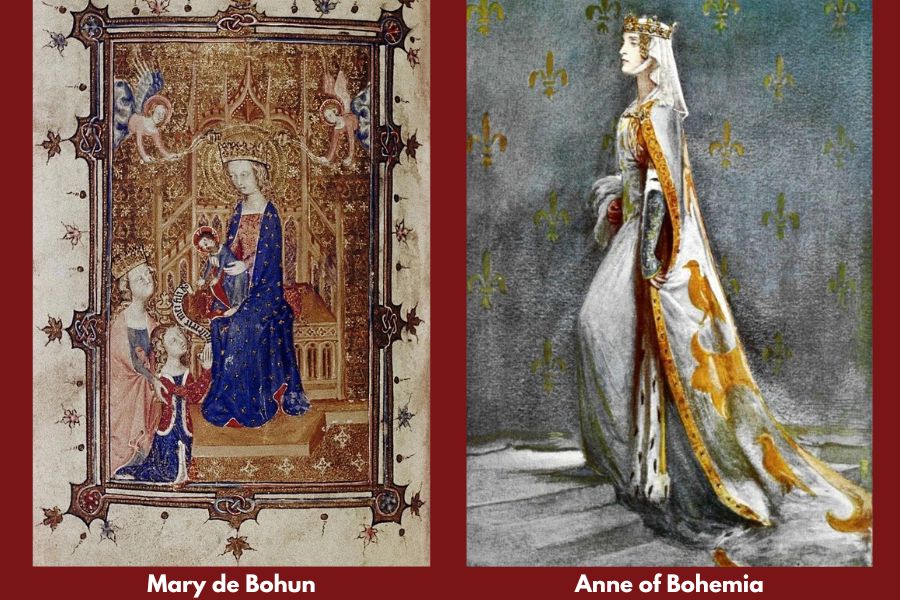
Some Plantagenet wives never got the chance to be discarded. They simply died. Anne of Bohemia married Richard II in 1382, a love match by all accounts. She was clever, well-read, and Richard worshipped her.
When she died of plague at Sheen in 1394, he was so undone that he ordered the palace where she died to be torn down. He never recovered. Within five years, he had lost his throne to Henry Bolingbroke, and within six, he was dead at Pontefract.
Mary de Bohun fared worse and is barely remembered for it. She was an English heiress, co-heir to the vast Bohun inheritance, and was married to Henry Bolingbroke when she was about 11. By the time she was 24, she had borne him six children, including the future Henry V.
She died in 1394, giving birth to her last daughter, Philippa. Her husband became king five years later. Mary never wore a crown. She wasn’t even buried as a queen.
Death in childbirth was the quiet killer of dynastic wives. The whole point of the marriage was the heir, and the heir was the thing that killed you. Aristocratic women were pregnant nearly continuously from marriage to menopause or death, whichever came first, and the medical care available to a queen was not much better than that available to a peasant.
Sometimes worse, because the stakes brought hovering physicians and superstitions in equal measure.
Anne Neville and the Crown She Barely Wore
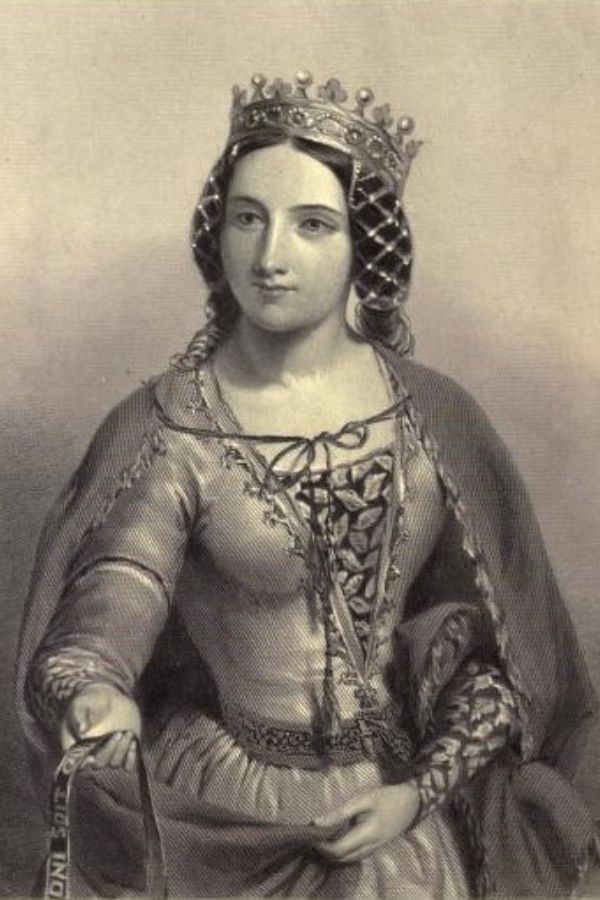
Anne Neville was the daughter of the Kingmaker, the Earl of Warwick. She was first married off at 14 to Edward of Westminster, the Lancastrian heir, in a desperate alliance to put Henry VI back on the throne. Her young husband was killed at Tewkesbury in 1471, possibly cut down on the field, possibly executed afterward. Her father had already died at Barnet three weeks earlier. In the space of a month, she lost both.
What happened next is debated. Anne ended up in the household of her sister Isabel, who was married to George of Clarence, and George had every reason to keep Anne hidden so he could control the Warwick inheritance. There’s a later account that Richard of Gloucester found her disguised as a kitchen maid in London.
Whether that’s romance or fact, she married Richard in 1472, and a Neville inheritance dispute that splintered the royal family was the price.
She became queen in 1483 when Richard III seized the throne. Within two years, her only son, Edward of Middleham, was dead. Within another year, she was dead too, in March 1485, probably of tuberculosis, though rumors flew that Richard had poisoned her to marry his niece Elizabeth of York.
Richard publicly denied it, which only made the rumor louder. Five months later, he was dead at Bosworth, and Anne’s whole tragic arc was reduced to a footnote in someone else’s victory.
Margaret of Anjou and the War She Could Not Win
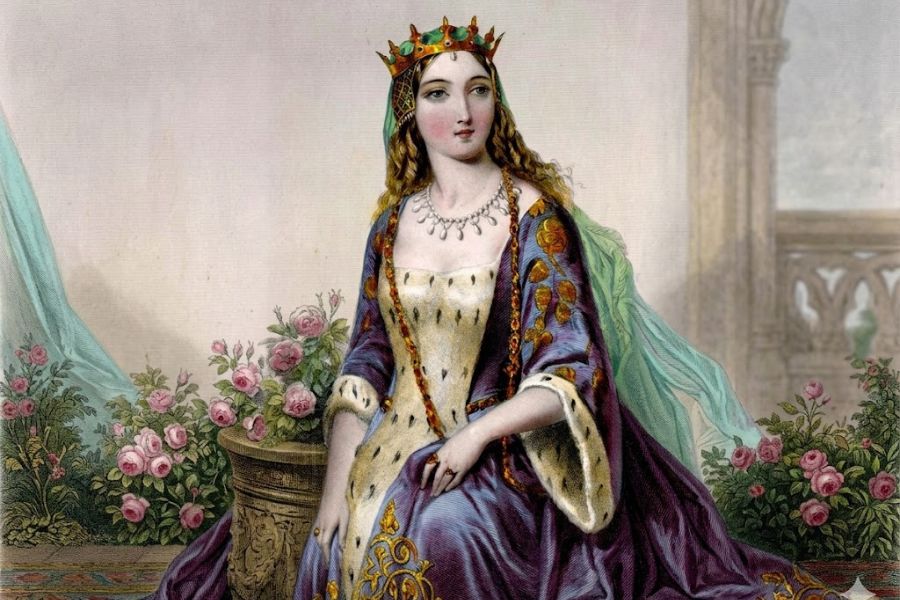
Margaret of Anjou is the case study for what happens when a Plantagenet bride is given a job no one can do. She arrived in France at 15 in 1445, sent to marry Henry VI as part of a peace deal in which England gave up territory in Maine. The English nobility resented her from the first port. They needed a peacemaker. They got a teenager carrying the blame for a treaty she had no hand in making.
Her husband was gentle, devout, and prone to catatonic collapses that left him unable to recognize his own son. Margaret stepped into the vacuum, and the English court hated her more for it.
When civil war broke out, she led armies in her son’s name, dragged her household across the north of England, and made alliances with Scotland, France, and anyone who would listen. She was called she-wolf, foreign witch, the worst of names.
After Tewkesbury, where her son was killed and the Lancastrian cause crushed, Margaret was imprisoned in the Tower and then at Wallingford. Eventually, Louis XI of France ransomed her, but only after she’d renounced every claim she had ever held in England. She died in 1482 in obscure poverty in Anjou, having buried a husband, a son, a cause, and a kingdom. The bride who’d been promised a peaceful queenship spent thirty years fighting for survival, and lost.
What the Crown Actually Cost
There’s a pattern in these stories that’s easy to miss when you read them one at a time. The Plantagenet marriage market ran on the assumption that a woman was a treaty in human form. She brought lands, alliances, money, and a womb.
Once those goods were delivered, her usefulness dropped sharply, and her safety with it. A widow with no living sons was a problem. A queen with too much foreign influence was a problem. A wife who failed to conceive was the biggest problem of all.
The English heiresses had it slightly different but not better. Women like Mary de Bohun or Isabel Neville weren’t political imports, but they came with enormous estates, and those estates were the actual prize. The husband took the land, the title, and often the children if the marriage failed. The woman herself was the wrapping paper. Useful for a generation, then folded away.
Related posts:
 12 Plantagenet Women Who Shaped Medieval History & Paid the Price of Power
 Six Women Who Dodged a Bullet, or Axe, by Not Marrying Henry VIII
 The Ones That Got Away. The Six Women Who Kept Their Heads, By Not Marrying Henry VIII
12 Incredible Plantagenet Women Who Did More For Medieval History Than Their Male Counterparts
The Ones That Got Away. The Six Women Who Kept Their Heads, By Not Marrying Henry VIII
12 Incredible Plantagenet Women Who Did More For Medieval History Than Their Male Counterparts