
Food is such an important part of our lives. I live in France, where everything revolves around meals. The French value their two-hour lunch break as it’s sacred downtime where people chat, spend time together, and enjoy whatever has been prepared.

Now, granted, what people ate in the Middle Ages was very different from what we eat today. No tomatoes or potatoes roasting in the oven. No chili flakes in the cupboard, no bar of chocolate broken into pieces on the counter, no vanilla, corn, peppers, green beans, burgers or chips.
Table of Contents
However, the ritual of breaking bread held just as much importance then as it does now. Feasts were prepared to impress, and meals were a chance to catch up with loved ones. But the pantry of a 14th-century household, even a rich one, would look strange to almost any modern cook.
So what did they eat and how did they pull off the famous feasts, the ones with peacocks and gilded pies and tables groaning with food, when half the ingredients we think of as basic hadn’t crossed the Atlantic yet?
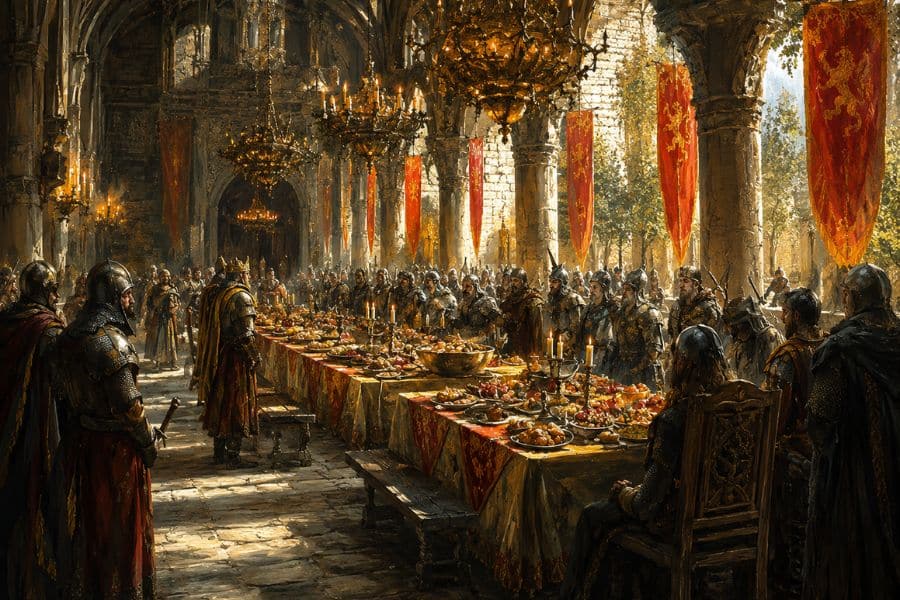
The Food Items They Didn’t Have On the Menu in the Middle Ages
Let’s start with the missing list, because it’s longer than most people realize. Tomatoes, potatoes, sweet potatoes, corn, all varieties of capsicum (so no bell peppers, no chilies, no paprika), green beans, lima beans, and kidney beans.
Peanuts, cashews, pumpkins, most squashes, zucchini, avocados, pineapple, papaya, vanilla, chocolate, turkey, and the kind of tobacco that fueled half of early modern Europe.
All of it came from the Americas, all of it after 1492, and most of it didn’t really enter ordinary European cooking until the 17th or 18th century, sometimes later.
Think about what that strips out of the cuisines we now consider deeply traditional. Italian food without tomato. Hungarian cooking without paprika. Irish life without potatoes (the famine was still centuries away).
Swiss chocolate, Belgian chocolate, French chocolate, none of it. A Spanish kitchen without peppers drying on the wall. Even the humble baked bean on toast, a British staple, is built on a New World legume.
The medieval cook worked with a different palette altogether, with different flavors and different colors on the plate.
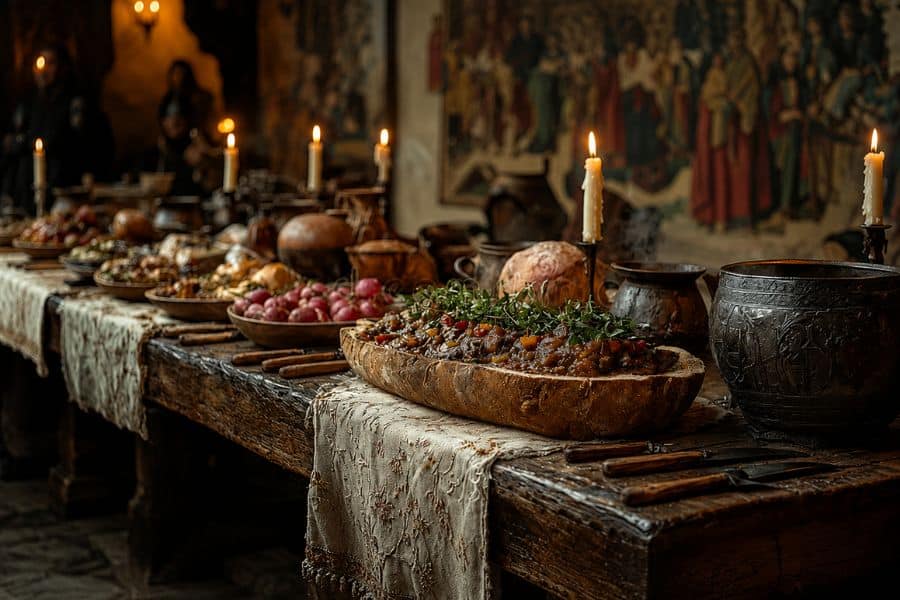
Medieval Foods You’d Find in a Pantry in the Middle Ages
The base of medieval European cooking was grain, and a lot of it. Wheat for the wealthy, rye and barley further down the social scale, oats in the north, millet in pockets of central Europe.
Bread came in every shade from white manchet for the lord’s table to dense, dark loaves for everyone else.
Pottage, a thick grain-and-vegetable stew simmered for hours in a single pot over the fire, was the meal most people ate most days, often for breakfast and dinner both.
The vegetables would look familiar if you squinted. Cabbages, leeks, onions, garlic, turnips, parsnips, carrots (mostly purple or white before the Dutch bred the orange ones in the 17th century), fava beans, peas, lentils, lettuce, spinach, kale, beets.
Fruit meant apples, pears, plums, cherries, quinces, medlars, strawberries (small wild ones), blackberries, gooseberries, figs and grapes in the south, citrus in Spain and Italy, dates and pomegranates brought in by Arab trade.
Almonds were everywhere in a wealthy kitchen, ground into milk for fast days when dairy was off the menu, thickening sauces the way cornstarch might now.
Meat depended entirely on who you were. A peasant household might keep a pig and salt it down for winter, eat chicken when a hen stopped laying, and see beef rarely. A noble table groaned with venison, boar, swan, heron, crane, peacock, rabbit, kid, lamb, beef, and every cut of pork from snout to trotter.
Fish mattered enormously because the Church called for meat-free days that added up to roughly a third of the year: pike, carp, eel, herring (salted by the barrel), cod from the North Atlantic, lampreys (Henry I supposedly died from a surfeit of them), oysters by the cartload in coastal towns.
Eggs, cheese, butter, and cream sat on the dairy side of the pantry, all of it banned during Lent unless you bought a dispensation, which the rich routinely did.
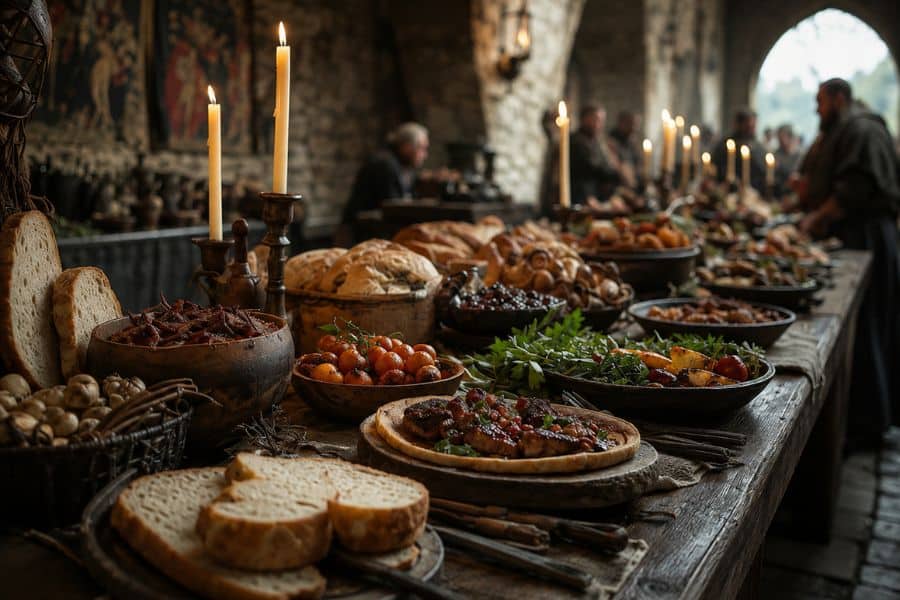
The Spices That Bankrupted Lords
A wealthy English or French household in the 14th century used pepper, ginger, cinnamon, cloves, nutmeg, mace, cardamom, galingale, grains of paradise, cubebs, long pepper, saffron, sugar (yes, sugar was classed as a spice), and a fistful of other aromatics most of us have never tasted.
Every one of them came east along the spice routes from India, the Moluccas, Sri Lanka, and farther still, passing through Arab and Venetian middlemen who marked the price up at every stop.
The sums involved were ruinous. A pound of saffron could cost as much as a horse. Pepper was so valuable it was counted by the peppercorn, kept under lock and key, and used as currency to pay rent or settle debts.
The phrase ‘peppercorn rent’ that English landlords still use comes from exactly this period, when a single peppercorn was a token of real value. Whole noble households dedicated a senior servant, the spicer, just to managing the cupboard.
When the Duke of Buckingham hosted Richard III in 1483, his spice bill for a single visit ran into figures that would make your eyes water.
Why bother? Because spice on the table was the medieval equivalent of parking a Bentley in the driveway. Pepper said you had connections to Venice. Saffron said you could afford to dye your food gold. Cloves and nutmeg said your ships, or your patron’s ships, reached places other men’s didn’t.
And the food really did taste of it, heavily, the way a good Moroccan tagine or a north Indian curry tastes now. Sweet and savory mixed freely. A roast might be sauced with wine, ginger, sugar, vinegar, and currants all at once. Sour, sweet, spicy, all on the same plate, all at the same time.
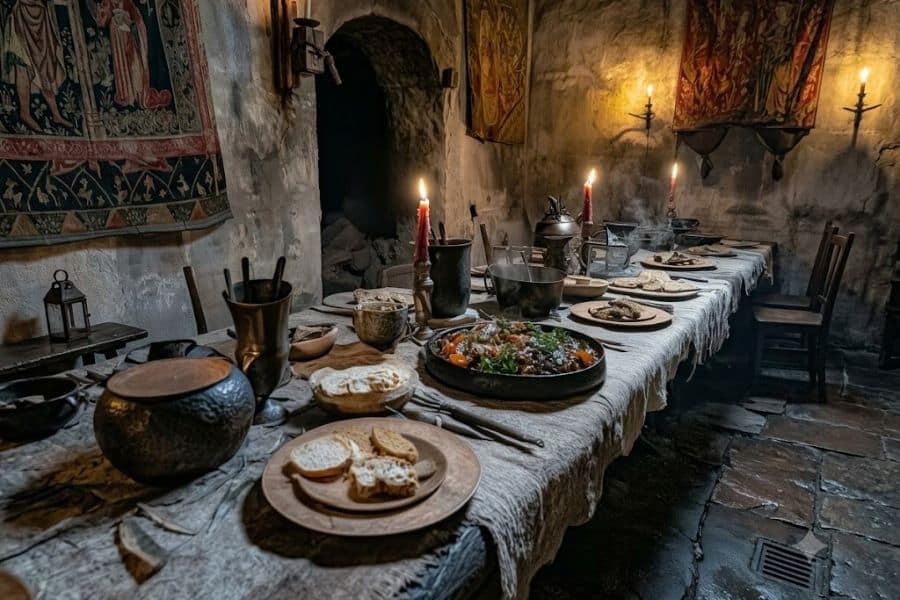
How Cooks Got Around the Missing Ingredients
Medieval cooks were nothing if not resourceful, and the gaps in their pantry got papered over with substitutions that often surprise modern readers. For sweetness, they had honey everywhere, sugar where they could afford it, and reduced fruit syrups, especially from grapes (defrutum, sapa) and dates.
For sourness in place of tomato or lemon, they reached for verjuice, the sharp juice pressed from unripe grapes or crab apples. Verjuice turns up in recipe after recipe as a substitute for a splash of lemon or a spoonful of tomato puree.
For color, they got inventive. Saffron gave yellow and gold; parsley juice, boiled hard, gave green. Sandalwood and dried red rose petals gave a deep red. Heliotrope or ‘turnsole’, a dye made from a Mediterranean plant, gave purple. Burnt toast or charred bread crumbs gave black.
A pie crust painted with egg yolk and saffron came out the color of polished brass, and carried meaning. Gold meant wealth. Red meant power. Green meant spring and renewal.
For thickening, where a modern cook might use a roux or a slug of cream, medieval cooks ground almonds with stock, or thickened with breadcrumbs, or used egg yolks beaten into hot liquid. Almond milk in particular did extraordinary work on fast days, standing in for real milk in sauces, custards, and even cheese-like blancmanges.
The famous medieval dish blancmange, in its original form, was shredded capon mixed with rice, almond milk, and sugar, white on white on white, served to invalids and lords alike. It bears no resemblance to the pink quivering pudding your grandmother might have made.
What a Feast Actually Tasted Like
Picture the wedding feast of Henry IV and Joan of Navarre in 1403, or any of the great recorded banquets of that era, and try to taste it.
The first course at a grand English dinner might include a brawn (boiled, pressed pork) served with mustard, a pottage of capon thickened with almonds, a roast swan re-dressed in its own feathers, venison in a sauce of red wine, cinnamon and cloves.
Then there was a ‘subtlety’, an edible sculpture in sugar and marzipan, perhaps a castle or a saint, set in the middle of the table to be admired before it was eaten.
The second course brought more roasted meats: peacock, served with its tail fanned; heron; rabbit; suckling pig; a pie of ground pork, currants, dates, and pepper, the pastry painted gold with saffron.
Sauces ran sweet and spiced, often a deep red or a clear yellow, ladled over the meat at the table. A bowl of frumenty, wheat boiled in milk with saffron and egg yolks, sat alongside the venison the way mashed potato might today.
There was no buttery mound of mash, roast potato, or Yorkshire pudding (that’s an 18th-century invention), no carrots in a glaze of brown sugar.
For a southern European version, swap the swan for a kid roasted with rosemary, the frumenty for rice cooked with almond milk and cinnamon, and the English pies for Sicilian pastries stuffed with cheese and honey.
The Arab influence in Spain and southern Italy meant more sugar, more citrus, more orange-flower water, more meat cooked with fruit. None of it tasted like the Mediterranean food we know now, because the bright acidity of the tomato simply wasn’t there to cut through the richness.
Instead you got fat balanced by vinegar, sweet balanced by spice, and a kind of layered, perfumed heaviness that’s mostly vanished from European cooking.
You can read the surviving recipe books, the Forme of Cury compiled around 1390 for Richard II’s court, or Le Viandier attributed to Taillevent in France, and the instructions are clear enough to follow.
What’s harder to recreate is the world they fed: the smoke from the hall fire, the trenchers of stale bread soaking up the sauce, the spicer unlocking his cupboard, and the cook at the hearth.


Kylie Lang is a nationally syndicated travel journalist with bylines on the Associated Press Wire & more, a medieval history writer, and the founder and lead author of Tales of the Middle Ages (talesofthemiddleages.com). She holds a BA (Honours) in History from the University of Kent and is a member of the British Guild of Travel Writers.