The great medieval feast gets a lot of attention in books, movies, and TV shows. Swans dressed in their own feathers, peacocks with gilded beaks, subtleties of marzipan shaped into castles. It’s the stuff of every Tudor drama and every painting of a banquet hall.

But on a wet Tuesday in November, in a one-room cottage outside York, what was actually in the pot? That’s the question I find more interesting.
Table of Contents
Daily food in the Middle Ages depended on who you were, where you lived, and what time of year it was. A serf in Yorkshire ate almost nothing in common with a Norman bishop. Yet certain things were near-universal: bread of some kind, something fermented to drink, and a pot that almost never went cold.
The Cauldron That Never Went Out
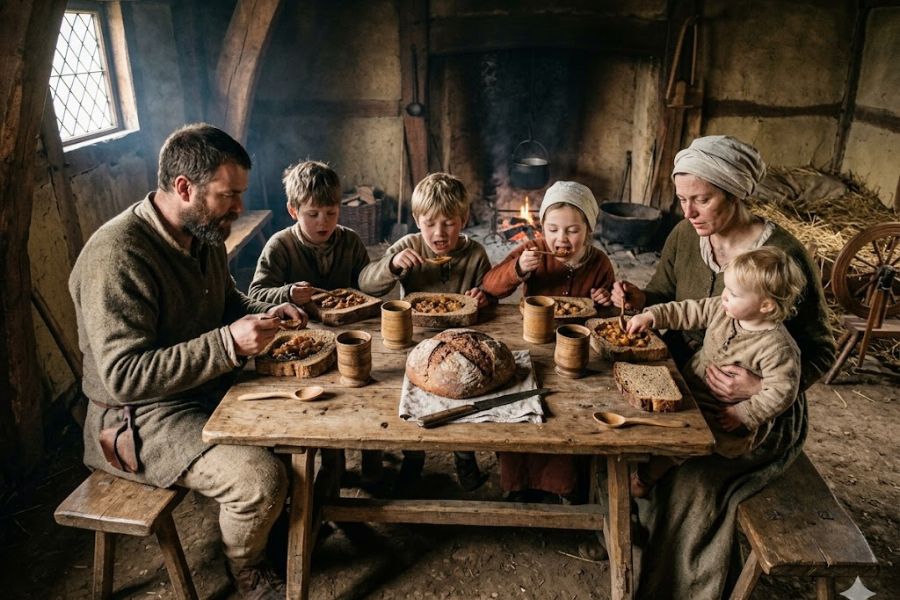
If you’d walked into a peasant’s cottage in 1340, the first thing you’d have noticed (after the smoke and the smell of unwashed bodies) was the iron pot hanging over the hearth. Inside it: pottage. A thick, slow-cooked stew of grains, vegetables, beans, and whatever else could be thrown in.
Pottage was the workhorse of the medieval diet. Oats or barley formed the base in the north, while rye and wheat were more common further south. To this went peas, beans, cabbage, leeks, onions, and whatever herbs grew in the garden plot.
If the family was lucky, a bit of bacon fat or a knuckle of salted pork went in for flavor. If they were unlucky, it was grain and water and not much else.
The trick was that the pot rarely got emptied. You ate from it, then topped it up. New ingredients went in on top of yesterday’s leftovers, which sat on top of the day before. In monasteries and wealthier homes, the kitchens were more organized, but in a peasant household, the same cauldron simmered for days at a stretch.
The food safety implications I’d rather not think about, though it explains why so many medieval recipes call for things to be boiled within an inch of their life, pretty much removing any goodness and the bad stuff, too.

The Bread Hierarchy
Bread was the second pillar of daily eating, and the kind of bread you ate told everyone exactly where you stood. At the top sat pandemain or manchet, a fine white loaf made from sifted wheat flour. Soft, pale, expensive, and reserved for lords, abbots, and the rich merchant class.
Below that came wheaten bread, a slightly coarser version eaten by yeoman farmers and townspeople who were doing well enough.
Then things got darker, literally. Maslin bread was made from a mix of wheat and rye, common across much of England and northern France. Rye bread alone was heavier and more sour, the staple of poorer households. At the bottom of the heap sat horse bread, a dense, near-inedible loaf made from peas, beans, bran, and whatever grain scrapings were left after the better flour had been sifted off. It was meant for horses, but in bad years, people ate it too.
The trencher deserves its own mention. Before plates were standard, diners ate off thick slices of stale bread that soaked up sauces and juices. At wealthy tables, the gravy-sodden trenchers were collected at the end of the meal and given as alms to the poor waiting at the kitchen door. So the lowest bread in the hierarchy was the soaked, second-hand remnants of someone else’s dinner.

Meat, Salt, and the Long Winter
Meat was where the gap between rich and poor opened into a chasm. A noble household in the thirteenth century might get through astonishing quantities of beef, mutton, pork, venison, rabbit, and game birds. The accounts of the Earl of Leicester’s household in 1265 record meat being served at almost every meal, in volumes that would horrify a modern cardiologist.
A peasant ate meat rarely, and when they did, it was usually salted pork. Most rural families kept a single pig, fattened through the summer on whatever it could scrounge, then slaughtered in November when the cold weather meant the meat could be preserved. The pig was bled, jointed, and packed into barrels with vast quantities of salt.
That barrel had to last until the next slaughter, which is why you find references to peasants eating bacon that was years old, gray, rancid, and tough enough to break teeth on.
Fish was the great equalizer, sort of. The Church mandated fish days on Fridays, Saturdays, sometimes Wednesdays, and throughout Lent and Advent. That’s roughly half the year. For coastal communities, this meant herring, mackerel, and cod, often salted or smoked. Inland, it meant freshwater fish from rivers and stews (the medieval word for a fish pond), or barrels of salted herring shipped from the North Sea.
By the time a salted herring reached a village in the Midlands, having been packed in brine for months, the eating experience was, by all accounts, an acquired one.

Why Nobody Drank the Water
Almost everyone, including children, drank ale. Not because medieval people had a national drinking problem, but because the water in most towns and villages was dubious at best. Small beer, a weak ale brewed to perhaps two or three percent alcohol, was the daily drink of choice across England, the Low Countries, and much of northern France. Adults might get through a gallon a day, spread across meals and work breaks.
In wine-growing regions, the picture shifted. Southern France, much of Italy, and Spain ran on watered wine in the same way England ran on ale. A monk in Burgundy in 1300 had a daily wine allowance that would put most modern drinkers under the table, though the wine itself was thinner, lower in alcohol, and often mixed with water and spices.
Mead, made from fermented honey, turned up where bees were kept, and grain was scarce. Cider came into its own in apple country, particularly the West Country of England and Normandy.
Brewing was women’s work, mostly. The alewife was a fixture of every village, brewing in batches and selling the surplus from her own house. She’d hang a bush or a green branch outside the door when a fresh batch was ready.
I find it striking that one of the most consumed substances in the medieval world was made, sold, and largely controlled by women, at least until commercial brewing took over and pushed them out in the later Middle Ages.

What Was on the Lord’s Table
If you climbed the social ladder, the food climbed with you. A baronial household ate four or five courses at the main meal of the day, served around ten or eleven in the morning. Roasted meats, pies of every description, stewed game, sauces thick with almonds and verjuice, custards, fritters, spiced wines.
Pepper, ginger, cinnamon, cloves, saffron, and grains of paradise arrived through Venice and Genoa at prices that make modern truffles look reasonable.
The medieval rich loved color. Food was dyed yellow with saffron, green with parsley juice, red with sandalwood, and gold with actual gold leaf. A dish called blancmange was made by poaching chicken, then pounding it with rice, almond milk, and sugar into a pale paste, and it was considered a delicacy fit for kings.
Subtleties, those elaborate sugar sculptures, sat between courses as edible theater. At the wedding of Henry IV’s daughter, Blanche, in 1402, the kitchens produced sugarwork shaped like leopards, eagles, and entire castles.
The one thing rich medieval diners didn’t eat much of was raw vegetables. Salads existed (there’s a recipe in The Forme of Cury from around 1390 that includes parsley, sage, garlic, onions, leeks, borage, mint, fennel, and rue, dressed with oil and vinegar), but most physicians considered raw greens dangerous.
Cooked, spiced, sauced, and disguised was the preferred state of almost everything. A roast peacock served with its feathers re-attached, its beak gilded, breathing fire through a wick of burning camphor in its mouth, was the kind of thing that turned up at a royal feast. I’ve eaten some strange meals in my time, but I’ve never had to dodge a flaming bird.

The Hungry Months and the Years That Killed
The lean months ran from late winter into early summer, after the previous harvest’s grain had run low and before the new crops were in. March, April, and May were the dangerous months. Stores of salted meat had gone off or run out. The hens weren’t laying much yet. Last year’s apples were rotten. Pottage thinned out to grain-flecked water.
In bad years, it got worse. The Great Famine of 1315 to 1317 killed perhaps ten to fifteen percent of the population of northern Europe. Constant rain rotted crops in the fields for three summers running. Chroniclers in England, France, and the Low Countries described people eating dogs, cats, roots dug from the forest floor, and bark stripped from trees.
There are credible accounts of cannibalism in the worst-hit regions of Poland and the Baltic. Salted herring, which had been peasant food, became luxury food because nothing else was left.
The ordinary medieval diet, then, looked very different depending on whether you caught it in a good September or a hungry April. In a good year, a Yorkshire peasant family might sit down to pottage thick with peas and bacon, a hunk of maslin bread, an onion, a wedge of hard cheese, and a quart of small beer.
In a bad April, the same family might be boiling nettles and the last handful of oats, watching the children’s bellies swell, and wondering how many weeks until the first green shoots came through.


Kylie Lang is a nationally syndicated travel journalist with bylines on the Associated Press Wire & more, a medieval history writer, and the founder and lead author of Tales of the Middle Ages (talesofthemiddleages.com). She holds a BA (Honours) in History from the University of Kent and is a member of the British Guild of Travel Writers.