During some research I was doing recently, I read a letter written by a woman in the 12th century, in which she instructed the schoolmaster looking after her young son to thrash him properly if he hadn’t applied himself. She said she’d be obliged to him for it. The boy was about 10, and he’d been living away from her for two years by then, and she hadn’t seen him in months.
It’s hard for us to imagine in the 21st century, in an era where we practically wrap our kids in cotton wool and molicoddle them within an inch of their lives. But in the Middle Ages, it was completely different.
Table of Contents
A child of 7, or 8, or sometimes even younger, was often packed onto a horse with a chest of clothes and sent off to be raised by people he’d barely met, in a house he didn’t know.
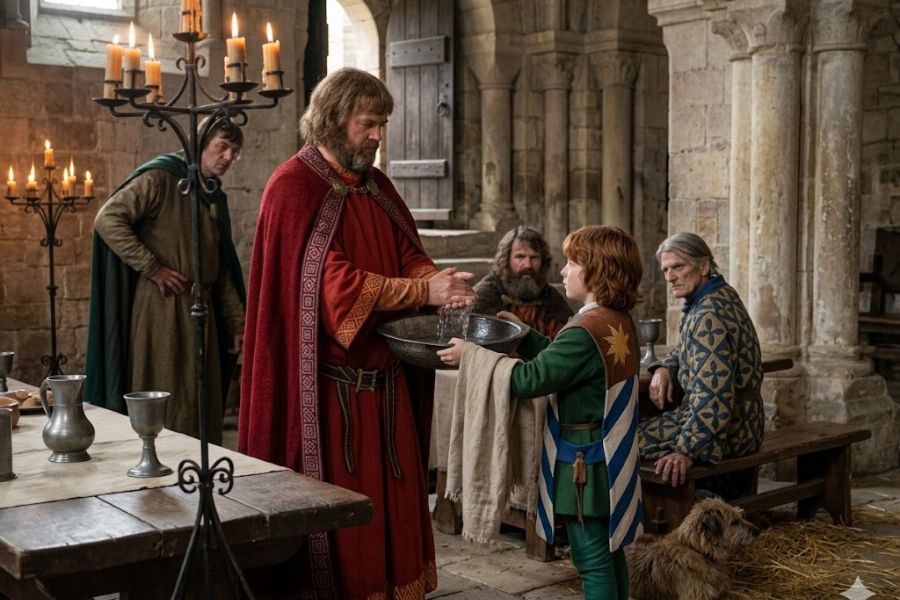
Why a Noble Child Left Home at Seven
The logic, if you grew up inside it, made perfect sense. A noble boy raised entirely by his own family would learn his father’s habits and his mother’s affections and very little about the wider world he was supposed to operate in.
He wouldn’t know how other great houses ran, have served at another lord’s table, learned another lord’s manners, or picked up the connections that would carry him through adulthood. He’d be, in the medieval sense of the word, untrained.
So, from roughly age 7, sons of the gentry and the nobility were sent out. Boys typically went to the household of a more powerful kinsman or patron, where they’d serve as a page first, then a squire, learning to ride, to handle weapons, to wait at table, to read the room when grown men were drunk and armed.
Girls were sent to other noble households too, often to learn the running of a great house from the mistress, sometimes to be educated alongside a future husband’s family, sometimes simply because a well-placed aunt had asked for them.
The boy who would become Henry V was placed in the household of Henry Bolingbroke. Margaret Beaufort had her son, Henry Tudor, raised largely by his uncle Jasper, and then in the household of William Herbert at Raglan, while she went years without seeing him. None of these arrangements was unusual.
The writer Bernardino of Siena, preaching in the 15th century, told parents that keeping a son at home past a certain age was a kind of indulgence that ruined him. The English humanist scholars who came along later said much the same.
An Italian visitor to England around 1500 wrote, in a passage that has been quoted ever since, that the English seemed to lack affection for their children because they sent them off to other people’s houses at 7 or 9 and kept them there for years. He thought it cruel. The English nobility, however, thought he didn’t understand how a child became a man.
What Daily Life Looked Like for a Page
A boy placed as a page in a great household woke before dawn in a dormitory of other boys, washed in cold water, heard Mass, and then began the day’s service. He’d lay fires, carry messages, fetch and pour wine, kneel to present a dish at the high table, and stand for hours behind his lord’s chair, watching, listening, learning who mattered and who didn’t.
In the afternoons, there’d be lessons in riding, in the use of arms, in reading and a bit of Latin if the household ran to it, in music and dancing if the lady of the house took an interest. The evenings meant more service at supper and then sleep on a pallet, often shared.
The beatings were constant. Schoolmasters and tutors used the rod as a matter of course. Agnes Paston, in the 1450s, wrote to the man teaching her son, Clement, that if the boy hadn’t applied himself, the master should belash him until he had. She added that she would be thankful for it. This was regarded as education, and a mother who didn’t insist on it was a mother who didn’t care about her son’s prospects.
What the boy felt about any of this, we mostly don’t know. The records that survive from inside the experience are thin. A boy of 9 who cried himself to sleep on a straw pallet in a Yorkshire hall in 1450 didn’t write it down.
What we have are the account books, the dry administrative records of how much was spent on his cloth, his horse, his boots, his small weekly allowance, and the occasional letter from a master reporting that the young gentleman was in good health and learning his Latin reasonably well.

Girls Sent Out, and the Question of What Happened to Them
Girls were sent out, too, though usually a little later and with a clearer endpoint in view: marriage. A daughter placed in the household of a great lady learned needlework, household management, the supervision of servants, the running of a still-room and a buttery, all courtesies expected of a wife. She also often met the man she’d marry, or his sisters, or his mother. The placement was a courtship by other means.
Anne Boleyn was sent to the court of Margaret of Austria at Mechelen around the age of 12 or 13, then to the French court in the household of Mary Tudor and later Queen Claude. She didn’t come home to England for years. By the time she returned, she had a polish that English court ladies didn’t have.
Her father had spent a fair whack of money on this education and got, in due course, the return he’d hoped for and rather more than he’d bargained for.
Not every girl came home in glory. Some were placed in households where the patron died, or fell out of favor, or simply forgot about them, and then there were awkward letters back and forth about who was responsible for them now.
Others were married off out of the household they were serving in, to men chosen by their hosts rather than their parents, and the parents had to live with it. Margaret Paston, the same family again, was furious when her daughter Margery secretly contracted herself to the family’s bailiff Richard Calle. ‘I charged my servants that she shouldn’t be received in my house,’ Margaret wrote. The girl had been part of the household. She’d made her own arrangement. Margaret cut her off.

The Children Given to God
There was another route, older and in some ways stranger, which was oblation. Parents could give a child to a monastery, sometimes as a baby, often by the age of 5 or 6, with the understanding that the child would be raised by monks or nuns and, when old enough, take vows and remain there for life.
The child was called an oblate, from the Latin for ‘offered.’ It was a real offering. The parents made a gift of land or money along with the child, and the child became, in religious terms, the property of the house.
Bede was an oblate. He was given to the monastery at Wearmouth-Jarrow around the age of 7, in the late 7th century, and lived there for the rest of his life, writing the Ecclesiastical History that’s still in print. He never expressed any regret about it, as far as the record shows, and his account of being raised by the monks is affectionate.
Other oblates fared less well. The 11th-century monk Guibert of Nogent wrote a memoir, one of the rare medieval autobiographies, in which he described his mother dedicating him to the religious life as a child and the misery of being beaten by an overzealous tutor while he was too young to defend himself. He stayed in the church and rose to be an abbot.
By the 12th and 13th centuries, theologians had begun arguing that a vow made for a 5-year-old by his parents couldn’t truly bind him, and the church began to require that oblates, upon reaching adulthood, either formally confirm the vow themselves or leave.
The records of religious houses in the later Middle Ages include occasional young men and women walking out of the only life they’d ever known, into a world they had no skills for and no kin who particularly wanted them back.
What the Parents Actually Wrote
This is where the records get difficult to read. The Paston letters, the Stonor letters, the Cely letters: the surviving 15th-century English family correspondence shows us parents who weren’t cold, exactly, but who treated the placing-out of children as an estate-management problem.
They wrote to ask after a son’s clothes, health, Latin, behavior, and expenses. They sent money and cloth for a new gown, also writing to the master of the household to ask, in passing, whether the boy was being kept in order.
A mother sending a son cloth for a new doublet, and money for his shoes, and a stern note about his studies, was a mother showing love in the only form the household economy and the letters of the day really had room for.
Whether the children experienced it that way is a different question, and the honest answer is that we mostly can’t know. What we have is the other end of the correspondence: the parents, writing to each other and to the household staff.
Coming Home, Or Not
Some children came home. A boy who’d served as a page and then a squire might return to his father’s manor in his late teens or early twenties, ready to take up his inheritance, marry the woman his parents had picked out, and start the cycle again with his own sons.
He’d have spent more of his life in someone else’s hall than in his father’s, and the men he counted as brothers were often the other boys he’d trained with rather than his own siblings, whom he barely knew.
The reunions aren’t recorded in any detail that I’ve seen. A 19-year-old riding back into his father’s manor for the first time in 12 years wasn’t a chronicle event.
Some children didn’t come home. They died in service, of fever or accident, or, in the case of the squires, in war. The Wars of the Roses killed a great many young men who’d been placed in the households of lords who took them onto the field at 15 or 16.
Some children were given as hostages: a great lord’s son sent to live in the household of his father’s rival or overlord as a guarantee of good behavior, treated decently as long as the father behaved, killed if he didn’t.
The greatest knight of all time, William Marshal, was sent to King Stephen as a hostage at a very young age and was lucky to survive the experience simply because Stephen developed a soft spot for the boy.
The young James I of Scotland spent 18 years as an English hostage after being captured at sea aged 11, and came home a grown man with English manners and an English wife.
And some children, the oblates especially, never came home at all because home wasn’t really an option anymore.
By the time they were old enough to leave, the monastery was the only world they knew, the only people they were used to, the only routine they’d experienced. Their parents were dead or distant or simply strangers. They stayed because there was nowhere else to go, and because, in the cases we can see clearly enough to judge, some of them had built lives within those walls that they wouldn’t have traded for anything the outside world had to offer.
Bede died at his desk in Jarrow, dictating a translation of John’s Gospel into English, in 735. He’d been there since he was 7.

Related posts:
 The Tragic Life of Edward, 17th Earl of Warwick, The Last Plantagenet
 Violette Szabo: The Young Mother Who Became Britain’s Most Decorated Spy
 How the Young William Marshal Conquered the Tourney Circuit and How He Built a Fortune Before He Was Famous
 5 Medieval Queens Who Ruled the Roost While the Men Were Away (Regents, Generals, and Political Operators)