
Violette Szabo was 23 years old when the SS shot her in the back of the head at Ravensbrück concentration camp, just three months before the war ended and the Allies liberated Germany.
She left behind a three-year-old daughter who’d never really known her mother, a father who’d taught her to shoot tin cans off fence posts in the back garden, and a legacy that would make her the second woman ever awarded the George Cross for valor.
Table of Contents
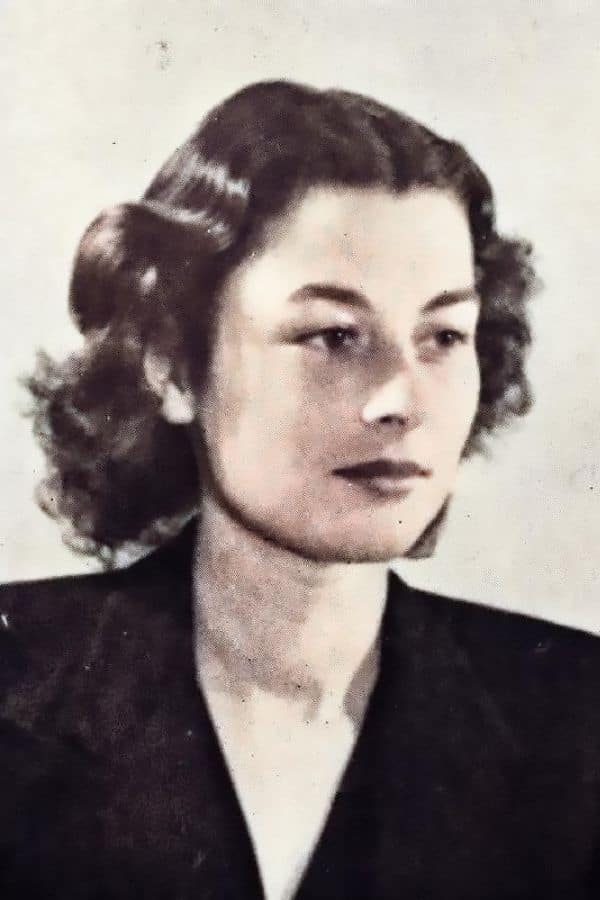
But before she became a legend, before the films and the books and the blue plaque on her childhood home in South London, Violette Szabo was just a girl who grew up between two countries, spoke two languages, and wanted revenge for a husband she’d loved for five weeks before he went off to war and never came home.
A Girl Between Two Worlds
Violette Reine Elizabeth Bushell was born in Paris on June 26, 1921, to an English father and a French mother who’d met during the chaos of World War I. Her father, Charles, had been driving supply trucks for the British Army when he met Reine Leroy, a dressmaker from a small town in the Somme.
After the war, they settled in London, where Charles worked as a taxi driver and later sold cars, but money was tight during the Depression, and young Violette spent her early childhood living with an aunt in Picardy while her parents tried to make ends meet in England.
The family finally reunited when Violette was eleven, moving into a house on Burnley Road in Stockwell, South London, where she’d live until the war changed everything.
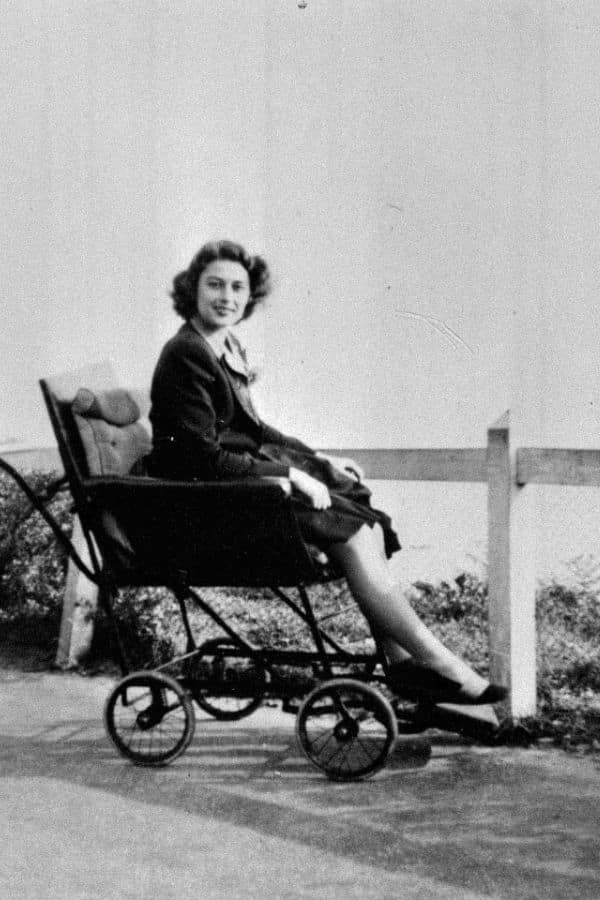
Violette was the only girl in a family with four brothers, and she grew up more like a tomboy than the delicate French daughter her mother might have hoped for. She hated needlework and anything to do with cooking or housework, but she could outrun and outclimb every boy on the street.
Her father taught her to shoot, and she got good at it, spending hours in the back garden knocking tin cans off fence posts with a .22 rifle. She was strong-willed and hot-tempered, and she’d argue with her father until the fights got so bad that once, when she was still a teenager, she packed a bag and took herself back to France on her own, staying with relatives until things cooled down.
The family spoke French at home except when Charles was around, and Violette moved between English and French so easily that nobody could tell which language came more naturally to her.
She left school at fourteen and went to work, first as an assistant in a French corset shop in South Kensington, then at Woolworths on Oxford Street, and finally at a department store in Brixton called Le Bon Marché, where she sold perfume behind the counter. By the time war broke out in 1939, Violette was eighteen years old.
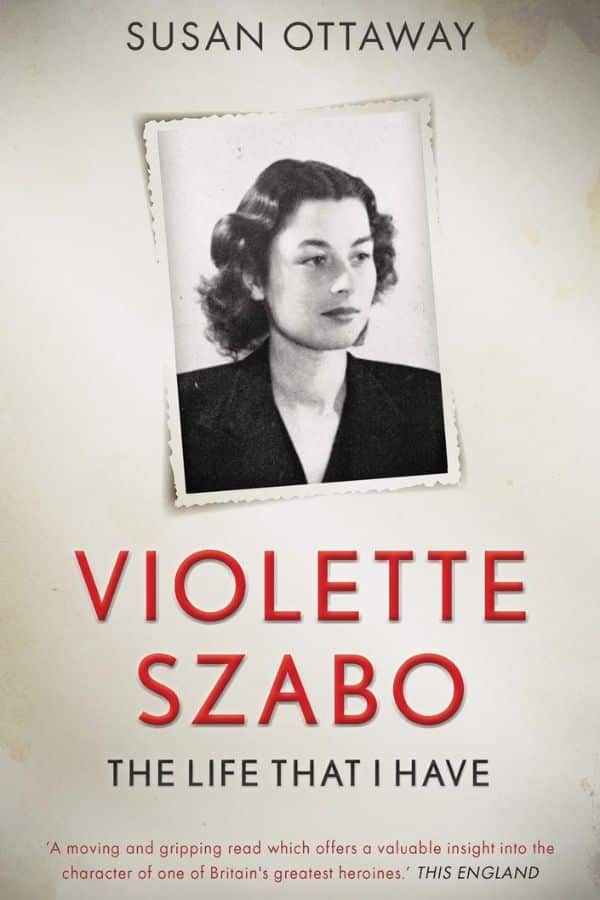
Violette Szabo: The Life That I Have
This exceptional work has been written with the assistance of Violette Szabo’s daughter, Tanya, and unravels fact and fiction about one of the most fascinating characters of World War II. Buy the book >>>
Five Weeks of Marriage
In July 1940, Violette’s mother decided the family should invite a French soldier over for Bastille Day dinner because she felt sorry for all the homesick Frenchmen stranded in London after France had fallen to the Germans.
She sent Violette out to find someone suitable at the parade, and Violette came back with Étienne Szabo, a decorated officer in the French Foreign Legion who was twelve years older than her and had the kind of dangerous charisma that made nineteen-year-old girls fall in love in about five minutes.
Étienne was of Hungarian descent but had been born in Marseille, and he’d already earned medals for bravery fighting in Norway and Finland before he ever met Violette at that parade.
They got married on August 21, 1940, at the register office in Aldershot after a whirlwind romance that lasted exactly 42 days. They had one week together for a honeymoon, and then Étienne shipped out to fight in West Africa.
He came back briefly in early 1941, long enough to get Violette pregnant, and then he was gone again, this time to North Africa, where Rommel’s Afrika Korps was tearing through the desert. Violette gave birth to their daughter Tania on June 8, 1942, at St. Mary’s Hospital in Paddington.
The next day, Étienne was at Bir Hakeim defending against a massive German assault, and he managed to escape when the position was overrun. Four months later, on October 24, 1942, he was killed leading his men in a diversionary attack at El Alamein. He never saw his daughter.
When Violette got the news, something inside her hardened into pure rage. She’d been working at an aircraft factory while Tania stayed with a childminder, trying to do her bit for the war effort, but it wasn’t enough. She wanted to fight. She wanted to kill Germans, but more than anything, she wanted revenge for the man she’d loved and lost, and she was willing to die to get it.

Recruited by the Shadows
Nobody knows exactly how SOE found Violette, but the story that’s most commonly told is that she met an agent named Harry Peulevé at a social event in mid-1943, and he mentioned her to Selwyn Jepson, SOE’s recruiter for F Section.
Jepson was a detective novelist who’d been given the job of finding women who could pass as French to be used as spies, and Violette was perfect. She was bilingual, had family connections in France, was physically fit and fearless, and had the kind of motivation that couldn’t be taught. When Jepson interviewed her in July 1943 and told her the survival rate for agents was about fifty-fifty, Violette didn’t hesitate. She was in.
The training was brutal. Violette spent months learning night navigation, escape and evasion tactics, how to use Allied and German weapons, hand-to-hand combat, demolitions and explosives, communications, and cryptography.
Her instructors reported that she was persistent, physically tough, self-willed, and not easily rattled. Max Hastings later wrote that she was adored by everyone at SOE both for her courage and her endless infectious Cockney laughter, and Leo Marks, the codemaster who worked with her, remembered her as a dark-haired slip of mischief with a Cockney accent that could make even the grimmest situations seem less terrible.
The final stage of training was learning to parachute, and that’s where Violette ran into trouble. On her first jump, she badly sprained her ankle when she hit the ground, and the injury sent her home for weeks of recovery. She passed on her second attempt in February 1944, but that ankle would never be quite right again, and six months later, it would be the thing that got her killed.
The Code Poem
Before Violette left on her first mission, Leo Marks gave her a poem to use as her cipher for encoding messages back to London. The poem was called “The Life That I Have,” and Marks had written it on Christmas Eve 1943 for Ruth Hambro, his girlfriend who’d just been killed in a plane crash in Canada.
The poem was heartbreakingly simple: “The life that I have is all that I have, and the life that I have is yours. The love that I have of the life that I have is yours and yours and yours.” Marks had been struggling with how to create secure codes that the Germans couldn’t crack, and he’d realized that using famous poems was dangerous because German cryptographers could just look them up.
So he started writing his own, and this one, written in the depths of grief for a woman he’d loved, became the code that would keep Violette’s messages secret as she worked behind enemy lines in occupied France.
Violette had been having trouble with the standard poem codes because she kept making small spelling mistakes that rendered her messages indecipherable, and Marks thought the simple rhythm of his poem might help her concentration. He gave it to her on March 24, 1944, and told her to memorize it exactly.
Years later, the poem would become famous when it was featured in the film about Violette’s life, though the movie incorrectly claimed that Étienne had written it for her. Marks had only agreed to let them use it on the condition that he wouldn’t be credited, because the poem was too personal, too wrapped up in his own grief, and he didn’t want people to know.
Hooked on the Middle Ages? Get more stories like this one in your inbox.
Mission One: Rouen
Violette’s first mission began on April 5, 1944, when she and her circuit organizer, Philippe Liewer, parachuted into occupied France near Cherbourg. Her cover story was that she was Corinne Reine Leroy, a commercial secretary from Le Havre, which gave her a plausible reason to be traveling in the heavily restricted coastal zone where the Germans had the tightest security.
The mission was to assess the damage that German arrests had done to the Salesman network in Normandy, and it was dangerous as hell because the entire circuit was suspected to be compromised.
Liewer couldn’t go himself to investigate because his face was on wanted posters all over the region, so Violette went alone to Rouen and then to Dieppe, traveling by train and bicycle, meeting contacts in cafés and safe houses, trying to figure out who’d been arrested and who might still be reliable. What she found was a disaster.
Over 120 members of the resistance network had been rounded up by the Gestapo, and the circuit was completely destroyed. She traveled back to Paris and reported the findings to Liewer, and they both returned safely to England together.
The mission was a success, Violette had proved she could handle the work, and SOE promoted her to Ensign in the First Aid Nursing Yeomanry, which was the cover organization they used for female agents.
Mission Two: The Roadblock at Salon-la-Tour
On the night of June 7-8, 1944, just one day after D-Day, Violette parachuted back into France with Liewer and two other agents. This time, the mission was to rebuild the Salesman circuit in the Limoges area and coordinate with local resistance groups to slow down German reinforcements heading north to counter the Allied invasion.
What nobody in SOE headquarters knew was that the 2nd SS Panzer Division Das Reich, one of the most brutal units in the entire German army, was moving through that exact region on its way to Normandy, and they were in a mood to kill anyone who got in their way.
On the morning of June 10, Liewer sent Violette by car with a resistance fighter named Jacques Dufour to meet with another circuit leader about 50 kilometers away. Dufour insisted on using a car even though the Germans had banned French civilians from driving after D-Day, and Violette brought her Sten gun and eight magazines of ammunition.
They picked up another young resistant named Jean Bariaud along the way, and the three of them were driving through the sunlit countryside near the village of Salon-la-Tour when they came around a bend and found themselves face to face with a German roadblock.
The Das Reich division was looking for one of their own battalion commanders, Sturmbannführer Helmut Kämpfe, who’d been kidnapped by the local maquis the day before. But when Dufour slowed the car at the checkpoint, the Germans got suspicious. Bariaud, who was unarmed, jumped out and ran into the woods.
Violette and Dufour opened fire. The Germans fired back. And then they were running across an open field toward a line of trees, with German soldiers chasing them and bullets kicking up dirt all around them.
Violette’s ankle gave out. The one she’d injured nine months earlier during parachute training twisted underneath her, and she went down hard. She told Dufour to run and save himself, and then she dragged herself to an apple tree at the edge of a wheat field and started firing.
For thirty minutes, Violette Szabo held off an entire German patrol, emptying magazine after magazine at them while Dufour escaped through the woods and made it back to warn the rest of the circuit. She killed at least one soldier and wounded several others. When she finally ran out of ammunition, two German soldiers climbed the hill and dragged her up to a bridge over the railway line, where an officer from Das Reich was waiting with an armored car.
The Germans drove her to Limoges, where the local resistance immediately started planning a rescue operation, but the Gestapo moved her to Paris before they could act.
Avenue Foch
The Gestapo took Violette to their headquarters at 84 Avenue Foch in Paris, the same building where they’d interrogated dozens of other SOE agents. She gave them the name Vicky Taylor, which was one of her cover identities, and she stuck to her story no matter what they did to her.
There’s debate about whether she was tortured at Avenue Foch, and her biographer, Susan Ottaway, thinks it’s unlikely, though the threat of torture was always there and the interrogations went on for days. What’s certain is that Violette didn’t give them anything useful.
She didn’t reveal the names of her contacts, didn’t tell them about the circuit’s plans, and didn’t break under pressure. She held out long enough for her people to scatter and find safety.
In August 1944, the Germans decided to move their most important prisoners out of France before the Allies liberated Paris. Violette was put on a train with 37 male prisoners and two other female SOE agents, Denise Bloch and Lilian Rolfe.
The train was heading for Germany when Allied planes attacked it near Paris, strafing the cars with machine gun fire. The German guards ran for cover, but a group of male prisoners were trapped in one of the cars as bullets tore through the metal.
Violette and the other two women got a jug of water from a bathroom and crawled through the train to reach them, even though one of the women was chained to Violette’s ankle, passing the water around and calming the men who were convinced they were about to die. The prisoners who survived that train ride never forgot what those three women did, and their testimony would later help ensure that all three received the George Cross.
Ravensbrück
After ten days in a transit camp at Saarbrücken, Violette, Denise, and Lilian were transferred to Ravensbrück concentration camp in northern Germany. Ravensbrück was a women’s camp, one of the worst in the Nazi system, where tens of thousands of women died from starvation, disease, medical experiments, and outright murder.
The three SOE agents were sent almost immediately to a satellite camp at Torgau, where they were put to work at a Heinkel aircraft factory. When the guards tried to force them to make munitions for the German war effort, Violette and about a thousand other French women refused. The Germans moved them to manual labor instead, digging potatoes and working in vegetable cellars outside the camp walls.
Violette made contact with French prisoners of war in a nearby camp who managed to smuggle them extra food, and she kept planning escape attempts even though the odds of success were almost zero. According to Virginia d’Albert-Lake, an American woman who was imprisoned with her, Violette constantly talked about escaping and kept everyone’s spirits up even when conditions were at their worst. When an informer betrayed one of their escape plans, the Germans sent the British women back to Ravensbrück in October 1944 as punishment.
From there, they were sent to an even worse camp near Königsberg on the Oder River, where they were forced to build a runway in the brutal East Prussian winter. Violette was still wearing the light summer suit and flat shoes she’d been captured in back in June, and the women had no blankets, barely any food, and had to stand outside for roll call every morning for up to five hours in temperatures well below freezing.
Many of the prisoners froze to death. According to Christine Le Scornet, a seventeen-year-old French girl who became friends with Violette, she maintained her morale through it all, stayed optimistic that the Allies would come, and kept making plans to escape even when it seemed hopeless. Lilian Rolfe was in terrible shape by this point, so weak she could barely walk, and Denise Bloch was suffering from what might have been gangrene in her feet.
The Execution
On January 19 or 20, 1945, the three British agents were recalled to Ravensbrück. They were sent first to the Strafblock, the punishment block, where they were possibly assaulted and beaten, and then to the punishment bunker, where they were kept in solitary confinement.
By this point, even Violette’s unbreakable morale was starting to crack. She was exhausted, starving, in constant pain, and she knew the war was almost over, but she also knew she wasn’t going to live to see it end.
On or before February 5, 1945, camp commandant Fritz Suhren read out the execution orders. The three women were taken to the courtyard near the crematorium. Lilian Rolfe and Denise Bloch were so weak they had to be carried on stretchers. Violette walked.
SS-Rottenführer Schult shot all three of them in the back of the head while they knelt on the ground, and their bodies were burned in the crematorium. Violette Szabo was 23 years old. The war in Europe would end exactly three months later.
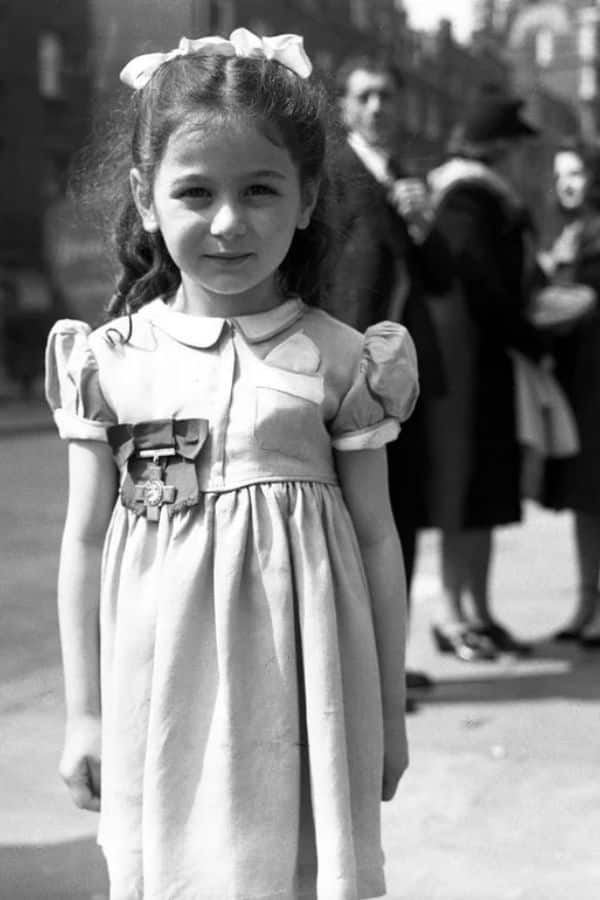
The George Cross
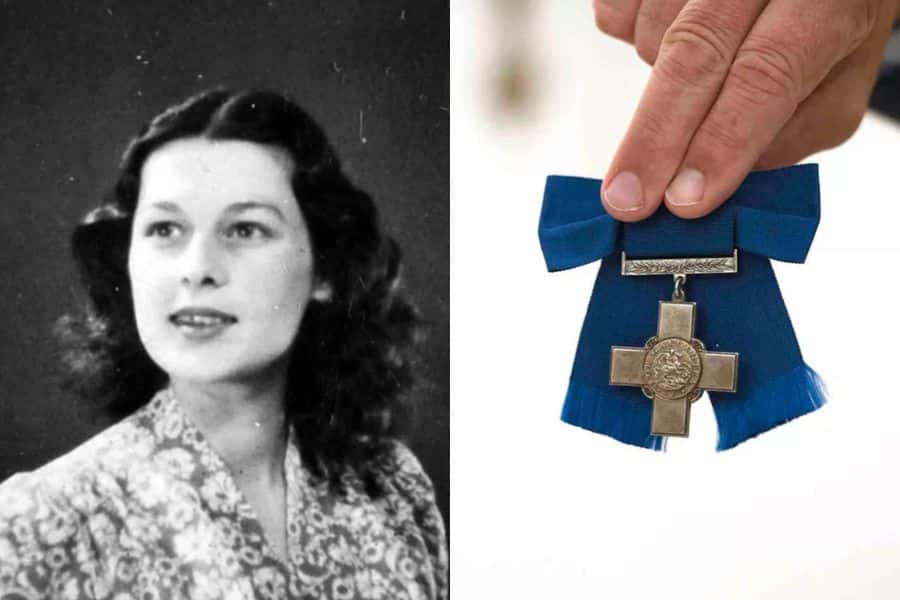
On December 17, 1946, King George VI posthumously awarded Violette Szabo the George Cross, Britain’s highest civilian decoration for heroism. Her four-year-old daughter, Tania, was taken to Buckingham Palace by her grandparents to receive the medal on her mother’s behalf.
The citation read: “Madame Szabo volunteered to undertake a particularly dangerous mission in France. She was parachuted into France in April 1944 and undertook the task with enthusiasm. In her execution of the delicate research entailed, she showed great presence of mind and astuteness. She was twice arrested by the German security authorities, but each time managed to get away.
Eventually, however, with other members of her group, she was surrounded by the Gestapo in a house in the southwest of France. Resistance appeared hopeless, but Madame Szabo, seizing a Sten gun and as much ammunition as she could carry, barricaded herself in part of the house and, exchanging shot for shot with the enemy, killed or wounded several of them. By constant movement, she avoided being cornered and fought until she dropped exhausted.
She was arrested and had to undergo solitary confinement. She was then continuously and atrociously tortured, but never by word or deed gave away any of her acquaintances or told the enemy anything of any value. She was ultimately executed. Madame Szabo gave a magnificent example of courage and steadfastness.”
The French government awarded her the Croix de Guerre in 1947 and the Médaille de la Résistance in 1973. Her husband, Étienne, had also received the Croix de Guerre, making them one of the most decorated married couples of the war.
In 1956, R.J. Minney published a biography titled Carve Her Name with Pride, which was adapted into a film in 1958 starring Virginia McKenna. A blue plaque was erected on the house in Stockwell where Violette grew up in 1981.
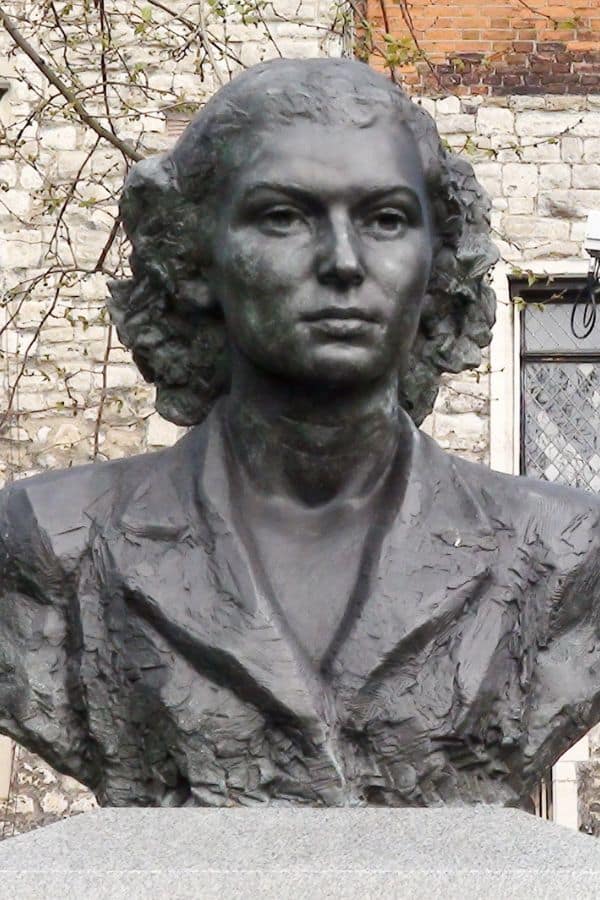
In 2009, she was chosen as the face of the SOE memorial on London’s Albert Embankment. There’s a museum dedicated to her in Herefordshire, in a cottage she used to visit before the war. And in Salon-la-Tour, where she made her last stand, there’s a memorial at the entrance to the rugby field marking the spot where a young woman with a twisted ankle held off the SS for half an hour so her friend could escape.
Tania Szabo grew up knowing her mother only through stories, photographs, and a George Cross in a velvet box. She spent her life defending Violette’s memory, writing a book about her mother’s missions, attending memorial ceremonies, and ensuring people understood that her mother hadn’t gone to France in search of adventure or glory. She’d gone because her husband had been killed and she wanted the people who’d killed him to pay. And they did.
Before the Germans captured her, Violette Szabo had helped destroy weapons, blow up railway lines, and coordinate resistance operations that slowed the Das Reich division’s advance toward Normandy just long enough to make a difference. She died three months before the war ended, but the work she did helped end it, and that’s what she would have wanted them to remember.
Love a good medieval story?
Join our readers and get tales of kings, queens, castles and ordinary medieval lives straight to your inbox.

Kylie Lang is a nationally syndicated travel journalist with bylines on the Associated Press Wire & more, a medieval history writer, and the founder and lead author of Tales of the Middle Ages (talesofthemiddleages.com). She holds a BA (Honours) in History from the University of Kent and is a member of the British Guild of Travel Writers.
Related posts:
 Vera Atkins, Legendary Spymaster of the SOE Turned Nazi Hunter
 Virginia Hall: The American Spy the Gestapo Couldn’t Catch Who Helped Win World War II
 Josephine Baker: The Superstar Who Became a Spy in World War Two
 Marie-Madeleine Fourcade Escaped From a Gestapo Prison and Gave the Allies the Map That Made D-Day Possible