
Whenever I watch a film or TV show set in the Middle Ages, it always makes me think how lucky I am to have access to modern-day medicine. Just the sight of a jar of leeches would be enough for me to make a mad dash for freedom. I remember seeing something similar in a day spa once, and just couldn’t bring myself to try it. Each to their own, I guess.
But it does beg the question of just how bad was it back then? Blood letting seemed to be the answer for many things, so I’d have had to get used to the leeches, but what about the rest of it? There were no painkillers, and even ether hadn’t been invented. Pain relief was biting down hard on something and dealing with what came.
Table of Contents
But once you start to dig a little deeper, you realize the medieval doctors were extremely learned men who trained for years, read Greek and Arabic texts, and could argue theoretical points till the cows came home. So why, then, were the methods so archaic?

The Four Humors and Why They Made Sense at the Time
Every educated physician in medieval Europe worked from one core idea, inherited from Galen through the Arab world: the body contained four fluids, and your health depended on keeping them in balance. Blood, phlegm, yellow bile, and black bile.
Each was linked to an element, a season, a temperament, and an organ, and the whole structure slotted together like a piece of clockwork that explained everything from why you got a cold in winter to why your neighbor was a miserable so-and-so.
If you had a fever, you had too much blood, which was hot and wet, so the physician would cool and dry you. If you were sluggish and cold, you had too much phlegm, so he’d warm and dry you. The treatments followed from the diagnosis.
A physician at the University of Bologna in 1320 could examine a patient he had never met, ask the right questions, look at the right signs, and prescribe a course of action that any other trained physician in Christendom would broadly agree with.
The system was wrong from top to bottom. There are no humors, fevers don’t come from excess blood, and cooling a feverish patient with bloodletting often killed them faster. But the framework gave physicians something most pre-modern healers didn’t have: a shared theory, a method, and a way to disagree with each other in writing.

What Was Actually in the Doctor’s Bag
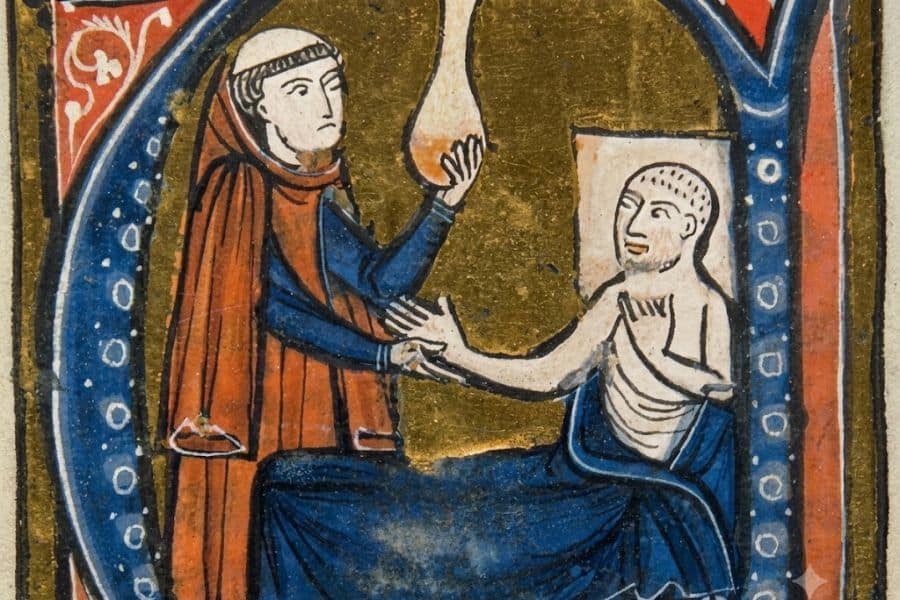
A working physician in the 13th or 14th century carried, more or less, the following kit. A urine flask, called a matula, made of clear glass and shaped like a bladder, so he could compare what you produced against a color wheel.
A small set of lancets for bleeding, a scale for weighing herbs and powders, and a book or two, often a copy of the Articella, the standard teaching anthology built around Hippocrates and Galen. A mortar and pestle for compounding on the spot, and a stock of dried herbs, opium poppy, mandrake, henbane, and the more exotic imports like rhubarb root from the East.
Uroscopy, the art of reading urine, was at the center of it all. The physician held the flask up to the light, noted the color against 20 named shades, from clear water through to black, observed the sediment, sniffed it, and, in some cases, tasted it.
He could tell from this, he believed, which organ was diseased, what humor was out of balance, and what the prognosis was. Sometimes he could see real things in there, such as the sweet smell of diabetic urine or blood from a kidney stone. Mostly, he saw what his theory told him to see.
The bag also contained the tools of the regimen, which physicians actually spent most of their time prescribing. Diet sheets, exercise plans, advice on sleep, sex, baths, and air. A patient with means would get a personalized regimen drawn up, written out properly, telling him to avoid roast pork in August, take a warm bath on a Tuesday, and sleep on his left side.
This was medicine as lifestyle management, and the wealthier you were, the more of it you got.
Hooked on the Middle Ages? Get more stories like this one in your inbox.
What the Physician Did When You Were Dying
Picture yourself in 1390, in a decent house in Norwich, running a high fever after three days of vomiting. Your family sends for a physician, who arrives in a long robe and a furred hood because his dress signaled his status as much as his learning.
He took your pulse, looked at your urine, and asked about your stool, your sleep, your appetite, your dreams, and what you’d eaten in the last week.
Then, depending on his read, he’d do some combination of the following. Bleed you, almost certainly, from a vein chosen according to which humor and which organ he was targeting, with the amount depending on your age, sex, the season, and the phase of the moon.
Prescribe a purgative, to clear the offending humor out the other end, often something with black hellebore or scammony, both of which are violent laxatives that would empty you out completely.
Apply hot or cold compresses. Give you a cordial mixed with wine, sometimes laced with opium, which at least made the dying part easier.
If you were rich enough, he’d stay. He’d visit twice a day, adjust the regimen, write a long letter to a colleague in Paris asking for a second opinion. If you were poor, you’d see a barber-surgeon instead, who would bleed you for a fraction of the price.
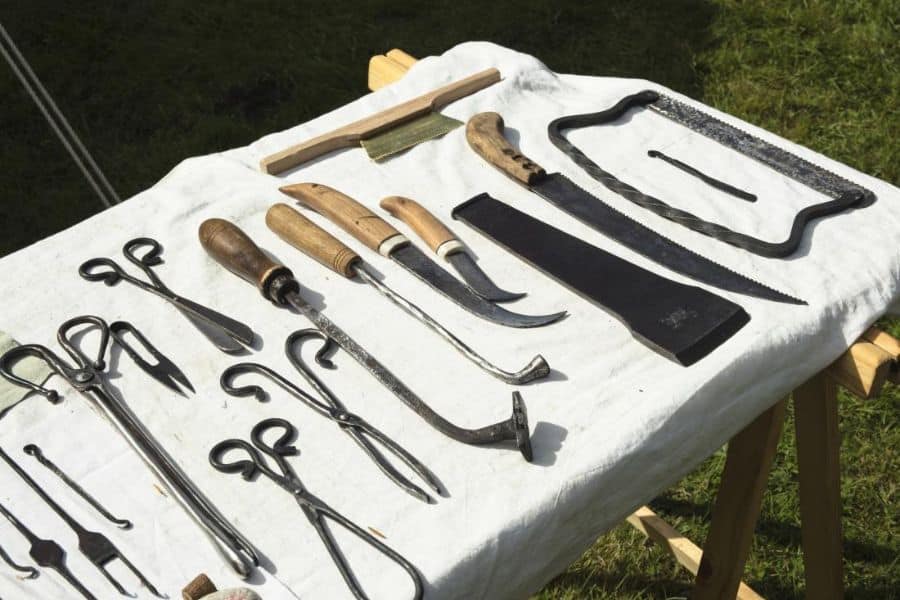
The barber-surgeon, oddly, often did less harm because he did less of everything. Bloodletting aside, his interventions were limited to what he could see and cut: abscesses, broken bones, and the occasional arrow.
The Things They Got Right
Medieval medicine was at its most competent in places you might not expect. Battlefield surgery, in the hands of someone like the 14th-century French surgeon Guy de Chauliac, was startlingly sophisticated.
Guy wrote a textbook, the Chirurgia Magna, that was used for 300 years, and it covered wound cleaning, the setting of fractures, the use of soporific sponges soaked in opium and mandrake as an anesthetic, and the differential treatment of clean wounds versus contaminated ones.
Surgeons could trepan skulls, remove cataracts using a couching needle, repair hernias, and perform lithotomies for bladder stones. The death rates were grim, but a surprising number of patients walked away.
Herbal pharmacology was another area where empiricism outran the theory. Monastic infirmaries, in particular, kept careful records of which preparations actually worked and which herbs were used.
Willow bark for pain and fever contains salicin, the precursor to aspirin. Foxglove, used cautiously for dropsy, gave us digitalis. Opium poppy did then what it does now, and the medieval dosing for pain relief was reasonably accurate.
Mint, fennel, and ginger for digestion, and garlic for wound infections, which has real antibacterial action.
They also understood, in a rough way, that some diseases spread between people. The response to plague in cities like Venice and Ragusa, where they instituted the 40-day quarantine in the 1370s, was based on observation rather than theory.
They didn’t know about bacteria; they had no idea that fleas were the vector, but they could see that isolating ships and sealing off infected houses slowed the spread. It’s where the word quarantine comes from, quaranta giorni, 40 days, and it worked.

Survival Rates and What Came After
So did medieval medicine, on balance, help people or kill them? The honest answer is that for most acute conditions, the physician made very little difference, and for some, he made things worse.
Bloodletting a patient with pneumonia or typhoid would hurry them along. Purging someone with dysentery finished the job. The famous case of King Charles II of England in 1685, bled and purged to death by 14 physicians over four days, was the logical endpoint of a tradition that lasted from Galen well into the 18th century.
What’s striking is how little improved when humoral medicine was finally abandoned. The germ theory of disease wasn’t accepted until the 1860s, antiseptic surgery came in with Joseph Lister around the same time, and effective antibiotics didn’t arrive until penicillin in the 1940s.
A patient with pneumonia in 1750, treated by a fashionable Enlightenment physician with all the latest theories, had roughly the same odds as one in 1350. The same went for childbed fever, dysentery, smallpox, and most of the rest. The doctors changed their robes and their vocabulary; the survival numbers barely moved.
Ibn Sina, the Persian physician known as Avicenna, wrote in the 11th century that the physician’s first duty was to do no harm and that observation should outrank theory. He was largely ignored on this point for another 800 years.

Love a good medieval story?
Join our readers and get tales of kings, queens, castles and ordinary medieval lives straight to your inbox.

Kylie Lang is a nationally syndicated travel journalist with bylines on the Associated Press Wire & more, a medieval history writer, and the founder and lead author of Tales of the Middle Ages (talesofthemiddleages.com). She holds a BA (Honours) in History from the University of Kent and is a member of the British Guild of Travel Writers.
Related posts:
 How Did Women Give Birth in the Middle Ages? The Ceremonies, Rituals, and Strange Goings On
 Dentistry in the Middle Ages: 7 Gross Things People Did Before Toothpaste
 Did Medieval People Smell That Bad? The Truth About Hygiene in the Middle Ages
 The Victorian Baby Bottle That Doctors Called a “Murder Bottle”