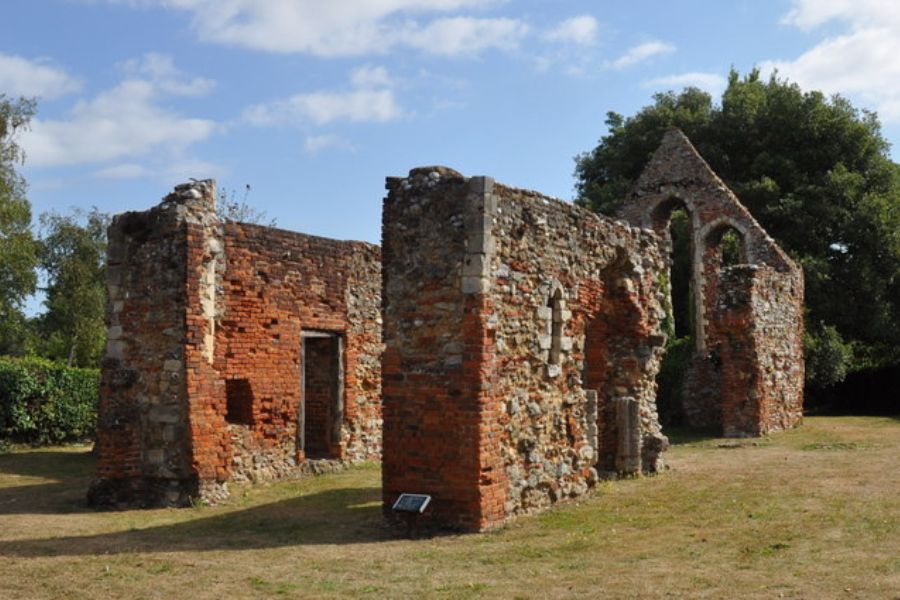
There’s a small ruined chapel I used to drive past on a back road in southwest France, sitting on its own in a field a little outside a village. No signpost, no information board, just a few stones in long grass and a track that probably hadn’t been a proper road since the Black Death. A neighbor told me, in passing one afternoon, that it had been a maladrerie, aka a leper house.
It was nothing as I’d imagined. What I’d vaguely pictured, if I’d pictured anything, was a sort of medieval horror cottage. A miserable hut full of people rotting quietly while the rest of the world held its nose and walked past.
Table of Contents
In reality, they were properly run hospitals, of a sort. They were properly planned and funded, with rules, account books, chaplains, gardens, and, in some cases, a better diet than that of the peasants outside the walls.
The Living Funeral
The moment someone was suspected of leprosy, a priest, sometimes with a barber-surgeon or a panel of already-diagnosed lepers, would examine the skin, the voice, the nostrils, the eyebrows. Medieval diagnostic manuals are oddly specific.
A hoarse, nasal voice, loss of feeling when pricked with a pin, nodules on the face, and loss of hair from the eyebrows in a particular pattern. Some of what they were looking at was almost certainly Hansen’s disease.
A lot of it wasn’t, and we now think a fair share of medieval “lepers” had psoriasis, eczema, syphilis later on, or any number of other skin conditions that happened to look frightening.
If the verdict went against you, what came next was a liturgy. The Sarum rite used in England, and similar rites across France and the Low Countries, walked the leper through what can only be described as a funeral.
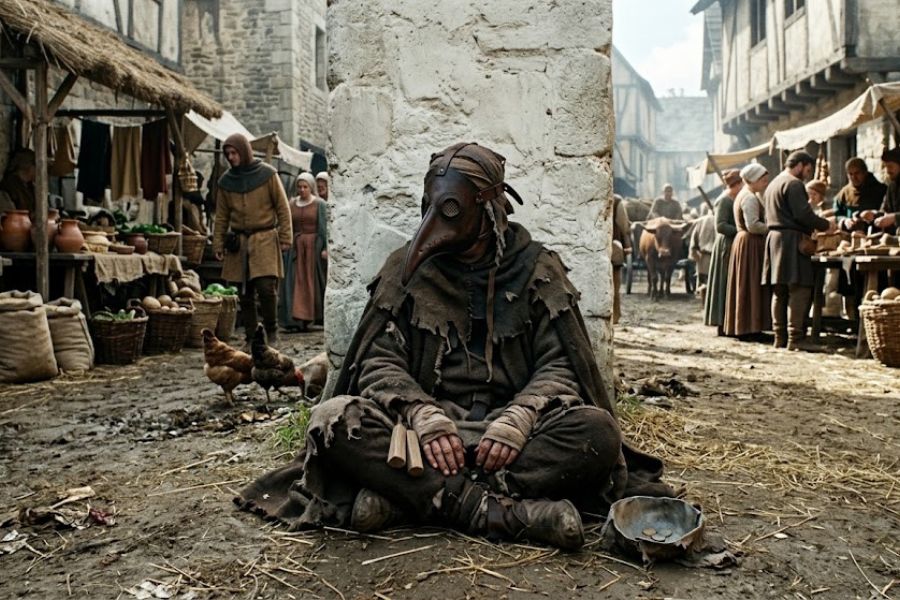
The diagnosed person was led into the church, sometimes made to lie under a black cloth before the altar while the Office of the Dead was sung over them. Earth was thrown, in some versions literally, in others symbolically, as if onto a coffin. Then they were led out, often to the lazar house itself, and given the tools of their new life: a wooden bowl, a clapper or bell to warn people of their approach, sometimes a special cloak and gloves.
After the ceremony, the leper couldn’t inherit, couldn’t bring a suit at law, couldn’t marry, couldn’t enter a church in many places except through a specially built squint in the wall, couldn’t draw water from a public well, and couldn’t touch goods at market without a stick.
In some jurisdictions, a wife could remarry as if widowed, but in others she couldn’t, which left women in a particularly grim half-state, neither widowed nor housed. The point of the ritual was administrative. The leper had to be moved from one legal category to another, and the medieval mind did that kind of thing with priests and Latin.
Where the Houses Stood, and Why
If you look at a map of medieval lazar houses in England, France, and the German lands, the pattern is immediately apparent. They’re placed within a short walk of a city wall, usually on a main road, often beside a bridge or a crossroads.
Close enough that someone with a bowl could be seen by every traveler heading into market. Far enough out that the prevailing wind, in the medical theory of the day, carried the corrupting air away from the city rather than into it.
London had Saint Giles in the Fields, founded around 1101 by Queen Matilda, sitting on what was then open country between the city and the village of Westminster. Canterbury had the Hospital of Saint Nicholas at Harbledown, perched on the hill, where the pilgrims came over on their way to Becket’s shrine, which was a clever bit of placement when you think about it.
Pilgrims in a mood to do something meritorious passed a row of lepers with bowls. Paris had the great house of Saint-Lazare on the road north toward Saint-Denis, which gave us the word lazaretto and eventually the Parisian prison and railway station built on its bones.
The lazar house I’d been driving past in France was one of perhaps 2,000 such institutions on French soil at the peak.
The siting helped because it kept the leper visible enough to remind the living of their own mortality, which medieval theology valued highly. It kept the leper close enough to receive alms from passing traffic, which kept the institution running. And it kept the leper outside, which kept everyone’s anxiety, theological and medical at once, just about manageable. A whole social problem was solved by a low wall and a strip of road.
Who Ran These Places, and How
A lazar house wasn’t really a hospital in the way we use the word. It was a religious community, often modeled on a monastery, in which the inmates were, in a sense, also its members. Many ran under the Augustinian rule. Some adopted a version of the rule of Saint Lazarus, the military-hospitaller order founded in the Crusader Kingdom of Jerusalem in the 12th century, specifically to care for leprous knights, which is one of those pieces of history that sounds invented until you check.
The inmates wore a habit, attended services, kept silence at meals, and lived under a master or prior. A typical English house in the 13th century might have had a master, a chaplain or two, a handful of healthy brothers and sisters as staff, and somewhere between 10 and 30 leprous brethren and sisters.
Account rolls survive for a few of them, and the picture they paint is surprisingly orderly. Bread, ale, pottage, salt fish on fast days, meat on feast days. Gardens for vegetables, pigs, a small infirmary, and sometimes a brewhouse. Plus, a burial ground inside the precinct, because the leper had been buried symbolically once already and now needed an actual grave.
Money came from a patchwork of sources, which is part of why these places lasted as long as they did. Royal grants, like Matilda’s at Saint Giles, bequests in wills, often quite small, a penny here and a sheep there, from people hedging their souls, and the right to collect tolls on a specific road or bridge. Licenses for certain inmates to go out and beg in particular parishes on particular days, with a badge to prove they were authorized.
The institutions were charitable, in the medieval sense of the word, but they weren’t soft. Inmates who broke the house rules, slipped out to drink in the town, refused to attend services, were beaten or expelled, which in practice meant the road.
The Strange Status of the Leper
Medieval theology had a deeply ambivalent relationship with the leper. On one hand, leprosy was read as punishment, a visible sign of sin, especially sexual sin, which is part of why the diagnosis carried such social weight. On the other hand, the leper was Christ.
Sermons and devotional writing across the period return repeatedly to the image of Christ as a leper, drawing on a particular reading of Isaiah 53. To wash a leper’s sores, to kiss a leper, to give alms to a leper, was to perform an act of intimacy with Christ himself.
Saints did it ostentatiously. Saint Francis of Assisi dated his conversion to the moment he embraced a leper on the road outside Assisi. Queen Matilda of Scotland, the same one who founded Saint Giles, was reported by William of Malmesbury to have washed and kissed the feet of lepers in her own chambers, to the horror of her brother David, who asked her what Henry would say if he knew her lips had touched such men. She’s said to have replied that the lips of an earthly king were less sweet than those of the King of Heaven.
So the same society that legally buried you alive also held that touching you was a fast track to grace. Lepers were, in some accounts, considered to be already doing their purgatory on earth, which meant they’d skip ahead in the afterlife. A few of the surviving statutes for lazar houses describe the inmates as a kind of spiritual elite, owed prayers by the founders rather than the other way round.
None of this would have been much comfort if you were the one in the habit with the clapper, but it shaped how the institutions were funded, how they were tolerated, and why they were so densely embedded in the religious geography of a city. The leper was untouchable and holy at the same time.
What Daily Life Was Actually Like
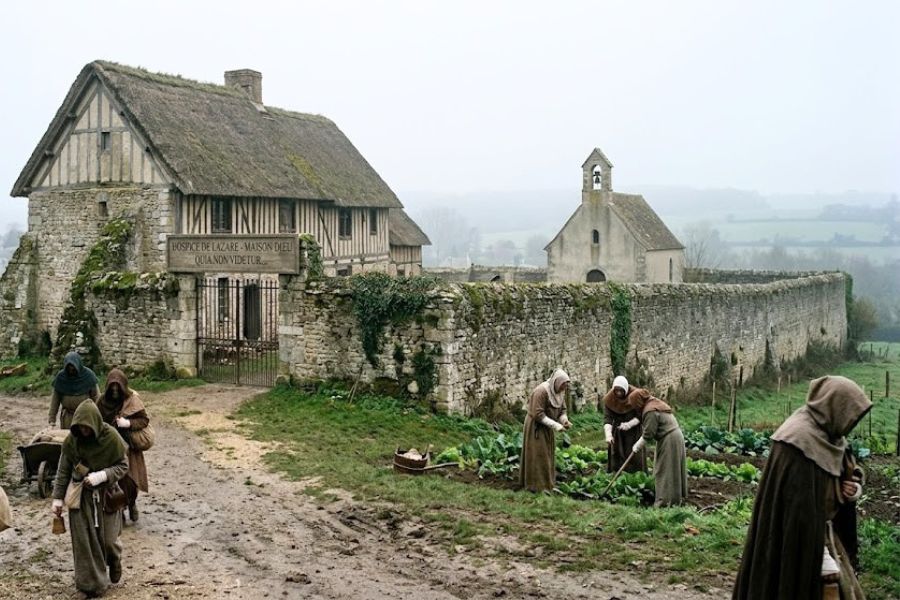
If you’d walked into a working lazar house in, say, 1280, you’d have found something closer to a small village than a hospital ward. A chapel at the center, almost always, a hall for communal meals, and individual or shared cells around a cloister or yard.
A kitchen, a brewhouse, sometimes a bathhouse, proving the modern stereotype of medieval squalor was wrong. Bathing was considered medically useful for leprous skin, and some houses had specific bathing days written into their rules.
The day ran on the monastic clock. Matins in the small hours, then the round of offices through the day, meals in silence with a reader, work for those still able. Inmates whose hands or feet had gone might do little; others gardened, kept bees, mended clothes, copied small devotional texts.
The rule at the great leper house of Saint Mary Magdalen at Sprowston, near Norwich, required brethren to attend chapel “insofar as their infirmity permits,” which is a phrase you find again and again, and which gives you a sense of the realism behind the religious frame.
Men and women lived in the same precinct in many houses, though usually in separate quarters, and the rules around contact between them were strict and frequently broken. Visitors trickled through, family members, almoners, the curious, the devout.
On certain feast days, the leper community processed through nearby streets to collect alms, hooded, ringing their clappers. For the inmates, this was probably the closest thing to a connection with their old life, and for the townspeople, it was a controlled, ritualized encounter with what they’d otherwise rather not see. Everyone went home afterward, the leper to their cell, the townsman to his bed, the system working as intended.

What Happened to Them
Leprosy began to retreat in western Europe from around 1350, for reasons no one has fully nailed down. The Black Death killed lepers along with everyone else, and at a higher rate in the close quarters of the lazar houses.
Tuberculosis, which seems to confer some cross-immunity to the leprosy bacillus, was rising, diets were changing, whatever the mix, by 1400 the houses were emptying, and by 1500 many of them stood half-occupied or were being repurposed.
The institutions didn’t all close, but mutated. Some became almshouses for the elderly poor, and others were plague hospitals during outbreaks, because the infrastructure of isolation was already there: walls, a chapel, a burial ground, a road to bring food in and bodies out. Saint-Lazare in Paris became a house of correction. Saint Giles in the Fields was dissolved by Henry VIII, and the parish that grew up around its ruins became one of the worst slums in early modern London.
What persists, more than the buildings, is the shape of the thinking. The medieval world worked out a remarkably sophisticated answer to a problem every society faces: what to do with people whose presence has become inconvenient.
You build a low wall just outside the gate, fill it with chapels and prayers and rules, and you tell yourself, as you drop a coin into the bowl by the road, that you’re being merciful.
The leper, meanwhile, stands behind the wall with their clapper, legally dead, theologically blessed, fed, housed, prayed over, and entirely, deliberately, gone.

Related posts:
 9 Historic Medieval Battles that Reshaped Kingdoms and Destroyed Dynasties
 Archaeologists Uncover Hidden Medieval Past at the Tower of London
 The Phantom Knights of Mont Saint-Michel: What Medieval Records Tell Us (and a Google Search Won’t) About Its Ghostly Past
 Virginia Hall: The American Spy the Gestapo Couldn’t Catch Who Helped Win World War II