Medieval baby names were nothing like they are now; in fact, they’re completely unrecognizable. In 1065, a baby boy born in an English village might have been called Aethelred, Godwin, Edmund, or Wulfstan. A year later, his little brother was far more likely to be a William, Robert, or Richard.
Names are one of the most personal things humans pass on, and yet they shift with politics, with conquest, with which saint is in fashion and which queen everyone wants to flatter. A name can ride high for two centuries and then disappear inside a generation.
Table of Contents
Sometimes the reason is a war, possibly a beheading, or even a pope changing his mind about who counts as holy. I find names fascinating, especially since my mom saw fit to give me an Australian first name (I’m not Australian), followed by my two middle names, Elizabeth and Margaret, after English princesses. Why? God knows.
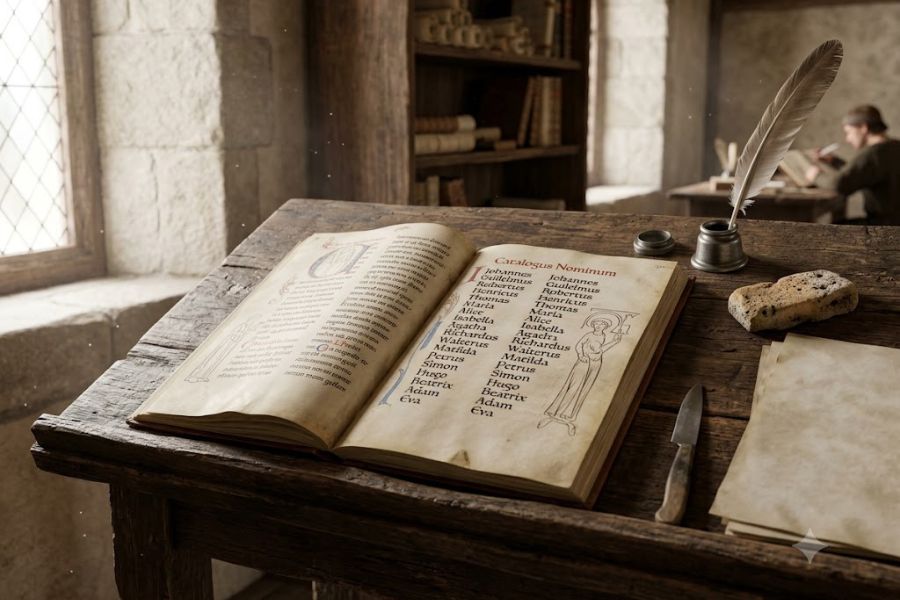
The Medieval Baby Names That Have Completely Disappeared
Here are the medieval names that once filled English baptismal records, and the specific reasons they fell out of favor.
Aethelred, Wulfstan, and the Anglo-Saxon Names the Normans Buried
Before 1066, English naming was a thicket of compound Old English words. Aethelred meant noble counsel. Aelfric meant elf-ruler. Wulfstan was wolf-stone. Godwin, the name of the most powerful family in pre-Conquest England, meant friend of God.
These names carried lineage, status, and sometimes a kind of verbal coat of arms. Parents picked elements from their own names and stitched them into the child’s, so an Aethelstan might father an Aethelwulf, who in turn fathered an Aelfred.
Then William of Normandy landed at Pevensey, and within two generations the entire system collapsed. The Norman aristocracy brought their own names with them, William, Robert, Richard, Henry, Hugh, and these became the names of power.
If you wanted your son to get on in the new England, you didn’t christen him Wulfnoth, you named him William. By 1150, English landowners with Norman-sounding first names and Old English surnames were everywhere. By 1200, the old names were largely gone from the gentry, clinging only in the countryside and among the poor.
Godwin had been the name of an earl who nearly ran the country. Within a hundred years of Hastings, it was the kind of name a Norman lord’s clerk would write down with a faint smirk. Aethelred, which had belonged to two kings of England, vanished so thoroughly that when antiquarians revived it briefly in the 19th century, it sounded like something out of a fairy tale rather than a real Christian name.
Matilda, Maud, and the Queens Who Made and Unmade a Name
Matilda is one of those names that tells you exactly when a dynasty was popular. William the Conqueror’s wife was Matilda of Flanders. Henry I’s wife was Matilda of Scotland, originally christened Edith but rebranded for Norman tastes.
Henry’s daughter, the empress who fought Stephen for the English throne in the 1140s, was also Matilda. For about a century, half the noblewomen in England seemed to be called Matilda, often shortened in everyday speech to Maud.
Then came the civil war known as the Anarchy, nineteen years of Matilda the empress fighting Stephen for the crown while the country bled. Chroniclers wrote that Christ and his saints slept. When the dust settled, and Matilda’s son Henry II took the throne, the name was still respectable, but something had shifted. Maud started replacing Matilda in common usage, and by the 14th century, even Maud was fading.
By the time the Tudors arrived, Matilda was archaic. It came back in the Victorian period as a self-consciously medieval choice, the kind of name you gave a daughter if you were really into Walter Scott.
Edith had a similar arc, though sadder. It was the name of Edward the Confessor’s queen, a woman who navigated the Conquest with a great deal of political skill and died in her bed in 1075. It was the name of Henry I’s wife before she was made to swap it for Matilda.
After that, Edith retreated into the convents and stayed there for about seven hundred years.
Hooked on the Middle Ages? Get more stories like this one in your inbox.
Saints, Cults, and the Names That Rose and Fell with Them
Medieval parents chose names for the saints associated with them. A boy named Edmund was placed under the protection of the East Anglian king, who was martyred by the Vikings in 869. A girl named Etheldreda was being entrusted to the founder of Ely Abbey. When a saint’s cult was powerful, the name was everywhere. When the cult faded, the name went with it.
Thomas exploded across England after Thomas Becket’s murder in Canterbury Cathedral in 1170. Before that, it was a relatively rare name. By 1200, it was one of the most common boys’ names in the country, and it remained so for centuries because Becket’s shrine became one of the richest pilgrimage sites in Europe.
Then Henry VIII dissolved the shrine in 1538, declared Becket a traitor rather than a saint, and ordered his name struck from liturgical books. Thomas ‘ name survived because it was also an apostle, but for a generation, naming a son Thomas in honor of Becket specifically became politically dangerous.
Other saints’ names didn’t survive the cull. Etheldreda, once one of the most venerated female saints in England, dropped out of use almost completely after the Reformation closed Ely’s pilgrimage trade.
Cuthbert held on in the north because Durham clung to its saint with both hands, but elsewhere it became the kind of name you only saw on tomb effigies. Swithun, Botolph, Wulfstan, Mildred, all of these had been ordinary baptismal names in the early medieval period.
Once the shrines were stripped and the relics burned, the names lost their gravitational pull and drifted out of fashion within two generations.
The Tudor Reshuffle and the Politics of a Christian Name
By the 16th century, naming had become a political act in a way that would have baffled an 11th-century parent. Calling your son Edward in 1547 was a nod to the new Protestant boy king. Calling your daughter Mary in 1553 was either a statement of Catholic loyalty or a piece of careful flattery to the queen.
Elizabeth went from a respectable but not especially common name in 1500 to one of the most popular girls’ names in England by 1600, for obvious reasons.
The Reformation also imported a new layer of names from the Old Testament. Suddenly, English parish registers filled with Sarah, Rebecca, Hannah, Joshua, and Abraham, names that had barely existed in medieval England outside the Jewish communities expelled in 1290.
Puritan families pushed even further, producing the famous virtue names, Patience, Mercy, Prudence, Fear-God, and the unforgettable Praise-God Barebone. Most of those didn’t last either, killed off by the Restoration and the general English preference for not having to introduce yourself as Fly-Fornication.
What got squeezed out in all this was the great middle layer of medieval saints’ names. Agnes had been one of the top girls’ names in 14th-century England. By 1650, it sounded like something a grandmother might be called, and by 1750, it was nearly extinct outside Scotland and Catholic households.
Margery, the everyday English form of Margaret, went the same way, undone partly by association with the more rustic-sounding peasant heroines of popular tales.
Hodge, Wat, and the Working Names That Lost Their Dignity
Some medieval names didn’t die out because of politics, but from class. Roger, Robert, Walter, and Richard were all perfectly respectable Norman imports in the 12th century, names borne by earls, bishops, and kings.
Over the centuries, their nicknames slid down the social ladder. Hodge for Roger became shorthand for any English peasant, the way Tommy later meant any British soldier. Wat for Walter became forever attached to Wat Tyler and the 1381 Peasants’ Revolt. Hick for Richard became a generic term for a country bumpkin.
Once a nickname became a slur, the formal name often suffered too. Roger stayed in use but lost some of its old aristocratic shine. Walter held on longer, especially among the gentry, but by the 18th century, it was a name people associated with butlers and elderly clergymen.
Hick, well, Hick never recovered. Neither did Hob, the medieval pet form of Robert that gave us hobgoblin and hobnob and eventually wandered out of the human-name category entirely.
This pattern repeats with girls’ names, too. Joan was once one of the most common names in medieval England, the female form of John and the name of saints, queens, and a notorious Pope, according to legend. By the Tudor period, Joan had become the generic name for a serving maid or a milkmaid.
The proverb, ” Every Jack must have his Jill, “ replaced an older ” Every Jack must have his Joan”, and the name slid down with it. Jane, originally a variant, climbed up to take its place at court. The same woman might have been Joan in 1450 and Jane in 1550, simply because Joan had become a name you gave a kitchen girl.
Naming patterns are recorded in parish books, tax rolls, and the wills of dying men. A grandfather named Aethelred, a father named William, a son named Thomas, a grandson named Edward, and a great-grandson named Joshua. Five generations, five different worlds, and the only thing connecting them was the village they were buried in.
Love a good medieval story?
Join our readers and get tales of kings, queens, castles and ordinary medieval lives straight to your inbox.

Kylie Lang is a nationally syndicated travel journalist with bylines on the Associated Press Wire & more, a medieval history writer, and the founder and lead author of Tales of the Middle Ages (talesofthemiddleages.com). She holds a BA (Honours) in History from the University of Kent and is a member of the British Guild of Travel Writers.
Related posts:
 The Remarkable Life of Emma of Normandy: She Ruled Beside Cnut and Aethelred
 The Top 10 Baby Names in the Middle Ages (And Your Medieval Match)
 Empress Matilda: The Crown, the Betrayal, and the Fight of Her Life
 Empress Matilda: Lady of the English and Queen of Ice and Snow. But Should She Have Been England’s First Queen?