
The sentence was read, the judge broke his white wand, and the prisoner was led back to a cell that smelled of damp stone and old straw. Outside, word was already traveling through the city. Pamphleteers were sharpening their quills, and carpenters were checking the scaffold timbers.
In Tudor and Stuart England, dying on the block or at Tyburn was a performance of the highest order. There was a script, and everyone from the lowliest cutpurse to a fallen queen was judged on how well they spoke their lines.
Table of Contents
What happened in those last days, between the verdict and the final breath, was a peculiar mix of theology, theater, and politics. Get it right, and you might salvage your name, your family’s fortunes, even your soul. Get it wrong, and you’d be remembered as a coward, a traitor, or worse, an unrepentant heretic destined for hell.
From Sentence to Cell
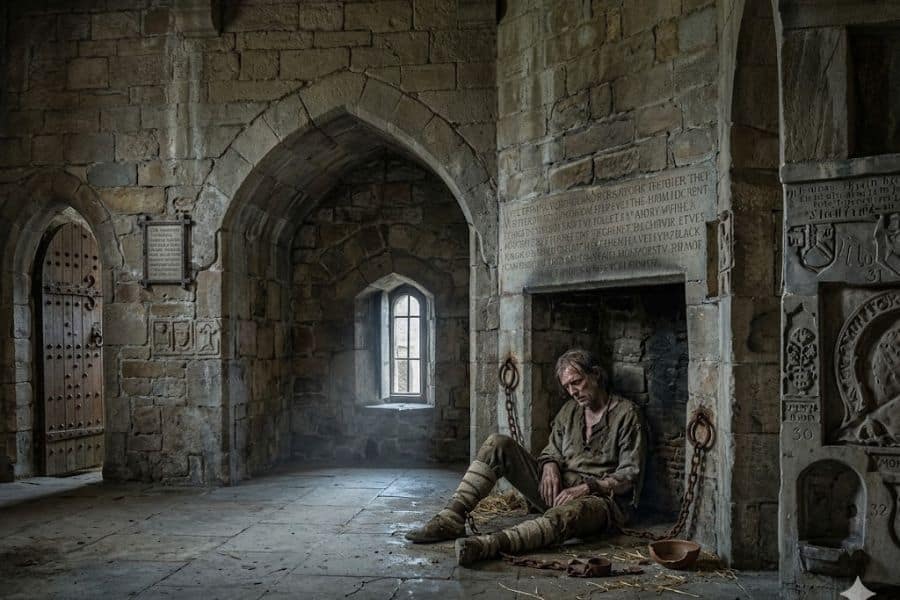
Once the death sentence was passed, the prisoner’s world shrank fast. For commoners, that often meant Newgate, a foul, overcrowded hole where the condemned were kept in a separate ward called, with grim simplicity, the condemned hold.
For those of higher rank, it might be the Tower of London, where conditions varied wildly depending on who you were and who you’d offended. Anne Boleyn was given the lodgings she had stayed in before her coronation. Lesser prisoners were stuffed into damp cells with bad food and worse company.
The gap between sentence and execution was usually short. Days rather than weeks for most, though a politically sensitive case might drag on while the Crown weighed timing. Thomas More waited about a week. Lady Jane Grey waited months while Mary I tried, briefly, to spare her.

The uncertainty was its own torture. Letters sometimes survive from this period, and they shake on the page, written by people who knew the warrant could arrive at any hour.
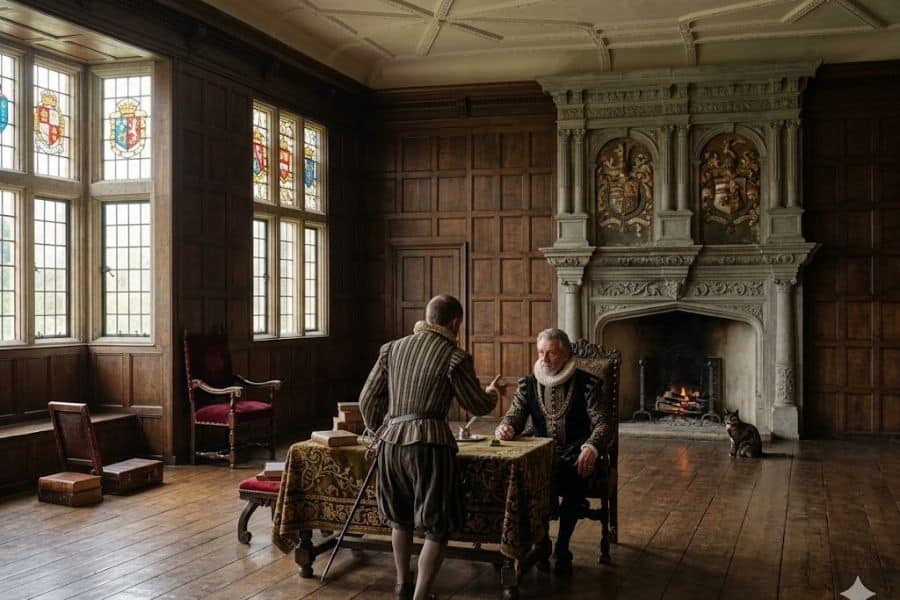
Visitors were allowed in many cases, especially for the well-connected. Servants brought clean linen for the scaffold, because what you wore mattered, as did your composure when receiving them. Word of how you behaved in the cell traveled, and the public was already forming an opinion before you ever set foot outside.
Even dying in the Tudor period was hard work. For all we romanticize about the past, this isn’t an era I would want to have lived in.
The Chaplain’s Work
The single most important visitor in those last days was the prison chaplain, sometimes called the Ordinary. His job was to bring the prisoner to a state of repentance suitable for a Christian death. This wasn’t optional comfort. It was a theological necessity in a society that took heaven and hell as literal destinations.
The Ordinary would press the prisoner to confess, not legally but spiritually. He’d run them through the catechism, pray with them, read scripture, and warn them, sometimes brutally, about what awaited an unrepentant soul.
At Newgate by the late seventeenth century, the Ordinary also had a sideline business: he sold the prisoners’ confessions afterward as cheap printed pamphlets. The dying speech industry was real and profitable.
For religious prisoners, the chaplain’s role got complicated. A Catholic condemned under Elizabeth I might refuse the Protestant minister entirely, insisting on a priest who would not be granted.
A Protestant martyr under Mary I faced the reverse problem. In these cases, the prisoner had to do the spiritual work themselves, and the cell became a place of private prayer, smuggled letters, and quiet defiance.
Edmund Campion, the Jesuit, spent his last days arguing theology with anyone who came near him, right up to the morning he was dragged to Tyburn.
Hooked on the Middle Ages? Get more stories like this one in your inbox.
The Last Meal and the Last Night
There was no formal tradition of a grand last meal in the way later centuries imagined it. What the prisoner ate depended entirely on who they were and who was paying. The wealthy could order food brought in. The poor at Newgate ate prison rations, which were notoriously thin unless friends sent provisions.
Drink, though, was nearly universal. Strong ale and wine flowed freely in the final hours, partly out of pity and partly because a steady prisoner made for a better spectacle. A man too drunk to stand was an embarrassment, but a man stone sober and shaking was worse.
The night before execution had its own rhythm. At Newgate, the bellman of St Sepulchre’s would come at midnight and ring his handbell outside the condemned cell, reciting a grim little verse urging the prisoners to repent before the morning.
Imagine trying to sleep through that. Most didn’t. They prayed, wrote letters, sat with their chaplain, or simply waited for first light.
Clothing was prepared with care. A nobleman might choose a dark doublet, perhaps something specific to make a point. Charles I famously wore two shirts to his execution in January 1649 so he wouldn’t shiver in the cold and have the crowd mistake it for fear.
Anne Boleyn wore a gown of dark damask with a crimson kirtle beneath it, the color of martyrs. Every detail of the dress was read by the crowd like a sentence in a book.

The Walk and the Crowd
The journey from cell to scaffold was itself part of the performance. For prisoners at the Tower, it was short, sometimes only as far as Tower Hill or, for the most privileged, the private scaffold on Tower Green.
For those bound for Tyburn, it was a slow, jolting cart ride of around three miles through the streets of London, with stops at taverns along the way where the condemned might be offered one last cup. The procession was led by officers and watched by enormous crowds.
Tyburn on a hanging day could draw tens of thousands. Vendors sold pies and pamphlets. Pickpockets, with grim irony, worked the edges of the crowd that had come to watch other thieves die. Windows along the route were rented out at premium prices, and the gallows itself, the famous triple tree, stood as a fixed landmark of the city’s grim entertainment calendar.
For the high-born facing the block rather than the rope, the crowd was smaller but the stakes higher. A beheading was reserved for the privileged, and the audience often included ambassadors, courtiers, and the men who had engineered the prisoner’s downfall.
Thomas Cromwell looked out at a crowd that contained more than a few of his old enemies. Walter Raleigh, on the morning of his execution in 1618, joked with the sheriff and asked to see the axe, remarking that it was a sharp medicine but a sure cure for all diseases. The crowd loved him for it.

The Speech
The scaffold speech was the heart of the ritual. The condemned was expected to address the crowd, and the content followed a fairly rigid pattern. Acknowledge the justice of the sentence, even if you privately believed it monstrous.
Ask forgiveness of those you’d wronged. Forgive those who had wronged you, including, pointedly, the executioner. Affirm your faith. Pray for the monarch. Commend your soul to God.
Deviating from the script was risky and revealing. Anne Boleyn stuck close to it, refusing to attack Henry VIII or protest her innocence directly. She praised him as a ‘good, gentle, and sovereign lord,’ which generations of historians have read as either careful diplomacy to protect her daughter, Elizabeth, or as pure sarcasm aimed at anyone listening closely.
Thomas More told the crowd he died ‘the king’s good servant, but God’s first,’ which was both obedient and quietly damning.
Others broke the form entirely. Charles I, on the scaffold outside the Banqueting House, declared himself ‘a martyr of the people’ and refused to admit the legitimacy of the court that had condemned him.
Religious martyrs on both sides of the Reformation often used their final minutes to preach doctrine, which is exactly what authorities feared. By the later Stuart period, scaffold speeches were sometimes cut short, drowned out by drums, or simply seized and rewritten by pamphleteers before they could spread.
Forgiving the executioner mattered, practically as well as spiritually. The headsman’s job was awful, the axes were often badly maintained, and a nervous executioner could make a horrific mess of the work. Margaret Pole, Countess of Salisbury, was reportedly hacked at multiple times before she died in 1541.
The customary tip of coins given to the executioner, and the formal words of pardon spoken from the scaffold, were a final attempt to make sure the man swinging the blade had a steady hand.
After the Blow
The performance did not end with death. The body’s fate was the last act, and it was carefully managed. Heads of traitors were boiled, tarred to preserve them, and set on spikes over London Bridge or the gates of the city.
Thomas More’s daughter Margaret Roper reportedly bribed a guard to retrieve her father’s head before it rotted, and is said to have kept it preserved until her own death. Quartered limbs of the most notorious traitors were sent to provincial towns as warnings.
For those beheaded privately at the Tower, the burial was usually quick and unceremonious. The chapel of St Peter ad Vincula holds the bones of an extraordinary cast: Anne Boleyn, Catherine Howard, Jane Grey, Thomas More, Thomas Cromwell, and many others.
The Victorian restoration of the chapel uncovered remains that were identified, with varying degrees of certainty, and reburied. The chapel today is one of the strangest small spaces in England, packed with the dead of three centuries of royal politics.
The pamphlets came almost immediately. Last dying speeches, real or invented, were printed within hours and sold for pennies on the same streets the condemned had been carted through. A ‘good death,’ performed well, could rehabilitate a reputation in print even when it could not save a life. A bad one, a fit of panic, a refusal to repent, a fight on the scaffold, became a cautionary tale recycled for decades.
What strikes you, reading through the accounts that survive, is how much agency the condemned could still wield in those final hours. They had lost everything else. Their lands, their titles, their freedom, often their families. But the scaffold gave them one last platform, and the script, restrictive as it was, allowed for a surprising amount of meaning if you knew how to use it.

Love a good medieval story?
Join our readers and get tales of kings, queens, castles and ordinary medieval lives straight to your inbox.

Kylie Lang is a nationally syndicated travel journalist with bylines on the Associated Press Wire & more, a medieval history writer, and the founder and lead author of Tales of the Middle Ages (talesofthemiddleages.com). She holds a BA (Honours) in History from the University of Kent and is a member of the British Guild of Travel Writers.


