You’ve seen the scene. A Scottish village, a nervous bride, an English lord riding up to claim his right to her wedding night while her new husband stands there powerless. Braveheart came out in 1995 and planted that image firmly in our imagination, so much so that we believed it to be true. But did Prima Nocta exist?
It isn’t. There’s no reliable evidence that any medieval English lord had a legal right to sleep with a bride on her wedding night. The right of the first night, prima nocta, droit du seigneur, whatever you want to call it, is largely a later invention, hardened into fact by 18th and 19th-century writers and then handed to Mel Gibson.
Table of Contents
But before you feel too relieved on behalf of medieval peasant women, wait. What the lords actually had was better documented, and, in some ways, nastier. It makes me very glad that I live in the 21st century rather than the Middle Ages.

Did Prima Nocta Exist?
The reality is that this story came from people writing about the Middle Ages long after they were over.
The French historian Alain Boureau thoroughly researched the sources for his book The Lord’s First Night: The Myth of the Droit de Cuissage, published in English in 1998, and found that the supposed right appears in medieval documents only rarely.
When it does show up, it’s usually as a metaphor, a joke, or a complaint about a specific abusive lord, not a description of a working legal custom.
The idea really caught fire in the 16th, 17th, and 18th centuries, when writers reaching back for evidence of how monstrous feudalism had been found prima nocta a very useful stick.
Voltaire ran with it. Enlightenment thinkers ran with it. By the time you get to the 19th century, it’s being reported as straightforward medieval fact in popular histories, and from there it slides into novels, opera (The Marriage of Figaro turns on exactly this premise), and eventually film.
What you almost never find is a medieval English manorial document saying anything like ‘the lord shall lie with the bride‘. What you do find, over and over, is the lord taking money instead. Which brings us to the part of the story that actually happened.
The Braveheart Prima Nocta Scene
What Power Did a Lord Actually Have Over a Peasant Woman?
To understand the real relationship between a lord and the women on his manor, and villein status. An unfree peasant, a villein, was legally tied to the manor.
Her body, her labor, her marriage, and her children were all considered, in a legal sense, part of the lord’s assets. The Statute of Merton in 1235 confirmed that villeins couldn’t leave the manor without permission and couldn’t marry off it without paying.
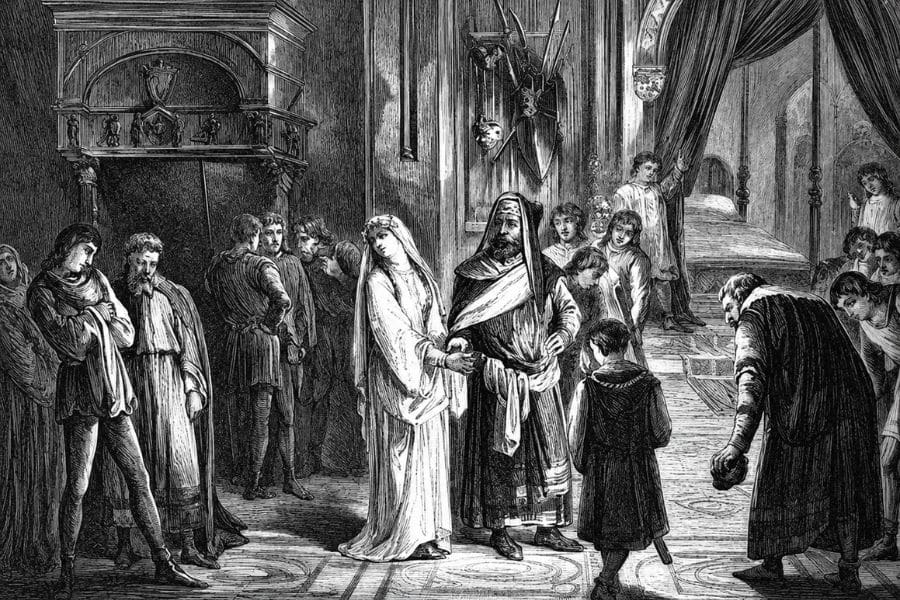
That didn’t mean the lord could do whatever he liked. Villeins had customary rights, enforced through the manor court. A lord who trampled them too openly could face resistance, from his own steward refusing to record something outrageous, from tenants withholding labor, from the church, or eventually from the royal courts if the abuse crossed into criminal territory.
The system was exploitative to its bones, but it was still a system with rules.
Where those rules bit hardest on women was around three specific moments: marriage, sex, and childbirth. Each of those had a fine attached. Each of those fines is recorded, by name, by amount, in the court rolls that survive from thousands of English manors.
And the pattern of who paid what tells you far more about medieval peasant life than any invented scene of a lord at the bedchamber door.
Hooked on the Middle Ages? Get more stories like this one in your inbox.
What Were Merchet, Leyrwite, and Childwite?
Merchet was the marriage fine. When a villein woman married, her father (or she herself, if she had her own holding) paid the lord for the privilege. Amounts varied enormously.
On the Wakefield manor rolls in West Yorkshire, which survive in a good series from 1274 onward, merchet payments ranged from a few pence to several shillings, with occasional huge payments from wealthier peasant families.
On the Elton rolls in Huntingdonshire, edited by the Selden Society, the same pattern appears: modest payments most of the time, larger ones when the woman was marrying off the manor or marrying someone of higher status.
Leyrwite was the fornication fine, paid when an unmarried villein woman was found to have had sex. Judith Bennett, whose work on medieval peasant women (Women in the Medieval English Countryside, 1987) is the standard, has traced how leyrwite fell almost exclusively on women.
Men who slept with those same women rarely paid anything. The fine was usually 6 pence to 2 shillings, a real bite from a peasant household’s cash, and the woman’s name went into the record. Everyone in the village knew.
Childwite was the fine for bearing a child out of wedlock, sometimes charged on top of leyrwite, sometimes instead of it.
Between them, these three fines meant that a peasant woman’s reproductive life was a taxable event from start to finish. She paid to marry. She paid if she didn’t marry and got caught. She paid if she had a child either way.
The lord didn’t need to sleep with her to profit from her body.
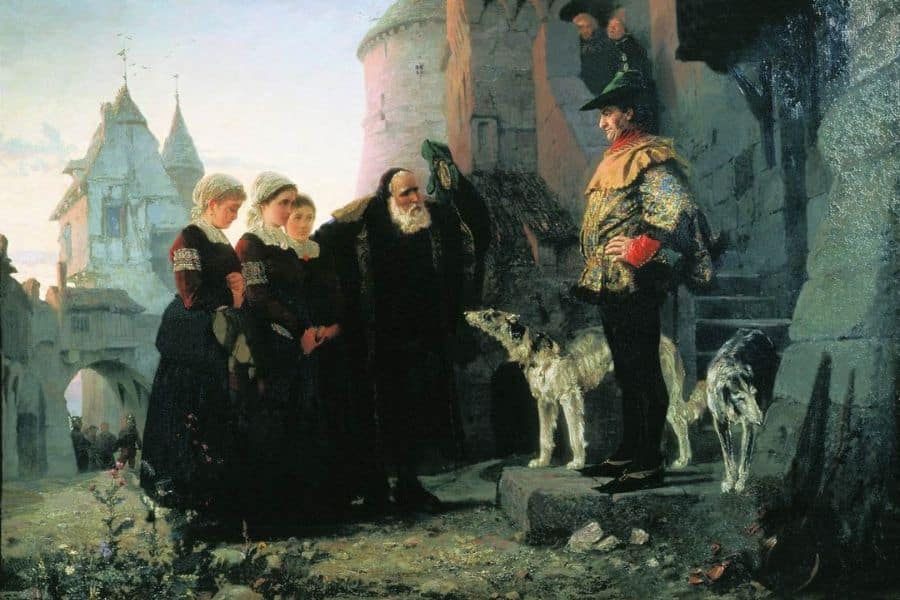
Could a Peasant Woman Refuse a Marriage Her Lord Wanted?
In theory, canon law required consent from both parties for a marriage to be valid. The church was firm on this from the 12th century onward, and church courts would sometimes annul marriages proven to have been forced.
In practice, on a manor, consent was a slippery thing. A lord who wanted a particular tenant matched with a particular widow (to keep a holding in productive hands) had a lot of leverage, and the woman’s father had a lot of leverage over her.
The court rolls show cases of women being fined for refusing marriages proposed by the lord. On some manors, an unmarried heiress could be pressured hard, because her land was too valuable to sit idle.
On others, widows were expected to remarry quickly or pay a fine to remain single, which is one of the reasons you see so many peasant widows appearing in the rolls with a note that they’ve paid to hold their late husband’s land in their own right.
So could she refuse? Sometimes. A woman with a strong family, a sympathetic priest, or a lord who didn’t want the fight could hold out. A woman without those things had a much narrower path.
The freedom of choice we take for granted, and that the church officially endorsed, ran up against the economic logic of the manor almost every time.
What Happened When a Lord Did Abuse a Woman on His Manor?
Abuse absolutely happened, and it was almost never called what it was. A lord who raped a peasant woman on his own land was rarely prosecuted. This would be partly because she’d have to bring the case, partly because the local jury would often be his own tenants, and partly because rape law in medieval England was structured around the woman’s status and the theft of her marriageability rather than around the assault itself.
When cases do surface, they tend to come up sideways. A woman is fined for leyrwite and the entry notes she named a particular man, sometimes a bailiff or steward. A complaint reaches the royal courts about a lord who has ‘oppressed’ his tenants, and buried in the list is a woman who was ‘defiled’.
Bracton, the 13th-century legal treatise attributed to Henry of Bratton, discusses raptus at length, but the remedies he describes were almost impossible for an unfree woman to pursue against her own lord.
What you don’t find anywhere is a lord invoking a legal right to a bride’s first night as a defense. Because no such right existed to invoke. The abuse that happened was illegal abuse, hidden or ignored or bought off, not the exercise of a custom written into the law of the land.
So Why Does Everyone Still Believe in Prima Nocta?
Because it’s a fantastic story, and stories move faster than footnotes. Braveheart gave prima nocta a face, a location, and a villain, and once you’ve watched Edward Longshanks calmly explain that he’ll breed the Scots out, it’s hard to unremember.
Add in The Marriage of Figaro, a shelf of Victorian potboilers, and the general modern appetite for medieval history as a parade of horrors, and the myth has all the momentum it needs.
Boureau’s argument, and it’s a good one, is that prima nocta survives because it does useful work for every era that repeats it.
For Enlightenment writers, it proved the barbarism of the old order. For 19th-century liberals, it justified everything the modern state had swept away.
For a Hollywood screenwriter in 1995, it gave William Wallace a personal reason to hate the English king. The myth keeps getting picked up because it keeps being useful, not because anyone has found new evidence for it.
The real story of what happened to peasant women on English manors is in the court rolls, sitting in county record offices and the National Archives at Kew, in ink that has faded but not vanished.
Names, amounts, dates. A woman called Alice paying 12 pence to marry a man from the next village. A woman called Matilda paying 6 pence for leyrwite in 1298. A widow called Emma paying to keep her own land. That’s the record.
## Sources
University of Chicago Press. https://press.uchicago.edu/ucp/books/book/chicago/L/bo3629910.html
Love a good medieval story?
Join our readers and get tales of kings, queens, castles and ordinary medieval lives straight to your inbox.

Kylie Lang is a nationally syndicated travel journalist with bylines on the Associated Press Wire & more, a medieval history writer, and the founder and lead author of Tales of the Middle Ages (talesofthemiddleages.com). She holds a BA (Honours) in History from the University of Kent and is a member of the British Guild of Travel Writers.
Related posts:
 What Was Daily Life Like for a Peasant Woman in the Middle Ages?
 What Did a Medieval Knight Actually Cost? The Horses, the Armor, the Retinue, and the Debt
 The Night Witches Were Fearless Russian Women Who Terrorized the Nazis from the Sky
 Medieval Wedding Night Customs: The Priest, the Crowd, and the Very Public Marriage Bed