You’ve seen the pitched battles in paintings and the films, and it makes for a great story. A king on a white horse, banners flying, knights in their full armor and regalia, archers shooting arrows into the sky, while the defenders stand on the battlements. It’s the image we conjure up when someone says “medieval siege.” But most medieval wars were not won that way.
They were won by sitting outside someone’s walls for months, sometimes years, until the people inside ran out of grain, or water, or hope. Siege warfare was the slow grinder of the medieval world, and commanders who understood it tended to keep their heads. Those who didn’t usually lost both armies and territories.
Table of Contents
What follows is what a siege actually looked like, on both sides of the wall. The engineering, the calculations, the diseases, the negotiations, and the psychology of people trapped together waiting to see who would break first.
Why Medieval Sieges Decided More Wars Than Battles
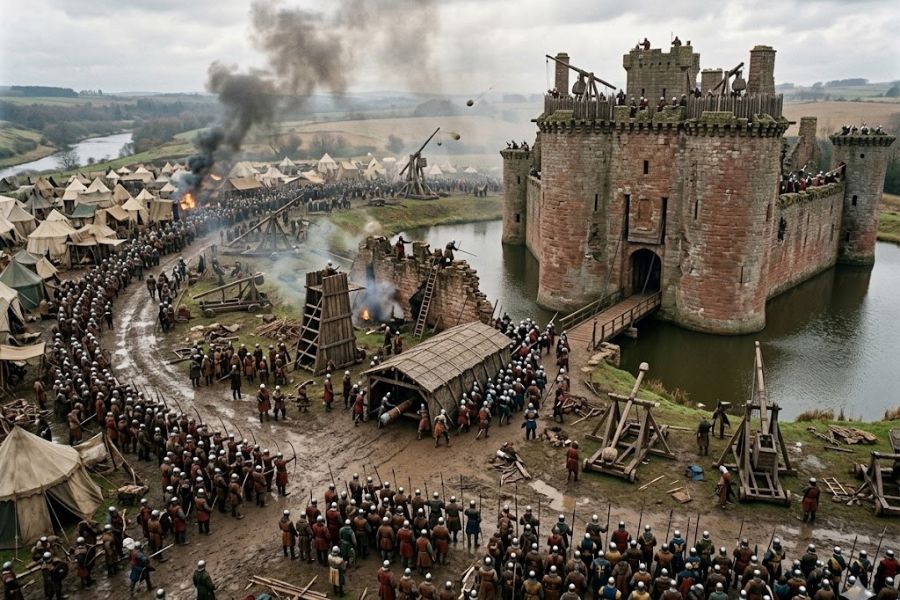
A medieval castle was a tool of territorial control. Whoever held the castle held the surrounding land, the roads, the rivers, and the tax revenue that came with them. An army could march past a hostile fortress, but the garrison inside would simply ride out after them, cut their supply lines, and pick off stragglers. Leaving an enemy castle at your back was suicide.
This is why so much medieval warfare looked less like Agincourt and more like patient, miserable encampments around stone walls.
William the Conqueror spent far more of his reign besieging rebellious strongholds than he ever did in open battle.
King John lost his kingdom largely because he couldn’t hold his castles in Normandy. Edward I built his great Welsh fortresses precisely because controlling castles meant controlling a country.
A pitched battle was a gamble. You could lose your army in an afternoon, and with it your throne. A siege was the safer play. Expensive, yes. Boring, often. But the outcome was usually predictable if you had the patience and the supplies to see it through. Commanders who lived to old age tended to be the ones who knew this.
What the Attackers Actually Did All Day
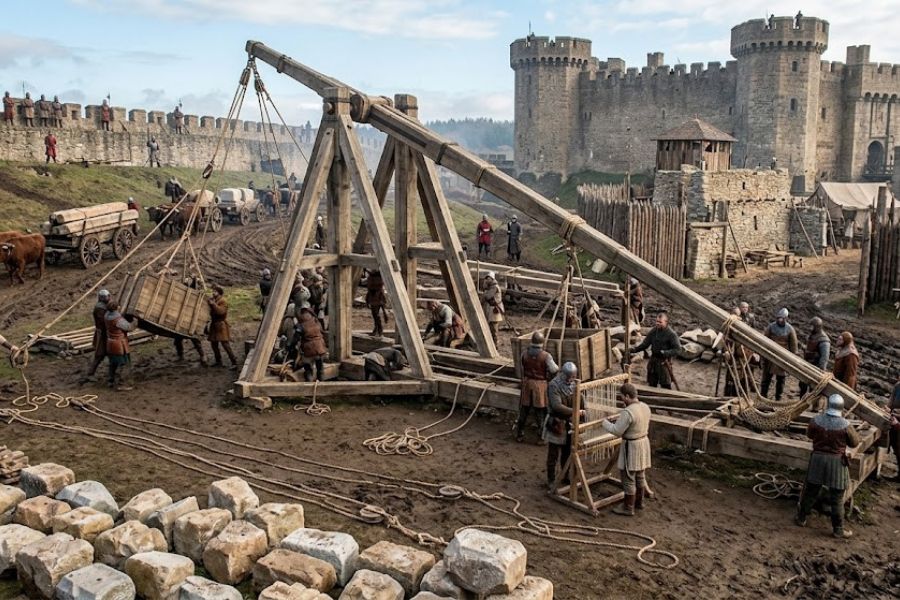
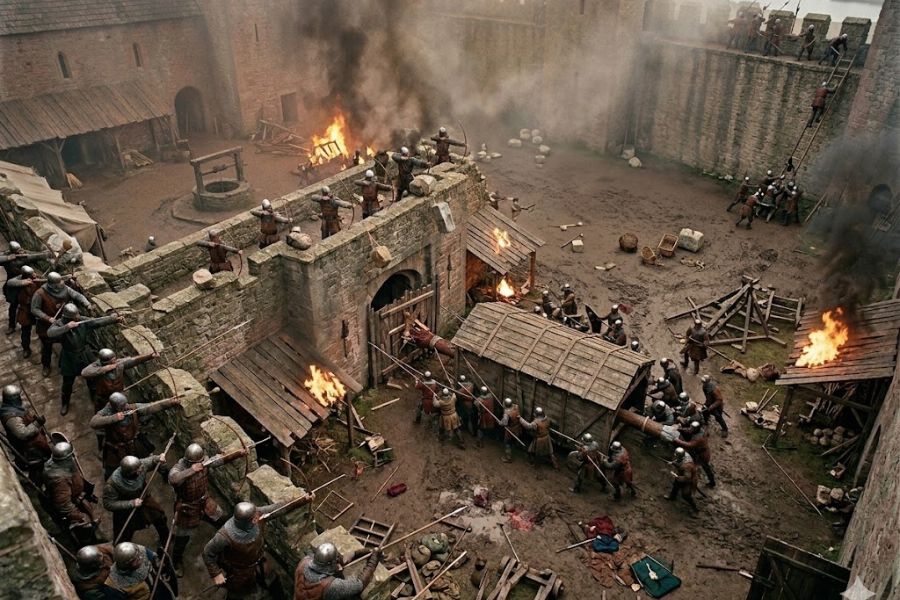
The image of siege warfare most people carry around is a trebuchet hurling boulders at a wall while soldiers wave swords. That happened sometimes, but it was a small part of the work. The bulk of a besieging army’s time went into digging, building, and waiting.
The first task was to surround the castle, or at least cut off its main approaches. This meant building a ring of camps, ditches, and palisades around the target, which was called circumvallation.
If a relieving army was expected, the besiegers might build a second ring, a contravallation, facing outward, so they could fight in both directions. Julius Caesar did this at Alesia, and medieval commanders copied the technique whenever they could afford the labor.
Then came the siege works proper. Saps, which were trenches dug toward the walls under cover. Mines, which were tunnels dug beneath a tower or section of wall, propped up with timber, then deliberately collapsed by burning the props out.
When the tunnel fell in, the wall above it cracked or toppled. Mining brought down a corner of Rochester Castle in 1215 after King John ordered the fat of forty pigs sent to fuel the fire. Siege engines came too, mangonels and trebuchets flinging stones, sometimes dead animals or even captured messengers, over the walls.
None of this was quick. Building a serious trebuchet on site took weeks, and digging a mine took even longer. And all the while, the besieging army had to feed itself, often in country it had already stripped bare. Sieges killed attackers as readily as defenders, just by different means.
The Math of Holding Out
From inside the castle walls, survival came down to arithmetic. How much grain in the storerooms, how many barrels of salt pork, how deep the well, and how reliable. How many mouths to feed, including the useless ones: refugees from the countryside, servants, animals.
A well-provisioned castle could hold out for a startling length of time. Harlech, during the Wars of the Roses, held out for seven years before surrendering in 1468. Kenilworth resisted Henry III’s army for nearly six months in 1266, and only fell because dysentery swept through the garrison.
Chateau Gaillard, Richard the Lionheart’s prized fortress in Normandy, held against Philip Augustus for around eight months in 1203 to 1204, and would have lasted longer if the defenders hadn’t expelled the noncombatants in a desperate move to stretch the food supply. The French refused to let them through their lines, and several hundred civilians starved to death in the ditch between the two armies, watched by both sides.
The basic ration question was brutal. A working adult needs roughly 2,500 calories a day, more in cold weather and during heavy labor. Medieval garrisons survived on bread, dried peas, salt meat, and beer or watered wine.
Storerooms were measured in months, not days, and a castellan worth the name knew exactly how many he had. When Simon de Montfort the Younger held Kenilworth, he had reportedly stocked enough grain for a year. He still ran out, partly because dysentery turned the food into a death trap rather than fuel.
Water was the other constraint, and often the worst one. A castle without its own well was finished the moment its cisterns emptied. Many fortresses were built specifically around a deep, defensible water source for this reason.
Lose access to clean water, and you had perhaps three or four days before the garrison collapsed, regardless of how much grain sat in the cellars.
Disease, the Real Killer
More people died in sieges from disease than from arrows, fire, or starvation. This was true on both sides of the wall, and it shaped how long a siege could realistically last.
Inside the castle, the problem was concentration. Hundreds or thousands of people, plus livestock, the dead, all packed into a space designed for a fraction of that number. Sanitation collapsed quickly as the garderobes (toilets) overflowed regularly.
Wells became contaminated, lice spread typhus, and flies spread dysentery. The siege of Acre during the Third Crusade saw both Christian besiegers and Muslim defenders ravaged by what chroniclers called the bloody flux, dysentery so severe it killed knights and kings alike.
Frederick Barbarossa’s son died of it, as did dozens of named nobles whose deaths were recorded, and thousands of common soldiers whose names were not.
Outside the walls, the besiegers had it nearly as bad. An army of ten or twenty thousand men camped in one spot for months produced a sea of human and animal waste. Their water sources were the same rivers their latrines drained into.
Henry V’s army at the siege of Harfleur in 1415 was so devastated by dysentery that he had perhaps half his original force left by the time he marched on toward Agincourt. The men he lost to the bloody flux outnumbered everyone he lost in the famous battle that followed.
This is why sieges often ended not in dramatic assaults but in quiet, exhausted surrenders. Both sides were sick, hungry, and demoralized. The question was simply who reached the breaking point first.
The Psychology of the Long Wait
A siege was a battle of nerves as much as resources. Defenders knew that if the walls were breached by assault rather than surrender, the laws of war as they were understood gave the attackers the right to sack the place. No holds barred. Men killed, women raped, and the town burned.
When Edward I took Berwick in 1296, his men reportedly killed thousands of civilians over three days. When the French finally stormed Limoges in 1370, the Black Prince ordered a massacre that horrified even his contemporaries.
So defenders had a powerful incentive to negotiate before the walls fell. And attackers had a powerful incentive to keep the threat of slaughter credible, while also offering reasonable surrender terms early on. The usual convention was that a garrison could agree to surrender on a fixed date if no relief came by then.
They’d send messengers to their lord asking for help, and if none arrived, they’d march out with their lives, sometimes with their weapons and banners, and hand over the keys. This let everyone save face. The defenders had done their duty, and the attackers had won without storming the walls, so the civilians inside survived.
When these conventions broke down, things got grim fast. At Rochester in 1215, King John wanted to hang the entire garrison after they finally surrendered. He was talked out of it, but only because his advisers warned that future garrisons would fight to the death rather than trust his word.
The threat of massacre worked best when it was occasionally followed through and occasionally restrained. Pure cruelty made enemies fight harder, but on the flip side, pure mercy made them refuse to surrender at all.
Inside the walls, the psychological pressure compounded with every passing week. Hunger sharpened tempers, and sickness thinned the ranks. Lords began to wonder which of their men might open a gate at night for a bag of silver.
Treachery ended more sieges than assaults did. Someone always had a cousin in the besieging army, a grudge against the castellan, or a wife and children in the town outside praying for it all to stop.
How Sieges Actually Ended
Most sieges concluded in one of four ways, and storming the walls was the rarest. A negotiated surrender, on agreed terms, was by far the most common. Starvation or disease forcing a collapse from within was next, followed by relief from an outside army that broke the siege. An actual successful assault, with ladders, breaches, and hand-to-hand fighting in the breach, was the exception rather than the rule.
When Harfleur fell to Henry V, it was through negotiated surrender after the defenders failed to receive promised French relief. When Chateau Gaillard finally fell, it was through a combination of mining, assault on a weakened section, and the exhaustion of a garrison reduced to a fraction of its original size.
When Kenilworth surrendered to Henry III, it was disease and hunger, not the king’s siege engines, that did the work. The famous trebuchets and battering rams were the supporting cast, but it was time that was the lead.
After a siege ended, the work wasn’t over. The victors had to garrison the place, repair the damage, and feed whoever was left alive inside. Sometimes the cost of taking a castle exceeded any benefit from holding it.
Philip Augustus spent vast sums to take Château Gaillard and the surrounding Norman strongholds, but the loss permanently weakened King John’s position in France, and the investment paid off in territory and tax revenue for generations.
Other sieges were strategic disasters even in victory. Henry V’s army was so wrecked by Harfleur that he nearly didn’t make it home, let alone win Agincourt.
The people who lived through sieges, the women carrying water under arrow fire, the boys running messages between towers, the priests burying the dead in shallow ditches because there was no room in the chapel, rarely got their names recorded.
The chronicles mention the lords and the captains, but what about those who made cogs turn? They were the majority of everyone inside those walls, and their endurance, or their failure of endurance, decided more medieval wars than any king on a white horse ever did.