If you love medieval history, you’ll have heard of Simon de Montfort, the father of the English Parliament. He had quite the life, and many believe he was more of a sinner than a saint.
So who was Simon de Montfort? He was Earl of Leicester, a French-born nobleman who married a king’s sister in secret, humbled that king in battle, and, in January 1265, summoned the first English parliament, including elected representatives from ordinary towns, the ancestor of today’s House of Commons.
Table of Contents
Nine months later, he was hacked to pieces on a battlefield at Evesham. He was a reformer, a zealot, a soldier, and a bigot, sometimes all in the same week. But that’s just the short version. Let’s meet him properly.
A Crusader’s Son with Nothing to Inherit
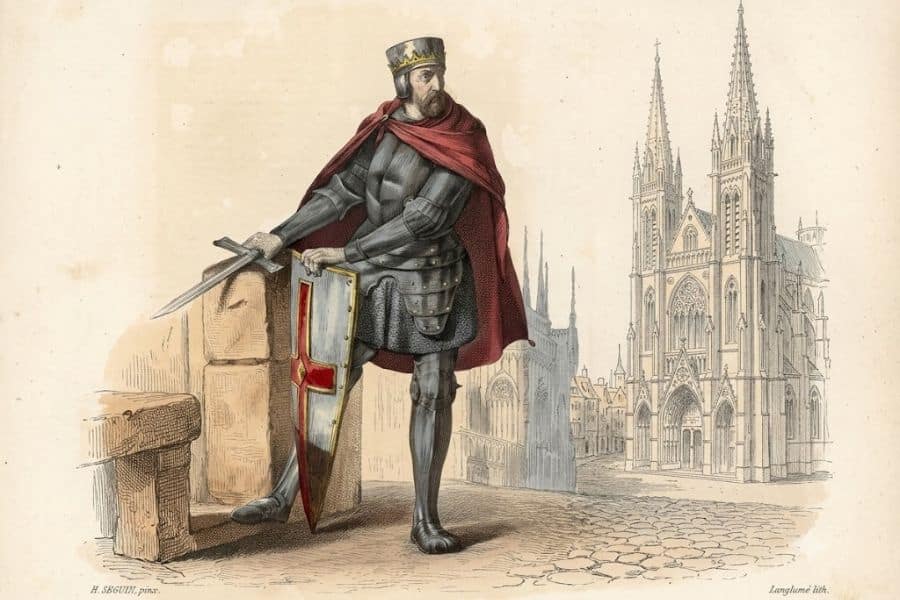
Simon was born around 1208 at Montfort-l’Amaury, near Paris, into one of the hardest families in Christendom. His father, also called Simon, was the military leader of the Albigensian Crusade, the vicious holy war the Church launched against the Cathars of southern France.
This was the campaign that produced the sack of Béziers, where thousands were slaughtered inside a church, and the famous order supposedly given to the soldiers: kill them all, God will know his own.
Simon’s father captured Carcassonne, ruled the conquered lands with an iron fist, and died in 1218 with his skull crushed by a stone hurled from a siege engine, worked, the story goes, by the women of Toulouse. Some would say a fitting end.
Simon didn’t even inherit much. He was a younger son, which in the Middle Ages meant you were born with a famous name and an empty purse. What he did have was a claim. His grandmother, Amicia de Beaumont, had been co-heiress to the earldom of Leicester in England, and Simon decided that earldom should be his.
So around 1229, he crossed the Channel, presented himself to the young King Henry III, did a deal with his older brother to give up the family’s French lands, and set about charming his way into the English inheritance.
By the late 1230s, the earldom of Leicester was his. Not bad for a landless second son with a good name and a lot of nerve.
The Secret Marriage That Scandalized a Kingdom
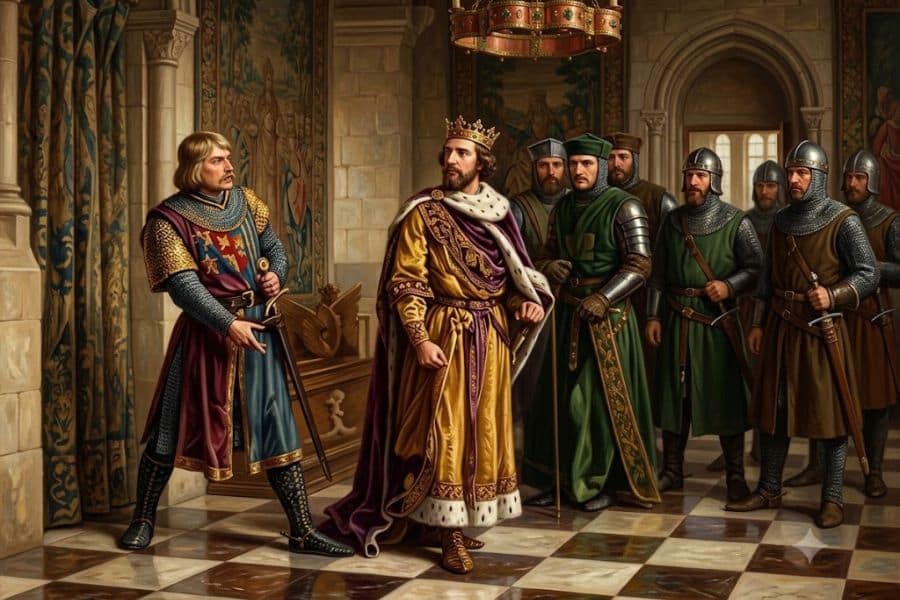
This is where Simon goes from ambitious newcomer to national scandal. In January 1238, in a small chapel inside the king’s own palace at Westminster, Simon secretly married Eleanor of England.
She was Henry III’s youngest sister. She was also the widow of the son of William Marshal, the greatest knight England ever produced, and after her first husband died, she had sworn a solemn vow of perpetual chastity in front of the Archbishop of Canterbury.
Then along came Simon, and the vow went out the window.
When word got out, the barons were furious. A king’s sister, promised to God, married off in secret to a foreign upstart with no royal blood and barely any land. Henry’s own brother, Richard of Cornwall, was so incensed that he raised armed men in protest, and Henry had to buy him off with the enormous sum of 6,000 marks.
Simon, meanwhile, had to ride all the way to Rome to talk the Pope into blessing a marriage that should never have happened.
For a while, mind you, it worked out beautifully. Simon was back in favor, rich in royal connections, and Henry even made him godfather to his baby son, Prince Edward. Hold that thought about Edward. He’ll be back, and he will not be returning the favor.
Then it all curdled. In 1239, Simon named the king as security for one of his debts without asking, and Henry exploded in public, snarling at him, “You seduced my sister, and when I found out, I gave her to you against my will to avoid scandal.”
Simon and Eleanor fled abroad in disgrace. The friendship never truly recovered. Under all the politics that followed, I’m inclined to think there was always this personal wound throbbing away, a king and a brother-in-law who each felt the other had cheated him.
Crusader, Governor, and a Slow Poisoning of Trust
Simon spent the 1240s rebuilding his reputation the medieval way, with a sword. He went on crusade to the Holy Land between 1240 and 1242, and by all accounts, he impressed people.
The barons of the crusader states thought so highly of him that they actually asked him to come and govern them.
A landless younger son from France was, within a few years, being offered the running of the Kingdom of Jerusalem. It’s impressive stuff.
Back home, Henry gave him a proper test. In 1248, he sent Simon to govern Gascony, England’s turbulent territory in south-west France, and told him to bring it to heel. Simon did exactly that, with a heavy hand.
The Gascons complained bitterly of his harshness, and in 1252, Henry hauled him in front of a tribunal to answer for it. Simon was cleared, but he was livid at having been put on trial at all for doing the brutal job he’d been sent to do. He came home with another grievance to add to the pile.
By now, the pattern was set. Simon believed the king was weak, badly advised, forever handing money and titles to his grasping foreign relatives, and the favorites clustered around Queen Eleanor of Provence.
Henry believed Simon was arrogant, greedy, and impossible to control. There’s a story that captures it perfectly. Sheltering from a thunderstorm on the Thames one day, Henry was told the approaching boat carried Simon. The king called out, “I fear thunder and lightning beyond measure, but by the head of God, I fear you more than all the thunder and lightning in the world.”
When your own king would rather face a lightning storm than face you, something has to give.
The Provisions of Oxford: Putting a King in Chains
And in 1258, it gave. Henry was broke, having promised the Pope a fortune he didn’t have in a mad scheme to buy the throne of Sicily for his second son. He came to his barons begging for money. This time, they came back with a price, and Simon was at the front of them.
At a gathering in Oxford that summer, later nicknamed the “Mad Parliament,” the barons forced Henry to accept a document called the Provisions of Oxford. It was extraordinary. It took the running of the kingdom out of the king’s sole hands and gave it to a council of fifteen, which would meet with the barons three times a year in what they were already calling parliaments.
Henry signed because he had no choice. He spent the next few years wriggling out of it, eventually persuading the Pope to release him from his oath, which in Henry’s mind made the whole thing null and void.
In 1264, the two sides even agreed to let the saintly King Louis IX of France judge between them. Louis, unsurprisingly, sided with his fellow king and threw the Provisions out entirely.
That was the last straw. Both sides reached for their swords.
The Battle of Lewes: Capturing a King
Here is the moment Simon de Montfort stopped being a rebel earl and became, for one astonishing year, the master of England.
On 14 May 1264, the royal army and the baronial army met at Lewes in Sussex. Simon was in his mid-fifties by now and had recently broken his leg in a riding accident, so he directed part of the battle from a horse-drawn cart, which tells you something about the sheer bloody-mindedness of the man. His forces wore white crosses on their chests to mark them out. And against the odds, they won.
It was a stunning victory. Simon captured King Henry III himself. He captured Henry’s brother, Richard of Cornwall, the same man who’d raged at his marriage decades before. And he captured Prince Edward, his own godson, the tall, formidable young heir who would one day be Edward I.
With the king in his pocket, Simon now ruled England in Henry’s name. Henry kept his crown and his title, but the decisions were Simon’s. For a landless second son from Montfort-l’Amaury, it was a breathtaking place to have arrived.
The trouble with holding a king prisoner, though, is that you then have to explain to everyone else why you, and not the king, are running the country. Simon needed legitimacy. And so he did the thing he is remembered for.

The Parliament of 1265: Why He’s Called the Father of the Commons
In January 1265, Simon summoned a parliament to meet at Westminster. Parliaments were nothing new. Kings had called their barons and bishops together for generations. What made this one different, and what earned Simon his place in every history book, was who else he invited.
Alongside the usual lords, he summoned two knights from every county, and, for the first time in a way that stuck, two burgesses from every major town and borough in England. Ordinary townsmen.
Merchants and traders from the growing towns sat in a national assembly to discuss the business of the realm. Power was beginning to leak out of the castles and into the market squares, and this is the reason Simon de Montfort is called the father of the House of Commons.
Simon didn’t summon this parliament out of pure democratic idealism, but because he was holding the king captive and desperately needed the support of the knights and townsmen against the nobles who were deserting him.
Of the great earls and barons, he invited only the handful who were still loyal to him. In other words, he rather stacked the guest list.
But intentions and consequences are different things. Whatever Simon meant by it, the precedent held. Within a generation, under the very Prince Edward who despised him, summoning townsmen to parliament had become normal, then expected, then permanent.
A ruthless political maneuver in a moment of crisis turned out to be the seed of representative government.
The Murder of Evesham
Simon’s rule lasted barely fifteen months, and it came apart fast. His great weakness was that he’d made himself look like exactly what his enemies said he was, an over-mighty subject enriching his own family while the king sat as his puppet.
His most powerful ally, Gilbert de Clare, the young Earl of Gloucester, switched sides. And then, in May 1265, the prize prisoner slipped the net. Prince Edward, out for a supervised ride, tested the fastest horses one by one until his guards’ mounts were tired, then spurred a fresh one and simply galloped away.
Edward was everything Simon had once been and more: young, brilliant, and now burning for revenge. He moved with terrifying speed, cutting Simon off from his son’s reinforcements and trapping the old earl in a loop of the River Avon near the town of Evesham.
On the morning of 4 August 1265, Simon saw a column of troops approaching under banners he recognized as his son’s, and for a moment he thought help had come. Then the banners came closer, and he understood. Edward had captured them and was flying them as a trick.
Looking at the disciplined ranks closing in, Simon is said to have remarked, almost admiringly, “They have learned from me.” Then, more soberly, “Let us commend our souls to God, because our bodies are theirs.”
He was right. Outnumbered roughly two to one, his Welsh foot soldiers fleeing, caught on bad ground in a thunderstorm, Simon’s army was not defeated so much as butchered. This was not the usual medieval battle where noble prisoners were ransomed.
Edward’s men had orders to kill. Simon’s son Henry fell. Simon himself was pulled from his horse and killed, and then his body was deliberately, ritually destroyed. His head, his hands, his feet, and his testicles were hacked off.
His head was sent as a grisly trophy to the wife of Roger Mortimer at Wigmore Castle. It was one of the more savage ends any nobleman met in the Middle Ages, and it was meant to send a message. A contemporary chronicler wrote the line that stuck: “Such was the murder of Evesham, for battle it was none.”

Saint or Sinner?
Something strange happened after Evesham. The mangled, dishonored rebel became a saint.
Within weeks, people were slipping to the spot where he died and to his grave at Evesham Abbey, praying to him and reporting miracles, hundreds of them. Cures, visions, the lot. Monks compiled a book of his miracles.
Hymns and laments were written for him. To a lot of ordinary English people, Simon de Montfort was a martyr who had died fighting a greedy king on their behalf. Henry III was so alarmed by the growing cult that he had Simon’s remains moved to stop it from becoming a shrine.
The Church never made it official, and no halo was ever formally granted. But in the hearts of the common folk, for a while, he was Saint Simon.
And now the part that doesn’t make it onto the plaques.
Simon de Montfort was a vicious antisemite, even by the ugly standards of his own century. One of his very first acts as Earl of Leicester, back in 1231, was to expel the entire Jewish community from the town, banning them and their descendants forever, “to the end of the world,” and declaring he did it for the good of his soul.
His friend and spiritual mentor, the respected bishop and adviser Robert Grosseteste, applauded the move. Worse was to come. When Simon’s rebellion swept the country in the 1260s, it was accompanied by savage attacks on Jewish communities in London, Worcester, Winchester, Canterbury, and Derby, with many hundreds murdered and debt records destroyed, which conveniently wiped out what the rebel barons owed.
The reform movement that widened English liberty was, at the very same time, soaked in the blood of England’s Jews.
So, which was he? A pioneer of democracy or an antisemitic strongman who found holding a parliament useful? The uncomfortable answer is both, at once, and I don’t think you can keep one without the other. He truly believed a king should be bound by law.
He helped plant the idea that ordinary people deserved a seat. And he did monstrous things, and was driven as much by money and pride as by principle. People are rarely as clean as the plaques would like. Simon less than most.
What Became of the Montforts
Simon’s widow, Eleanor, held out under siege and then went into exile in a French convent, where she died in 1275. His son Henry died beside him at Evesham. His son Simon the Younger arrived too late to save either of them and eventually fled abroad.
And his son Guy took the family’s talent for violence to its grim conclusion. In 1271, in a church in the Italian town of Viterbo, Guy de Montfort hunted down and murdered his cousin, Henry of Almain, the son of Richard of Cornwall, in cold blood at the altar, in revenge for Evesham.
The killing so shocked Europe that the poet Dante later placed Guy in Hell for it, standing forever in a river of boiling blood.
And Simon’s daughter, another Eleanor, married Llywelyn ap Gruffudd, the last native Prince of Wales. Edward I, that vengeful godson, had her captured at sea to stop the match, then later allowed it, and she died in childbirth in 1282, the same year Edward crushed Llywelyn and swallowed Wales whole.
Frequently Asked Questions
Did Simon de Montfort Really Found Parliament?
Simon de Montfort did not invent Parliament, but he did summon the first one to include elected representatives from ordinary towns. In January 1265, alongside the barons and the knights of the shires, he called two burgesses from each major borough. That made his parliament the direct ancestor of the House of Commons, which is why he is remembered as its father, even though earlier kings had held parliaments of nobles.
How Did Simon de Montfort Die?
Simon de Montfort died at the Battle of Evesham on 4 August 1265. Trapped by Prince Edward’s larger army in a bend of the River Avon, he was pulled from his horse and killed, and then his body was deliberately mutilated. His head, hands, feet, and testicles were hacked off, and his severed head was sent as a trophy to Roger Mortimer’s wife at Wigmore Castle. A chronicler called it “the murder of Evesham, for battle it was none.”
Was Simon de Montfort a King?
No, Simon de Montfort was never king. He was the Earl of Leicester. After capturing Henry III at the Battle of Lewes in 1264, he ruled England in the king’s name for around fifteen months as the effective head of government.
Why Is Simon de Montfort Important?
Simon de Montfort is important because his parliament of 1265 was the first to summon elected townsmen as well as nobles and knights, a milestone on the road to representative government and the modern House of Commons. He also forced Henry III to accept the Provisions of Oxford in 1258, one of England’s earliest attempts to place legal limits on the power of the crown.
What Were the Provisions of Oxford?
The Provisions of Oxford, agreed in 1258, were a set of reforms that forced Henry III to share power with a council of fifteen barons and to hold regular parliaments. Often described as an early English constitution, they stripped the king of unchecked authority. Henry later persuaded the Pope to release him from his oath to uphold them, which helped trigger the civil war known as the Second Barons’ War.
Was Simon de Montfort a Good Person?
Whether Simon de Montfort was a good person is still fiercely debated. He championed reform and wider political representation, but he was also driven by money and personal ambition, and he was viciously antisemitic. He expelled the Jews from Leicester in 1231, and his rebellion in the 1260s was accompanied by deadly massacres of Jewish communities. He was reformer and bigot at the same time, which is what makes him so hard to sum up.
Are There Two Simon de Montforts?
Yes, there are two famous Simon de Montforts, a father and a son. The father, Simon de Montfort the Elder, led the brutal Albigensian Crusade against the Cathars in southern France and died besieging Toulouse in 1218. His son, Simon de Montfort the Younger, is the one who founded England’s first representative parliament and died at the Battle of Evesham in 1265. They are often confused, but their stories are very different.
Related posts:
 How Eleanor of Provence Rose from Teenage Bride to England’s Most Controversial Queen
 The Legend of Joanna of Flanders, Jeanne la Flamme, Warrior Duchess of Brittany
 Unearthing the Last Plantagenet King: The Story of How Richard III Was Found After 500 Years
 How the Magna Carta Came About: The Bankrupt Kingdom, the Cruel King, and the Knight Who Saved It