
Medieval beds in costume dramas are carved oak, velvet curtains, a mountain of pillows, and a king propped up against the headboard, giving orders. Now, although that bed existed, people rarely slept in it.
Medieval beds ranged widely, from straw thrown on the floor to a wooden frame strung with rope and topped with a mattress of hay or feathers, up to curtained, canopied frames stuffed with down for those who could pay.
Table of Contents
A good bed was the single most expensive thing most families owned, which is why it was an important item within a will. Most people shared one, often with the whole household in the same room, and the grandest beds were as much about showing off as sleeping.
So what were they actually made of, who got to sleep in what, and why did Tudor men think pillows were for women and the sick?
What a Medieval Bed Made Of
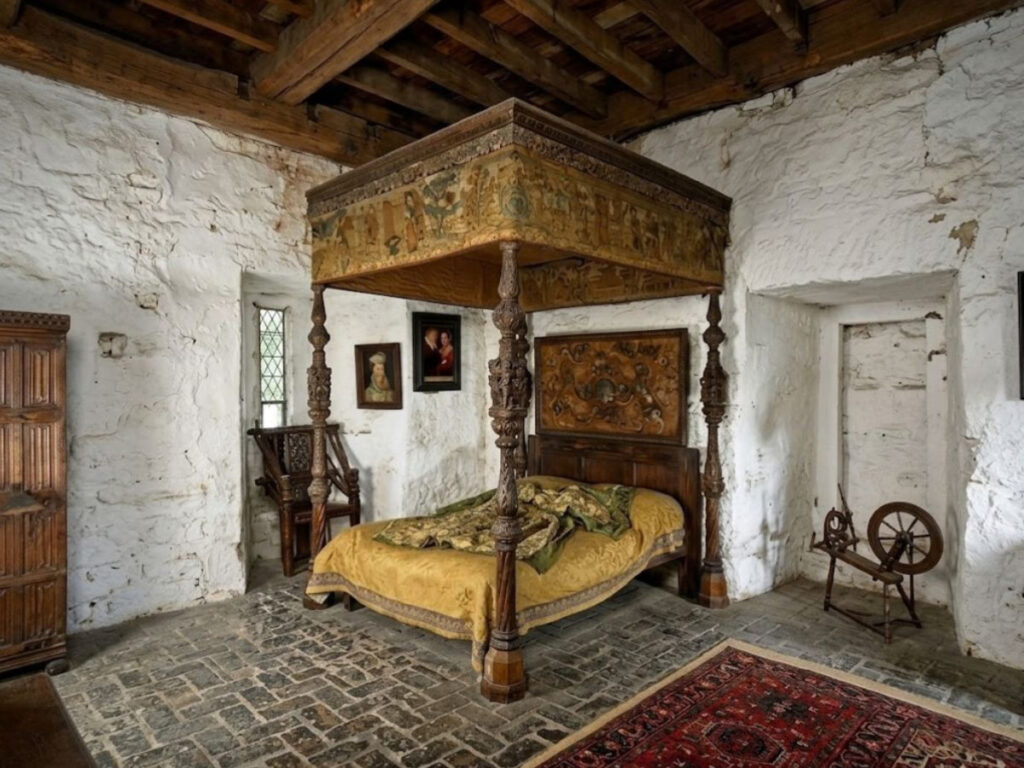
Strip away the hangings and the carved posts, and a medieval bed was a fairly simple piece of carpentry: a wooden frame, usually oak, with a lattice of rope strung tight across it from side to side and head to foot.
The mattress sat on top of the ropes, and the ropes did the work of a modern box spring. Over time, they sagged, the sleeper rolled toward the middle, and the whole thing had to be retightened every so often with a wooden wrench called a bed key.
It’s thought to be the origin of the phrase ‘sleep tight’, though nobody can prove it.
The mattress itself was a cloth sack, known as a tick, stuffed with whatever you could get your hands on. At the bottom of the scale, that meant straw or hay, swapped out when it got filthy or verminous.
The wealthy had down and feathers, usually in layers with a coarser straw mattress underneath to give a bit of support, then a feather bed on top of that. A bit like the old fairy tale of the Princess and the Pea. Then on top of that went the sheets, a bolster, woolen blankets, and possibly a quilted coverlet.
Roberta Gilchrist‘s work on medieval daily life in her book Medieval Life: Archaeology and the Life Course goes into detail about the hierarchy.
By the later Middle Ages, yeomen and prosperous townspeople had bedsteads with feather beds, bolsters, and coverlets. The elite had the same, plus the hangings, and often a carved frame. The poor had the tick on the floor, and sometimes not even that.
The straw underneath the floor rushes was changed when the smell became impossible to ignore, which, judging by what was written, wasn’t nearly often enough.
What Did Peasants Sleep On in the Middle Ages?
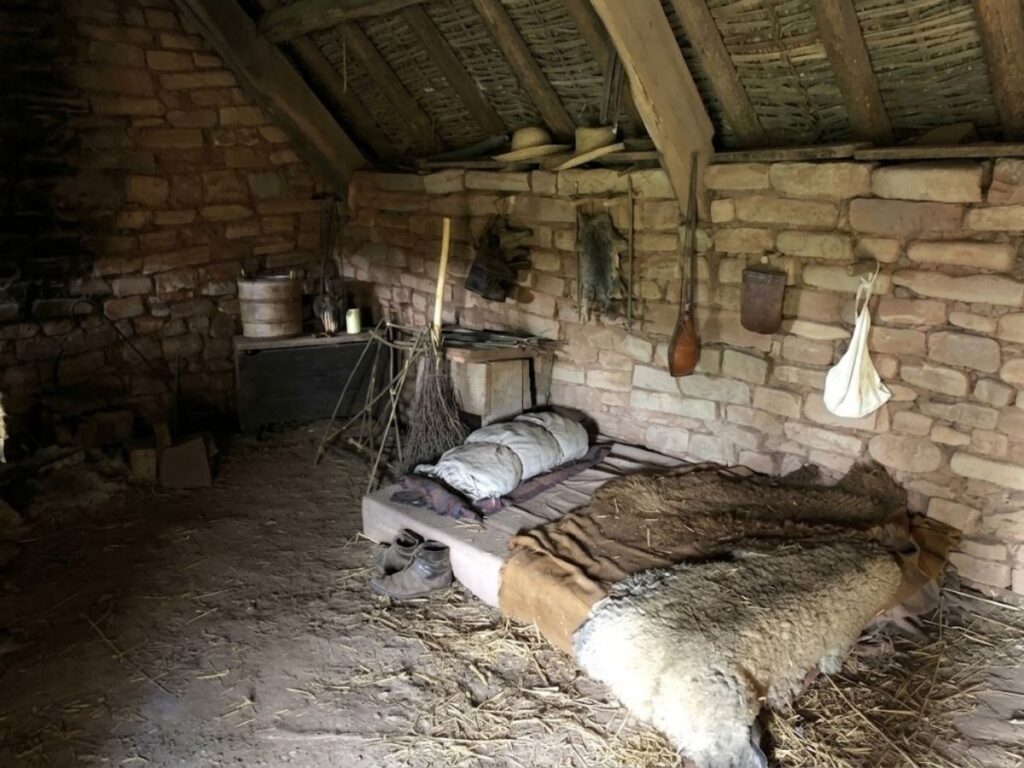
A medieval peasant, in the main, slept on a mattress stuffed with straw, hay, wool, or rags, laid on either a low wooden frame or the earth floor. The poorest households didn’t have a bed at all. They slept on loose straw or hay heaped in a corner, with a cloak or a single rough blanket thrown over the top.
A cottage might have one bed between the parents, and the children slept on pallets or on the floor by the hearth, where it was warmest.
In a one-room house, as most peasant dwellings were, the bedding was rolled up and shoved out of the way during the day. The same floor space had to serve for cooking, working, eating, and sleeping, and leaving a mattress out would have been impractical.
Pallets came out at night and went away in the morning, and the household lived around them.
William Harrison, writing his Description of England in 1577 for Holinshed’s Chronicles, caught the tail end of this world.
He quoted older men in his village who remembered sleeping on straw pallets with ‘a good round log under their heads instead of a bolster’. A proper mattress, they told him, was a thing a lord might own, and a servant was lucky to get a sheet between himself and the straw to keep it from scratching through his shirt.
Hooked on the Middle Ages? Get more stories like this one in your inbox.
Why a Bed Was the Most Valuable Thing a Family Owned
People left their beds in wills to named children, widows, and servants because a bed was often the single most expensive object in the house. A yeoman might have a bedstead worth more than his plow team.
That’s why Shakespeare’s famous bequest, leaving Anne Hathaway his ‘second-best bed’, has been argued over for centuries. On one reading, it’s an insult; on another, it’s the opposite, because the second-best bed was the marital bed, with the best bed kept for guests.
Either way, nobody at the time thought it strange that a bed was a thing worth putting in a will at all. It was an investment, built to last, and families saved for years to afford one.
Harrison again gives the number. He wrote that an older man in his parish reckoned a servant was doing well if, ‘after he had married and gotten up three or four pots and a mattress’, he thought himself as rich as a lord.
The bed was the big-ticket item, and it took most of a working life to put together the household goods that went around it.
When the bed was finally made, they didn’t throw it out when it got old. The frame was repaired, the ropes replaced, the tick restuffed, and it passed from parent to child. They weren’t the throwaway society we are today; they couldn’t afford to be. We could probably learn a thing or two from them.
The Noble Bed: Canopies, Curtains and Carved Oak
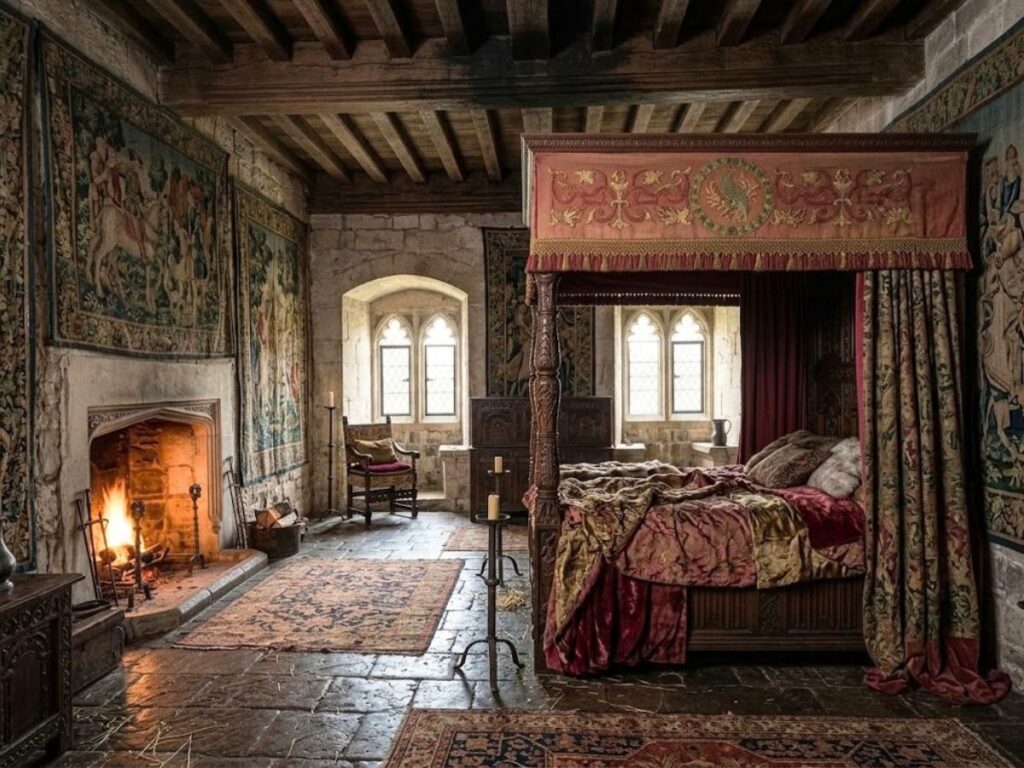
By the 14th century, the beds of the aristocracy had turned into enormous pieces of theater. The frame itself was carved oak, often painted and gilded, standing on a low platform. From the four posts hung a tester, which was the flat canopy over the top, and curtains that ran all the way around and could be drawn shut at night.
The hangings were velvet, damask, silk, or heavy wool depending on the season, often embroidered with the owner’s arms, saints, or scenes from Scripture.
The practical argument for all this fabric was warmth and a little privacy. Stone-walled chambers were cold and drafty, and a curtained bed was a small, enclosed room within a larger one.
Attendants slept on pallets in the same chamber. A lady-in-waiting might be on a low bed at the foot of her mistress’s, and the curtains were the only thing standing between the queen and her household at three in the morning.
The other reason was that a noble bedchamber wasn’t a private space in the modern sense. It was a reception room. Lords received petitioners, ambassadors, and senior household members from the bed itself, propped up against bolsters in a shirt or loose gown.
A king’s bedchamber was a political arena, and the bed was its throne. Hangings embroidered with the royal arms, a coronet carved into the headboard, a coverlet of cloth of gold.
A royal bed could involve dozens of yards of imported velvet, silver thread, down from specific regions, and a frame commissioned from a named joiner. These objects were valued like jewelry, listed separately in household accounts, moved from house to house as the court traveled, and dismantled and reassembled by specialist servants.

Did Medieval People Share Beds?
Yes, absolutely, medieval people shared a bed. A married couple slept together, often with the youngest child between them, and older children shared beds. Servants shared with servants, travelers at an inn shared with whoever happened to be on the road that night, and it was perfectly ordinary for a guest to be shown to a bed in which a stranger was already asleep.
In the earlier Middle Ages, even great lords slept in the hall alongside the rest of the household, pulling a curtain across a corner or sleeping on a raised dais.
The private solar, the lord’s chamber off the hall, became common from the 12th and 13th centuries onward, but even then it was shared with family, servants and guests of rank. Thomas Becket, before his falling out with Henry II, is said to have shared a bed with the king on occasion, and the chroniclers mention it as a sign of favor.
The reasons were partly economic, because beds and bedding were expensive and nobody had the material to make up a separate bed for every person. They were also practical. Medieval houses had no heating beyond the hearth, and the hearth was in the hall below.
A chamber at the top of a stone tower in February was punishingly cold. Bodies kept each other warm, hangings kept out the drafts, and a cat or a dog on top of the covers also helped.
Were Pillows Really Only for Women and the Sick?
Pillows were thought fit only for ‘women in childbed‘. A grown man used a bolster, a long, firm cushion running the width of the bed, or propped his head on a folded cloak or a log, and he was thought the hardier for it.
Some of this was practical. A soft pillow in a tick full of feathers encouraged you to lie flat, and medieval and Tudor medical thinking preferred sleeping half-upright, propped against the bolster.
Lying flat was thought to let the humors pool badly and to bring on nightmares and worse. Grand beds often had a stepped arrangement of bolster, then pillow, then a smaller cushion, specifically so the sleeper’s upper body was raised.
A man who demanded a feather pillow was soft, and softness was suspect. The only time this changed was if you were sick. Sick people, in any period of the Middle Ages, got the softest bedding the household could manage, propped high on pillows to help them breathe and to keep bedsores at bay.
How Big Were Medieval Beds, and What About the Great Bed of Ware?
Medieval beds were, on the whole, small. A typical bedstead ran about 6 feet long and 3 to 4 feet wide, built for a sleeper who was propped half-upright on a bolster rather than stretched flat, and designed to be shared with at least one other person.
The real reason beds were short was that nobody expected to lie out full length. You slept sitting half up, knees bent, under heavy covers.
The exception is the Great Bed of Ware. It’s an oak four-poster of around 1590, late Tudor rather than medieval proper, measuring roughly 11 feet wide and 11 feet long. The Victoria and Albert Museum, which holds it, records that it was most likely made as a tourist attraction for an inn in the Hertfordshire town of Ware, a convenient overnight stop for travelers going to Cambridge University or further north.
Reputedly it could sleep at least four couples at once, head to toe, and the inn made a steady trade in curious guests who paid extra for the privilege.
In Twelfth Night, written around 1601, Sir Toby Belch tells Sir Andrew Aguecheek to write a challenge full of lies ‘as big as the bed of Ware in England’.
Frequently Asked Questions
What were beds like in the medieval period?
Beds in the medieval period varied enormously by wealth. The poorest slept on straw or hay laid straight on the floor, while middling households had wooden frames strung with rope and topped with a straw or feather mattress. The rich slept in curtained, canopied frames with down mattresses and fine linen.
What did peasants sleep on in the Middle Ages?
Peasants slept on mattresses stuffed with whatever came to hand: straw, wool, hair, rags, sometimes feathers. If you were poor, it would be straw or hay spread across the floor, rolled up during the day to free the cramped living space.
Did medieval people share beds?
Yes, medieval people shared beds, and sleeping alone was rare. A whole family might pile into one bed, and high-status visitors were often invited in alongside them. In the early Middle Ages, lords and ladies slept in the great hall with children, servants, and guests ranging around them.
Why was a bed the most valuable thing a medieval family owned?
A bed was the most valuable thing many medieval and Tudor families owned because the frame, the mattress, and the hangings together cost a small fortune, and families saved for years to afford a proper bedstead.
Were pillows only for women and the sick in medieval times?
Pillows were widely seen as fit only for women in childbed and the sick, at least in the account the Tudor clergyman William Harrison set down in 1577.
Love a good medieval story?
Join our readers and get tales of kings, queens, castles and ordinary medieval lives straight to your inbox.

Kylie Lang is a nationally syndicated travel journalist with bylines on the Associated Press Wire & more, a medieval history writer, and the founder and lead author of Tales of the Middle Ages (talesofthemiddleages.com). She holds a BA (Honours) in History from the University of Kent and is a member of the British Guild of Travel Writers.
Related posts:
 The Reality of Life in a Medieval Castle, the Sounds, Smells, and Struggles of Daily Life
 Why Medieval Castles Were Filthy Places You’d Never Want to Live In
 Medieval Wedding Night Customs: The Priest, the Crowd, and the Very Public Marriage Bed
 The Politics of the Bedchamber: Why the Rich Slept in Separate Bedrooms in the Middle Ages