English is a language built on rotten foundations. Half the phrases we toss around at the office or mutter into a coffee cup were born in a world of shared latrines, fraudulent butchers, and pies stuffed with the bits no one wanted to look at too closely.
Most of us use them without thinking. We say someone got the wrong end of the stick and picture a confused friend, not a Roman public toilet. We eat humble pie and imagine a slice of something cozy, not a crust packed with deer guts.
Table of Contents
What follows is a dictionary of the grimiest expressions still in everyday use, with the medieval, Tudor, or earlier muck they crawled out of. Hopefully, they’ll bring a smile to your face and maybe a chuckle into the bargain.
1. The Wrong End of the Stick
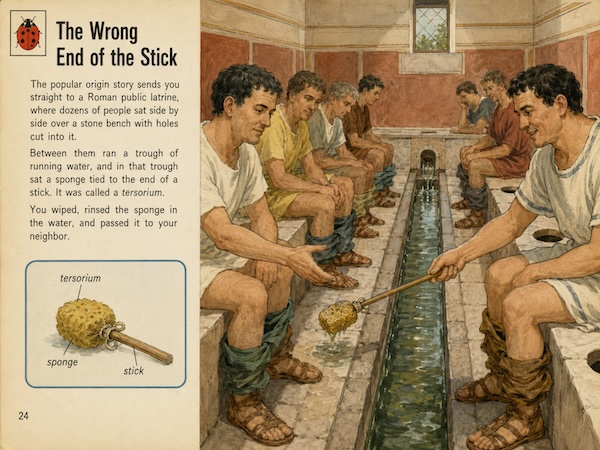
The popular origin story sends you straight to a Roman public latrine, where dozens of people sat side by side over a stone bench with holes cut into it. Between them ran a trough of running water, and in that trough sat a sponge tied to the end of a stick. It was called a tersorium. You wiped, rinsed the sponge in the water, and passed it to your neighbor.
Grab it by the wrong end and your day got considerably worse. It’s a gloriously disgusting image, and it fits the phrase perfectly, which is probably why it spread. The trouble is, the earliest recorded uses of “wrong end of the stick” in English don’t appear until the 19th century, long after the Roman sponge had been retired from active service.
Linguists tend to think it just means picking up a walking stick or a tool by the dirty end. But why spoil a good story when it makes you giggle to think of just how gross it was back in the day?
2. Pig in a Poke
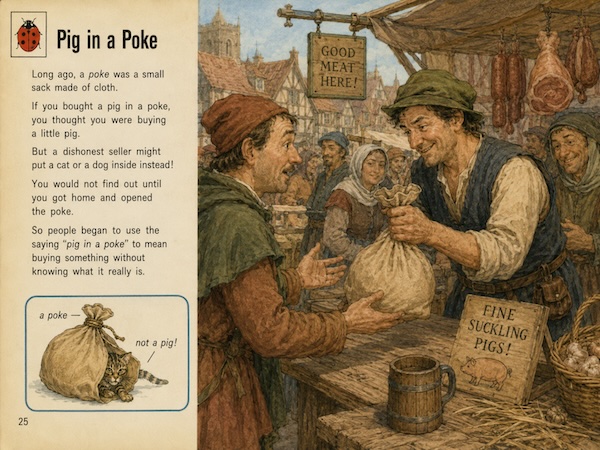
A poke was a small sack, from the Old French poque. At a medieval market, you’d buy a suckling pig by the sack rather than carrying the squirming thing home in your arms. A dishonest seller would slip a cat or a dog into the poke instead, knot it tight, and hand it over while the buyer was distracted by the next customer or a tankard of ale.
By the time you got home and opened the sack, the seller and his stall were long gone. You’d bought a pig in a poke. The phrase appears in English by the 14th century and in many European languages, with the same warning attached. The Germans still say “die Katze im Sack kaufen” to mean buying the cat in the sack.
The companion phrase is “to let the cat out of the bag”, which is the moment the fraud falls apart at home, or the moment a savvy buyer demands to see the goods before paying. Both expressions came from the same thing, which tells you something about how often this scam worked. If a phrase sticks in the language for 700 years, it’s because the trick kept catching people.
3. Humble Pie
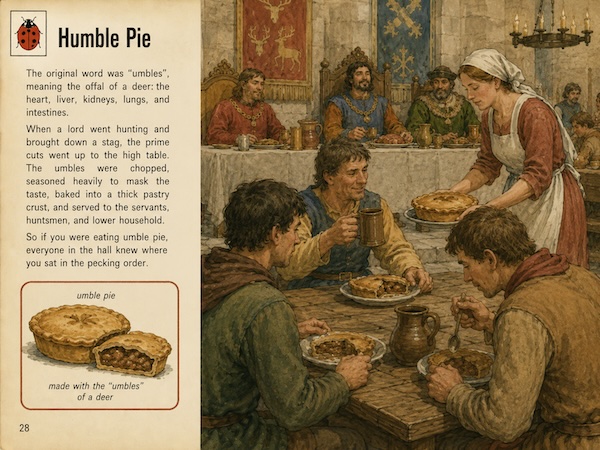
The original word was “umbles”, meaning the offal of a deer: the heart, liver, kidneys, lungs, and intestines. When a lord went hunting and brought down a stag, the prime cuts went up to the high table. The umbles were chopped, seasoned heavily to mask the taste, baked into a thick pastry crust, and served to the servants, huntsmen, and lower household.
So if you were eating umble pie, everyone in the hall knew where you sat in the pecking order. The shift from “umble” to “humble” happened gradually, aided by the fact that the two words sounded similar and their meanings lined up so neatly.
By the 17th century, the phrase had drifted into metaphor. To eat humble pie meant to swallow your pride, take a demotion, or apologize publicly.
The pie itself stuck around longer than you’d expect. Recipes for umble pie appear in English cookbooks well into the 18th century, and some upmarket households served it as a deliberate nod to old tradition.
4. Don’t Throw the Baby Out with the Bathwater
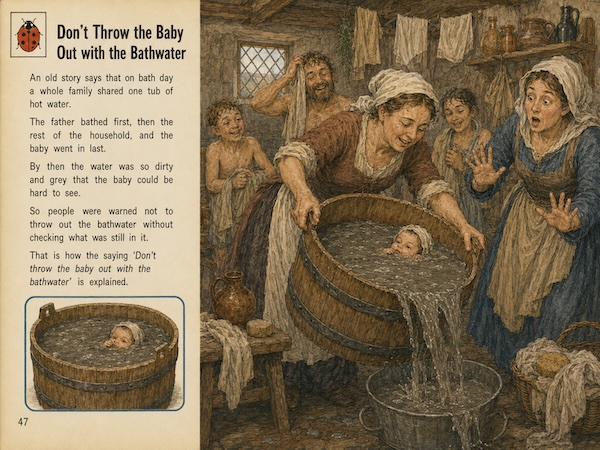
The story goes that a medieval household shared a single tub of hot water on bath day. The head of the household washed first, then the adult sons, then the women, then the children, with the babies going in last. By the time the baby got in, the water was murky enough that you might lose track of where the child ended and the bathwater began.
It’s a fantastic image and almost certainly not true. The earliest known version of the phrase appears in a 1512 satire by the German writer Thomas Murner, illustrated with a woodcut of a woman tipping a baby out of a wash basin. Murner used it as a metaphor for foolish overreaction, and it stayed mostly German until the 19th century, when Thomas Carlyle dragged it into English.
What is true is that bathing in the medieval and Tudor periods was a communal, infrequent affair for most people, and the water did get reused. Public bathhouses, called stews, were notorious for doubling as brothels and were eventually shut down by Henry VIII in 1546 after a syphilis outbreak.
Hooked on the Middle Ages? Get more stories like this one in your inbox.
5. Mind Your Ps and Qs

In medieval and early modern alehouses, drinks were served in measures called pints and quarts, abbreviated on the slate behind the bar as P and Q. A drinker running a tab needed to mind his Ps and Qs because the landlord might add an extra mark or two when nobody was looking, and a drunk customer might not notice he’d been charged for quarts he never drank.
There’s a parallel story about printers’ apprentices, who set type backwards and had to be careful not to confuse the lowercase p and q in the wooden tray. Both trades had a real reason to drill the warning into juniors, and both probably contributed.
Watered ale, short measures, loaded reckonings. Brewers in England were regulated by the assize of ale from the 12th century onwards, with ale-tasters appointed in every town to check strength and price. If you wanted to drink your wages without losing them, you minded your Ps and Qs.
6. Baker’s Dozen
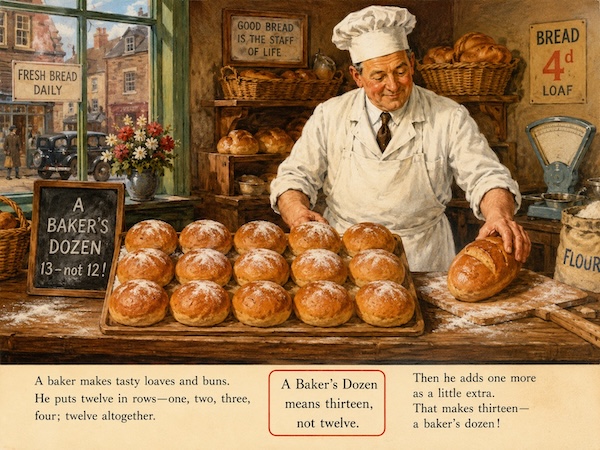
This one comes from a law that could cost you a hand. The Assize of Bread and Ale, enacted by Henry III in 1266, fixed the price and weight of a loaf according to the price of grain. Sell an underweight loaf and the punishment ranged from a fine to the stocks to, in some accounts, the loss of a hand or an ear. Bakers had a real incentive to comply, and a real fear of getting it wrong.
The trouble was that bread weight was hard to predict. Loaves shrink as they bake, flour varies by batch, and an oven on a hot day behaves differently from one on a damp morning. To avoid being short by accident, bakers got into the habit of throwing in an extra loaf with every dozen sold to a retailer or innkeeper.
Thirteen for the price of 12, with the 13th called the in-bread or vantage loaf. If your stack came in light, the freebie made up for it.
Whether bakers were ever actually mutilated for short weight is debated. Court records show fines, pillorying, and being dragged through the streets on a hurdle with the offending loaf tied around the neck. The fear of the law and the practical workaround, though, are well documented, and the baker’s dozen has stuck around for nearly 800 years as a reminder.
7. Eat Crow
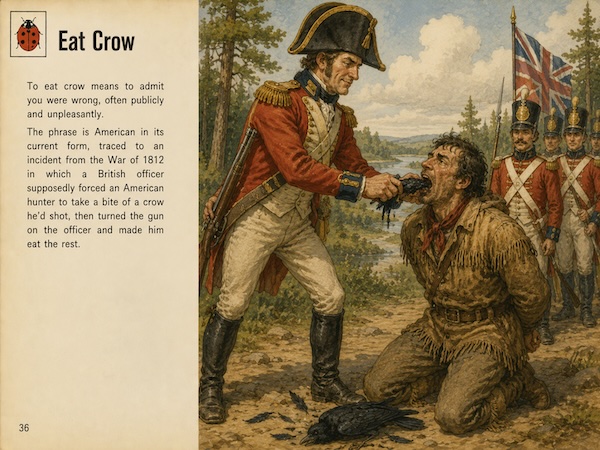
To eat crow means to admit you were wrong, often publicly and unpleasantly. The phrase is American in its current form, traced to an incident from the War of 1812 in which a British officer supposedly forced an American hunter to take a bite of a crow he’d shot, then turned the gun on the officer and made him eat the rest.
Crow was famine food in medieval Europe and well into the early modern period. The meat is dark, stringy, tough, and tastes strongly of whatever the bird has been eating. Cookbooks from the period include crow recipes alongside rook and jackdaw, with heavy instructions to soak the meat in vinegar or milk overnight before stewing it for hours.
Even then, the result was the kind of dish you served to people you didn’t like, or ate yourself when there was nothing else.
Rook pie persisted in rural England into the 20th century, made from young rooks shot in May before they could fly far from the nest. My grandmother, who grew up on a farm, remembered being served it as a child and described the taste as like liver that had been left out in the rain.
8. Cat Got Your Tongue
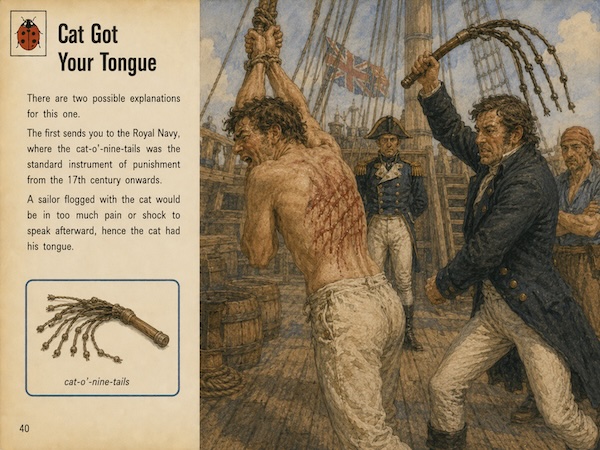
There are two possible explanations for this one. The first sends you to the Royal Navy, where the cat-o’-nine-tails was the standard instrument of punishment from the 17th century onwards. A sailor flogged with the cat would be in too much pain or shock to speak afterward, hence the cat had his tongue.
The second origin is older and worse. Judicial mutilation of the tongue was a documented punishment in medieval Europe for blasphemy, perjury, and sedition. The tongue could be pierced with a hot iron, slit, or, in extreme cases, cut out altogether.
There are also folkloric references to the tongues of liars being cut out and fed to cats as a form of symbolic justice. Whether anyone actually did this or not, the image is clear enough.
The phrase itself doesn’t appear in print until the 19th century, which weakens both origin stories considerably. It may be nothing more than a Victorian nursery scolding, with the cat-as-villain serving the same function as the bogeyman.
9. Skeleton in the Closet
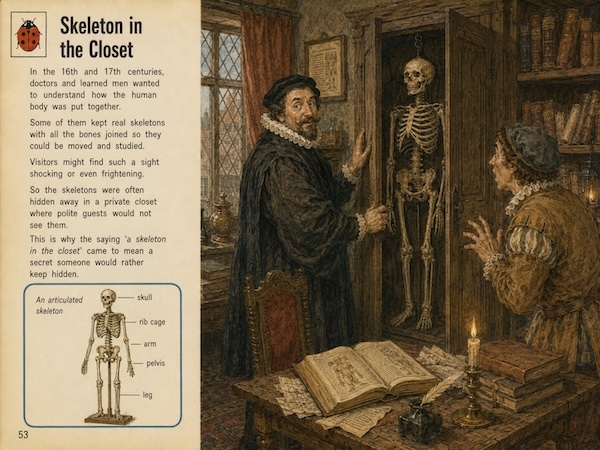
The phrase entered English in the early 19th century, but the image it conjures has medieval roots. “Closet,” in older usage, didn’t mean a wardrobe but a small private room, often a study or a chapel, where a person kept things they didn’t want others to see. A skeleton in such a room was a literal one: human remains hidden away from public view.
There are two probable sources. The first is the practice of anatomy. Medical men in the 16th and 17th centuries kept articulated skeletons for study, often obtained through grave-robbing or from the bodies of executed criminals. A respectable physician’s private closet might contain a hanged thief, bones boiled clean and wired together. Polite society preferred not to think about where these specimens came from.
The second source is family scandal. In a culture obsessed with lineage and inheritance, the disappearance or disgrace of a relative was a problem that sometimes needed a physical solution. A relative executed for treason might be retrieved at night and tucked into a wall or a crypt the family controlled, rather than left to rot on the city gates.
The Tower of London’s records include cases of families paying for the return of beheaded relatives so they could be buried discreetly on private land.
10. Saved by the Bell
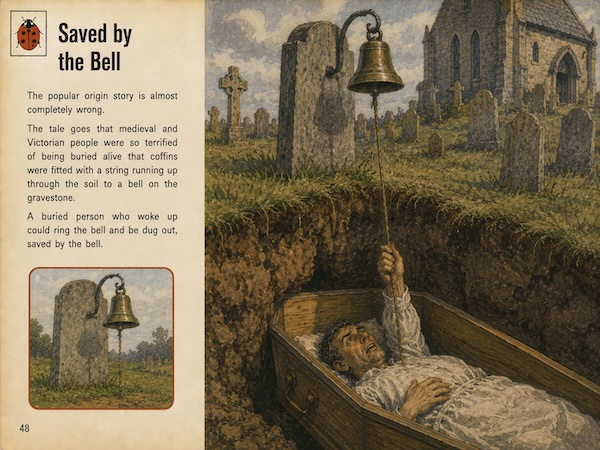
The popular origin story is almost completely wrong. The tale goes that medieval and Victorian people were so terrified of being buried alive that coffins were fitted with a string running up through the soil to a bell on the gravestone.
A buried person who woke up could ring the bell and be dug out, saved by the bell. There were even patents for such devices, filed in the 19th century, and at least one surviving example in a museum in Germany.
The phrase itself, though, comes from boxing. A fighter knocked down and on the verge of being counted out could be saved by the bell ringing to end the round, giving him a minute to recover. The earliest uses in print, from the 1890s, are all boxing contexts. The grave-bell story attached itself later.
Fear of premature burial was real, mind you. The 18th and 19th centuries saw genuine panic about it, fueled by cases of bodies exhumed for reburial that showed signs of movement after death.
Mortuaries with waiting rooms were built across Europe, where corpses were left for several days with strings tied to their fingers connected to bells, so an attendant would know if anyone twitched.

Love a good medieval story?
Join our readers and get tales of kings, queens, castles and ordinary medieval lives straight to your inbox.

Kylie Lang is a nationally syndicated travel journalist with bylines on the Associated Press Wire & more, a medieval history writer, and the founder and lead author of Tales of the Middle Ages (talesofthemiddleages.com). She holds a BA (Honours) in History from the University of Kent and is a member of the British Guild of Travel Writers.