Why did the French lose the Battle of Agincourt so badly, when they had the numbers, the ground of their choosing, and Europe’s finest heavy cavalry? In a word: the English longbowman’s skill set, though the muddy terrain didn’t help.

On October 25, 1415, on a narrow, rain-soaked strip of plowed field between two woods in northern France.
Table of Contents
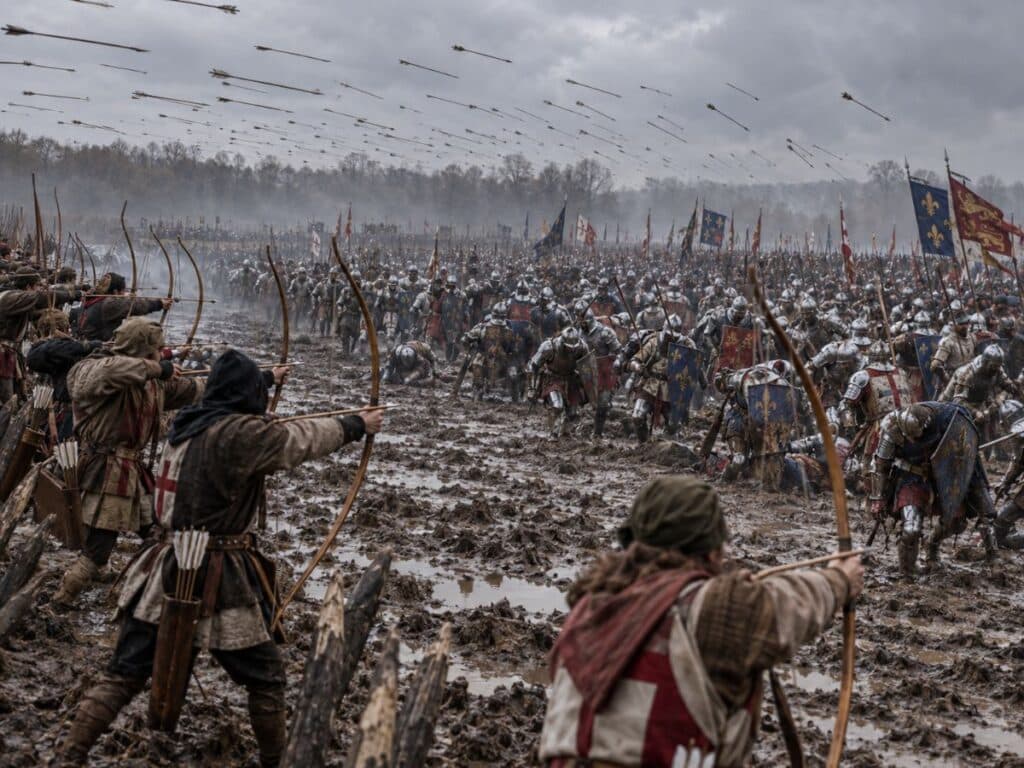
French knights on foot funneled themselves into a killing zone where English longbowmen and lighter men-at-arms cut them down as they slipped, crushed together, and drowned in mud.
What Really Happened at Agincourt on October 25, 1415
The battle of Agincourt took place on Saint Crispin’s Day, on a strip of farmland near the village of Azincourt in the county of Saint-Pol, in what’s now northern France. It lasted roughly three hours, and possibly much less, though the argument and the killing after the battle went on longer than the fighting itself.
Henry V’s army had marched out of the ruined port of Harfleur intending to reach English-held Calais and take ship home before winter. A much larger French force caught them on the road and drew up across their path on open ground between two thick woods.
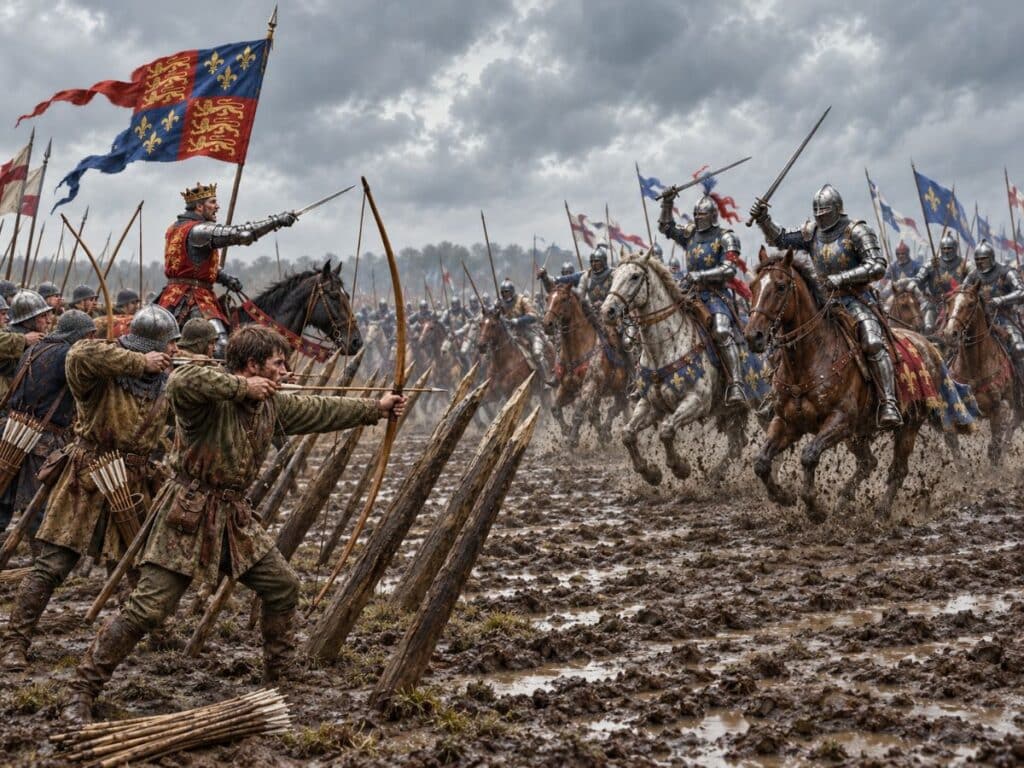
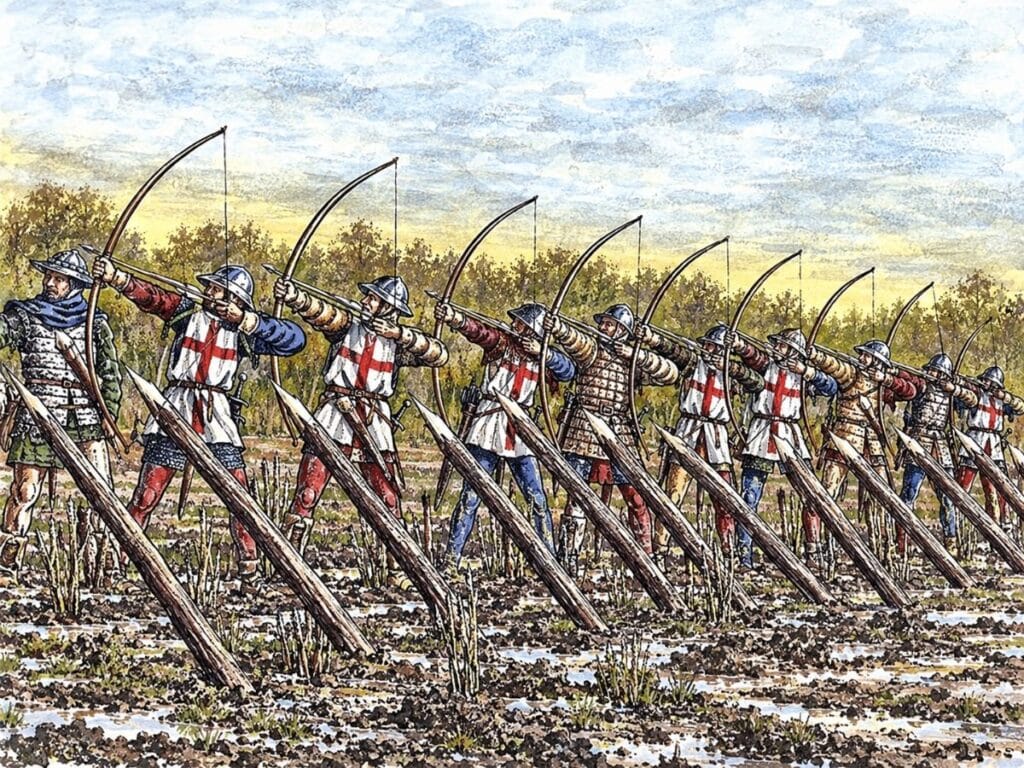
On the morning of the 25th, Henry decided to advance his line so they were within longbow range of the French. Planting the stakes his archers had been carrying for weeks, they waited.
The French command was already in trouble before a single arrow flew. Charles VI, whose bouts of severe mental illness had left him unfit to lead an army for years, wasn’t on the field. Neither was his son the Dauphin.
Command fell instead to the Constable of France, Charles d’Albret, and Marshal Jean Boucicaut, both experienced soldiers, but around them clustered a swarm of great lords, princes of the blood and their retinues, each convinced of his own right to be in the vanguard. It was a battle for superiority within the ranks.
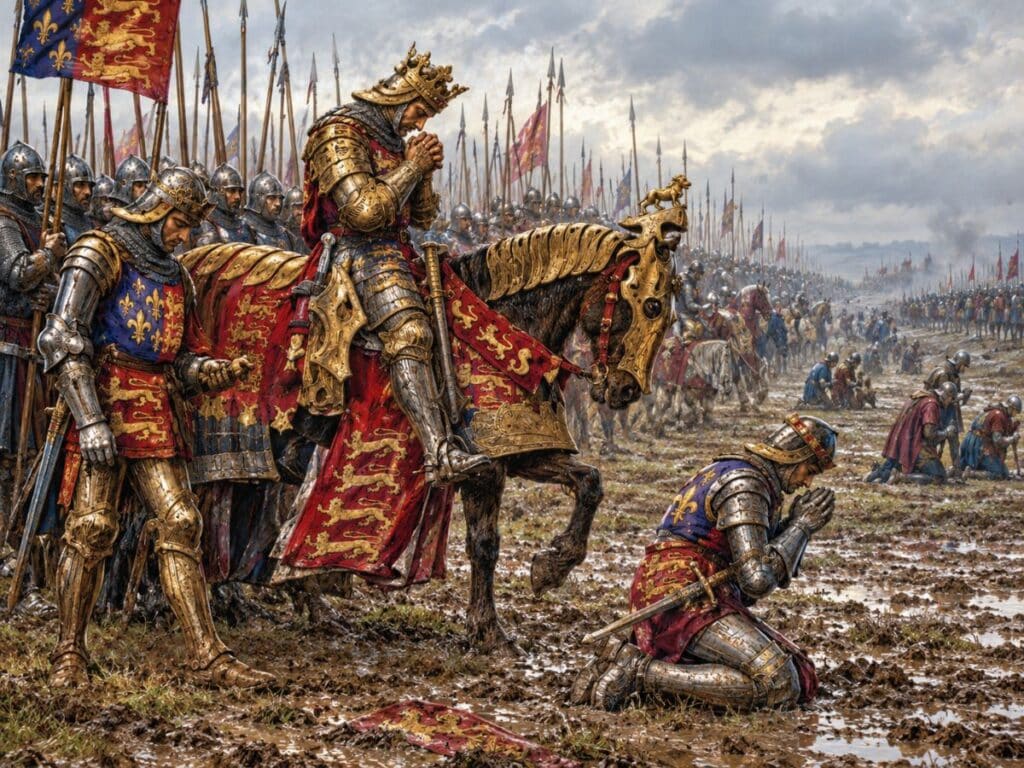
How Did Henry V’s Army End Up So Small and Sick?
Henry landed in Normandy in August 1415 with 12,000 men and immediately set up camp in front of Harfleur. The siege, supposed to take a week, took five, and it broke his army before he ever met the French.
Dysentery tore through the English camp. Men were wasting in the trenches, unable to stand, dying in numbers that horrified even veterans of earlier French wars.
The Bishop of Norwich died of it, as did the Earl of Suffolk, and when Harfleur finally surrendered on September 22, Henry had lost serious numbers to disease.
When Henry got to Harfleur, his army was a lot smaller than what he’d set out with, and this was one of the reasons he decided not to sail home but to march overland to Calais instead. It was a daunting prospect as it took them through hostile territory and was about 150 miles, as the crow flies.
By the time the English reached the field at Azincourt they’d been on the road for a fortnight, were desperately short of food, and were still losing men to dysentery. The chaplain who wrote the Gesta Henrici Quinti, and who was with the baggage train that day, describes soldiers so ill they were fouling themselves in their armor as they marched into position.
Were the English Really Outnumbered Five to One at Agincourt?
For centuries, we’ve been told how hugely outnumbered the English were against the French, with 6,000 English against 20,000 to 30,000 French, a ratio of four or five to one that made Henry’s victory a near-miracle.
And of course, we have to credit the good old medieval chroniclers for some of that, most of whom had every reason to exaggerate.
But Anne Curry’s work, Agincourt: A New History, went back to the muster rolls and pay records that survive in the English and French archives and came out with a very different figure: something closer to 9,000 English against about 12,000 French.
Not every historian accepts her numbers, though; that would be too easy. Clifford Rogers and others have argued the French army was larger, perhaps closer to the older estimates. However, one thing not in dispute is that the French outnumbered the English, but the ratio wasn’t five to one.
The French army was heavy with mounted nobility and their armored retainers, the flower of the aristocracy, competing for the honor of striking the first blow. The English force was mostly archers, perhaps five for every man-at-arms, lightly equipped and used to moving fast.
The French advantage was prestige and armored weight, but the English advantage was the number of bows and a commander who actually led his own line.
Hooked on the Middle Ages? Get more stories like this one in your inbox.
Why the Mud and the Terrain Beat the French
The ground at Azincourt did more damage to the French than the English did. It had rained heavily for days before the battle, the field had been plowed for the autumn sowing, and the whole strip between the two woods was churned into thick clay.
The woods of Azincourt and Tramecourt closed in on either side and squeezed the open ground into a funnel roughly 1,000 yards wide at the English end and narrower still where the French massed.
When the French van finally advanced, on foot because their commanders had decided a mounted charge into the English stakes was suicide, they had to cross several hundred yards of that bog under arrow fire.
Knights arrived at the English line already exhausted, breathing hard inside their helmets, and were then pushed forward by the ranks behind them into a press so tight, according to Le Fèvre and Wavrin, that men could barely raise their weapons.
When the front rank started to fall, disaster set in. Men who went down in armor didn’t get up. They were trodden into the mud by their own side, or suffocated under the weight of those pressing behind.
The Gesta describes heaps of French dead piled higher than a man’s head in three separate places along the English line.
When the English archers ran low on arrows, they dropped their bows, grabbed hammers, mallets, and hatchets from the baggage, and went into the mud on foot to finish what was there.
Did the English Longbow Really Win the Battle of Agincourt?
Although the longbow was the star of the show, the mud, the stakes, and the French formation certainly played their part. Roughly five of every six men in Henry’s army carried one, and the sheer volume of arrows the English put in the air, tens of thousands in the opening minutes, was something the French couldn’t compete with.
Arrows did well at killing horses, wounding the lightly armored, breaking up neat formations, and making men keep their heads down and their visors closed as they advanced. What they didn’t do, at least not reliably, was punch through good plate armor at long range.
The bow’s real work was to force the French to come to Henry across the worst possible ground. By advancing his line into arrow range and opening fire, Henry gave the French command a choice: charge across the mud or stand there being shot at. Divided and quarrelsome, they charged.
The Gesta Henrici Quinti, written by a chaplain who watched the battle from the English side, describes the archers planting sharpened stakes at an angle in the ground before them, a hedge of points to break any mounted charge.
Behind and between the archers stood Henry’s men-at-arms in a thin line, three deep. When the French infantry finally reached that line, jammed together, exhausted, and half-blind inside their helmets, the archers came in from the sides with mallets and knives.
Why Did Henry V Order the French Prisoners Killed?
Partway through the day, with the French vanguard broken and thousands of prisoners in English hands, Henry V gave the order to kill the prisoners. The order spared the great lords, whose ransoms were worth fortunes, but it condemned the rank and file, the men-at-arms and lesser nobility who had thrown down their weapons when the line collapsed.
Monstrelet, writing on the Burgundian side, and Le Fèvre and Wavrin, who were both there, agree on why, and although cruel you can understand. A raid on the English baggage train at the rear of the army, possibly by local peasants under a minor lord named Isambart d’Agincourt, coincided with signs that the French rearguard, which hadn’t yet fought, was regrouping for another push.
Henry had more prisoners than guards. If the rearguard came on and the prisoners rearmed themselves, he would be caught between two enemies with his exhausted line pinned in place. What else was he to do?
The English men-at-arms weren’t happy about it and refused to do what Henry asked. As well as losing ransoms, worth a lot of money, it went against the grain to do something so barbaric, even in medieval times.
It stopped as soon as the French rearguard scattered without attacking. It was a legal act by the standards of the time, prisoners taken in the melee having no guaranteed quarter until formally accepted for ransom, but it was still an atrocity.
Who Died at Agincourt and What It Cost France
Many of those killed at Agincourt on the French side were in the nobility. Among them were Charles d’Albret, the Constable of France, and the Duke of Brabant, who’d ridden hard to reach the field and joined the fight in borrowed armor with a surcoat made from a trumpeter’s flag.
The chroniclers put the total French dead somewhere between 4,000 and 10,000, which is quite a large number either way, although we’ll never know the true figure.
English losses are harder to pin down and were almost certainly minimized by Henry’s people for propaganda purposes.
It was certainly more than 30 English dead, despite what Gesta claims, and the figure is probably more like several hundred, still nothing like the French though.
What Agincourt cost France wasn’t really the men, but the leadership class of an entire generation and the fragile balance of a country already tearing itself apart.
The civil war between the Armagnac and Burgundian factions, simmering since the assassination of the Duke of Orleans in 1407, now had fresh grievances and a badly weakened Armagnac party. The road that led to the 1420 Treaty of Troyes, in which a broken Charles VI disinherited his own son and named Henry V heir to the French throne, is a direct result of Agincourt.
How Do We Know Any of This?
Almost everything we can say about Agincourt with any confidence comes from three narrative sources written by people who saw it, or spoke at length to people who did.
The Gesta Henrici Quinti, or Deeds of Henry the Fifth, was composed within two years of the battle by an anonymous chaplain in Henry’s household, who was with the baggage train that day and heard the shouting.
It’s the closest thing we have to an English eyewitness account, but you also have to remember it was written to glorify the king. It’s invaluable, but it’s biased.
On the French and Burgundian side, the two indispensable sources are Jean Le Fèvre de Saint-Remy and Jean de Wavrin, whose Recueil des croniques et anchiennes istories de la Grant Bretaigne is the fuller of the two.
Frequently Asked Questions
Why did the French lose the Battle of Agincourt?
The French lost the Battle of Agincourt on a field of freshly plowed farmland that days of rain had turned to sodden clay, funneled between the woods of Agincourt and Tramecourt, and they crossed it on foot in full armor.
The knights arrived exhausted and packed so tightly they could barely swing a weapon, while English longbowmen harried them into the killing zone. Fallen men were trampled or suffocated in the mud, and lighter English troops finished the survivors.
How many soldiers died at the Battle of Agincourt?
The number of soldiers who died at the Battle of Agincourt fell heaviest on the French, with common estimates putting their dead at around 6,000 against roughly 400 English, all in a single afternoon.
The exact figures are disputed, and Henry V may have understated his own losses. Among the French dead were the Constable, three dukes, and dozens of the leading nobles of the realm.
Were the English really outnumbered at Agincourt?
The English were outnumbered at Agincourt, but the degree of imbalance is debated. The traditional account puts about 6,000 English against 20,000 to 30,000 French. Anne Curry went back to the surviving muster rolls and argues for roughly 9,000 English and about 12,000 French. Either way, the French had the larger force, but the crushing numerical superiority of legend may be overstated.
Why did Henry V order the killing of French prisoners?
Henry V ordered the killing of French prisoners because he was scared of losing control. His army was tiny by this point, and the thousands of captives outnumbered their guards.
A raid on the baggage train and signs that the French rearguard was regrouping convinced him the fight could still turn. The killing stopped once the threat passed, and the most valuable prisoners were spared for ransom.
Did the longbow win the Battle of Agincourt?
The longbow was a winning factor at the Battle of Agincourt. Thousands of archers formed the bulk of Henry’s army, and their arrows broke up the French advance and drove the men-at-arms into a mud-choked funnel between two woods.
Sharpened stakes protected the archers and English discipline held, and once the French were packed into that funnel, the ground and the crush did most of the killing.
Where was the Battle of Agincourt fought?
The Battle of Agincourt was fought on a narrow strip of recently plowed farmland hemmed in by the woods of Agincourt and Tramecourt, near what is now the village of Azincourt in northern France.
It took place on October 25, 1415. Henry V had marched his army out of Harfleur and was making for the English-held port of Calais. The terrain squeezed the larger French force into a space it could not use.

Love a good medieval story?
Join our readers and get tales of kings, queens, castles and ordinary medieval lives straight to your inbox.

Kylie Lang is a nationally syndicated travel journalist with bylines on the Associated Press Wire & more, a medieval history writer, and the founder and lead author of Tales of the Middle Ages (talesofthemiddleages.com). She holds a BA (Honours) in History from the University of Kent and is a member of the British Guild of Travel Writers.