Did King Arthur’s legendary sword Excalibur truly exist? Explore the legend of Excalibur, myths, history, and possible origins of this famous weapon.
A sword jammed into stone, its blade etched with indecipherable runes. A teenage boy yanks it free and becomes king of a fractured, war-torn land. King Arthur’s Excalibur is the ultimate underdog myth—but here’s the catch: no one’s ever found it. Not in Welsh bogs, not beneath Glastonbury Abbey, not even in the depths of eBay listings.
Table of Contents
Plenty of movies have been made about the Legend of Excalibur, from Disney’s Sword in the Stone, which I remember seeing as a kid, to the more recent King Arthur: Legend of the Sword. But do any of them have any basis of truth?
Was Excalibur real, or was it a medieval PR stunt to distract Britons from Saxon invasions? We’re slicing through centuries of hype to uncover the truth.
The Sword in the Stone: Miracle or Marketing Ploy?

The “sword in the stone” legend first appears in Robert de Boron’s Merlin (c. 1200), written 700 years after Arthur’s supposed reign. Coincidentally, it emerged during England’s bloody civil wars. A magical sword uniting the realm? Suspiciously convenient.
In 1191, monks at Glastonbury Abbey “found” Arthur’s grave—conveniently after a fire destroyed their church. They claimed a lead cross inscribed “Here lies Arthur, king” marked the site. The cross vanished by the 18th century, and the sword was conspicuously absent. Modern scholars call it a fundraising hoax.
But why a sword in a stone? The trove taps into ancient symbolism. In Celtic lore, sacred stones like the Lia Fáil (“Stone of Destiny”) were believed to roar when touched by a true king. Boron’s story Christianized this pagan motif, swapping druidic mysticism for divine right. The sword became a holy prop, a weapon blessed by God to legitimize shaky monarchs.
Excalibur vs. Caliburn
Early Welsh texts, like the Historia Brittonum (9th century), name Arthur’s blade Caledfwlch (“hard cleft”), a practical weapon with no magic. By the 12th century, Geoffrey of Monmouth Latinized it to Caliburn, adding flair for Norman audiences. By the French romances, it became Excalibur, complete with a watery goddess bestowing it. The sword transformed from a tool to a divine endorsement, proving myth evolves faster than steel.
The name itself is a linguistic battleground. Caledfwlch likely derives from the Irish Caladbolg, a lightning-wielding sword from the Ulster Cycle. The Normans, eager to erase Celtic roots, rebranded it Excalibur to sound more Latin and more marketable.
Archaeology’s Cold Steel: What Swords Were Found
Fifth-century British swords were brutal, rusty tools. In 2017, a sword dredged from Cornwall’s Dozmary Pool (linked to Excalibur’s return) turned out to be a 14th-century relic.
The Pommel of Rhydderch, a 7th-century Welsh artifact adorned with dragons, hints at elite craftsmanship but lacks any link to Arthur. Even the famed Ring-Sword from Kent, a 5th-century blade with a “singing” pommel, was likely a psychological weapon, not a magical one.
The Lady of the Lake: Pagan Goddess or Political Puppet?
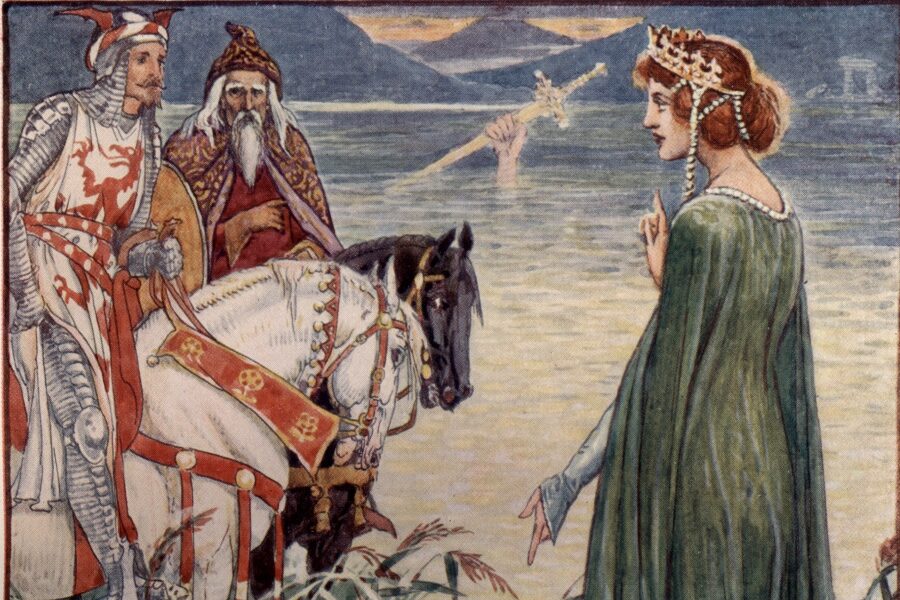
The Lady of the Lake, Viviane, Nimue, take your pick, is absent from early Arthurian lore. She emerges in French tales, handing Excalibur to Arthur like a watery deity. Historians argue she’s a recycled Celtic water spirit, repurposed to Christianized pagan myths.
But lakes were medieval dumping grounds. Hundreds of swords rest in European waters, tossed as offerings or lost in battle. Excalibur’s “return to the lake” might just be a poetic license for scrapping old weapons.
Hooked on the Middle Ages? Get more stories like this one in your inbox.
Excalibur’s Dark Side: Cursed Blade or Crowd Control?

Later tales claim Excalibur’s scabbard made Arthur invincible until his half-sister Morgan le Fay stole it. The message? Power is fleeting, even with magic.
Real Dark Age warlords used fear, not fairy tales. The Ring-Sword’s eerie hum when swung was designed to terrify enemies. Excalibur’s legendary glow? Likely sunlight on polished iron.
But curses sell. In 1485, Richard III’s corpse was found under a parking lot with a sword still wedged in his skull. Tudor propagandists spun it as “divine justice,” proof even kings aren’t immune to myth’s bite.
Possible Explanations for the Myth
So, what lies at the heart of the Excalibur legend? Here are three possible explanations:
1. A Real Sword Amplified by Legend
It’s conceivable that Arthur (or a historical figure upon whom he was based) possessed a particularly impressive sword. Over centuries of retelling, its significance grew, transforming it into a supernatural artifact capable of shaping destinies. Think of it as Chinese Whispers, where every time the story is told, it’s embellished.
2. Symbolic Representation
Excalibur may never have existed as a tangible object but instead served as a metaphor for Arthur’s leadership, justice, and connection to higher powers. In this interpretation, the sword embodies the ideals of chivalry and kingship.
3. Pure Fiction
Finally, Excalibur could simply be a literary invention created by medieval authors to enhance the drama and mystique of their stories. As a plot device, it adds depth and intrigue to the already compelling tale of King Arthur.
Why We Still Want Excalibur Real

Excalibur endures because it’s the ultimate underdog story, a nobody rising in chaos. Brexit divisions and pandemic fatigue make the myth feel freshly relevant.
It’s also lucrative. Tintagel Castle, marketed as Arthur’s birthplace, peddles Excalibur keychains and Merlin-themed beer. Never mind that the site was abandoned by the 6th century.
Even Hollywood can’t resist. From Monty Python’s coconut-clapping knights to King Arthur: Legend of the Sword (a box-office flop), Excalibur’s legend adapts but never dies.
Could Excalibur Even Exist?
Iron Age swords were brittle. The famed Ulfberht Viking blades (9th century) used superior steel, but Arthur predated them by 400 years. A sword that never breaks? Not without the metallurgy Europe had yet to discover.
Unless Excalibur was Roman, the spatha, a Roman cavalry sword, was durable enough to inspire legends. One found in a 4th-century Sussex grave had no owner’s name, but it’s the closest thing to Arthur’s blade we’ve got.
The Politics of Legend: Who Benefits from Excalibur?

Myths serve masters. Henry VIII displayed a fake Excalibur at Westminster to legitimize his break from Rome. Napoleon Bonaparte commissioned paintings of himself clutching a sword-in-stone knockoff. Even Hitler’s SS looted Tintagel artifacts, seeking ties to “Aryan” legends.
Excalibur isn’t just a sword; it’s a political tool. Whoever controls the story controls the throne.
The Final Verdict: Legend, Not Ledger
Excalibur’s power lies not in its edge but in its story. It’s a narrative forged from desperation, a fractured nation’s longing for unity. Arthur may have been a footnote, but his sword became a symbol of resilience, sharp enough to cut through 1,500 years of doubt.
The truth? Kings rise and fall, swords rust, and history is written by those who survive. Excalibur endures because we need it to, a gleaming lie that outlives the bones of the past.
Love a good medieval story?
Join our readers and get tales of kings, queens, castles and ordinary medieval lives straight to your inbox.

Kylie Lang is a nationally syndicated travel journalist with bylines on the Associated Press Wire & more, a medieval history writer, and the founder and lead author of Tales of the Middle Ages (talesofthemiddleages.com). She holds a BA (Honours) in History from the University of Kent and is a member of the British Guild of Travel Writers.
Related posts:
 King Arthur’s Dark Side: 7 Shocking Decisions That Almost Destroyed His Kingdom
 Did They or Didn’t They? Was Catherine of Aragon Still a Virgin When She Wed Henry VIII?
Did Catherine of Aragon Lie About Her Virginity?
 Did Catherine of Aragon Marry Henry VIII as a Virgin? Or Did She Have Us All Fooled?