
A letter went out from London in May 1536, addressed to a diplomat in France. The writer claimed Anne Boleyn had slept with over a hundred men, including her own brother. None of it was true. It didn’t need to be. By the time the letter was read, Anne was already dead.
This is how the Tudor court actually worked. Not through laws or ledgers, but through whispers. A word in the right ear at the right moment could lift a family into the peerage or send a man to the block. Reputation was the currency, and gossip was the exchange rate.
Table of Contents
Henry VIII’s court was an information ecosystem, and everyone in it, from the queen down to the lowliest page, was either trading rumors or trying to outrun it. The people who understood that survived, while the people who didn’t ended up on Tower Hill.
Why Gossip Was the Real Power at Court
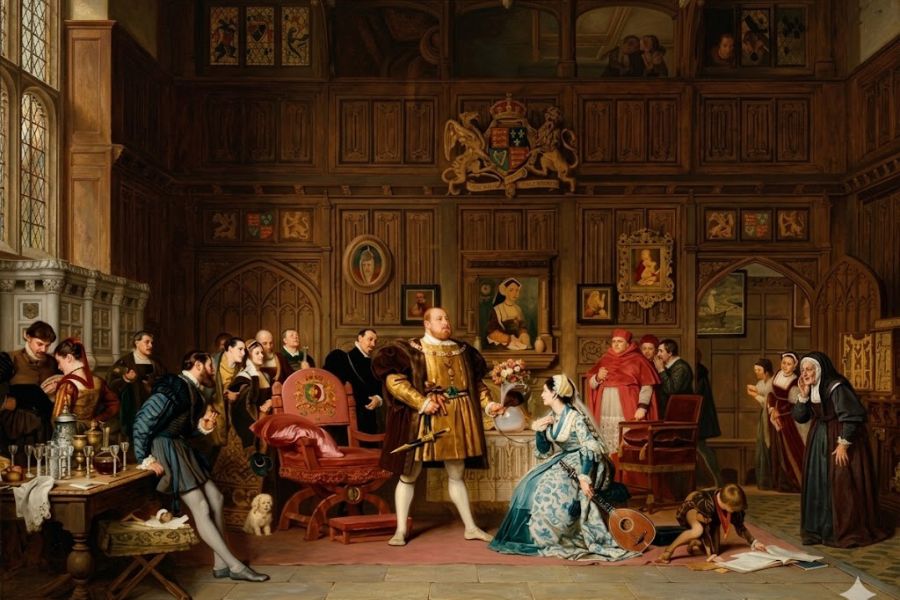
The Tudor court was a closed world of around a thousand people, all of them packed into the same palaces, eating in the same halls, sleeping in chambers within earshot of one another. Privacy didn’t exist in any modern sense.
Servants slept on truckle beds in their masters’ rooms. Grooms emptied chamber pots and saw exactly who’d shared whose bed. Laundresses knew whose sheets carried what stains.
All of this information had value. A diplomat who knew Henry was tiring of his wife could write home to his king with weeks of advantage. A courtier who heard that Cromwell was out of favor could pivot his loyalties before the fall.
The man who controlled the flow of whispers controlled who rose and who fell, and Henry himself was the most attentive listener of all.
This made the court a kind of nervous system, twitching at every rumor. A glance held too long, a letter delivered in private, a French hood worn at the wrong angle, any of it could be read as a sign. And once a sign was read, it could be reported, and once it was reported, it could kill you.
Anne Boleyn and the Anatomy of a Smear
Anne Boleyn’s destruction in 1536 is the clearest example of what Tudor gossip could do when properly weaponized. The charges brought against her were lurid: adultery with five men, including her brother George, plus plotting the king’s death.
The evidence was thin to nonexistent. The dates on the indictments place Anne in cities where she demonstrably wasn’t. One alleged tryst happened while she was still recovering from childbirth.
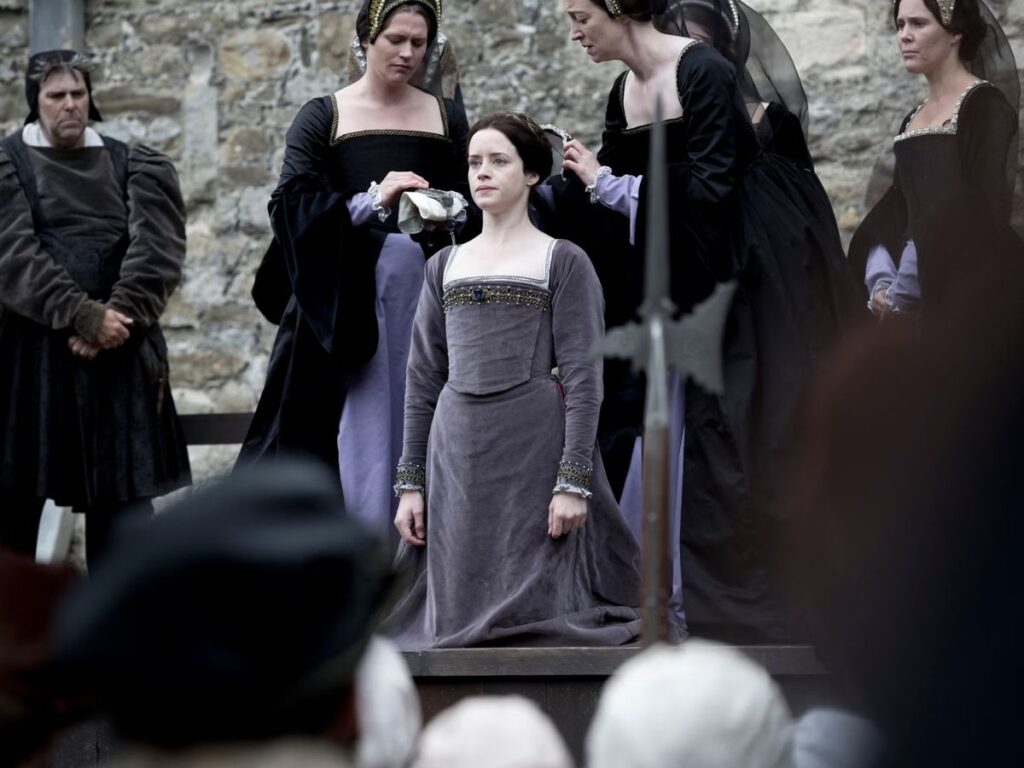
None of that mattered because by the spring of 1536, the gossip had already done its work. Anne had a reputation for sharp words and sharper enemies. She’d quarreled with Cromwell over the proceeds of the monasteries. She’d miscarried a son in January, and the court was already whispering that Henry was looking at Jane Seymour, and once the king’s eye wandered, the vultures gathered fast.
What’s striking is how quickly the rumors hardened into accepted fact. Eustace Chapuys, the imperial ambassador and no friend of Anne’s, reported the incest charges with a kind of grim satisfaction, although even he doubted them in private.
Within a generation, Catholic writers were claiming Anne had six fingers and a goiter, that she was a witch, that she’d seduced Henry with sorcery. The smear outlived her by centuries. It still shapes how she’s pictured today.
Hooked on the Middle Ages? Get more stories like this one in your inbox.
Jane Boleyn and the Whisper That Killed a Queen
If Anne was the victim of gossip, Jane Boleyn was, at least for a while, its operator. Jane survived the 1536 bloodbath that killed her husband George and her sister-in-law Anne, and she did it by knowing when to talk and when to stay quiet.

She gave evidence at the trials, though exactly what she said remains in dispute. The Boleyns went down. Jane walked away and was back at court within months.
She served Jane Seymour, then Anne of Cleves, then Catherine Howard. And it was with Catherine that her instinct for whispered intrigue finally caught up with her. Jane helped arrange the private meetings between the teenage queen and Thomas Culpeper in 1541. She stood guard at doors, passed messages, and was, in essence, running the operation.
When the affair was uncovered, the gossip moved faster than anyone could control. A man named John Lascelles told Cromwell’s successor about Catherine’s past in the Dowager Duchess of Norfolk’s household. From there it unspooled: the music master Henry Manox, the gentleman Francis Dereham, and finally Culpeper.
Jane confessed under interrogation and reportedly lost her mind in the Tower before her execution. She’d lived by court whispers for years. In the end, they took her too.
Cromwell, the Spider at the Center of the Web
Thomas Cromwell understood gossip better than anyone in Henry’s reign, because he built his power on it. His agents were scattered across England and the continent, sending him reports on everything from a priest’s sermon in Yorkshire to the contents of a Spanish ambassador’s private letters.
He maintained a network of informers that would have impressed a modern intelligence service.

What made Cromwell formidable was the way he collected and then shaped information. The case against Anne Boleyn was almost certainly built in his office, with witnesses interviewed, statements taken, and a narrative constructed before the arrests began.
He did the same to lesser figures all the time. A few well-placed depositions, a sympathetic juror or two, and a man’s lands and life were forfeit.
The irony is that Cromwell himself fell to exactly the same machinery in 1540. His enemies, chiefly the Duke of Norfolk and Stephen Gardiner, fed Henry a steady drip of complaints: Cromwell was a heretic, Cromwell had pushed the king into the disastrous Anne of Cleves marriage, Cromwell was getting above his station.
The whispers reached the king at the right moment, with the right intensity, and Cromwell was arrested at a council meeting without warning. He died on the block in July. The spider got caught in his own web.
The Foreign Correspondents Who Kept the Gossip Alive
A great deal of what we know about Tudor court gossip survives because foreign ambassadors wrote it down. Chapuys, the imperial envoy, was at court for sixteen years and sent dispatches back to Charles V that read like a high-end scandal sheet.
He recorded who looked unwell, who quarreled at dinner, and who slipped a note to whom. He had paid informants inside the royal household and wasn’t above repeating laundry-room gossip if it served his master’s interests.
The French ambassadors did the same. So did the Venetians, whose dispatches are some of the most acute portraits we have of Henry’s court. These men were professional listeners. They cultivated relationships with disgruntled courtiers, bribed servants, and traded information with one another in a kind of diplomatic black market.
When Catherine of Aragon was being pushed aside, Chapuys knew the details almost before Catherine did.
The problem, for historians, is that ambassadors had their own agendas. Chapuys hated Anne Boleyn and was happy to repeat anything that made her look bad. The French ambassador Marillac despised Cromwell and painted him in the worst possible light.
The gossip was real, in the sense that it circulated and was believed. Whether it was true is a different question, and one we often can’t answer.
How a Rumor Became a Death Sentence
The mechanism by which gossip turned lethal had a few consistent stages. First, a story would start circulating, often from a low-status source: a servant, a former lover, a dismissed retainer with a grudge. Then it would be picked up by someone with access to the king or his chief minister.
Then it would be tested, sometimes by interrogation, sometimes by a quiet conversation in a privy chamber. If the king reacted, the machinery engaged. Arrests, depositions, a trial that was largely a formality, and then the scaffold.

The speed of all this is what shocks. Anne Boleyn was arrested on May 2, 1536, and dead on May 19. Catherine Howard was first questioned in November 1541 and executed in February 1542. Cromwell fell in June 1540 and was beheaded in July.
Once the gossip reached critical mass, the end came quickly. There was no real defense against it, because the trial wasn’t designed to test the evidence. It was designed to confirm the outcome.
This is why so many Tudor courtiers spent so much energy on what looks, from a distance, like petty social maneuvering. The clothes, the seating, the precedence at dinner, the question of who carried whose train at a christening, all of it was a public reading of where each person stood with the king.
If you fell out of favor, the whispers would start, and once they started, you were already in trouble. Survival meant managing your reputation every single day.
Conclusion
What looks from the outside like a glittering Renaissance court was, from the inside, a permanent low-grade war fought with words. Every meal was a chance to be observed. Every letter could be intercepted, and the very real possibility that every servant might be in someone else’s pay.
The people who thrived, the Cromwells and the Jane Boleyns and the survivors of the Seymour clan, were the ones who treated information as the resource it was.
The ones who didn’t, or who simply ran out of luck, tend to be the names we remember best. Anne Boleyn, Catherine Howard, George Boleyn, Thomas Cromwell himself, all of them brought down at least in part by stories that may or may not have been true, told by people who stood to gain from the telling.
The historical record is so thick with rumor that historians are still trying to untangle what actually happened from what was simply whispered loud enough to stick.
It’s worth remembering, when reading about the Tudor court, that the sources we rely on were themselves often gossip. A dispatch from Chapuys, a deposition taken under threat of torture, a hostile pamphlet written years later, none of these are neutral.
The scandal sheet of Henry’s court has been running for nearly five hundred years, and we’re all still reading it.

Love a good medieval story?
Join our readers and get tales of kings, queens, castles and ordinary medieval lives straight to your inbox.

Kylie Lang is a nationally syndicated travel journalist with bylines on the Associated Press Wire & more, a medieval history writer, and the founder and lead author of Tales of the Middle Ages (talesofthemiddleages.com). She holds a BA (Honours) in History from the University of Kent and is a member of the British Guild of Travel Writers.
Related posts:
 Beyond Wolf Hall: The Dramatic Rise and Fall of Thomas Cromwell
 The Execution of Lady Jane Grey: The Teenager Crowned Queen and the Nine Days That Sealed Her Fate
 The Rise and Fall of Anne Boleyn: Power, Passion, and Politics
 The Queen Who Blew Up the Tudor Court: Catherine Howard’s Rise and Catastrophic Fall