
Katherine Swynford spent more than two decades as the mistress of the most powerful man in England, raised four children outside marriage who were openly called by his name, and then, in her mid-forties, walked into Lincoln Cathedral as the lawful wife of John of Gaunt. The Pope legitimized her children, and surprisingly, parliament agreed.

From those children came the Beauforts, and from the Beauforts came Margaret Beaufort, and from Margaret came Henry Tudor. Without Katherine, there’s no Bosworth or Tudor dynasty. Some would say that wasn’t a bad thing.
Table of Contents
Every English monarch from Henry VII onward, including the one currently on the throne, traces back to a knight’s widow from Hainault who outlived three queens, two husbands’ deaths, and a peasants’ revolt that put her name on a list of women the rebels wanted dead.
Her story is one of the strangest survival arcs of the 14th century, and the political machinery that made her great-great-grandson king started turning the day she became Gaunt’s mistress.

A Hainaulter at the English Court
Katherine was born around 1350, the daughter of Paon de Roet, a herald in the service of Queen Philippa of Hainault. Philippa was Edward III’s queen, and she’d brought a small entourage of her countrymen with her when she came to England to marry him in 1328.
Hainault sat in what’s now Belgium, and a steady trickle of its minor nobility followed Philippa across the Channel, looking for work and favor.
Paon de Roet died when Katherine was young, and she and her sister Philippa were raised in the queen’s household. That’s where the story gets interesting: Philippa de Roet, Katherine’s sister, married a court official named Geoffrey Chaucer. Yes, that Chaucer.
Katherine was the sister-in-law of the man writing the Canterbury Tales. It doesn’t get much better, really. It means the woman at the center of England’s most consequential royal scandal was sitting at family dinners with the father of English literature.
Around 1366, Katherine married Hugh Swynford, a Lincolnshire knight in the service of John of Gaunt. Gaunt was Edward III’s third surviving son, Duke of Lancaster, and one of the richest men in Europe.
Hugh held lands at Kettlethorpe, a moated manor in the Lincolnshire flatlands, and Katherine moved there as his wife. She had at least two children by him before Hugh died on campaign in Aquitaine in 1371. She was about 21 and a widow with young children to feed.

Governess, Mistress, and the Long Affair
By the time Hugh died, Katherine was already in Gaunt’s orbit. She’d been appointed governess to his daughters by his first wife, Blanche of Lancaster, the woman who would grow up to be Philippa, Queen of Portugal, and Elizabeth, Duchess of Exeter.
Blanche herself had died of plague in 1368, and Gaunt had remarried for political reasons in 1371, taking Constance of Castile as his second wife in pursuit of a claim to the Castilian throne.
The affair with Katherine began somewhere in those years, probably around 1372. Nobody knows the exact start date, and the chroniclers who wrote about it later were too scandalized to be precise.
What we do know is that by 1373, Katherine was pregnant with the first of four children she’d have by Gaunt: John, Henry, Thomas, and Joan Beaufort. The surname came from one of Gaunt’s French lordships. For now, it was simply a tidy way of marking children who couldn’t carry their father’s name.
Katherine wasn’t hidden away in a country manor. She traveled with Gaunt’s household, received generous grants of land and rents from him, and was a recognized presence at court. Constance of Castile, the legal wife, kept her own separate household and her own staff of Spanish attendants, and the two women’s worlds rarely touched.
It was an arrangement nobody approved of in theory, and everyone tolerated in practice. Until the summer of 1381, when everything fell apart.

The Peasants’ Revolt and the Public Break
When Wat Tyler and the rebels marched on London in June 1381, John of Gaunt was the most hated man in the country. He was blamed for the poll tax, for the failures in France, and for taxes generally.
The rebels burned his palace at the Savoy to the ground, smashing his treasures and tipping his wine cellar into the Thames. Katherine’s name appeared on lists of people associated with Gaunt whom the rebels wanted to find. She was in Yorkshire at the time and escaped harm, but the shock seems to have changed something.
Gaunt was in Scotland on the king’s business when the revolt broke out. When he came south again, he made a public renunciation of Katherine. He declared the affair over, called it sinful, and formally separated their households.
The grants she’d received weren’t revoked, and Gaunt continued to provide for their children, but the official position was that the relationship had ended.
Whether they actually stopped seeing each other is a question historians still argue about. What’s clear is that for the next 13 years, Katherine lived a more retired life, mostly at Kettlethorpe and Lincoln, while Gaunt remained married to Constance and pursued his Castilian ambitions.
The Beaufort children were raised, educated, and provided for. Katherine kept her place in the family in everything but name. Then, in 1394, Constance of Castile died, and Gaunt, now in his mid-fifties, made a decision that astonished Europe.

The Marriage Nobody Saw Coming
In January 1396, John of Gaunt married Katherine Swynford in Lincoln Cathedral. He was 55. She was around 46. He was the king’s uncle, the wealthiest peer in England, and arguably the most powerful man in the country after Richard II himself. She was a knight’s widow whose sister had married a poet. The match broke every rule about how dukes were supposed to marry.
Froissart, the great chronicler of the age, recorded that the great ladies of England were furious that a woman of such humble origin had been raised above them. The Duchess of Gloucester reportedly said she would not enter any room where Katherine was present.
Gaunt didn’t care. He’d outlived two political marriages and decided, at the end of his life, to make legal the woman he’d actually chosen.
The marriage came with a second act. In September 1396, Pope Boniface IX issued a papal bull declaring the four Beaufort children legitimate. The following February, Richard II confirmed the legitimation in letters patent read in Parliament, and the children were formally recognized as members of the royal family.
What the charter didn’t originally say, and what would be inserted later by Henry IV when he came to the throne, was a crucial clause: excepta dignitate regali. Except for the royal dignity. The Beauforts were legitimate for every purpose except inheriting the crown.
The Bloodline That Became the Tudors
John of Gaunt died in February 1399, three years into the marriage. Within months, his son Henry Bolingbroke, by Blanche of Lancaster, had deposed Richard II and become Henry IV. The Beauforts, Katherine’s children, were now half-siblings to the king.
Henry IV loaded them with offices and titles. John Beaufort became Earl of Somerset. Henry Beaufort became one of the most powerful churchmen in Europe, eventually a cardinal. Thomas became Duke of Exeter. Joan married Ralph Neville, Earl of Westmorland, and through her descendants, you can trace half the great families of 15th-century England, including Richard III’s queen Anne Neville and Edward IV’s queen Elizabeth Woodville’s mother-in-law’s family. The Beauforts were everywhere.
It was John Beaufort’s line that mattered most. His grandson was John Beaufort, Duke of Somerset, and his daughter was Margaret Beaufort, born in 1443. Margaret married Edmund Tudor, son of Henry V’s widow, Catherine of Valois, and her second husband, Owen Tudor, and in 1457, a thirteen-year-old Margaret gave birth to Henry Tudor.
The Beaufort blood Henry carried was the entire basis of his claim to the throne. It was thin, it was famously excepted from the royal dignity by Henry IV’s clause, and it was all he had. At Bosworth in August 1485, it proved to be enough.
Katherine herself didn’t live to see any of this. She died in May 1403, four years after Gaunt, and was buried in Lincoln Cathedral. Her tomb sits beside that of her daughter, Joan Beaufort, in the sanctuary, near the high altar, in the most honored space the cathedral has.


Kylie Lang is a nationally syndicated travel journalist with bylines on the Associated Press Wire & more, a medieval history writer, and the founder and lead author of Tales of the Middle Ages (talesofthemiddleages.com). She holds a BA (Honours) in History from the University of Kent and is a member of the British Guild of Travel Writers.
Related posts:
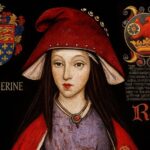 Katherine Swynford: From Court Scandal to the Tudor Bloodline
 Six Women Who Dodged a Bullet, or Axe, by Not Marrying Henry VIII
 The Ones That Got Away. The Six Women Who Kept Their Heads, By Not Marrying Henry VIII
 From Teenage Widow To Tudor Powerbroker: The Real Margaret Beaufort Story (Not The Villain You Think)