The history of Halloween stretches back a long way. It began as two festivals that fell on the same night. One was Samhain, the Gaelic feast that marked the start of winter in Ireland and Scotland.
The other was All Hallows’ Eve, the Christian vigil held the night before All Saints’ Day on November 1, and that’s where the name comes from.
Table of Contents
Over the centuries, the two got tangled together. Add a lot of Scottish and Irish mischief and a very large American candy budget, and you get the Halloween we know today. So where did it all begin?
The History of Halloween

Halloween came from Samhain, pronounced “SAH-win,” a Gaelic festival held around November 1 to mark the end of summer and the start of the dark half of the year.
The best stories about Samhain come from medieval Irish tales, and they’re cracking. People gathered at Tara, the seat of the High Kings, for feasts lasting three days before and three days after Samhain.
Every year on the eve of Samhain, a fire-breathing creature called Aillén would turn up, play his harp until the whole court fell asleep, and burn Tara to the ground.
It took a young Fionn mac Cumhaill to stop him. Fionn kept himself awake by breathing in the fumes of a poisoned spear and killed Aillén. His reward was the leadership of the Fianna, the famous band of warriors.
The Celts also believed spirits walked the Earth at Samhain. In Ireland, that belief lasted for centuries. Clodagh Doyle of the National Museum of Ireland says, “there was a belief that the dead of your family might want to come home on that night,” so families left out food or a place for them.
The medieval Church took the other world seriously too. For centuries, it taught that night-flying witches were a delusion sent by the devil, but it never doubted the devil was real.

Was Samhain Really a Festival of the Dead?
This is where it gets a bit murky. A lot of what you read about druids and a Celtic “festival of the dead” was put together by Victorian scholars, long after the Middle Ages were over.
The historian Ronald Hutton traced the idea back to two men. Sir John Rhys suggested Samhain was the Celtic New Year, and Sir James Frazer then argued it was a pagan feast of the dead.
But as Hutton points out in The Stations of the Sun, no record of such a festival exists. Frazer worked backward from the Church’s own feasts on November 1 and 2 and filled in the gaps.
I’m inclined to think the truth is somewhere in the middle.
Samhain was real, and the Irish clearly linked it with the supernatural. The picture of druids lighting fires for the dead is mostly a Victorian invention.

Did the Church Steal Halloween From the Pagans?
Rome first honored all the martyrs on May 13, after Pope Boniface IV dedicated the Pantheon in 609. A century or so later, Pope Gregory III consecrated a chapel in St. Peter’s to all the saints and fixed the anniversary for November 1.
By around 800, churches in England and Germany were already keeping November 1. Irish churches, the ones you’d expect to be most keen to cover up Samhain, used April 20 instead. In 835, the Emperor Louis the Pious made the November date official across his empire, at the suggestion of Pope Gregory IV.
So if anyone was copying anyone, the date seems to have come from northern Europe and spread from there. The Irish just happened to be holding their own party on the same night.
Hooked on the Middle Ages? Get more stories like this one in your inbox.
Where Does the Name Halloween Come From?
The name Halloween is Christian through and through. In Old English, a “hallow” was a holy person or saint, so All Hallows’ Day was the feast of all the saints, also known as Hallowmas.
The night before was All Hallows’ Eve. Say that quickly a few hundred times, and you get Hallowe’en, and eventually Halloween.
What Was Halloween Like in the Middle Ages?
In the Middle Ages, Halloween began as Hallowtide, three days of prayer for the dead from October 31 to November 2. The whole point was to help the souls of the dead on their way.
The third day, All Souls’ Day, was added by the monks of Cluny in Burgundy.
Between 1024 and 1033, they began commemorating the dead on the day after All Saints’, and the idea spread across Europe. Medieval Christians believed most souls spent time in purgatory before reaching heaven, and the prayers of the living could shorten their stay.
If you’d lived in a village in medieval England, you wouldn’t have got much sleep on Halloween. The church bells rang for the dead, and in some parishes they went on all night, to comfort the souls in purgatory and scare off anything nasty that might be wandering about. Someone even got paid for it. Parish accounts from the 1500s list payments for “the ringing of the soul bell.”
Families lit candles for the people they’d lost, and bonfires burned on the hills. I’d have been the one lying awake, cursing the bell ringer.
Then there were the soul cakes. These were small spiced cakes marked with a cross. Poor villagers and children went from house to house offering to pray for the household’s dead, and they were paid in cakes, food, or drink.
This was called souling, first recorded in England in the 1400s. Some households even left a soul cake on the windowsill overnight for any wandering spirits.
The fun and games came a little later. If you peeled an apple in one long strip and then tossed it over your shoulder, it was supposed to reveal the initial of your future husband. So was roasting nuts in pairs on the hearth. Most of these divination games come from later folk traditions and were carried on well into the 1800s.

Where Did Trick-or-Treating Come From?
Trick-or-treating came from medieval souling and guising. In Scotland, guisers dropped the prayers and went door to door in disguise instead. They sang songs, told jokes, and performed “tricks” for their treats.
Scottish and Irish immigrants took guising to North America. The earliest known use of the phrase “trick or treat” in print appeared in the Lethbridge Herald in Alberta on November 4, 1927.
It reported that “youthful tormentors were at back door and front, demanding edible plunder with the words trick or treat.”
Edible plunder. I love that.
What Is Mischief Night?
Mischief Night is the night of pranks, and it’s older than most people realize. The earliest known mention comes from the Sheffield Independent of May 22, 1830, which reported boys causing trouble on “May een,” the eve of May Day.
In England, it later moved to November 4, the night before Bonfire Night, and in parts of England it’s still held then. In America, it ended up on October 30. In the 1920s and 1930s, town leaders promoted trick-or-treating to cut down on Halloween vandalism, and pranks simply shifted to the night before.
It goes by all sorts of names in the US. New Jersey calls it Goosey Night, and Michigan calls it Devil’s Night. In Detroit, that last one turned deadly serious. In 1984, more than 800 fires were set on Devil’s Night, and the city still has a curfew for minors on October 30.
Why Do We Carve Pumpkins at Halloween?
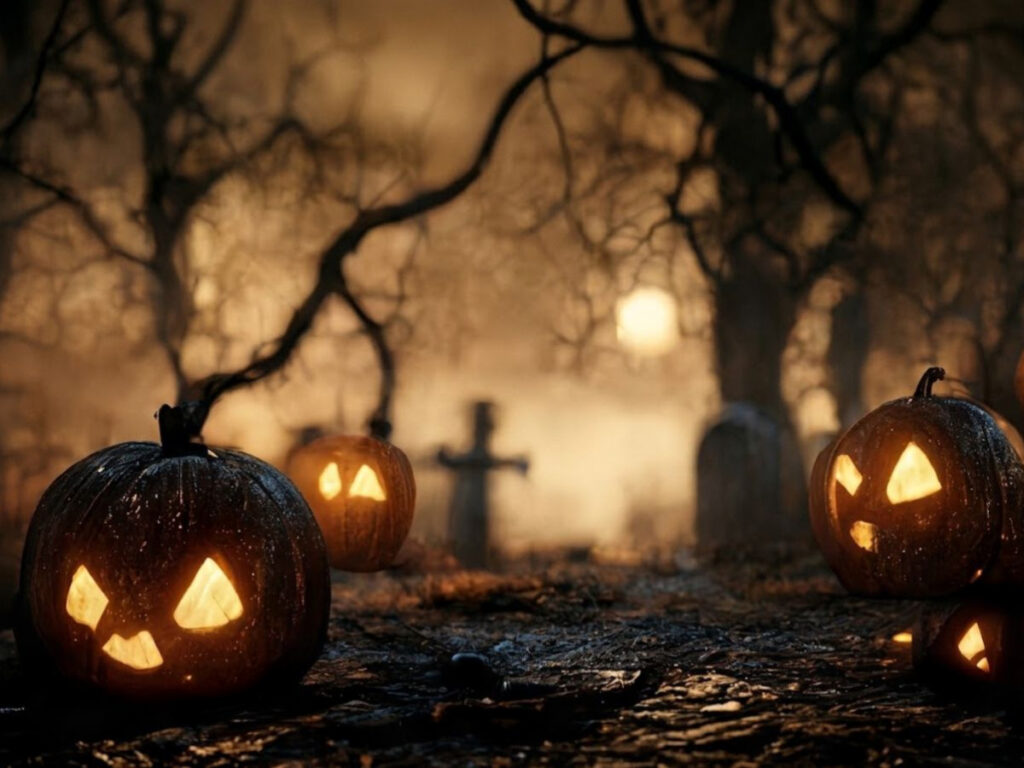
We carve pumpkins because the Irish and Scots used to carve turnips. Metal lanterns were expensive, so people hollowed out root vegetables and put a candle inside to keep the spirits at bay.
The National Museum of Ireland’s Museum of Country Life in County Mayo has a plaster cast of one with a “pinched angry face.” The original came from Donegal and a schoolteacher donated it in 1943, noting that “nobody was making this type of lantern anymore.” It was falling apart, so the curators made a cast. Look it up. It’s the stuff of nightmares.
The lanterns came with a story. Stingy Jack was a drunken Irish blacksmith who tricked the Devil twice. When he died, heaven wouldn’t have him, and hell wouldn’t take him back, so the Devil gave him a burning ember to light his turnip lantern, and he’s been wandering ever since.
When Irish immigrants reached America in the 1800s, they found pumpkins, which are native to North America and far easier to carve than a rock-hard turnip. The likely first picture of a pumpkin jack-o’-lantern appeared in Harper’s Weekly in 1867.
Halloween FAQs
Where did Halloween originate?
Halloween originated from Samhain, the old Gaelic festival that marked the start of winter in Ireland and Scotland around November 1. The name came later. Christians kept the night before All Saints’ Day as All Hallows’ Eve, and over time the two celebrations rolled into one.
Why is Halloween celebrated on October 31?
Halloween is celebrated on October 31 because it is the eve of All Saints’ Day on November 1. Pope Gregory III fixed November 1 for all the saints in the 700s, and the same night was already the eve of the Gaelic festival of Samhain.
Where does the name Halloween come from?
The name Halloween comes from All Hallows’ Even, the night before All Hallows’ Day on November 1. In Old English, a “hallow” was a holy person or saint. All Hallows’ Even was shortened to Hallowe’en, and later to Halloween.
Did the Church steal Halloween from the pagans?
The Church did not steal Halloween from the pagans, as far as the dates show. Churches in England and Germany were keeping All Saints’ Day on November 1 by around 800, while Irish churches used April 20. The November date seems to have spread from northern Europe.
Where did trick-or-treating come from?
Trick-or-treating came from souling and guising. In medieval souling, the poor went door to door offering prayers for the dead in return for soul cakes. In guising, Scottish children went in disguise and performed for treats. The earliest known use of the phrase “trick or treat” in print was in Alberta, Canada, in 1927.
What is Mischief Night?
Mischief Night is a night of pranks, held on October 30 in much of the US and on November 4 in parts of England. It was first recorded in Sheffield in 1830, when it fell on the eve of May Day. It is also called Devil’s Night, Cabbage Night, and Goosey Night.
Why do people carve pumpkins for Halloween?
People carve pumpkins for Halloween because Irish and Scottish families used to carve turnips into lanterns to keep spirits away, linked to the legend of Stingy Jack. Irish immigrants in America swapped turnips for pumpkins, which are native to North America and much easier to carve.
Love a good medieval story?
Join our readers and get tales of kings, queens, castles and ordinary medieval lives straight to your inbox.

Kylie Lang is a nationally syndicated travel journalist with bylines on the Associated Press Wire & more, a medieval history writer, and the founder and lead author of Tales of the Middle Ages (talesofthemiddleages.com). She holds a BA (Honours) in History from the University of Kent and is a member of the British Guild of Travel Writers.
Related posts:
 Grace O’Malley: Ireland’s Pirate Queen Who Ruled the Sea, Robbed the English, and Met Elizabeth I
 10 Medieval Festivals Where They Partied Like It Was 1399
 How Medieval Women Managed Their Periods: Moss, Rags, and No Knickers
 What Would Your Dog Have Been Called in the Middle Ages? Real Medieval Pet Names From Nosewise to Purkoy