I was watching Lottie, my border collie, tear across the garden the other morning in hot pursuit of a pigeon that was never in any danger, and I got to wondering what she’d have been called 600 years ago.
Naturally, as these things tend to do, it sent me down a rabbit hole of real medieval pet names, and I can tell you now, medieval dog owners were far funnier than we give them credit for.
Table of Contents
It was one of the more interesting things about animals I’ve had to research, and there are actual account books, court records, poems, and one big manuscript that lists over a thousand dog names in Middle English.
So if you’ve ever wondered what your dog would have been called in the Middle Ages, take a load off and prepare to be entertained with these medieval pet names.
The Manuscript with 1,065 Dog Names
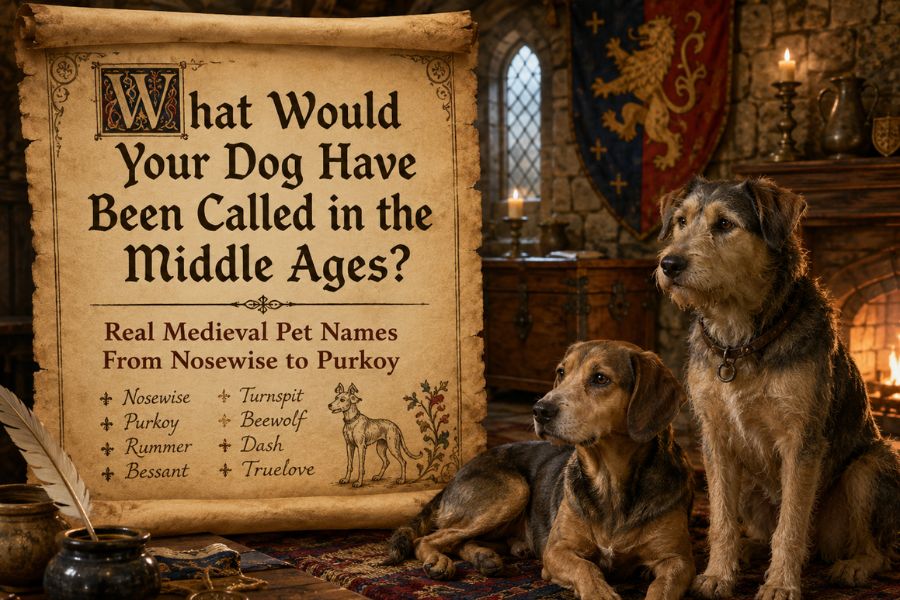
Somewhere between 1460 and 1480, an English scribe sat down and filled twelve pages of a manuscript with nothing but names for hunting dogs. It’s known as The Names of All Manner of Hounds, and it records 1,065 of them, every one in the everyday Middle English that gave us so many of the ancient phrases we still use today.
The manuscript itself sold at Sotheby’s in 2006 for £198,400, which is a fair whack for a list of dog names, however lovely.
The trick with these names is to say them out loud because then you’ll understand them. Ready?
- Nosewise.
- Fyndewell.
- Holdfast.
- Lightfoot.
- Go-bifore.
- Brynge-yn.
These were working hounds, and their names were job descriptions. A dog called Fyndewell found things well. A dog called Holdfast did not let go. My favorite of the lot is Goodynowze, which is simply Good Nose, and I’m assuming he could sniff out anything.
Medieval parents recycled the same handful of baby names, so half the village answered to William or Agnes. With that in mind, I wasn’t holding out a lot of hope for the dog names being that interesting. Well, how wrong can you be?
The Rudest Medieval Pet Names
Now for the good stuff. Tucked in among the Trustys and Sturdys are dogs called Filthe, Synfull, Blabbe, Braynesike, and my absolute favorite, Oribull.
Someone in 15th-century England looked at their hound and christened it Horrible. I’m inclined to think the scribe was having fun with some of these, but the historian who studied the list, David Scott-Macnab, points out that the dog-handlers who fed, bathed, and nursed these hounds every day knew them as individuals.
If a dog got called Wrecche, the poor thing had probably earned it.
There’s a dog in the list called Soneforgete, or Soon Forgotten, which is bleak even by medieval standards. Another called Havegoodday. Another called Penyboy. It’s the same funny tradition that produced medieval insults, just aimed at the dog basket instead of the neighbors.
Were they all meant unkindly? I doubt it. Anyone who has ever bellowed a ridiculous nickname across a field at a beloved dog will recognize exactly what was going on here.
Hooked on the Middle Ages? Get more stories like this one in your inbox.
Dogs Named After Kings, Knights, and a Roman Emperor
Plenty of medieval dogs carried grander names than their owners. The manuscript lists hounds called Charlemayne, Ercules, Arture, and Gaweyne, straight out of the same stories as the knights who became legends.
A 14th-century French knight, Jehan de Seure, had a hound named Parceval, and his wife had one called Dyamant. Naming your dog after an Arthurian knight is not a modern invention. People were doing it while the Arthurian stories were still being written.
Then it takes a turn. There are dogs in that list called Nero and Pilate. I would love to know what those two did to deserve it.
The occupations are in there, too. Hounds called Duchesse, Monke, Nonne, Hosewife, Tynker, and, wonderfully, Scheparde. Whole packs must have sounded like a roll call of medieval jobs being shouted across the countryside.
Chaucer joined in as well. The Nun’s Priest’s Tale names three village dogs, Colle, Talbot, and Gerland, chasing a fox through the chaos.
Every Cat in England Was Called Gyb
Cats got a rougher deal. In medieval England, nearly every cat was called Gyb, short for Gilbert. It was the generic tomcat name, the way every unknown cat today gets called Tom.
The earliest record is a seal from the late 1300s belonging to one Gilbert Stone, showing a cat with a mouse and the motto “gret wel gibbe oure cat,” or “greet well Gib our cat.” A man named Gilbert put his own cat, also named Gilbert, on his official seal. That is commitment.
Across the Channel, the French generic cat was Tibert, who appears as the cat in the Reynard the Fox fables. But individual cats with individual names do turn up. A cat called Mite prowled Beaulieu Abbey in the 13th century. Isabella d’Este, the formidable ruler of Mantua, had a cat named Martino.
And the Irish, bless them, gave us the loveliest cat names of the entire Middle Ages. Old Irish texts record cats called Meone, meaning little meow, Cruibne, little paws, and Breone, little flame, which was surely a wee orange cat.
The most famous of all is Pangur Bán, a white cat belonging to an Irish monk in the 9th century. The monk wrote a poem comparing his night’s work hunting words to his cat’s night hunting mice.
Purkoy, the Lapdog Who Broke Anne Boleyn’s Heart
The Tudors, as ever, provide the drama. Anne Boleyn had a little lapdog called Purkoy, from the French pourquoi, meaning why, supposedly because of his inquisitive little face. Purkoy arrived at court as a strategic gift.
Lady Lisle sent him to Anne’s cousin Sir Francis Bryan to curry a bit of goodwill, and the dog hadn’t been in Bryan’s hands an hour before the queen claimed him for herself. Gift-giving at the Tudor court was a competitive sport, as any of the ladies-in-waiting could have told you, and a charming dog was hard currency.
Then, in December 1534, Purkoy fell from a window and died. Nobody dared tell the queen. I mean that literally. The court record says “there durst nobody tell her Grace of it,” and in the end, it was Henry VIII himself who had to break the news. Whatever else you think of Henry, picture the most feared man in England shuffling in to tell his wife the dog had died.
Henry had dogs of his own, Cut and Ball, who were forever getting lost. They wore velvet and kid leather collars decorated with gold and silver Tudor roses, and the royal accounts show rewards of fifteen shillings paid to people who brought them home.
That was serious money for returning a runaway dog. Some things clearly never change, only now we use microchips instead of velvet collars.
Sparrows Called Philip and Squirrels Called Fouquet
Dogs and cats weren’t the half of it. Medieval people kept birds, squirrels, and monkeys, and gave whole species default names. In England, every robin was Robin and every pet sparrow was Philip. In France, a monkey was Robert, a squirrel was Fouquet, a parrot was Pierre, a magpie was Margos, and a crow was Colas.
In 1504, a shooting festival in Switzerland recorded the names of the 80 dogs that attended, and the most popular name was Furst, meaning Prince. A locksmith brought a dog called Hemmerli, Little Hammer, and a wagoner brought Speichli, Little Spoke.
When Rubino, a dog belonging to Ludovico Gonzaga, the ruler of Mantua, died in the 15th century, Ludovico had him buried in a casket with his own tombstone. People have always loved their animals to bits, no matter what century you’re in.
So What Would Lottie Have Been Called?
Which brings me back to Lottie. As a border collie, she’d have been a working dog through and through, so the honest answer is something like Go-bifore or Brynge-yn, both proper herding instructions wearing collars.
Lightfoot would suit her. Nosewise, less so. I love her dearly, but she’s not the most intelligent collie. Even the farmer I bought her from told me he didn’t want her because she was a dud.
There’s a dog in that manuscript, actually named Scheparde, which, for a sheepdog, is very fitting.
But here’s the bit that made me grin. Lottie is short for Charlotte, which comes from Charles, and sitting right there among the 1,065 names is Charlemagne, the grandest Charles of them all. So it turns out my scruffy pigeon-chaser has been carrying a medieval name this whole time. She’d have fit into the 15th century without changing a thing.
Love a good medieval story?
Join our readers and get tales of kings, queens, castles and ordinary medieval lives straight to your inbox.

Kylie Lang is a nationally syndicated travel journalist with bylines on the Associated Press Wire & more, a medieval history writer, and the founder and lead author of Tales of the Middle Ages (talesofthemiddleages.com). She holds a BA (Honours) in History from the University of Kent and is a member of the British Guild of Travel Writers.
Related posts:
 10 Ancient Phrases We Still Use Today, From the Grossest in the English Language to Those Born From Medieval Scams
 13 TV Series Set in the Middle Ages You’ll Want To Binge Watch
 The Medieval Baby Names Nobody Uses Anymore and the Stories Behind Why They Disappeared
 Deadly Beliefs and Cursed Loaves: Inside the Twisted World of Medieval Superstitions