Margaret Beaufort spent her life maneuvering one boy onto the throne of England. By the time she died in June 1509, just days after watching her grandson Henry VIII be crowned, the Tudor dynasty looked solid. Two kings down, an heir in the cradle of the future, a treasury full of Henry VII’s careful savings.
What almost no one talks about is how quickly the male line started to wobble, and how often it was Margaret’s female descendants, her granddaughters and great-granddaughters, who kept the bloodline alive when the boys ran out.
Table of Contents
Henry VIII would die, leaving one frail son and two daughters, whom the law had bastardized. Edward VI would die at 15, and Elizabeth would die childless. The throne in 1603 went north, to a man whose claim ran entirely through women.
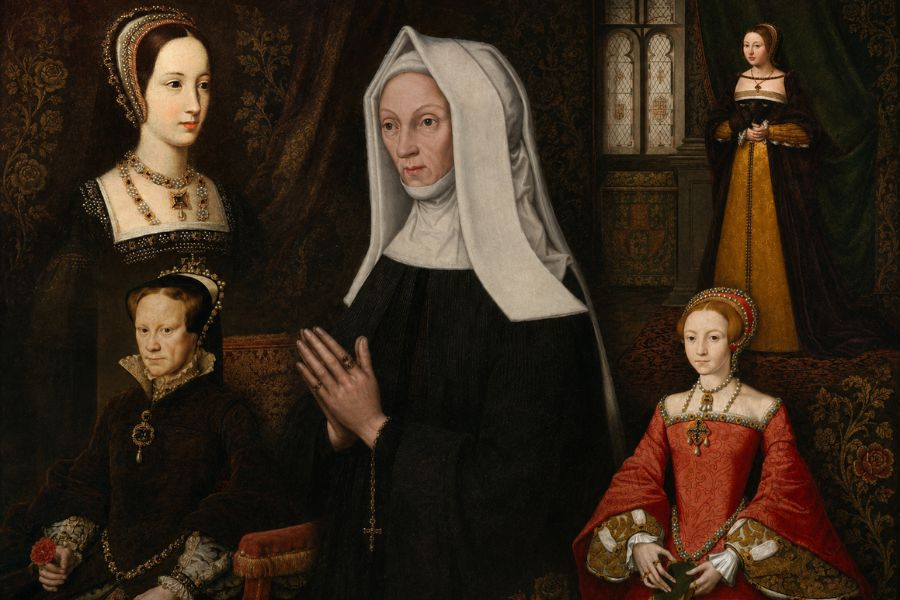
Margaret Tudor: The Granddaughter Sent North
Margaret Beaufort’s eldest granddaughter was named for her, and she was 13 when she was married off to James IV of Scotland in 1503. The match was Henry VII’s idea, the so-called Treaty of Perpetual Peace, and it was meant to stop the centuries of border raids by stitching the two royal houses together.
Margaret Beaufort reportedly worried the Scottish king wouldn’t wait for her granddaughter to be old enough, and she was right to worry. James didn’t wait long.
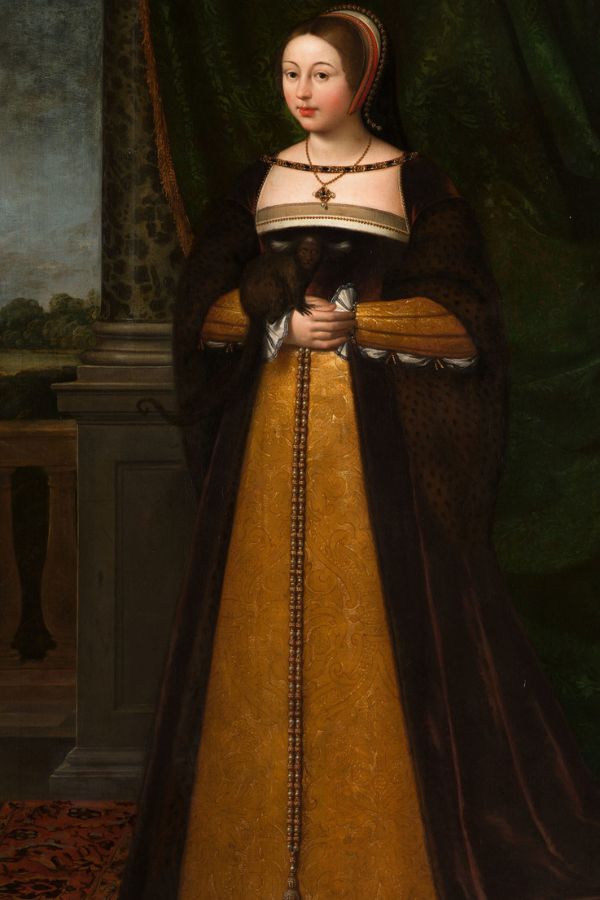
Young Margaret Tudor produced six children with James IV, of whom only one, the future James V, survived infancy. Then, in 1513, her husband marched south while her brother Henry VIII was off fighting in France, and was cut down at Flodden along with most of the Scottish nobility. Margaret was 23, pregnant, and suddenly regent of a kingdom that didn’t want an English queen running it.
Margaret remarried, badly, to the Earl of Angus, lost the regency, fled south to her brother’s court, went back, divorced Angus, married a third time, and spent the rest of her life clawing for influence in a Scottish court that loathed her.
She died in 1541 at Methven Castle. Her granddaughter, born of the marriage to Angus, was Mary Stuart’s mother-in-law’s rival and the mother of Henry Stuart, Lord Darnley. That is the line that nearly ended the Tudors entirely, because it eventually replaced them.
Mary Tudor: The French Queen Who Married for Love
The other granddaughter, Margaret Beaufort’s namesake’s younger sister, was Mary. She was the pretty one, the favorite, and Henry VIII used her the same way his father had used her sister. In 1514, she was packed off to marry Louis XII of France, a man in his fifties whose health was already failing. She was just 18.
Louis lasted 82 days. Whether he died of exhaustion in the marriage bed, as the French court joked, or simply of the gout he’d been nursing for years, Mary was a widow before she’d been a wife in any real sense.

And then she did something almost no princess of her generation got away with. Before Henry could marry her off again, she secretly married Charles Brandon, Duke of Suffolk, her brother’s best friend, who’d been sent to France to bring her home.
Henry was furious, and fined them an enormous sum and made them pay it in installments for years, but he let the marriage stand. Mary had four children with Brandon before dying in 1533, aged 37, probably of tuberculosis. Her daughter, Frances Brandon, would become the mother of Lady Jane Grey.
I find it hard not to feel for Mary, who perhaps got three good years out of a life that was otherwise other people’s chess pieces. She also, almost incidentally, founded the line that Henry VIII would later try to use to lock the Scots out of the English succession.
The Grey Sisters: Three Lives, Three Disasters
Frances Brandon married Henry Grey, Marquess of Dorset, and produced three daughters: Jane, Katherine, and Mary. All three were great-great-granddaughters of Margaret Beaufort, and all three got swept into Tudor succession politics in ways that destroyed them.
Jane is the one everyone knows. Queen for nine days in July 1553, executed at the Tower in February 1554 after her father got involved in Wyatt’s Rebellion.

Katherine Grey’s story is less famous and arguably sadder. She secretly married Edward Seymour in 1560 without Elizabeth I’s permission, a serious crime for someone with a claim to the throne.
Elizabeth threw them both in the Tower, where Katherine somehow gave birth to two sons before the queen separated them permanently. She died at 27, having essentially starved herself, leaving behind two boys whose legitimacy would be argued over for decades.
Mary Grey, the youngest, was tiny, possibly a dwarf, and made the same mistake: she married a court official without permission in 1565 and was placed under house arrest for the rest of her short life. With her, the Suffolk line that Henry VIII had favored in his will ran out.
Margaret Douglas: The Granddaughter Who Played the Long Game
Back to Scotland for a moment, because Margaret Tudor’s daughter by the Earl of Angus was a piece of work in the best possible sense. Margaret Douglas was born in 1515 in a snowstorm at Harbottle Castle in Northumberland, while her mother was fleeing the Scottish court.
She grew up at Henry VIII’s English court, was close to her cousin Mary I, and spent much of her life under suspicion because her royal blood made every move she made political.
She was imprisoned twice for unauthorized engagements, once for getting involved with Thomas Howard (Anne Boleyn’s uncle) in 1536, and again later for a flirtation with Charles Howard. She finally married Matthew Stewart, Earl of Lennox, and produced Henry Stuart, Lord Darnley.
What she also was, patiently and with serious cunning, was a matchmaker. She wanted her son to marry her niece, Mary, Queen of Scots, and she got her wish in 1565. That marriage was a catastrophe for Mary Stuart personally, ending in murder, scandal, and Mary’s eventual flight to England.
For Margaret Douglas’s bloodline, though, it was a triumph. The boy that marriage produced, James VI of Scotland, would inherit the English throne in 1603. Margaret didn’t live to see it. She died in 1578 and is buried in Westminster Abbey, in a tomb that proudly lists her royal descendants. She’d already done the political work.
Why the Female Line Kept Nearly Derailing the Male One
Here’s the pattern that becomes obvious once you lay out the bloodline this way. Henry VII had four children survive infancy: Arthur, Margaret, Henry, and Mary. Arthur died at 15. Henry VIII had three legitimate children: Mary, Elizabeth, and Edward. Edward died at 15, Mary I died childless at 42, and Elizabeth I died childless at 69. In just three generations, the legitimate male Tudor line was finished.
Everything after that point ran through women. Henry VIII spent a good deal of his Will trying to redirect the succession away from Margaret Tudor’s Scottish descendants and toward Mary Tudor’s English ones, the Greys. It didn’t work. The Greys were executed, imprisoned, or married into obscurity, and when Elizabeth finally died, the only viable Protestant heir with a serious claim was James VI of Scotland. Margaret Beaufort’s great-great-grandson, through four generations of women.
Elizabeth understood this perfectly, which is part of why she was so vicious about controlling the marriages of her female cousins. Katherine Grey in the Tower, Mary Grey under house arrest, Margaret Douglas locked up more than once, and Mary Queen of Scots was eventually executed.
The threat to her throne wasn’t a foreign invasion or a Catholic plot in the abstract, but the fact that each of these women carried Margaret Beaufort’s blood and could produce an heir who might displace her. She was a Tudor woman trying to stop other Tudor women from doing exactly what Tudor women had been doing for a century: carrying the dynasty forward when the men ran out.
What Margaret Beaufort Actually Built
If you stand at Margaret Beaufort’s tomb in the Lady Chapel at Westminster Abbey, you can read Erasmus’s epitaph and look at her hands, folded in prayer, her face set in that famous severe expression. The chapel itself is Henry VII’s, the dynasty’s monument, and her tomb sits just off to the side. It is a tomb for the woman who put a king on the throne.

What the tomb doesn’t tell you is that the king she put on the throne would fail to produce a lasting male line, and that the dynasty would survive only because the women she’d helped place into royal marriages, her granddaughters Margaret and Mary, kept producing daughters who produced daughters who produced sons.
The Treaty of Perpetual Peace that married Margaret Tudor to James IV in 1503 looked like a diplomatic afterthought at the time. A century later, it turned out to have been the most important succession decision the early Tudors ever made.
When James VI of Scotland rode south to take Elizabeth’s throne in 1603, he did so as the great-great-grandson of Margaret Beaufort, through four generations of women whose names most people can’t now recite.
Margaret Tudor in her contested Scottish regency, Margaret Douglas in her English prisons, Mary Stuart on her scaffold at Fotheringhay, and further back, the woman who started the whole project, lying under her bronze effigy at Westminster, hands still folded, still waiting.
Related posts:
 Six Women Who Dodged a Bullet, or Axe, by Not Marrying Henry VIII
 The Ones That Got Away. The Six Women Who Kept Their Heads, By Not Marrying Henry VIII
 6 Forgotten Scottish Queens: The Women Who Sat on the Stewart Throne and What It Cost Them
 The Real Margaret Beaufort: The Woman Who Built the Tudors