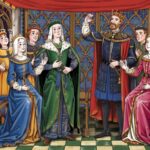
When war tore Brittany apart in the fourteenth century, Joanna of Flanders stepped into a role few women would dare to take. She led armies, held her ground against French forces, and earned the name Jeanne la Flamme for her fearless defense. She rode through fire to rally her troops and faced down some of the most dangerous moments of the Hundred Years’ War.
She lived in a world ruled by men, where women were expected to keep to the sidelines, but she had no intention of staying in the shadows. If you’re looking for a medieval female trailblazer, she’s right up there with Joan of Arc and Eleanor of Aquitaine. A warrior, a strategist, and a survivor, Joanna of Flanders earned her place in the history books.
Table of Contents
Yet, for all her courage, the end of her story doesn’t play out the way you’d expect it to. This is the story of a woman who refused to be ordinary and paid the price.

Joanna’s Early Life & Marriage
Joanna of Flanders was born around 1295 into a powerful lineage. Her father, Louis I of Nevers, was the son of Robert III, Count of Flanders, a man deeply involved in the political storms between France and the Low Countries.
Her mother, Joan of Rethel, was the ruling Countess of Rethel in her own right, a rare position for a woman in the Middle Ages. Rethel was a small but strategically important lordship in northeastern France, sitting on the frontier between France and the Holy Roman Empire. Joan inherited this title after her father’s death.
Joanna’s upbringing placed her at the intersection of competing dynastic ambitions. The Counts of Flanders were wealthy and influential, often resisting French attempts to dominate their territory. This tension frequently erupted into war, and Joanna’s family was deeply involved in these disputes.
Political marriages were tools of survival, and Joanna was no exception. In 1329, she married John of Montfort, a member of the Breton ducal house and half-brother of Duke John III of Brittany. At the time, Brittany was a duchy of immense strategic value, lying between England and France with a long coastline vital for trade and military movement.
John of Montfort’s claim to the duchy rested on his status as the younger son of Arthur II, Duke of Brittany, from his second marriage. John III, the duke at the time, had no legitimate children and was hostile to his half-brother, which made succession uncertain from the start.
The marriage between Joanna and John gave Montfort powerful connections to Flanders and Rethel, strengthening his position in any future dispute over the Breton inheritance. Neither of them could have predicted how soon that dispute would ignite into a war that would consume the rest of their lives.
The Brewing Storm: Why Brittany Was a Powder Keg
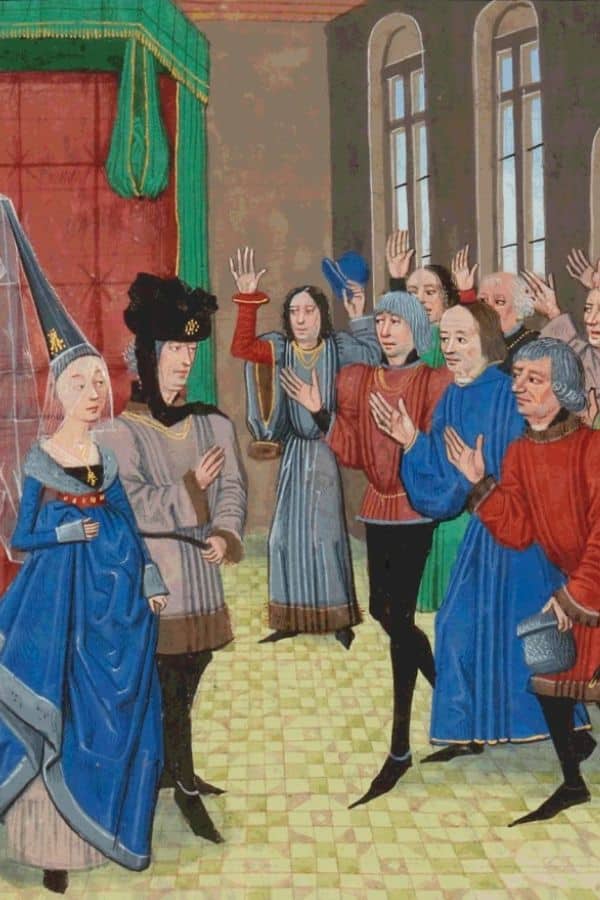
To understand why Joanna’s life changed so dramatically, you need to look at Brittany’s place in 14th-century Europe. The duchy sat on the edge of France, a maritime stronghold with strong trade links to England. It was technically a vassal of the French crown, but Breton dukes had long fought to maintain independence.
When Duke John III died in 1341 without a direct heir, two rival claims emerged. One came from Joanna’s husband, John of Montfort, who argued that Breton law allowed male succession through the half-blood. The other came from Charles of Blois, a French noble married to Joan of Penthièvre, the late duke’s niece, who claimed the title under a strict interpretation of inheritance through the female line.
The French crown supported Charles of Blois, while England backed the Montfort claim. Neither side cared only about Brittany. For both kingdoms, this was a chance to expand influence during the early stages of the Hundred Years’ War. Whoever controlled Brittany could dominate trade routes in the English Channel and threaten the other side’s coastline.
War of the Breton Succession: Stakes & Claims
When Duke John III of Brittany died in April 1341, he left no legitimate heirs and no clear will naming a successor. That single fact plunged Brittany into chaos. Two rival claims emerged almost immediately, and both were rooted in different interpretations of inheritance law.
On one side stood John of Montfort, Joanna’s husband. He argued that Breton law followed a male-preference system, allowing inheritance through the male line even when the claimant was a half-brother. As the younger son of Duke Arthur II from his second marriage, John believed he had the strongest claim. He wasted no time pressing his case, seizing ducal castles and even taking control of the treasury in Nantes.
The opposing claim came from Charles of Blois, a French noble married to Joan of Penthièvre, the only daughter of John III’s full brother. Their argument leaned on feudal custom favoring inheritance through the closest blood relative, even if that relative was a woman. Charles had something John of Montfort didn’t: the backing of the French king, Philip VI, who saw Brittany as a convenient extension of French influence.
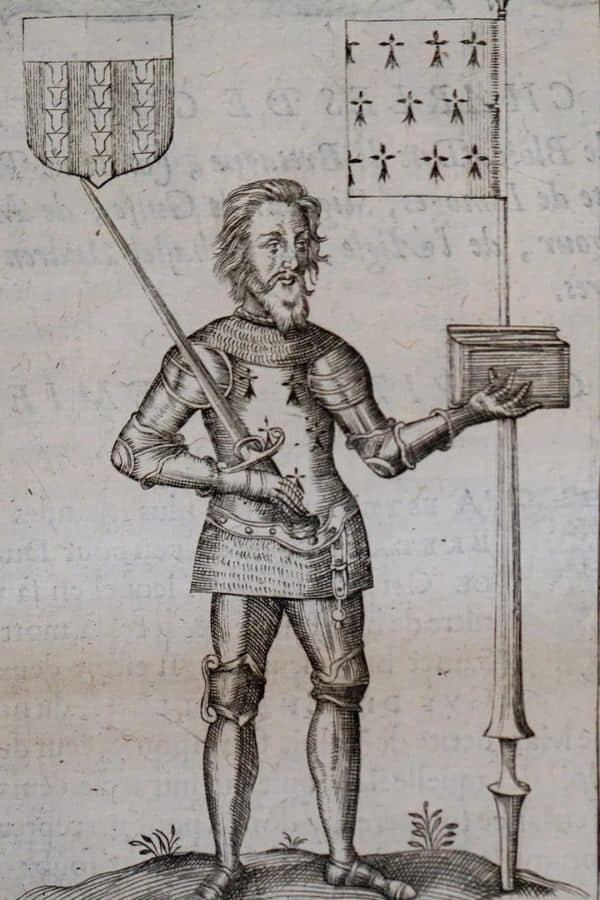
The dispute might have remained a local feud if not for the broader war already simmering in Europe. The Hundred Years’ War had begun in 1337, and England was looking for allies on the Continent. Brittany’s coastline offered deep-water ports ideal for English military operations. Edward III of England quickly sided with Montfort, turning a regional succession fight into a proxy war between two kingdoms.
What started as a family dispute became part of a much larger struggle for power, and Joanna of Flanders was about to find herself at the center of it all.

Hooked on the Middle Ages? Get more stories like this one in your inbox.
Joanna Takes Command
When John of Montfort was thrown into a Paris prison in late 1341, the Montfort cause looked finished. His capture left Brittany leaderless, and Charles of Blois, with French troops at his back, was sweeping through the duchy. Many expected Joanna to surrender, hand over her son, and hope for mercy. She did the opposite.
Joanna declared herself regent in her husband’s name and swore to defend her son’s rights. It was a bold move in a world where few women held political or military authority, but Joanna wasted no time proving she meant business. She gathered loyal barons to her side, secured control of key fortresses, and began raising troops. Chroniclers tell us she put on armor and rode among the men to stiffen morale.
By early 1342, Charles of Blois was closing in. His forces targeted Hennebont, a strategic town that guarded access to the Breton coast. Joanna chose it as her base, knowing it would become the focal point of the war. What came next would turn her into one of the most formidable women of the Middle Ages.
Siege of Hennebont & Her Military Prowess
In the spring of 1342, Hennebont became the heart of Joanna’s resistance. Perched on the River Blavet, the walled town controlled vital approaches to Brittany’s southern coast. When Charles of Blois marched in with his French-backed army, he brought enough men and siege equipment to crush any hope of escape. Joanna was inside with a small garrison, a handful of knights, and the townsfolk whose lives now depended on her resolve.
The siege dragged on for weeks. French forces pounded the walls with trebuchets while trying to choke off supplies. Inside, food ran short, disease crept in, and fear spread like smoke. But Joanna refused to yield.
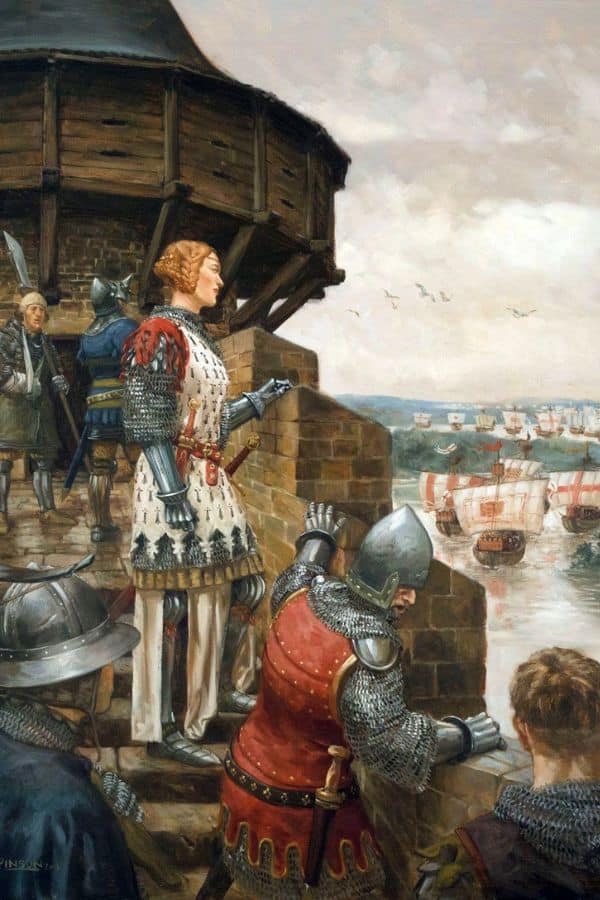
She transformed the castle hall into a command center, meeting daily with her captains to plan sorties and maintain discipline among both soldiers and civilians. Contemporary chroniclers describe her moving through the streets in armor, speaking to the townspeople, and reassuring them that Hennebont would not fall.
Then came the moment that made her a legend. Seeing the French siege engines closing in, Joanna mounted her horse, gathered a band of knights, and rode straight out through the gates. With fire and steel, they stormed the enemy lines, cutting through tents and setting the great wooden towers ablaze.
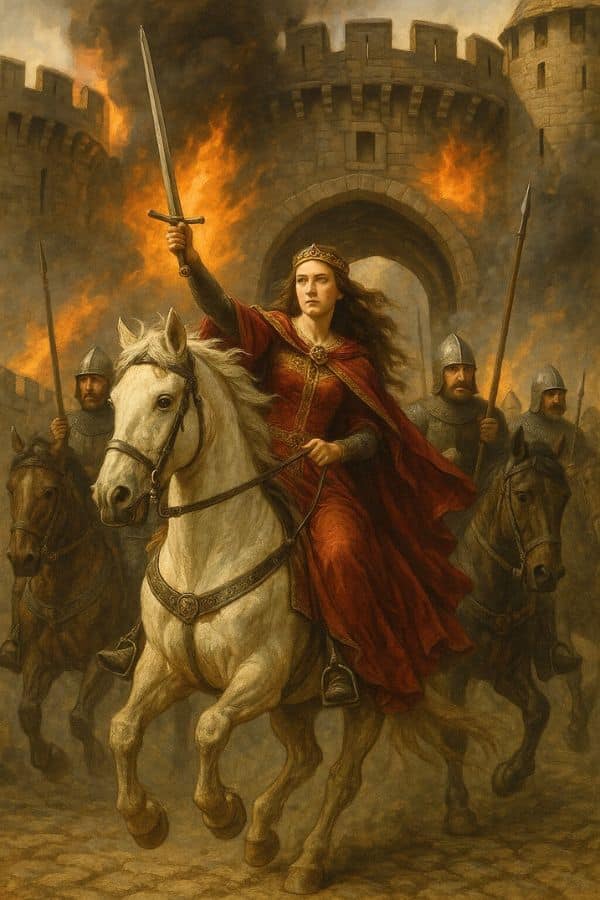
Flames roared skyward as French troops scrambled in panic, and Joanna fought her way back inside before the enemy could recover. The audacity of the raid stunned both sides. That night, as fire lit the horizon, her troops began calling her Jeanne la Flamme, Joan the Flame.
The daring strike didn’t break the siege, but it bought precious time. Joanna knew reinforcements were the only hope. She dispatched envoys across the Channel to plead for help from Edward III of England, and the gamble worked. In June 1342, an English fleet landed at Brest with men, horses, and supplies.
The French, unwilling to face a fresh English army, lifted the siege and fell back. Against all odds, Joanna had held Hennebont. She ruled from the saddle and turned a desperate defense into one of the most remarkable episodes of the Hundred Years’ War.
Joanna’s Last Stand in Brittany
The lifting of the siege at Hennebont was a turning point, but it didn’t end the war. With English support now in play, Joanna moved quickly to consolidate her position. She rode out with her forces and joined English troops in a campaign that recaptured several key strongholds. For a brief moment, it looked as if the Montfort faction might secure Brittany once and for all.
But the war was far from over. Charles of Blois regrouped with fresh troops, and the conflict dragged into a brutal stalemate. Battles flared across the duchy, towns switched sides, and ordinary Bretons bore the brunt of the chaos. Joanna remained at the center, advising commanders and keeping the Montfort cause alive. Yet the strain was immense. Supplies were tight, loyalties were fragile, and France’s resources outweighed anything the Montforts could muster on their own.
By 1343, Joanna faced an impossible situation. Negotiations for a truce began, but trust was scarce. Her son’s claim was still uncertain, and her enemies were relentless. Realizing Brittany was no longer safe for her or the boy, Joanna accepted Edward III’s offer of refuge. In the spring of that year, she boarded a ship for England, leaving behind the land she had fought so fiercely to defend.
Aftermath: Exile and Obscurity
Joanna’s arrival in England in 1343 marked the end of her life as a warrior. Edward III welcomed her as an ally and gave her refuge at Tickhill Castle in Yorkshire. It was a far cry from the fire and chaos of Brittany. Joanna brought her son, the future Duke John IV, and her daughter, Jeanne. For a time, she remained a respected figure at the English court, the woman who had kept the Montfort cause alive when all seemed lost.
But Joanna’s story takes a darker turn here. Contemporary accounts suggest that something changed in her health or mental state after those relentless years of war. Chroniclers suggest periods of withdrawal and possible mental illness, though the exact nature of her condition is impossible to confirm. What is clear is that Joanna spent the rest of her life in relative isolation, far from the political stage she once dominated.
She died around 1374, likely still at Tickhill. The duchy eventually passed to her son, John IV, after decades of bloodshed; however, Joanna did not live to see him secure the title she had fought so fiercely to claim. Long before Joan of Arc raised a sword for France, Joanna of Flanders rode through fire to defend her cause.
Further Reading
If you want to dig deeper into Joanna’s extraordinary life and the turbulent world she lived in, these sources are a great place to start:
- Joanna of Flanders: Heroine and Exile by Julie Sarpy – A detailed biography that explores both her wartime leadership and her mysterious years in England.
- The Hundred Years War by Jonathan Sumption – A masterful overview of the wider conflict that set the stage for Joanna’s fight.

Love a good medieval story?
Join our readers and get tales of kings, queens, castles and ordinary medieval lives straight to your inbox.

Kylie Lang is a nationally syndicated travel journalist with bylines on the Associated Press Wire & more, a medieval history writer, and the founder and lead author of Tales of the Middle Ages (talesofthemiddleages.com). She holds a BA (Honours) in History from the University of Kent and is a member of the British Guild of Travel Writers.