
Everyone knows the daughter of Henry I of England, Empress Matilda. After all, she was part of the civil war known as the Anarchy, fought between her and Stephen of Blois. But what about his other daughter, Juliane? Have you heard of her?
I hadn’t until I stumbled across her while doing some research on Henry I. As I started reading and digging deeper, I was both fascinated and horrified. Her story reads more like a Brothers Grimm horror story than something that actually happened.
Table of Contents
So, who was Juliane Fontevrauld, and what happened between her and Henry, her father, that turns my stomach?

A Book About Juliane Fontevrauld
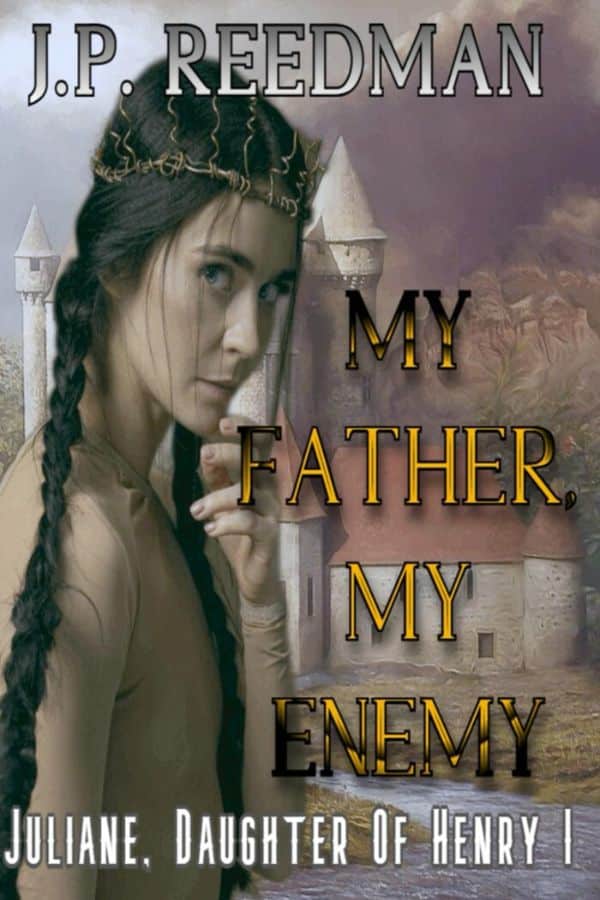
While researching Juliane, I came across My Father, My Enemy: Juliane, Daughter of Henry I by J.P. Reedman. It’s an excellent read and not too long.
Juliane’s Origins and Family
If you know anything about Henry I, you’ll know he had a talent for two things: ruling with an iron hand and fathering children. Legitimate and otherwise. Historians estimate he had more than twenty illegitimate sons and daughters, though no one can be sure of the exact number.
In an age when royal blood was a political currency, those children were pawns in the complicated chessboard of medieval power. Many were married off to noble families across England and Normandy, strengthening alliances and securing Henry’s influence far beyond his court.
Juliane Fontevrauld (also known as FitzRoy) was one of them. Born around 1090, a good decade before her legitimate half-sister Matilda, she came into the world before Henry had even claimed the throne. Her mother’s identity is uncertain. Some sources name a woman called Ansfrida, while others simply refer to her as a concubine. What is clear is that Juliane was acknowledged as Henry’s daughter, raised with the advantages that came with being part of his bloodline, even if she could never sit on the throne herself.
Life for an illegitimate royal child in the 12th century was a balancing act. They lived between two worlds: close enough to power to feel its weight, but constantly reminded of the thin line separating them from their legitimate siblings. For Juliane, that world would soon become a battlefield. Her father’s political maneuvers shaped her fate, but her choices, and the rage that burned within her, would shape her story.
Hooked on the Middle Ages? Get more stories like this one in your inbox.
Marriage to Eustace of Breteuil
In the early 1100s, Juliane was married to Eustace of Breteuil, the son of William of Breteuil, a powerful Norman noble whose family held land that was strategically vital to controlling the region. The Breteuil lordship sat on the frontier between rival territories in Normandy, making it a key stronghold for anyone seeking to dominate the area. For Henry I, marrying his daughter into that family was a political move meant to secure loyalty where it mattered most.
The marriage likely took place around 1103, not long after Henry became king. Juliane would have entered the union with expectations typical of the time: lands, wealth, and influence. But it also came with responsibilities. As Eustace’s wife, she was expected to strengthen his position and further her father’s interests. What she probably did not expect was how quickly that alliance would turn bitter.
Juliane and Eustace had at least two daughters, whose names are lost to history. Some records also mention sons named William and Roger, though details about their lives are scarce.
The Crisis Over Ivry (1119)
By 1119, Juliane and Eustace had reached a breaking point. Eustace believed that Château d’Ivry rightfully belonged to him by inheritance. But the castle sat in the hands of Ralph Harenc, who held it as the king’s constable.
Eustace pressed Henry to restore the fortress to him. Henry stalled. To avoid immediate war, he proposed a hostage swap: Ralph would send his son into Eustace’s hands, and Juliane and Eustace would hand over their two daughters (Henry’s granddaughters) as guarantees of good faith.
Orderic Vitalis, a chronicler, wrote that Eustace accepted the arrangement but almost immediately acted against it. Swayed by Amaury de Montfort, who “used every artifice that malice could suggest” to incite him, Eustace had Ralph’s son blinded and sent him back to his father. Ralph then came to Henry with his complaint.
Furious, Henry handed over Juliane’s daughters so that Ralph might retaliate. With the king’s permission, Ralph proceeded to gouge out their eyes and cut off the tips of their noses. Orderic spares no pity: he calls it a tragic inversion, where “innocent childhood suffered for the sins of the fathers.” What a loving grandfather Henry was.
Unsurprisingly, the mutilation sparked open revolt. Eustace fortified castles at Lire, Glos, Pont-Saint-Pierre, and Pacy, preparing to resist royal forces. Juliane withdrew to Breteuil to hold the citadel. Yet the townsfolk were reluctant to risk Henry’s wrath, and you can’t blame them after what he did to his own granddaughters. They opened the gates, inviting him in, forcing Juliane into the stronghold alone.
Desperate, she sent word that she would negotiate. Henry agreed and approached under a banner of truce. But as he came near, Juliane unleashed her fury: she raised a crossbow and shot at him. The bolt missed. Furious, Henry destroyed the drawbridge and sealed off the fortress.
Cornered and humiliated, Juliane surrendered the castle. Henry denied her a safe exit. She had herself lowered from the wall, fell into the freezing moat, with her legs exposed, and waded through the ice-cold water until she reached Pacy, where she met Eustace again. Orderic notes that she was “covered with shame” at the state of her flight.
Henry then moved swiftly. He stripped Eustace of Breteuil, awarding it to a relative of Ralph Harenc, while allowing Eustace to keep Pacy. Some months later, in a gesture of uneasy reconciliation, Juliane and Eustace came barefoot and kneeling before Henry. Their brother, Richard of Lincoln, interceded, and Henry relented. Eustace was granted a pension of 300 silver marks annually.

Death and Legacy
After her rebellion collapsed and her lands were stripped away, Juliane disappeared from the historical record almost entirely. Most accounts agree that she retired to Fontevrault Abbey, the powerful monastic community founded by Robert of Arbrissel, which often served as a refuge for disgraced noblewomen.
Some historians believe she took the veil there and lived out the rest of her life as a nun. Others suggest she remained under the abbey’s protection without formally entering religious life. What we do know is that she died sometime after 1136, although no chronicler records the exact date or circumstances.
Of Henry I’s many children, legitimate or otherwise, she is the only one known to have raised a weapon against him. Her attempted assassination of the king, her own father, stands as one of the most shocking acts of rebellion in 12th-century England and Normandy. For a woman in her position to commit such an act was almost unthinkable, which is likely why chroniclers such as Orderic Vitalis paid so much attention to it.
Orderic’s portrayal of Juliane is steeped in moral judgment, not unusual for a chronicler of that period. He writes of her shame and fury, presenting her as a cautionary figure rather than a tragic one. In his telling, she is consumed by rage, driven beyond reason by the mutilation of her daughters and her thirst for vengeance.
He does not excuse her, but he does not ignore the cruelty that pushed her to that point either. Later writers followed his lead, framing her story as a tale of feminine rebellion gone too far, a scandal that embarrassed the crown and disrupted the natural order of royal obedience.
Modern historians take a more nuanced view. Some see Juliane as a victim of a brutal political system that used women and children as bargaining tools. Others interpret her actions as a rare display of agency in a society that offered women little power of their own.
Much about her later life remains uncertain, and many details are lost. But the fragments that survive reveal a woman whose story defied the expectations of her age. Juliane was remembered for daring to strike at the heart of royal authority and for coming closer than anyone might have imagined.

Love a good medieval story?
Join our readers and get tales of kings, queens, castles and ordinary medieval lives straight to your inbox.

Kylie Lang is a nationally syndicated travel journalist with bylines on the Associated Press Wire & more, a medieval history writer, and the founder and lead author of Tales of the Middle Ages (talesofthemiddleages.com). She holds a BA (Honours) in History from the University of Kent and is a member of the British Guild of Travel Writers.