The legacy of the Knights Templar doesn’t stop when the Middle Ages ends. They are known throughout medieval history, but their legend lives on.
Living in France means you stumble across all kinds of history. Roman ruins in the middle of nowhere, medieval castles hiding behind vineyards, and yes, actual Knights Templar graves tucked away in corners of the countryside. There’s one just a few miles from my house.
Table of Contents
These warrior monks were powerful, rich, secretive, and at the heart of European politics. And like most things that involve too much influence and not enough royal flattery, it ended badly. King Philip IV of France rounded them up, tortured confessions out of them, and sent the lot to burn at the stake. And just like that, the order was gone. Or was it?
The Templars left behind a long list of questions, treasure theories, secret codes, and influence that seems to pop up in everything from modern Freemasonry to Jedi knights. I’ve followed the trail through rural chapels and fortress ruins, and I can tell you this much: They were way more than just men in white cloaks with red crosses.
So if you’ve ever been curious about who they really were and what’s just been cooked up by Hollywood, here’s your starting point. Thirteen things you probably never knew about the Knights Templar. The real ones. The weird ones. And the ones that just might make you want to head off on a little medieval mystery tour of your own.

3 Great Books About The Knights Templar
- The Templars by Dan Jones
- Daughter of War (Knights Templar) by Simon Turney
- The Last Templar by Raymond Khoury
I’ve read all three and loved them. If you’re looking to be drawn into the Templars world these books do the trick.
Friday the 13th: A Templar Legacy?
There’s a reason this list features thirteen Templar facts. It stems back to a certain Friday in French history. Let’s rewind to the early 1300s. King Philip IV of France was broke. He’d borrowed enormous sums of money from the Knights Templar to fund his wars and keep his kingdom running. So Philip did what any scheming medieval monarch might do and decided to erase the debt by erasing the Templars.
On Friday the 13th of October, 1307, he made his move. At dawn, across France, hundreds of Templars were arrested. Charges of heresy and devil worship were thrown around, but it was all smoke and mirrors. The real motive? Power, politics, and a whole lot of gold. Those who didn’t confess under torture were eventually burned at the stake. It was one of the most calculated takedowns of a powerful order in European history. That’s why Friday the 13th carries such a stigma.
But not every Templar met a fiery end. At La Rochelle in southwest France, the order’s major port and naval headquarters, the Templars escaped. When the king’s men arrived to arrest them, the fleet was gone. Vanished. No one knows exactly where it went or who was on board, but the timing was just a little too perfect. While their brothers were being imprisoned and tortured across the country, the Templars at La Rochelle made a quick getaway, taking their secrets (and possibly their treasure) with them.
The Jedi Connection: How the Templars Inspired Star Wars
You don’t need to look hard to spot the similarities. A brotherhood of warrior monks, trained from a young age, bound by strict codes, feared by their enemies, and eventually betrayed by the very institutions they once served. Sound familiar?
In some of the early scripts, there were even references to Jedi Templars. Coincidence? I think not. George Lucas was interested in the Middle Ages, which transferred onto the big screen and the parallels are hard to ignore. Both lived by a strict code. Both had a mysterious, almost mystical air about them. Both were trusted, respected, and then suddenly wiped out by powerful leaders who saw them as a threat. The Jedi had Order 66. The Templars had King Philip.
Even the robes feel familiar. The Jedi’s long cloaks and calm, collected demeanor match up well with how the Templars are often depicted in historical accounts. There’s also that whole idea of sacrificing personal ties for a bigger cause, which sits right at the heart of both stories.
Templars: The Medieval Roadside Assistance
Before they were caught up in treasure legends and royal conspiracies, the Knights Templar had a much more practical role. They were basically the medieval version of roadside assistance. Their original mission was simple: to protect Christian pilgrims making the long and dangerous journey to the Holy Land.
Travel back then was dangerous. Bandits, illness, and the occasional army getting in the way made it a risky business. So the Templars set up safe houses, known as commanderies, along the main routes. Think of them like a mix between a rest stop and a fortress. Pilgrims could get food, medical help, and protection for the road ahead.
Templars actually rode alongside groups of travelers, swords at the ready. You can still visit the remains of some of these commanderies in France today. It’s one of the more grounded parts of their story, and honestly, one of the most impressive. Before they became symbols of mystery and myth, they kept people safe in a pretty dangerous world.
A Strict Code: No Bad Breath Allowed
You’d expect warrior monks to follow a strict set of rules, but the Knights Templar took things to a whole new level. They even had rules about smelling decent.
According to the Catalan Rule, if a brother’s breath was so bad it disturbed the others and couldn’t be fixed by a doctor or by changing his diet, he would be separated until it improved. Harsh? Maybe. But when you’re living, eating, and sleeping side by side in a barracks with no toothpaste in sight, you start to understand why they were so particular.
Their code covered everything from how they dressed, how much meat they could eat, and how often they were allowed to speak. Silence was valued. Vanity wasn’t.

Hooked on the Middle Ages? Get more stories like this one in your inbox.
Banking Pioneers: The Templars’ Financial Empire
The Knights Templar ran one of the most sophisticated financial networks in medieval Europe. Yes, they were fearsome fighters, but they were also excellent with a balance sheet.
The system they created was an early version of modern banking. Pilgrims heading to the Holy Land could deposit money with the Templars in one city and withdraw it in another, using coded letters that acted like checks. It meant travelers didn’t have to carry huge amounts of cash across dangerous territory, which seriously cut down on robbery and stress.
The Templars also loaned money to kings, financed big projects, and held enormous estates. In some places, they even acted as treasurers for monarchs. Their wealth and independence made them powerful, and eventually, they became targets. All their money led to their eventual terrible downfall.
Distinctive Fashion: The Iconic Templar Attire
If you’ve ever seen an image of a Knight Templar, you’ll recognize the look straight away. Long white cloak, and a big red cross on the front. But this wasn’t just a medieval fashion statement. Every part of their outfit meant something.
The white mantle was chosen to represent purity. Not because they were perfect, but because they’d taken vows like monks. Poverty, chastity, obedience. Wearing white set them apart from regular knights who often rode into battle in bold colors and flashy gear. The Templars kept it simple on purpose.
That striking red cross came later, around the time of the Second Crusade. Pope Eugenius III approved it, and from then on, it became their signature. The red symbolized their willingness to shed blood for their faith. Even on the battlefield, they stuck to their uniform. And that image still holds power centuries later.
The Curse of Jacques de Molay
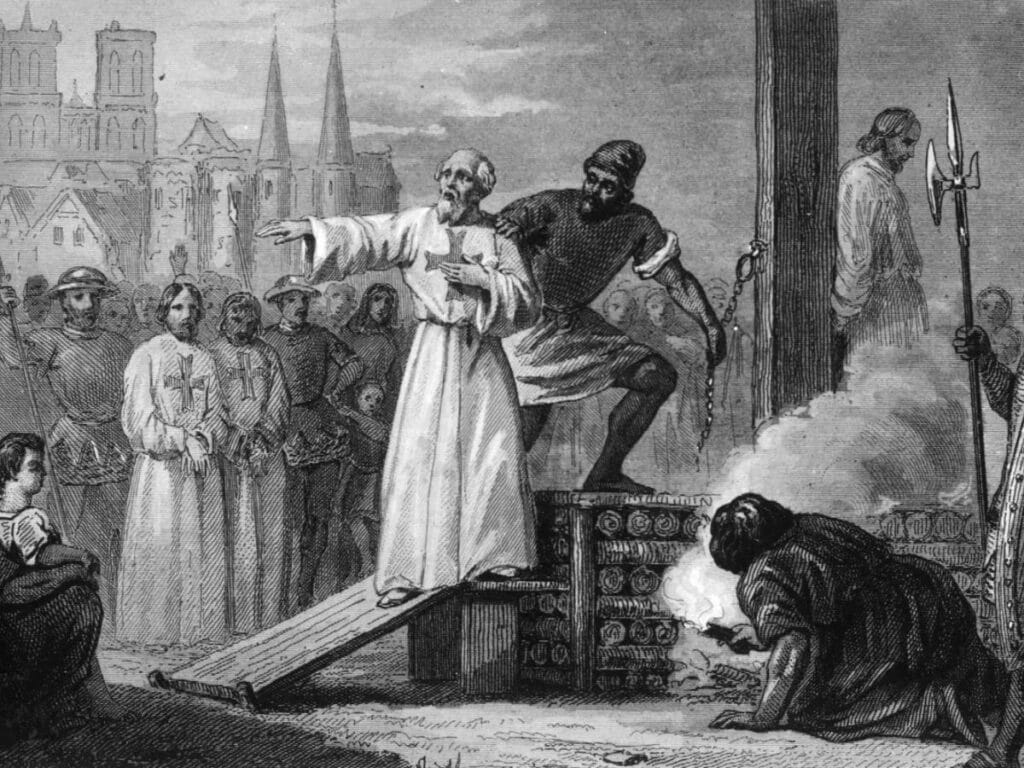
If one moment sealed the Knights Templar into legend, it’s the execution of their last Grand Master, Jacques de Molay. After being paraded as a heretic, he was burned at the stake in Paris in 1314. But not before he had a few final words.
According to legend, as the flames rose around him, de Molay called out a curse. He summoned both King Philip IV and Pope Clement V to appear before the judgment of God within a year. And strangely enough, they both died not long after. The king from a sudden stroke and the pope from illness. Coincidence? Maybe. But it didn’t stop people from whispering about a curse.
That moment gave the Templars an eerie kind of immortality. Their power may have been crushed, but their story didn’t end there. Walk around Île de la Cité in Paris today, and you can still find the small plaque marking the spot where de Molay was executed.
The Chinon Parchment: Papal Absolution
For centuries, people believed the Templars were officially excommunicated and condemned by the Pope. After all, they were accused of heresy, arrested in one sweeping move, and many were tortured and executed. It looked like the Church had turned its back on them completely.
But in 2001, a dusty old document turned up in the Vatican archives that changed everything. Known as the Chinon Parchment, it revealed that Pope Clement V had actually absolved the Templars back in 1308.
So while they were being burned alive and branded heretics in public, behind closed doors the Church had cleared them of their so-called crimes. It was all about politics. The Pope was under massive pressure from King Philip IV, and going against him outright could have caused serious problems. So the Church stayed silent, let Philip do his thing, and buried the paperwork.
The Templar Treasure: Lost or Hidden?
You can’t bring up the Knights Templar without someone mentioning hidden gold, secret tunnels, or the Holy Grail. Over the years, it’s become one of the most talked about mysteries in history. But how much of it is true?
The real story is a lot murkier. When the Templars were rounded up in 1307, King Philip expected to find piles of gold and priceless relics. What he actually got was not much. Some think the order moved it just in time. Others say there never was a treasure. But that didn’t stop the legends from growing.
Historian Dan Jones, in his book The Templars, cuts through a lot of the noise. He points out that the Holy Grail obsession wasn’t based on fact. It came from medieval storytellers like Chrétien de Troyes, Wolfram von Eschenbach, and Robert de Boron. They used the Grail as a symbol. It was never meant to be a real object. According to them, the Grail wasn’t gold or jewel-encrusted. It was Jerusalem. A metaphor for spiritual enlightenment, not treasure chests and secret chambers.
So was there a treasure? Maybe. But if the Templars hid anything, it was probably documents, land deeds, or resources. Not glowing goblets or ancient scrolls that unlock immortality. Still, the mystery is half the fun.

Templars in Scotland: A Safe Haven?
When the Templars were being rounded up in France, some of them looked north. Scotland, at the time, was in open rebellion against England and had been excommunicated by the Pope after Robert the Bruce took the crown. That papal cold shoulder meant Scotland didn’t exactly feel the need to cooperate with Catholic orders. Which, for the Templars, made it one of the few places left in Europe where they might actually find shelter.
The Templars already owned land and commanderies in Scotland. When the Church put them on trial at Holyrood in 1309, most knights didn’t stick around to see how it played out. Some are believed to have joined forces with Robert the Bruce, who was busy leading the fight against the English invasion.
This is where the Bruce Legend comes in. It claims that a group of Templars fought alongside Bruce at the Battle of Bannockburn in 1314. As the story goes, their help was so valuable that Bruce created the Royal Order of Scotland to honor them. Sounds great, but modern historians aren’t quite so convinced. Some, like Oliver and Thory, point out that the Royal Order of St. Andrew of the Thistle, the one linked to Bruce, wasn’t founded until 1440 under James II. Bit of a timeline issue there.
Another tale, known as the D’Aumont Legend, claims a group of Templars disguised themselves as stonemasons and fled to Scotland, where they laid the foundation for what would eventually become Freemasonry. It’s a romantic story that has been passed around for centuries, but there’s no solid historical evidence to back it up. Most scholars see it as myth rather than fact.
Female Templars: The Unsung Sisters
While the Templar Rule officially barred women from joining, the reality was more nuanced. Women, often of noble birth, became donatas or consorors, lay sisters who supported the order through land donations and other means. In return, they received spiritual benefits and, in some cases, a place within the Templar community. These women played crucial roles, managing estates, overseeing agricultural operations, and ensuring the smooth running of Templar properties.
One standout figure is Ermengarda d’Oluja. She took the reins as a preceptrix, leading the Templar house at Rourell in Catalonia. This wasn’t a ceremonial title; Ermengarda was actively involved in the order’s operations, a testament to the significant, albeit often overlooked, contributions of women in the Templar ranks.
Author Simon Turney brings it to life in his novel Daughter of War. Set against the backdrop of the Spanish Reconquista, the book delves into the experiences of women intertwined with the Templars. Turney’s meticulous research sheds light on the complexities of these women’s lives, bridging the gap between historical fact and compelling narrative. I loved it and couldn’t put it down.
Game of Thrones’ Night’s Watch and the Templar Parallels
If you’ve ever watched Game of Thrones and thought the Night’s Watch felt familiar, you’re not alone. A brotherhood that takes a vow, lives apart from society, wears distinctive black cloaks, and guards against danger from the edges of the world? Sounds an awful lot like the real-life Knights Templar.
Both groups were sworn to a higher cause. They gave up wealth, marriage, and freedom in exchange for duty. The Templars guarded pilgrims on the road to Jerusalem. The Night’s Watch guarded the realm from whatever was creeping beyond the Wall. Different enemies, same energy.
The Cartel That Thought It Was the Knights Templar
As if the real Templars didn’t already have enough myths floating around them, a modern drug cartel in Mexico decided to adopt their name and symbols too. In the early 2010s, a group called Los Caballeros Templarios, which literally means The Knights Templar, started making headlines for all the wrong reasons.
These guys handed out their own code of ethics, wore symbols based on the medieval order, and claimed they were protecting people from corruption and injustice. But while the original Templars swore vows of poverty and guarded pilgrims, this lot were trafficking drugs, extorting businesses, and killing anyone who got in their way. Not exactly holy work.
The cartel controlled huge parts of Michoacán and even meddled in the avocado trade, squeezing local growers and fixing prices. It got so bad that normal, everyday people started forming vigilante groups to fight back. These self-defense militias, along with Mexican federal forces, eventually pushed the cartel into decline. Some of the leaders were arrested or killed, and by 2017, their grip had loosened.
Knightfall TV Series
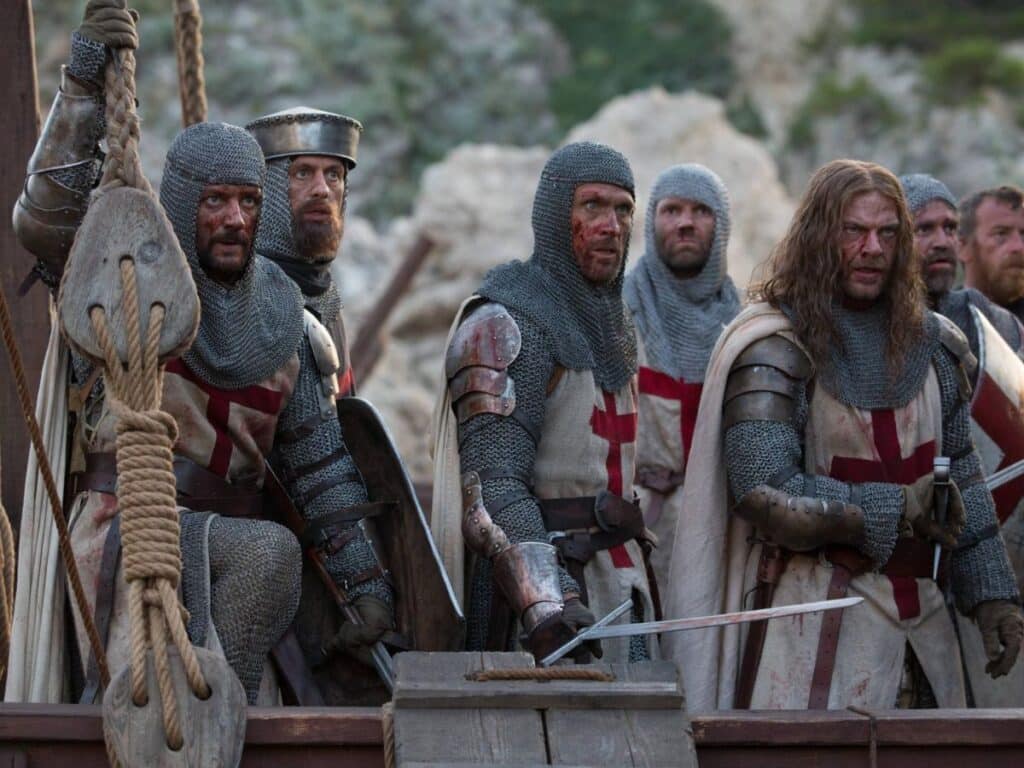
For those who love a bit of history mixed with a fair amount of fiction, tune into Knightfall, a TV program with two series about the Knights Templar. You will need to separate fact from fiction, such as Joan of Navarre having an affair with a Templar Knight and consequently being killed for having his baby, but I enjoyed it nonetheless.
Love a good medieval story?
Join our readers and get tales of kings, queens, castles and ordinary medieval lives straight to your inbox.

Kylie Lang is a nationally syndicated travel journalist with bylines on the Associated Press Wire & more, a medieval history writer, and the founder and lead author of Tales of the Middle Ages (talesofthemiddleages.com). She holds a BA (Honours) in History from the University of Kent and is a member of the British Guild of Travel Writers.
Related posts:
 Did They or Didn’t They? Was Catherine of Aragon Still a Virgin When She Wed Henry VIII?
 Isabella of France: History Called Her a She-Wolf The Truth Is Far More Interesting
Isabella of France: History Called Her a She-Wolf The Truth Is Far More Interesting
Isabella of France: History Called Her a She-Wolf The Truth Is Far More Interesting
 Must-Read Books on the Hundred Years War. These Page-Turners Nail It