The Gallowglass warriors were hardened Scottish mercenaries who changed the way wars were fought in medieval Ireland. Hired by Gaelic kings and chieftains, they arrived in the 13th century carrying heavy axes, long swords, and a reputation for getting the job done.
They came from Norse-Gaelic families in the Hebrides and western Scotland, trained for battle since youth. Once in Ireland, they became part of the local clans, fighting for land, power, and payment. Their loyalty could be bought, but their respect had to be earned.
Table of Contents
For three centuries, the Gallowglass dominated the battlefield. They left behind a legacy of strength, strategy, and blood, proof that in the Middle Ages, survival belonged to those willing to fight for it.
When Norse Blood Met Gaelic Soil
To understand who the Gallowglass warriors were, you have to go back a few centuries, to when Norse ships first began appearing on the shores of Ireland and Scotland. From the 8th century onward, the Vikings came seeking land, wealth, and control, leaving a permanent mark on the islands they invaded.
By the 9th century, Norse influence stretched deep into the British Isles. They carved out the Danelaw in England, proving just how strong their grip had become. In Scotland, they went a step further and founded the Kingdom of the Isles, a territory they called Suðreyjar, the “Southern Islands.”
It included the Hebrides, the Isle of Man, and the islands in the Firth of Clyde, while their “Northern Islands” were Shetland and Orkney. From these strongholds, Norse fleets ruled the Irish Sea, shaping the fate of both Ireland and Scotland for generations.
The Kingdom of the Isles lasted until the 13th century, defined by constant battles for power. The Norsemen of the Isles clashed with the Norse rulers of Dublin, drawing the Earls of Orkney into the conflict. But while these rival Viking powers fought each other, it was the local Gaelic population who suffered most. They were raided, enslaved, and stripped of their land. Gaelic captives became thralls, slaves with no rights and no future.
Yet time has a way of blurring boundaries. As generations passed, Norse settlers began to marry into Gaelic families. They took on the Gaelic language, customs, and even names. Out of this blending emerged a new people: the Norse-Gaels. They carried both Viking and Gaelic blood, and for a time, they stood apart from both groups.
In Ireland, they were called Gall-Goídil, and in Scotland Gall-Ghàidheil, “foreigner Gaels.” The name reflected what they were: outsiders who had become part of the native world. Over time, many of these Norse-Gaelic families rose to power, founding clans that still trace their roots back to this period. Before they disappeared entirely into Gaelic identity, they built a warrior culture unlike any other. And from that world, the Gallowglass were born.
The Rise of the “Foreign Warriors”
This is where the Gallowglass story truly begins. Their name comes from the Gaelic gallóglaigh, meaning “foreign warrior.” The word tells you exactly who they were: outsiders with a reputation for strength, discipline, and a readiness to fight anyone who paid the right price.
The Gallowglass were born from Norse-Gaelic clans that had risen to power in Scotland by the 13th century. These families ruled much of the Hebrides and western Isles, living under the loose authority of the Lords of the Isles. Their wealth came from the sea, their power from their ships, and their pride from their fighters. From this mix of Norse heritage and Gaelic loyalty came a new kind of soldier, one the Irish would soon come to depend on.
The Hebrides were their home and training ground. Clans like the MacDonalds, whose chiefs ruled from Finlaggan Castle on Islay, led fleets of galleys and bands of Gallowglass warriors. These men were professional fighters, trained for war since childhood, wearing heavy armor and wielding long swords and massive axes.
Contemporary accounts describe them as tall, broad, and unyielding. They fought in tight ranks and refused to back down, even when outnumbered. One account from the 1600s called them “men of great and mighty bodies, cruel without compassion, choosing rather to die than yield.”
For Irish chieftains, hiring them was a smart move. These mercenaries could hold the line against any army, and because they weren’t tied to local clans, they could be trusted to stay loyal to their employers. Many chieftains used them as personal guards, not just warriors. The Gallowglass, in turn, relied on these contracts to earn their keep, serving for pay, land, or both.
Hooked on the Middle Ages? Get more stories like this one in your inbox.
The Weapons That Defined the Gallowglass
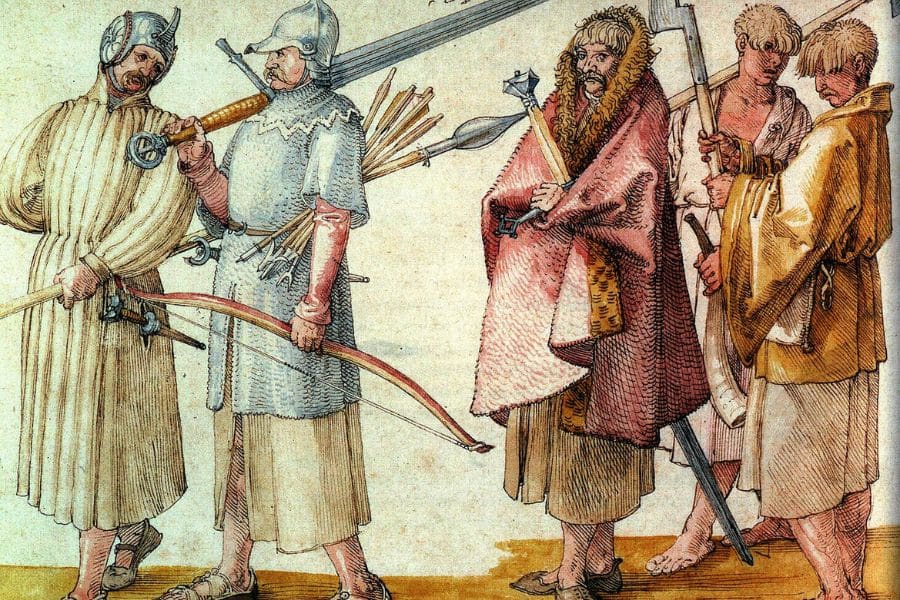
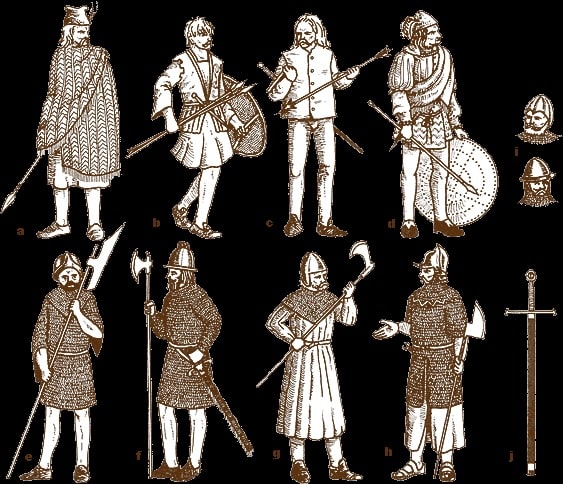
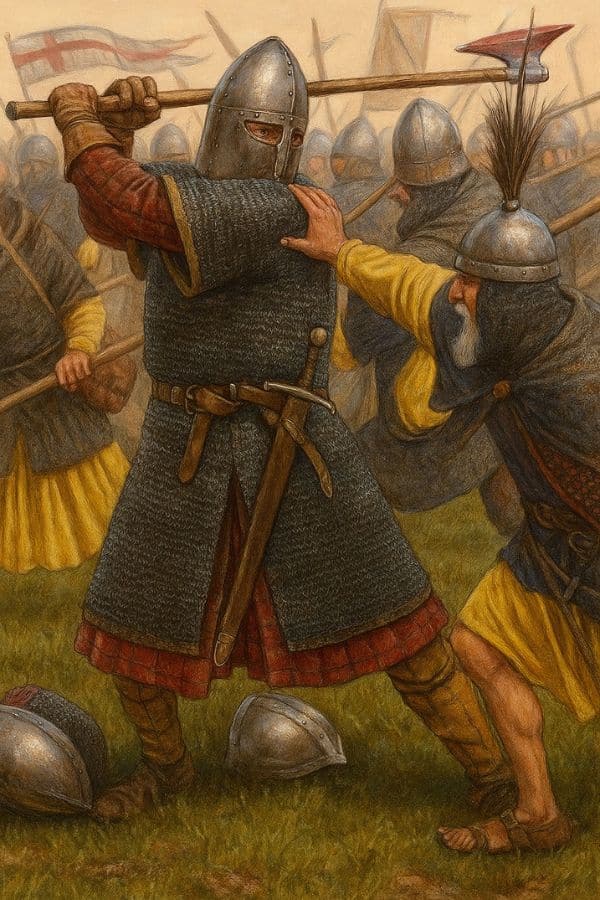
Descriptions of the Gallowglass leave little doubt about what kind of soldiers they were. Their appearance alone told you they meant business. They wore mail shirts that reached to the knees, layered over padded jackets for extra protection. A simple iron helmet covered the head, while their legs were bare, much like the traditional kilted dress of the Highlands. Some fought barefoot.
Their weapons were even more distinctive. The Gallowglass were famous for the sparth axe, a long-handled weapon around six feet in length with a curved blade designed for both reach and power. It was a regional design, developed in the Hebrides and western Scotland, and it hit with devastating force. The shape echoed their Norse ancestry, where the axe was part of a warrior’s identity.
Alongside the axe, many carried a claidheamh-mór, better known today as the claymore. This two-handed sword could reach nearly five feet in length and required strength and precision to use effectively. In skilled hands, it was as deadly as it was imposing.
Together, the heavy armor, long weapons, and disciplined formation made the Gallowglass a fearsome presence on any battlefield. They were professionals who treated war as a craft, and their tools reflected that.
Soldiers of Fortune
From the 13th to the 16th centuries, the Gallowglass were the muscle behind Gaelic power in both Ireland and Scotland. They became the backbone of Irish armies, a professional force unlike anything the native levies could field. Records suggest that as many as half a million Gallowglass fought across these centuries, leaving a deep mark on every battlefield they entered.
They fought close and hard. Rows of men advanced in formation, their sparth axes and claymores cutting through enemy lines. They didn’t rely on speed or numbers; instead, they relied on skill, endurance, and sheer intimidation. Few could stand against them in open combat, and fewer still walked away after trying.
As their reputation grew, so did their status. Some Gallowglass became veterans who earned land and wealth, commanding small groups much like Norman knights. Each seasoned warrior was attended by a small team: two kern, lightly armed Irish infantry, and a “horse boy,” usually a youth tasked with carrying supplies and tending to the warrior’s gear. In battle, the kern backed their Gallowglass leader with pole weapons, while the horse boy used bows or heavy throwing darts called “war darts.” Together, this tight unit formed a Sparr.
Over time, Gallowglass families spread throughout Ireland and the Scottish Highlands. After the Wars of Scottish Independence, many lost their lands for siding with the Scots and crossed the sea to Ireland in search of new fortunes. Their descendants still carry their legacy through surnames such as MacNeill, McDonnell, McRory, McSheehy, McCabe, McQuillan, MacDonald, and Sweeney.
Life in the Hebrides had made these men tough. The islands were rocky, poor in soil, and harsh in climate. Fishing and survival left little room for comfort. For men descended from Viking adventurers, that life was too small. The Gallowglass turned to the one thing they knew they could master: war. Fighting was their trade, their identity, and their escape from the hardships of home. They lived by the sword because peace offered them nothing.
Loyalty followed coin, not crown, and they never hesitated to fight if the price was right. It wasn’t unusual for men from the same clan to meet as enemies on the battlefield. Once a contract was signed, blood ties meant nothing.
One of their bloodiest tests came at the Battle of Knockdoe in 1504. It was a brutal clash between Gerald FitzGerald, the Lord Deputy of Ireland, and Ulick Fionn Burke, Lord of Clanricarde. Both sides hired Gallowglass battalions, and by the end of the day, the ground was thick with their dead. It became one of the most violent confrontations in Irish history, a grim reminder of how costly these mercenary wars could be.
Service often ran deep within families. A Gallowglass sept would stay loyal to a lord for generations, passing that allegiance from father to son. But such ties also meant that kin sometimes fought against kin when rival lords clashed. It created grudges that outlasted lifetimes and helped fuel the endless web of clan feuds across Ireland and Scotland.

The Enduring Spirit of the Hebrides
The Gallowglass stand as one of the most striking symbols of the Gaelic world’s turbulent past. For centuries, these mercenaries thrived in that environment. Every raid, feud, and battle gave them purpose and profit. They were part of the rhythm of Gaelic life, woven into its history, its clans, and its sense of identity.
The Gallowglass carried the spirit of the Hebrides wherever they went, tough, proud, and unwilling to bow to anyone. Their legacy is proof that even in an age of endless war, strength and skill could turn survival into legend.
Love a good medieval story?
Join our readers and get tales of kings, queens, castles and ordinary medieval lives straight to your inbox.

Kylie Lang is a nationally syndicated travel journalist with bylines on the Associated Press Wire & more, a medieval history writer, and the founder and lead author of Tales of the Middle Ages (talesofthemiddleages.com). She holds a BA (Honours) in History from the University of Kent and is a member of the British Guild of Travel Writers.
Related posts:
 Grace O’Malley: Ireland’s Pirate Queen Who Ruled the Sea, Robbed the English, and Met Elizabeth I
 What Really Happened to the Knights Templar in England, Ireland, and Scotland?
 Isabel de Clare: The Forgotten Power Behind the Greatest Knight, William Marshal
 The Pretender Prince: Perkin Warbeck and the Plot to Overthrow Henry VII