
If you’ve ever looked at a portrait of Henry VIII, you already know what I’m talking about. It’s impossible to miss. It was designed to be impossible to miss. That was entirely the point.
The codpiece is one of those historical pieces that sounds like a joke until you understand the context. Then it becomes one of the more fascinating windows into how Tudor men thought about power, masculinity, and survival.
Table of Contents
Because the story of the codpiece involves all three, plus a syphilis epidemic, a legal mandate, and a queen who effectively killed the whole trend when she came to the throne. Let’s start at the beginning.
The Story Behind the Origin of the Codpiece
The codpiece solved a slight wardrobe problem for medieval men.
Men in the 14th century wore hose as two entirely separate pieces, one for each leg, pulled up over linen drawers and attached to a doublet by ties or laces. This worked fine until fashion started pushing doublet hemlines higher and higher.
The shorter the doublet got, the more obvious the gap in the middle became, and at a certain point, there was essentially nothing covering the area between the two hose.
By 1463, English law had decided that this was enough of a problem to legislate on. The solution was practical and inelegant: a small triangle of cloth fastened across the opening, held in place by ties or buttons. It covered the gap and preserved a basic level of modesty.
Nobody could have predicted what it would become.
The Arms Race
By the early 1500s, something had shifted. The modest cloth triangle had been replaced by something padded, stiffened, and increasingly difficult to ignore. Men were stuffing their codpieces with horsehair, sawdust, and fabric to give them shape and size.
Tailors were constructing them from silk velvet, decorating them with ribbons, tassels, and jeweled pins. Some were designed to be detachable, meaning a man could swap one out depending on the occasion.
They also served a practical secondary purpose. The interior of a codpiece served as a pocket for carrying coins, keys, small weapons, and love letters. The saying “family jewels” almost certainly originated here.
The codpiece grew and grew. By the 1540s, it had reached what historians politely describe as extraordinary proportions.

Hooked on the Middle Ages? Get more stories like this one in your inbox.
Henry VIII and the Politics of Presentation
Henry VIII is the man most associated with the codpiece, and for good reason. Henry understood clothing as political communication, and every element of his presentation in portraits was calculated.
The Holbein portraits show you exactly what Henry wanted you to see. Broad shoulders padded to impressive width, a powerful square silhouette tapering down to slimmer legs, and at the center of the image, prominently placed, the codpiece. The eye follows the composition directly to it, and that was no accident.
Henry needed heirs. The Tudor dynasty was barely two generations old when he took the throne, and proving his fertility and virility to rival European powers was a genuine political priority. The codpiece did much of that work.
There’s a persistent story that Henry’s large codpiece concealed syphilis treatment, specifically the mercury-soaked bandages used for the disease. It’s a compelling theory that refuses to die, but the historical record doesn’t support it in Henry’s case. There is no evidence in his medical records that he ever received mercury treatment, which was the standard 16th-century approach to syphilis and would have been well documented for a king.
His physicians would have known, and so would every ambassador in Europe, since court gossip traveled fast and Francis I of France was openly known to be receiving mercury treatment for the disease at the same time. Henry’s codpiece was political theater, not a medical device.

The Pox, the Mercenaries, and Why Fashion Absorbed a Disease
That said, the syphilis connection to codpieces generally is historically significant, just not in the way the Henry myth suggests.
Syphilis arrived in Europe around 1494 and moved through the population with devastating speed. It was far more aggressive in its early European outbreaks than it is today, and treatments were crude.
The main option was a mercury-based ointment applied directly to the affected area, combined with bandages to hold it in place. This created a practical problem: the treatment was messy, it stained clothing, and it made the disease visible to anyone who looked closely.
German mercenaries, who were among the first groups hit hard by the epidemic in the early 1500s, appear to have been the first to adopt a larger, more enclosed codpiece specifically to contain the disease. The padded, boxy construction held bandages in place, protected expensive clothing from stains, and concealed the evidence of infection.
From there, the style moved upward through the social ranks. When kings and nobles adopted it, wearing a large codpiece lost its association with illness and became simply fashionable. The disease stigma was absorbed into the court style and disappeared. One of history’s more effective pieces of social camouflage.

It Went on the Battlefield Too
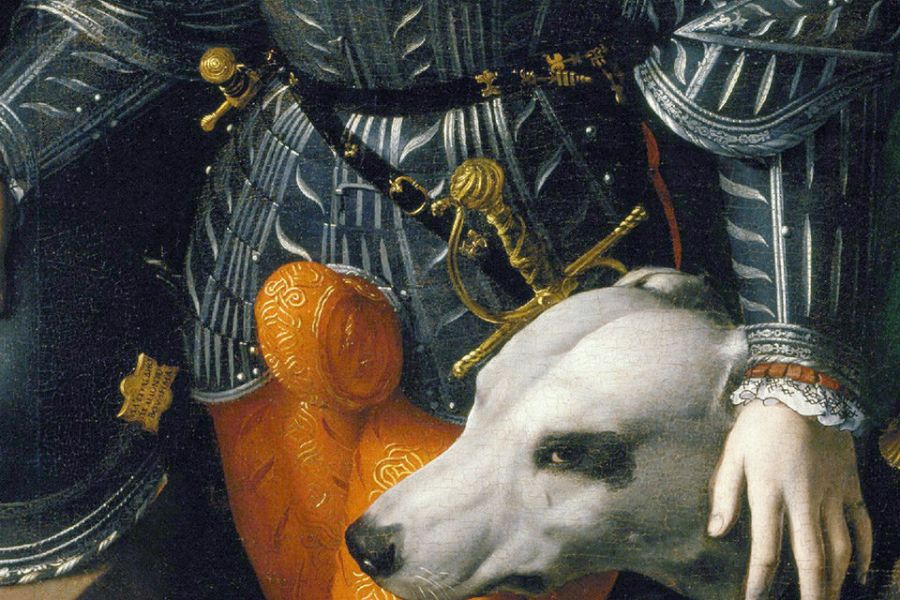
The codpiece wasn’t confined to civilian fashion. It made its way onto the battlefield in metal plate armor, where it served a straightforwardly protective function. Henry VIII’s armor on display in the Tower of London includes one.
German and Swiss mercenaries wore armored codpieces as standard equipment. The French satirist Rabelais wrote an entire mock-serious passage arguing that men’s genitals required the same protection as seeds in their husks, to ensure the continuation of the species.
Even young boys were dressed in small versions of the garment. It was thoroughly embedded in 16th-century fashion. A character in the Elizabethan play Wily Beguiled listed a “carousing codpiece” among his most attractive qualities when boasting to women about his appeal. The codpiece was everywhere, in art, theater, armor, and portraiture, for roughly fifty years.
The Queen Who Ended It
When Elizabeth I came to the throne in 1558, the visual priorities of the English court changed sharply. Elizabeth was not interested in masculine swagger, only in her own image, which was meticulously constructed around a different kind of authority entirely.
The Sumptuary Act of 1562 referred specifically to the “monstrous and outrageous greatness” of codpieces, restricting oversized versions to courtiers and categorizing anyone else wearing one as stepping above their station. The phrase “aping your betters” circulated widely. The law didn’t ban the codpiece outright, but combined with the shift in court fashion, it accelerated the decline.
Under Elizabeth, the fashionable male silhouette moved away from the broad-shouldered, prominently fronted look of Henry’s era. Ruffs at the neck drew attention upward to the face. The padded stomach, known as the peascod belly, became the fashionable focal point for men’s dress. The codpiece began to shrink. By 1580, it barely registered in portraits, and by 1600, it was gone.
A garment that lasted barely a century left behind an outsized historical footprint. The codpiece shows up in royal armor, court portraits, satire, legal proclamations, and medical history.
It shows that the Tudors understood image management in sophisticated ways, that social anxiety about status and disease could be addressed through fashion, and that masculinity in the 16th century was something men performed publicly and loudly.

Love a good medieval story?
Join our readers and get tales of kings, queens, castles and ordinary medieval lives straight to your inbox.

Kylie Lang is a nationally syndicated travel journalist with bylines on the Associated Press Wire & more, a medieval history writer, and the founder and lead author of Tales of the Middle Ages (talesofthemiddleages.com). She holds a BA (Honours) in History from the University of Kent and is a member of the British Guild of Travel Writers.


