In a world where monuments are defaced, riots are an almost daily occurrence, and the whole world seems to have gone mad, Remembrance Sunday has even more significance.
It begs the question: what would the men and women who laid down their lives for our freedom think of what is happening in today’s world?
Table of Contents
Great Britain, along with other allied countries, went through two World Wars, and it feels as though another is on the brink. When will we learn from history?
On Sunday, November 8, 2026, the traffic in Whitehall will stop, Big Ben will strike eleven, and a nation will come to a standstill and spend two minutes in silence to remember. It’s not a political event; it is simply a moment to remember those who gave their lives for us.
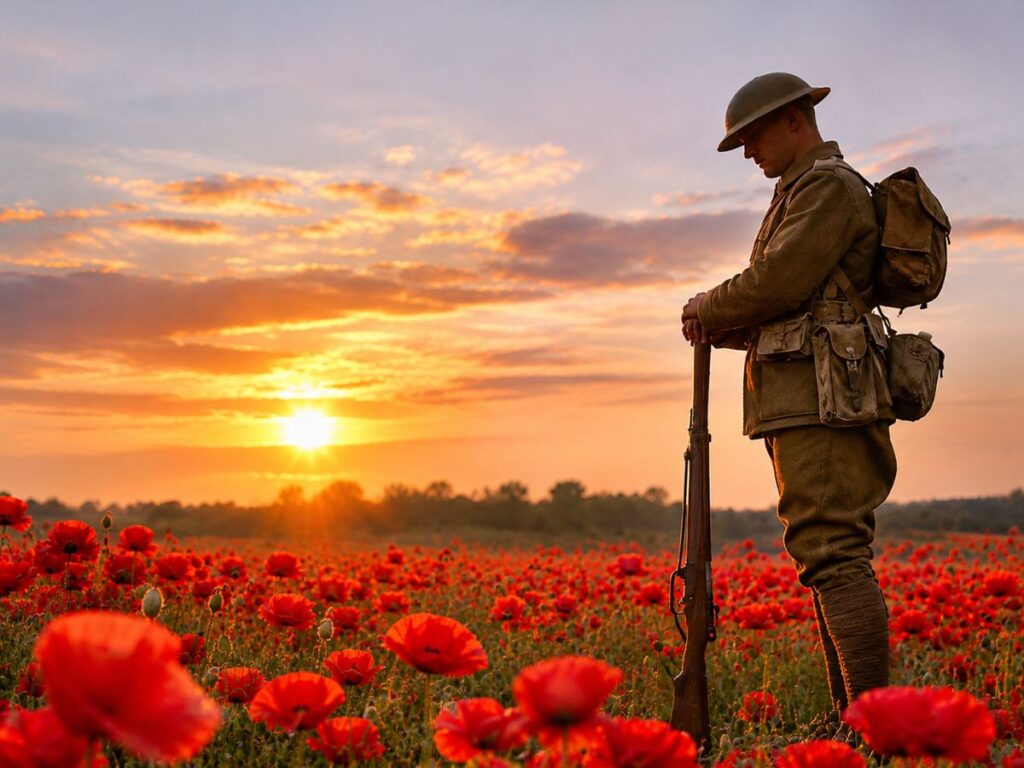
What Is Remembrance Sunday and When Is It in 2026?
Remembrance Sunday is the second Sunday of November, set aside in Britain and the Commonwealth to remember the servicemen and women killed in the two World Wars and in every conflict since.
In 2026, it falls on November 8. The national service takes place at the Cenotaph on Whitehall in London, with the king, the prime minister, the leaders of the other political parties, the heads of the armed forces and representatives of the Commonwealth laying wreaths of red poppies at the foot of the memorial.
Armistice Day is a separate thing, and it’s the older of the two. It’s always November 11, the anniversary of the morning in 1918 when the guns stopped on the Western Front, and this year it falls on a Wednesday. In my adopted country, France, it’s a public holiday and services are held throughout the country.
Many workplaces, schools and stations across Britain observe the two-minute silence at 11 o’clock that morning as well as on the Sunday.
Remembrance Sunday came into being because by the late 1930s, Armistice Day on a weekday meant factories, shipyards and offices stopping work mid-morning, and after 1945 the government wanted a form of remembrance that didn’t disrupt the working week.
From 1946 onward, the main national service was shifted to the nearest Sunday, and the custom has held ever since.
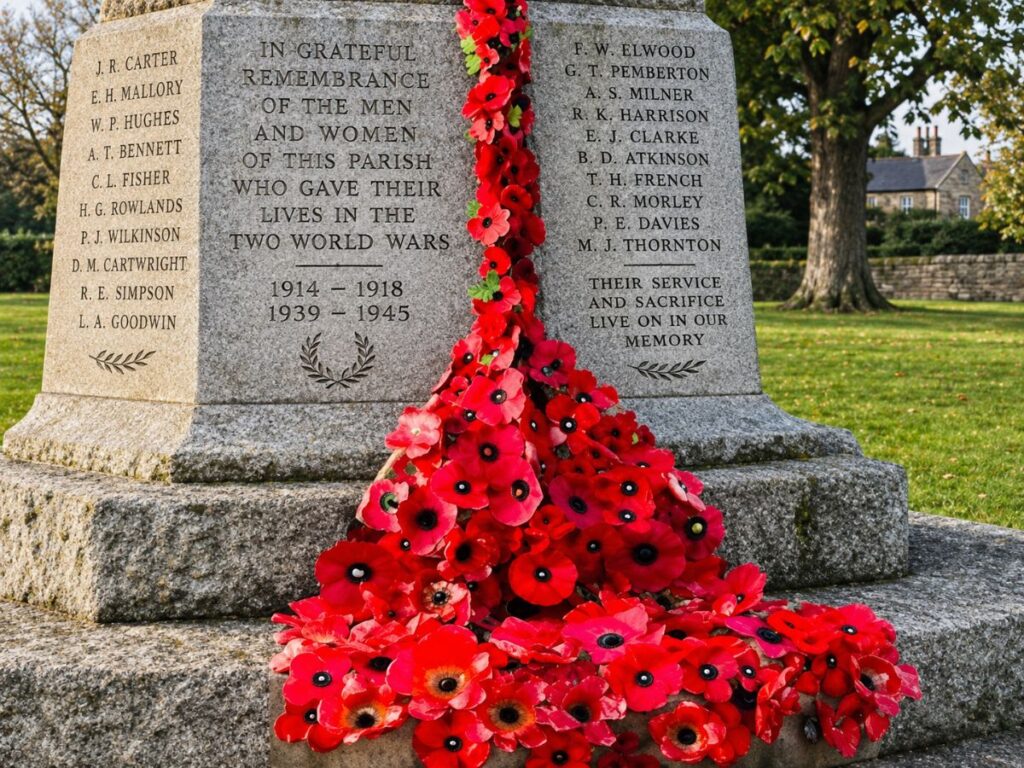
Where Did the Two-Minute Silence Come From?
The idea came from an Australian journalist, Edward George Honey, who had served in the British Army during the First World War and was living in London in 1919. In 1919, he wrote to the London Evening News suggesting a five-minute silence to honor the sacrifice of those who had died during the war. His letter was signed only “Warren Foster” and attracted little attention at the time.
The idea reached King George V by a different route. A South African politician, Sir Percy Fitzpatrick, who’d lost his eldest son Nugent on the Western Front in 1917, proposed something very similar to the king’s private secretary later that year.
A trial was held in the garden of Buckingham Palace, with Honey present, and five minutes proved too long. Two minutes was the compromise: one for the dead, one for the survivors who had to go on living.
On November 7, 1919, the king issued a proclamation asking that at the eleventh hour of the eleventh day of the eleventh month, “there may be for the brief space of two minutes a complete suspension of all our normal activities.”
Four days later, the country stopped, with buses pulling up in the middle of the road and telephone operators refusing to connect calls. In the Stock Exchange, where fortunes turned on seconds, men stood with their heads bowed.
The silence has been kept every year since, through another world war, through terrorism, through pandemic lockdowns when people stood on their own doorsteps rather than in crowds.
Hooked on the Middle Ages? Get more stories like this one in your inbox.
Why Do People Wear Poppies on Remembrance Day?
The poppy comes from a poem. In May 1915, a Canadian army doctor called John McCrae was serving at a dressing station on the Ypres Salient in Belgium after the Second Battle of Ypres, where the Germans had used chlorine gas for the first time.
A close friend of his, Lieutenant Alexis Helmer, had been killed by a shell, and McCrae had conducted the burial himself. The next day, sitting in the back of an ambulance looking out at the churned-up ground where wild poppies were already flowering between the graves, he wrote: “In Flanders Fields.”
It was published anonymously in Punch magazine in December 1915 and became the war’s most widely read poem.
An American academic, Moina Michael, read it in 1918 and vowed to wear a red poppy as a sign of remembrance. A French woman, Anna Guérin, took the idea further and began selling artificial poppies to raise money for war orphans.
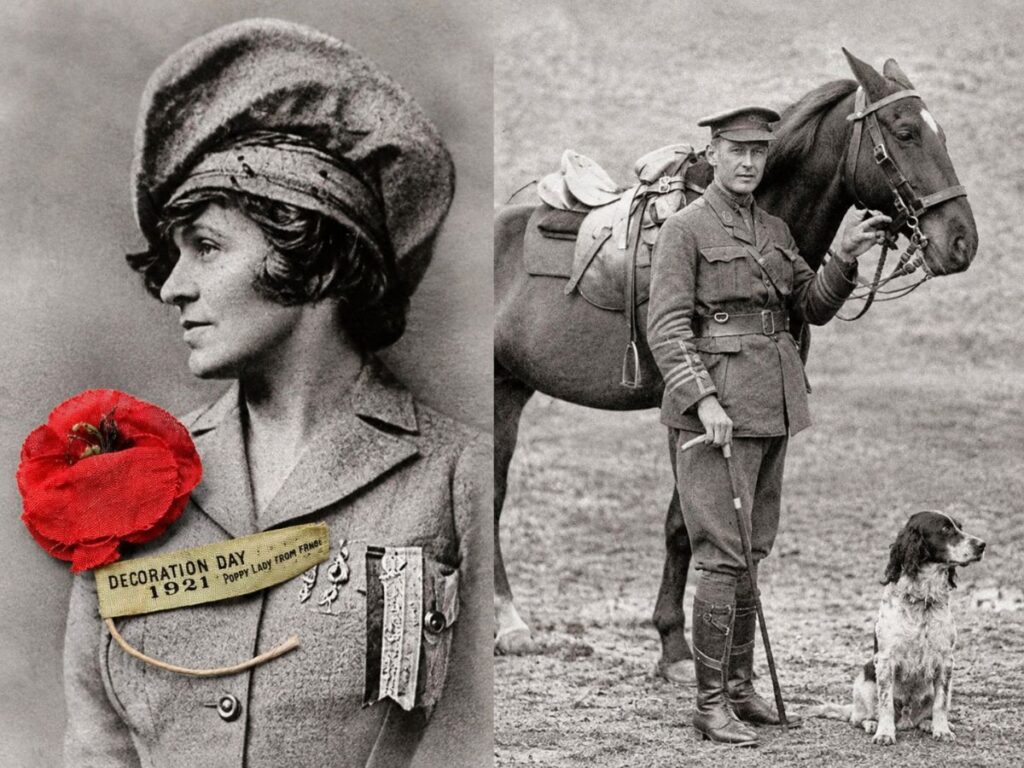
In 1921, she traveled to London and persuaded Field Marshal Earl Haig, founder of the British Legion, to adopt the poppy as the Legion’s emblem. The first British Poppy Appeal that November raised 106,000 pounds, a vast sum at the time, and the money went to veterans struggling to find work and homes.
The Royal British Legion still runs the Poppy Appeal every autumn, and the paper poppies you see pinned to coats in October and November are made at the Poppy Factory in Richmond, which employs disabled veterans.
The white poppy is different: sold by the Peace Pledge Union since 1933, it represents remembrance of all victims of war and a commitment to peace. Some people wear both, but the argument over which is more appropriate has gone on for nearly a century.
What Is the Cenotaph and Why Is the Service Held There?
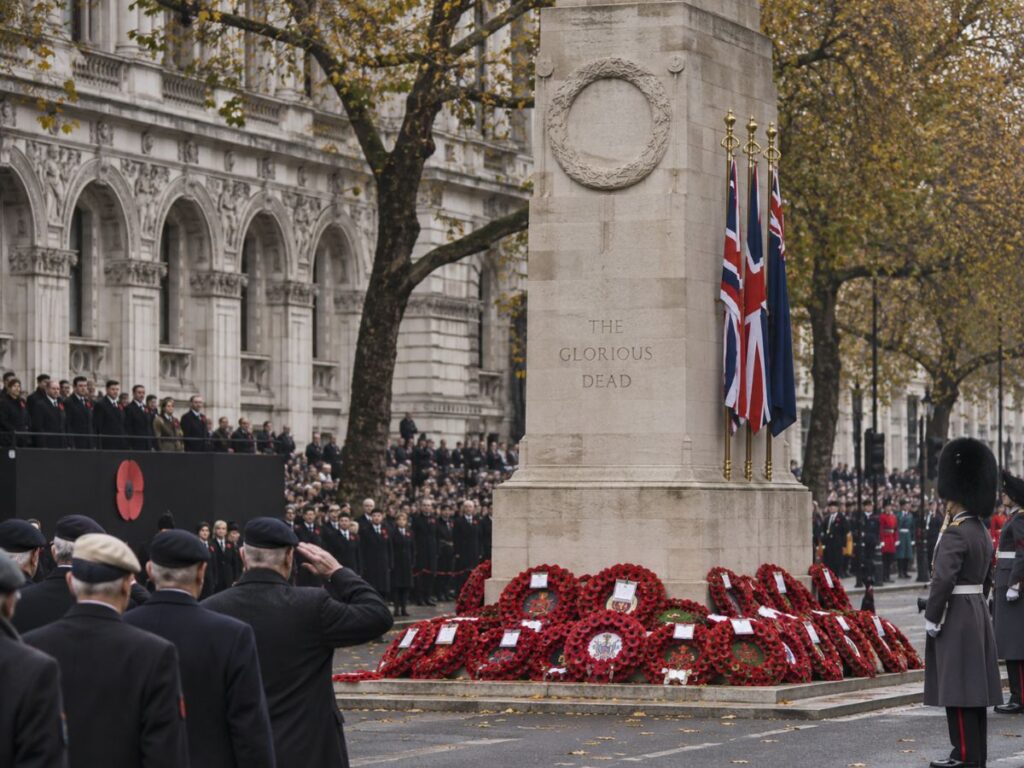
The Cenotaph on Whitehall is a plain rectangular monument of Portland stone, 35 feet high, with no religious imagery and no figurative sculpture.
The word itself is Greek and means “empty tomb,” which is what the monument represents: a tomb for the hundreds of thousands of British and Commonwealth dead who were buried where they fell, in France, Belgium, Gallipoli, Mesopotamia, East Africa, and never came home.
It was designed by the architect Sir Edwin Lutyens, who’d already been commissioned by the Imperial War Graves Commission to design cemeteries on the Western Front. The first version was a wood-and-plaster structure thrown up in a fortnight for the Peace Day parade of July 19, 1919, and was meant to be temporary.
Public reaction was so strong, with thousands of mourners leaving flowers at its base over the following week, that the government commissioned Lutyens to build a permanent stone version. It was unveiled on November 11, 1920, as part of the same ceremony that brought the body of the Unknown Warrior from France to be buried in Westminster Abbey.
Lutyens built subtle optical refinements into the design, in the manner of the ancient Greeks. The vertical sides aren’t actually vertical; they lean inward slightly, so that if continued upward they would meet about a thousand feet above the pavement. The horizontal surfaces are gently curved, part of enormous imaginary spheres.
Every year on Remembrance Sunday the king lays the first wreath at its base, followed by the royal family, the prime minister and the opposition leaders, the high commissioners of the Commonwealth, the armed forces and the merchant navy.
After the official wreaths, columns of veterans march past, organized by the Royal British Legion, in a parade that takes close to an hour to pass.
Remembrance Day vs Veterans Day: What Is the Difference?
The confusion is understandable, because both fall on November 11 and both grew out of the same 1918 armistice. The difference is what each country chose to do with the date afterward.
Britain and the Commonwealth kept the focus on the dead, but the United States, after the Second World War and Korea, shifted the focus to the living.
In America, November 11 was originally Armistice Day too, signed into law by President Woodrow Wilson in 1919 and made a federal holiday in 1938. After the Second World War, a veteran called Raymond Weeks from Alabama lobbied to expand the day to honor all American veterans, not only those of the First World War.
President Eisenhower, himself a former general, signed the bill in 1954 and renamed it Veterans Day. It remains a day for living veterans, with parades, free meals at restaurants, and ceremonies at the Tomb of the Unknown Soldier at Arlington.
The American equivalent of Remembrance Sunday, in the sense of honoring the war dead specifically, is Memorial Day at the end of May.
Canada, Australia, and New Zealand kept the name Remembrance Day and held it on November 11, with poppies and silences very similar to Britain’s. Australia and New Zealand also have Anzac Day on April 25, marking the Gallipoli landings of 1915, which has become the main national day of military remembrance in both countries. France and Belgium also mark November 11 as a public holiday, with ceremonies at the Arc de Triomphe in Paris and at town war memorials across the country, though France wears the bleuet, a blue cornflower, rather than the poppy.
What Happens at the Remembrance Sunday Service in 2026?
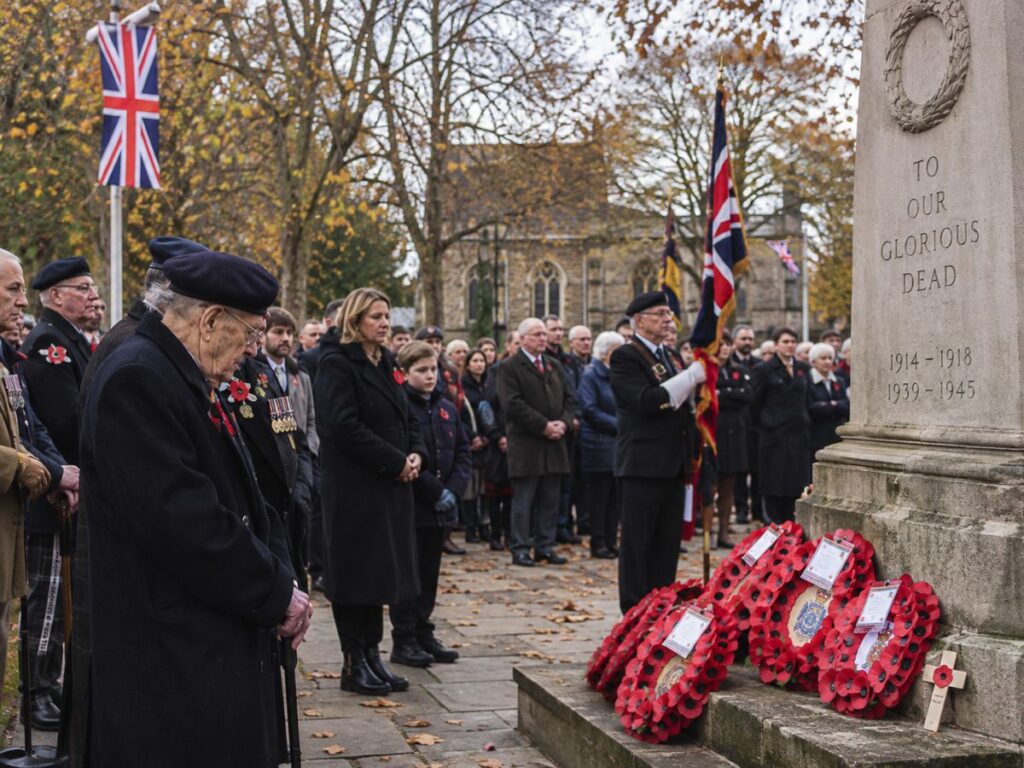
The order of service at the Cenotaph has barely changed since the 1920s. The crowds begin to gather from about 8 in the morning, and Whitehall is closed to traffic. By 10:30 the detachments of the armed forces are in position, along with the massed bands of the Guards Division, and the veterans’ columns are formed up in Horse Guards Parade behind.
At 10:55 the King arrives, along with the Queen, the Prince of Wales, and other members of the royal family. The Bishop of London leads a short service. At 11 am, a single gun is fired from Horse Guards Parade as Big Ben strikes eleven, and that gun starts the two-minute silence across Whitehall.
The silence is broken two minutes later by the Last Post, played by buglers of the Royal Marines. The king lays his wreath first, then the other royal wreaths, then the prime minister and the leaders of the opposition parties. Reveille sounds, and the national anthem is sung.
After the official wreath-laying, the march past begins. Around 10,000 veterans, organized by the Royal British Legion, process down Whitehall and past the Cenotaph. Some are in their 90s and ride in wheelchairs pushed by younger comrades.
There are contingents from every regiment of the British Army, from the Royal Navy and the Royal Air Force, from the merchant navy, the police, the fire service, the Women’s Land Army, the Bevin Boys who were conscripted to work the coal mines in the Second World War, and increasingly from the units that served in Northern Ireland, the Falklands, Iraq and Afghanistan.
Every veteran drops their own small wreath or poppy at the foot of the Cenotaph as they pass. By the time the last of them has gone by, the base of the monument is buried under them.
At a thousand parish churches, cathedrals and village war memorials across Britain, smaller versions of the same thing happen simultaneously.
Love a good medieval story?
Join our readers and get tales of kings, queens, castles and ordinary medieval lives straight to your inbox.

Kylie Lang is a nationally syndicated travel journalist with bylines on the Associated Press Wire & more, a medieval history writer, and the founder and lead author of Tales of the Middle Ages (talesofthemiddleages.com). She holds a BA (Honours) in History from the University of Kent and is a member of the British Guild of Travel Writers.