
You look at a portrait of a woman in full court dress, panniers wider than a doorway, yards of silk weighing down her hips, and you can’t help but wonder. Where did she go when she needed to go?
There was no bathroom down the corridor or modern conveniences, no plumbing to help the situation, and no chance of hoisting all that fabric up in a hurry.
Table of Contents
Ladies in the 18th century went to the toilet using a chamber pot or a slim, boat-shaped porcelain pot called a bourdaloue, which they held between the thighs while standing or crouching.
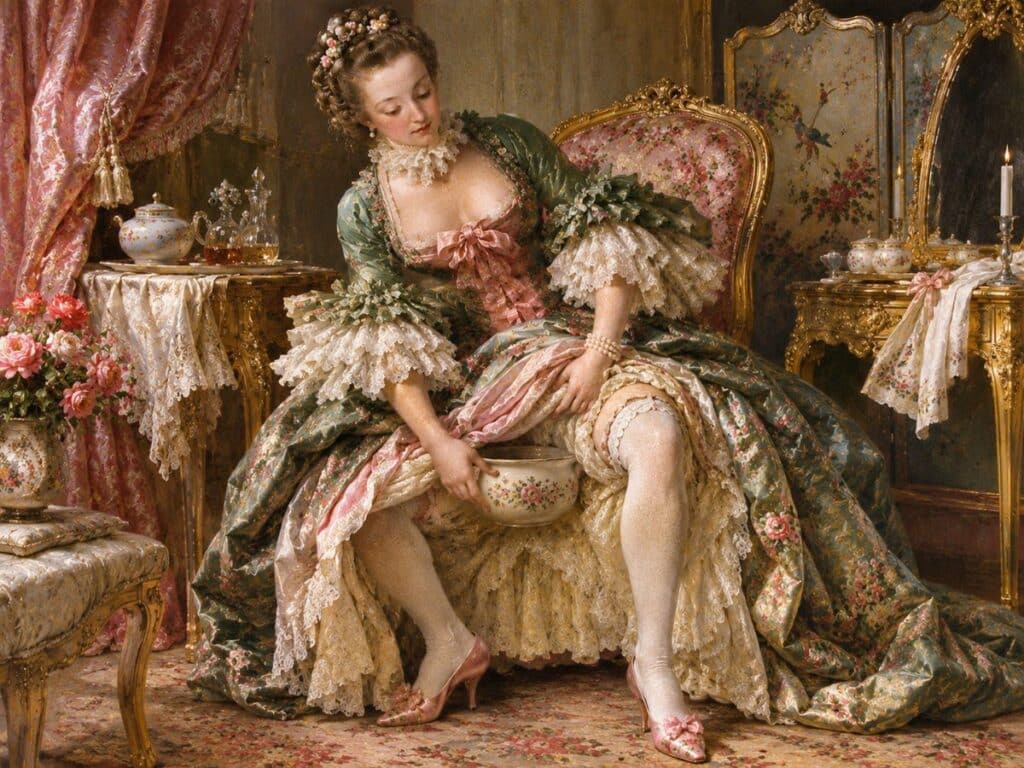
And the reason it worked so well was that women wore no underwear beneath their petticoats, so there was nothing to pull down. A maid carried the pot and emptied it afterward. The enormous dresses that look so impractical ended up being what made the whole business manageable.
How 18th-Century Ladies Actually Relieved Themselves
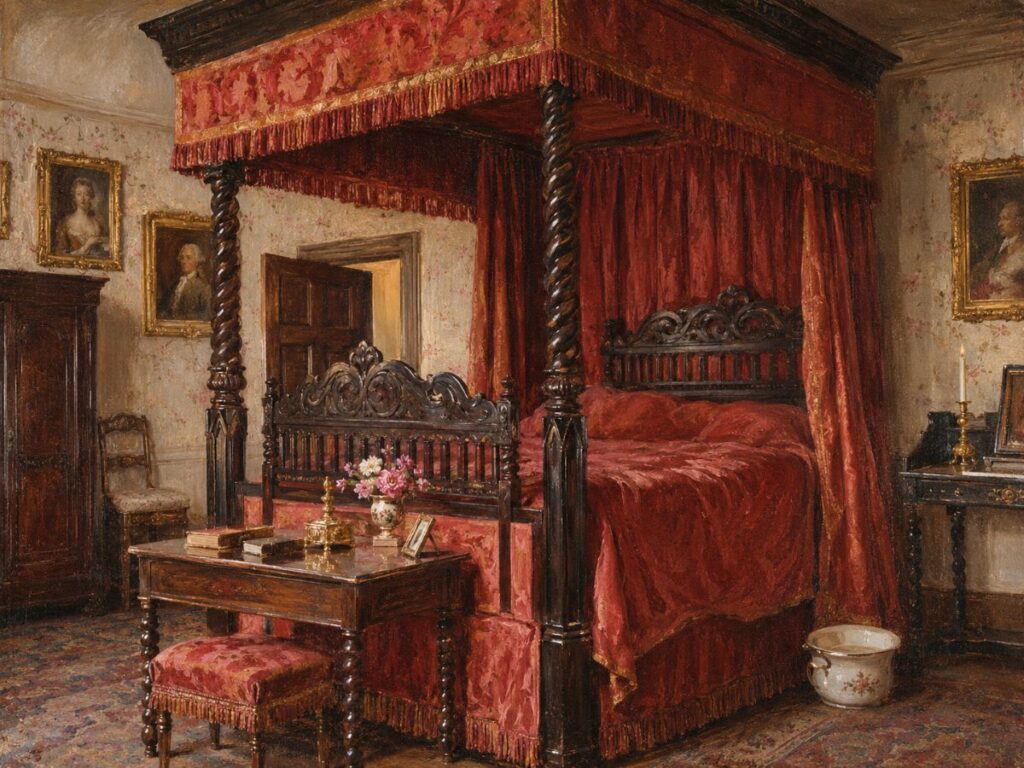
Indoors, in her own rooms, a woman used a chamber pot kept under the bed or inside a close-stool, which was a padded box with a hinged lid and a pewter or ceramic pan inside.
When she was out and about, she used a bourdaloue instead. It was a small oval pot, a bit like a gravy boat, and she could tuck it under her skirts and hold it between her thighs without taking anything off. That made it handy at a ball, at the theater, during a long sermon, or on a bumpy carriage ride.
Either way, someone else had to deal with what came next. A maid or lady-in-waiting carried the pot away, emptied it, rinsed it out, and brought it back, ready for next time. I’m glad that wasn’t in my job description!
The skirts stayed down. A woman lifted them at the front or back just enough to position the pot, and the petticoats fell over her hands and the pot itself, which gave a surprising amount of privacy even in a crowded retiring room.
She’d stand, or crouch slightly, and angle the pot so nothing splashed back onto her linen. There’s even a painting attributed to François Boucher of a woman doing just that. She has the pot in one hand, and her skirts gathered up, and she looks completely unbothered, as if she were doing nothing more unusual than brushing her hair.
The thing that made all of it workable was that there was nothing between her legs and the pot. No drawers to unbutton, no tights to roll down, no modern layering at all.
A woman in 1750 could relieve herself in under a minute without disturbing a single ribbon on her bodice, and she did it several times a day without anyone, including her husband, giving it much thought.
Did 18th-Century Women Wear Underwear?
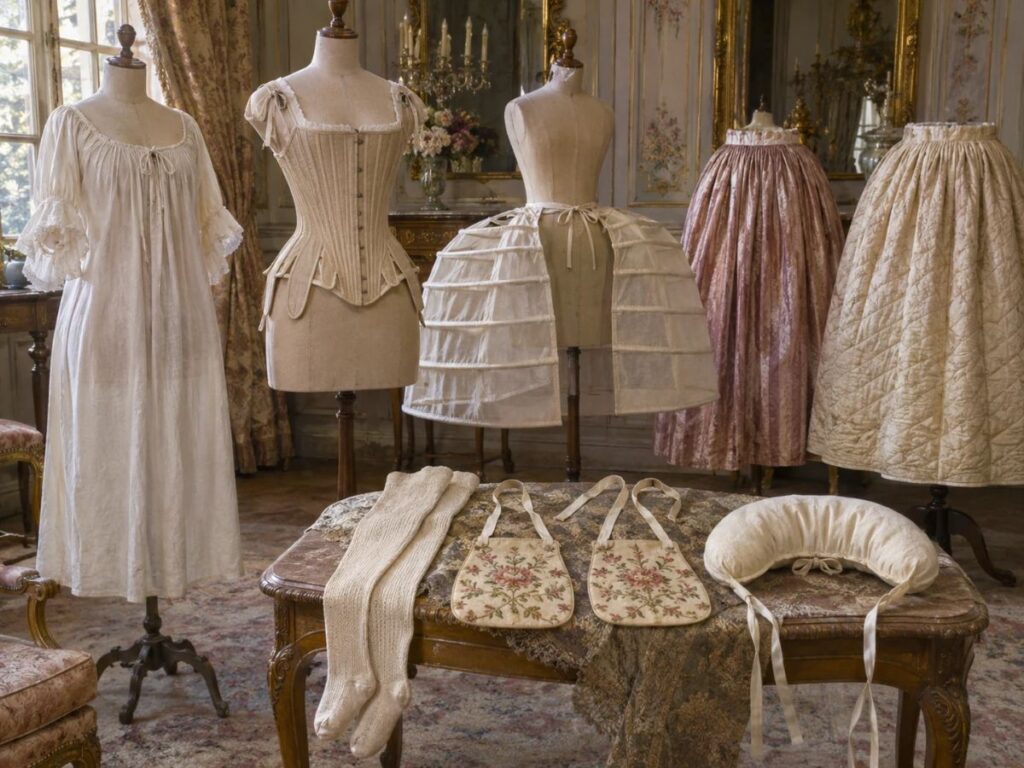
No. Women in the 1700s wore a linen shift or chemise next to the skin, reaching to about the knee, and that was the only layer between them and their stays, petticoats, and gown. Below the waist, they were bare. No drawers, no knickers, no pants of any kind.
Every woman did it this way, from a scullery maid in Yorkshire to Marie Antoinette at Versailles. For most of the century, it was simply how things were done across Europe.
Women didn’t wear underwear the way we think of it today. There was a long linen shift under everything and stockings held up with garters, but nothing that closed between the legs. So she could squat over a pot, use a bourdaloue, or nip behind a hedge without taking a thing off.
And trust me, getting dressed was hard enough already. Her stays laced up at the back, her petticoats tied at the waist, her panniers or hoops strapped on separately, and then her gown was pinned or hooked over the top of it all. Add a pair of underwear into that mix, and a quick trip to relieve herself would have taken all afternoon.
Drawers for women arrived around 1800, imported from France and worn first by young girls, where they peeped out below shorter dresses and were considered faintly scandalous when seen on adults.
Even when grown women took them up in the early 19th century, the drawers were split-crotch, two separate legs joined at the waistband with an open seam between. Closed-crotch underwear for women is a very recent invention, really a thing of the late Victorian period onward. And boy, am I relieved they became fashionable.
Hooked on the Middle Ages? Get more stories like this one in your inbox.
What Was a Bourdaloue, and Who Used One?
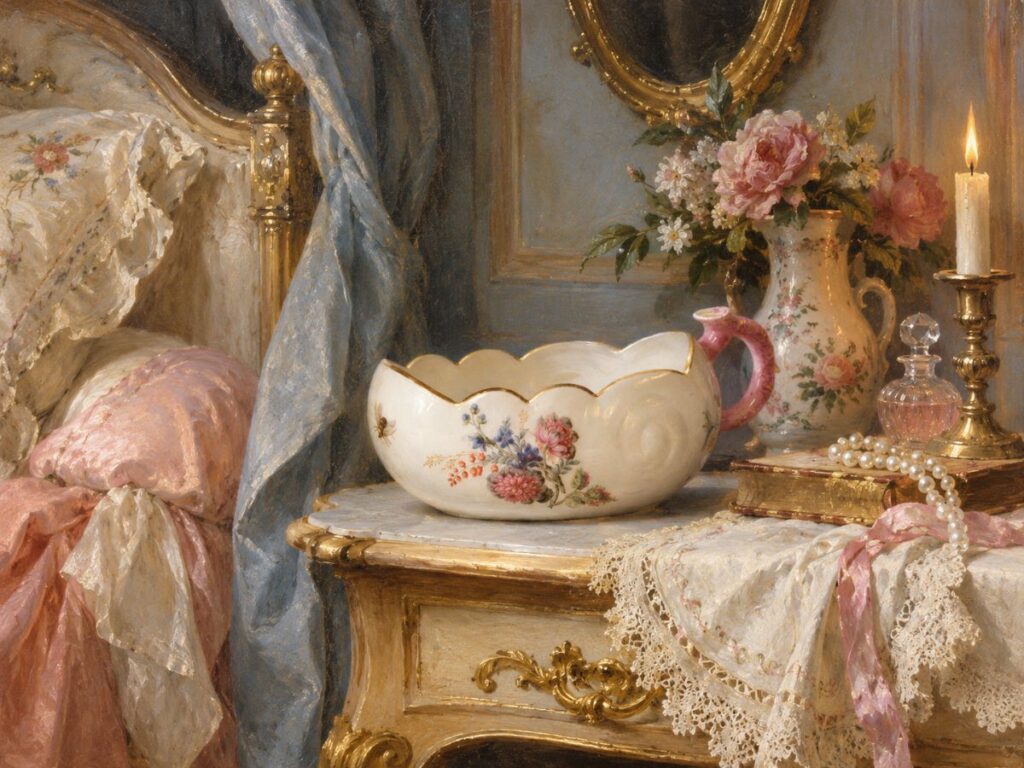
A bourdaloue was a small, oval, spouted pot, usually five or six inches long, shaped like a shallow gravy boat with a curled handle. The best examples were fine porcelain or tin-glazed faience, painted with flowers, landscapes, or coy little mottoes inside the bowl.
The form fitted the female body: narrow at one end, wider at the other, low enough to slip under petticoats held out by panniers. They were completely discreet.
The name came from Louis Bourdaloue, the Jesuit preacher whose sermons at Versailles between the 1670s and his death in 1704 drew huge, fashionable crowds. The story goes that his sermons ran so long that ladies in the congregation needed relief mid-service and had their maids slip the pots to them under their skirts.
The tale is almost certainly a later joke, but the name stuck, and Diderot and d’Alembert’s Encyclopédie of the mid-18th century records ‘pot-de-chambre à la Bourdaloue’ as a standard term.
In England, the same object was called a coach pot, which gives you another clue about its use. Women took them on long journeys, into theater boxes, into church, and anywhere a stop wasn’t possible.
The pots were small enough to tuck into a traveling case and pretty enough to display, which is why so many have survived. Antique dealers today regularly misidentify them as sauce boats or gravy jugs, and the occasional dinner party has been served with a 250-year-old urinal at the center of the table.
How Did Women Go to the Toilet at a Ball?
At a grand ball, a lady withdrew to a retiring room set aside for the purpose. Chamber pots or close-stools stood behind screens, along with a basin for washing hands, mirrors, candles, and one or more maids on hand to help manage the skirts.
Those panniers made it hard to move in a small space. A wide court dress couldn’t even get through an ordinary door unless she turned sideways, so having someone with her was a practical help as much as a social one. Friends often went in together and chatted while they waited. I like to think that’s where our habit of going to the ladies’ room in pairs comes from, though nobody can prove it.
On the way home, a bourdaloue made life much easier. A woman could use one in her carriage with the curtains drawn, hand the pot to her maid, and step out at her own front door as if nothing had happened.
Number two was a different matter. For that the stays had to come off, or at least loosen, and the whole lower apparatus of petticoats and panniers had to be managed, which took time and privacy.
Women generally timed bowel movements for first thing in the morning or last thing at night, when their maids were dressing or undressing them anyway. A lady at a ball who found herself in sudden need of more than a bourdaloue had a real problem, and the retiring rooms at the better houses were designed to give her the space and the help to solve it.
Did the Palace of Versailles Have Toilets?
Barely. By 1789, the palace that housed several thousand courtiers, servants, guards and hangers-on had only around nine flushing toilets, and almost all of them belonged to the royal family.
Everyone else used chamber pots and close-stools, which servants called porte-chaises d’affaires emptied into cesspits dug beneath the palace. By the end of the ancien régime, there were more than 30 of these pits, and night-soil men cleared them out.
The Duc de Saint-Simon, whose Mémoires are one of the great eyewitness sources for Louis XIV’s court, recorded courtiers relieving themselves in corridors, on staircases, in corners behind curtains, and in the gardens.
Versailles may have looked glorious, but it certainly didn’t smell it. In 1764, a writer called La Morandière complained that the park, the gardens and even the palace itself turned your stomach with their foul smells. He said the passageways, courtyards and corridors were full of urine and worse.
With so few toilets to go around, anyone caught short between the Hall of Mirrors and their own apartment simply found a quiet corner. The famous gardens, with all their fountains and parterres, did double duty as an open-air latrine.
Louis XVI began a sanitation overhaul of Versailles in the 1770s, installing more water closets of the English type and trying to drain the worst of the cesspits, but the work was slow, and the money ran short, and the Revolution overtook it in 1789.
Lawrence Wright’s Clean and Decent, still the standard history of the bathroom, lays out how far ahead some English country houses were by then, with mechanical water closets installed in the 1770s and 1780s while France’s own royal palace still largely ran on pots and pits.
What Did 18th-Century Women Use Instead of Toilet Paper?
Toilet paper as a manufactured product didn’t exist for most of the 18th century. Women and men used whatever was to hand: squares of linen or wool kept for the purpose and washed afterward, scraps of old shirts, moss, leaves in the country, pages torn from almanacs or pamphlets in the towns.
Wealthy households kept a basket of soft cloths in the close-stool cupboard, and a maid took the soiled ones to be laundered with everything else.
The French added a step the English and Americans did not: the bidet. Jane Austen’s World cites the earliest recorded use at 1710, and by mid-century a bidet was standard equipment in a fashionable French lady’s dressing room, a low porcelain basin on a wooden stand filled with warm water from a jug.
A woman sat astride it after using the pot and washed with her hand or a sponge. Full-body bathing was rare, perhaps once a month in a portable hip bath hauled into the dressing room, but the daily toilette involved a great deal of washing of the face, hands and intimate parts in basins.
Periods were managed, as far as we can tell, with folded linen cloths or rags held in place by the shift itself, tucked between the legs and changed several times a day. The surviving record is thin because women didn’t write about it and the cloths were washed and reused rather than kept.
Dark-colored petticoats helped, and so did careful timing of social engagements. Some women almost certainly bled freely into their shifts on quiet days at home, washed the shift, and got on with it.
Where the Waste Actually Went
In a townhouse, the chamber pots were carried down by a servant at dawn and emptied into a cesspit in the yard, or into a stream, a drain, or straight into the street.
The Edinburgh cry of gardyloo, a corruption of the French gardez l’eau, warned passers-by on the street below that a pot was about to be tipped from an upper window, and gave them a moment to flatten themselves against the wall. The warning wasn’t always issued in time.
Travelers’ accounts of Edinburgh and Paris in the 1700s are full of complaints about what had landed on their coats.
Older castles and manor houses still had garderobes, stone privies built into the thickness of a wall, with a shaft dropping to a moat or a pit below. This was medieval technology, but it worked, and plenty of 18th-century households still used it.
In the cities, night-soil men went around after dark with carts and shovels, emptying cesspits and carrying the contents out beyond the walls to be spread on fields or dumped in the river. London and Paris both relied on this system well into the 19th century, and the smell of either city in August would have been absolutely foul.
The constant presence of waste in the streets, in the gutters, in the palace corridors is a large part of why the 18th century was also the century of heavy perfume, pomaded hair, scented gloves, and pomanders worn on chains at the waist.
Frequently Asked Questions
How did ladies go to the toilet in the 18th century?
Ladies in the 18th century went to the toilet using a chamber pot, or a slim porcelain alternative called a bourdaloue, held between the thighs and used while standing or crouching. Since women wore no underwear beneath their petticoats, they didn’t have to pull anything down. They lifted the skirts clear, positioned the pot, and a maid carried it away and emptied it.
Did 18th-century women wear underwear?
18th-century women did not wear underwear in the modern sense. The only underlayer was a linen shift, or chemise, worn next to the skin, and nothing covered the crotch.
What is a bourdaloue, and how was it used?
A bourdaloue was used as a small, oval, spouted chamber pot, often in fine porcelain, shaped to fit the female body. A woman slipped it beneath skirts held out by panniers, held it between her thighs, and used it standing or crouching.
Did the Palace of Versailles have toilets?
The Palace of Versailles had almost no toilets for most of the 18th century. By 1789, there were only around 9 flushing toilets in the whole palace, nearly all reserved for the royal family, while thousands of courtiers made do with chamber pots. Servants emptied them, often into the stairwells, the gardens, or out of the windows. Louis XVI began a proper sanitation overhaul in the 1770s.
What did 18th-century women use instead of toilet paper?
Instead of toilet paper, 18th-century women used cloth, rags, sponges, or water. The French increasingly used a bidet, recorded from around 1710, for washing afterward in the privacy of the dressing room. Wealthier households kept basins and sponges handy for the purpose, and most people used whatever fabric was available.

Love a good medieval story?
Join our readers and get tales of kings, queens, castles and ordinary medieval lives straight to your inbox.

Kylie Lang is a nationally syndicated travel journalist with bylines on the Associated Press Wire & more, a medieval history writer, and the founder and lead author of Tales of the Middle Ages (talesofthemiddleages.com). She holds a BA (Honours) in History from the University of Kent and is a member of the British Guild of Travel Writers.
Related posts:
 Just How Filthy Were Medieval Toilets? Were They as Bad as We Think They Were?
 How Medieval Women Managed Their Periods: Moss, Rags, and No Knickers
 Did Medieval People Smell That Bad? The Truth About Hygiene in the Middle Ages
 The Politics of the Bedchamber: Why the Rich Slept in Separate Bedrooms in the Middle Ages