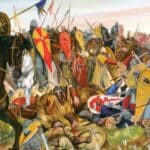
England in the early 1000s was anything but stable. Viking fleets prowled the coasts, rival kings grabbed for power, and alliances shifted with every battle. In the middle of this chaos stood Emma of Normandy, a woman who managed to survive and even thrive while others around her were destroyed.
She was married to not one but two kings of England. She gave birth to two more who wore the crown, and her bloodline was tied directly to the events that ended with William the Conqueror. Few figures can claim to have influenced Saxon, Danish, and Norman England in one lifetime, but Emma did.
Table of Contents
Her story is one of politics, survival, and the cold reality of life at a court where betrayal could come from your own family. To understand Emma is to see the road that led to 1066 begin to take shape decades earlier.

Emma’s Origins in Normandy
Emma of Normandy was born in the 980s into one of the most powerful families in northern Europe. Her father was Richard I, Duke of Normandy, and her mother was Gunnor, a woman of Danish heritage who became a key figure at the Norman court. The family’s power rested on Viking roots.
Normandy had only existed for about a century, created when Viking raiders settled and carved out land along the Seine. Emma grew up in a world where the memory of those hard-edged ancestors was still very much alive.
Her childhood would have been shaped by the politics of her father’s court at Rouen. Normandy in her youth was a rising force. The dukes had to balance loyalty to the Frankish kings with their own ambitions, and that meant clever diplomacy, well-placed marriages, and a readiness to use force when needed. Emma, as a daughter of the ducal house, was never going to be left outside those games. Girls in her position were raised to play their part, and that part was often marriage.
Emma’s brother Richard II inherited Normandy and carried on that balancing act. It was through him that Emma’s future was decided. England, across the Channel, was being torn apart by Viking raids. The English king Aethelred was desperate for allies, and Normandy was a natural choice. Richard had every reason to agree, since it secured his duchy against the same raiders who threatened England.
Emma, still young but already valuable as a political pawn, became the link between the two courts. Her marriage would be the bridge, and through it, she would step into the brutal world of English royal politics.
Marriage to Aethelred
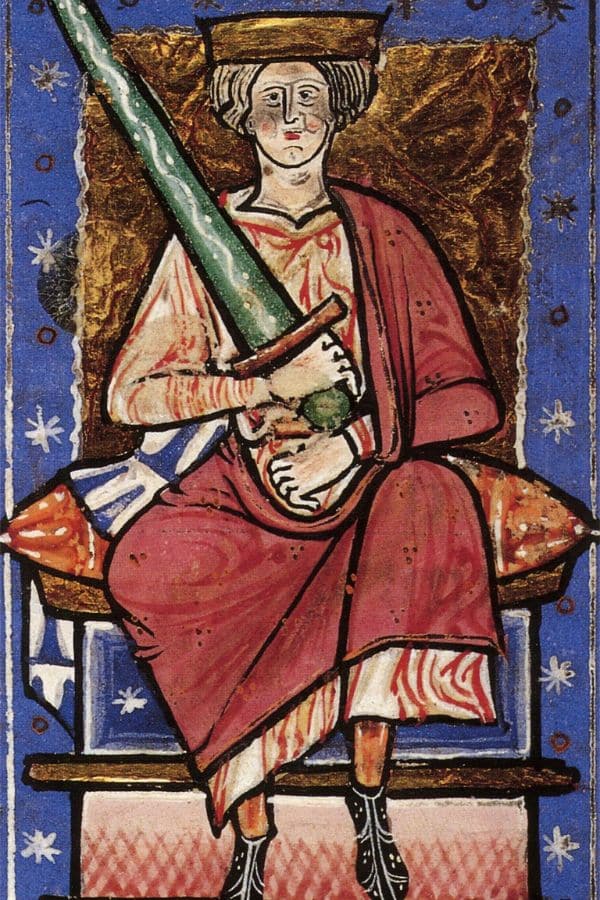
In 1002, Emma was sent across the Channel to marry King Aethelred of England, as part of a political deal struck to shore up Aethelred’s crumbling position against the Danes. For Richard II of Normandy, it secured peace with England and the promise that Norman ports would no longer give safe harbor to Viking raiders. For Aethelred, it meant an alliance with a duchy that could act as a buffer against invasion. Emma was the human seal on the bargain.
In England, she was given the name Aelfgifu, a traditional Saxon name meant to make her more acceptable to her new subjects. She was crowned and anointed, a ritual that carried spiritual as well as political weight. It showed that the Church recognized her role, and it also gave her a visible presence in a kingdom struggling to hold itself together.
The marriage produced children who would later matter a great deal. Edward, the future Edward the Confessor, was born around 1003. His brother Alfred and sister Godgifu followed. For now, though, Emma’s position was anything but secure. England was under constant threat.
Viking attacks grew bolder, and Aethelred’s reign was marked by defeat and mistrust. Emma’s very first years in England were marked by crisis. In 1013, when Sweyn Forkbeard of Denmark invaded and seized the throne, Emma fled back to Normandy with her children. Aethelred soon followed.
Their exile didn’t last long. Sweyn died the next year, and the English nobles called Aethelred back. Emma returned at his side, but the stability didn’t hold. Aethelred died in London on April 23, 1016, as Cnut’s forces were pressing the city. The Anglo-Saxon Chronicle notes his death on St. George’s Day and sums up his reign as one lived in heavy trouble. It does not give a cause, though later writers suggest he had fallen ill in the weeks before he died.
He was buried in Old St Paul’s Cathedral. The tomb did not survive the Great Fire of 1666, so its exact location is lost. After his death, the councillors chose his son Edmund as king, and the struggle with Cnut carried on through that year.
Emma’s Time as a Widow
When Aethelred died, the Witan (the council of nobles and churchmen) chose his son Edmund Ironside as king. Edmund was Aethelred’s son by his first wife, not by Emma. That mattered because it meant Emma’s own boys, Edward and Alfred, were not first in line. They were very young at the time and were left vulnerable in a court that had little reason to protect them.
Emma herself seems to have had no role in Edmund’s brief reign. The sources place her back in Normandy with her children during this time. It was the safest place for her, as Cnut’s war with Edmund raged across England. Edmund fought hard, but by late 1016, he agreed to split the kingdom with Cnut. He ruled Wessex while Cnut took the north. Only weeks later, in November, Edmund died suddenly, leaving Cnut free to seize the whole kingdom.
That moment changed everything for Emma. Instead of fading into obscurity as a widow with two boys in exile, she was recalled to England and married to Cnut in 1017. It was a ruthless but shrewd match. By marrying Emma, Cnut legitimized his hold on the English throne and tied himself to the old royal line. For Emma, it was survival, and it set her on course to become queen for a second time.

Hooked on the Middle Ages? Get more stories like this one in your inbox.
Marriage to Cnut
On the surface, it might look like a shocking turnaround: the widow of Aethelred, mother of his young heirs, suddenly becoming the wife of the man who had just defeated her stepson. But in the world of early medieval politics, survival often meant adapting fast.
With Emma at his side, Cnut could present himself not just as a conqueror, but as a king accepted by both Saxon and Norman interests. She was anointed queen once again, this time not just of England but also of a wider Scandinavian empire. Through Cnut, Emma became linked to Denmark and later Norway. It was a rare role for a woman of the time, placing her at the heart of politics in three kingdoms.
Emma and Cnut had children of their own. Their son Harthacnut would later inherit the Danish and English crowns, and their daughter Gunhilda was married into the Holy Roman Empire. Emma herself gained enormous influence.
She was a landholder in her own right, and documents show her name listed alongside Cnut’s in charters, something that underlined her importance in the kingdom. Unlike many medieval queens, Emma was not kept in the background. She had a clear place in the machinery of power.
Emma and Cnut ruled together for nearly twenty years, a rare stretch of stability in a violent century. When Cnut died in 1035, it was the end of not just a marriage but of an empire that had briefly united England, Denmark, and Norway. Emma, once again, was left a widow. This time, however, she was no powerless dowager. She had wealth, allies, and grown children ready to press their claims, and she would use every ounce of her influence to shape what came next.
After Cnut: Widowhood and a Kingdom in Crisis
For nearly two decades, she had enjoyed a secure place at the center of power. She had land, influence, and two sets of royal children who could claim crowns. Now, with her husband gone, the court fractured, and enemies who had quietly waited for their chance began to circle.
The immediate question was succession. Cnut and Emma’s son Harthacnut was the obvious heir, but he was in Denmark at the time, busy defending his throne there. That left a dangerous vacuum. Cnut had an older son, Harold Harefoot, from an earlier union with Aelgifu of Northampton. Harold wasted no time pressing his claim. A civil war between rival heirs loomed, and Emma was right in the middle of it.
Emma held the royal treasury at Winchester, and that gave her enormous leverage. It wasn’t just gold and silver she controlled, but the ability to pay men and win support. She backed Harthacnut, her own son, as the rightful king. But Harold’s faction in the north moved quickly. By 1037, Harold had been recognized as king of all England, and Emma was forced into exile. She fled to Flanders, staying at the court of Count Baldwin V, a powerful ally with close ties to Normandy.
Even in exile, Emma did not sit idle. She had two older sons by Aethelred, Edward and Alfred, living in Normandy. She looked to them as a counterweight to Harold’s rule. In 1036, Alfred sailed to England, possibly at his mother’s urging, but the plan ended in disaster. He was captured by men loyal to Earl Godwin of Wessex, handed over to Harold’s forces, and brutally blinded. He died soon after. The episode left a permanent stain on Godwin’s reputation and gave Edward every reason to hate him.
When Harold Harefoot died in 1040, the balance shifted again. Harthacnut crossed to England and finally took the throne. Emma returned with him, once more restored to power. For a brief period, she was back at the center of the court, with her son ruling as king. But fate intervened yet again. Harthacnut died suddenly in 1042, collapsing at a wedding feast. He was only in his mid-twenties.
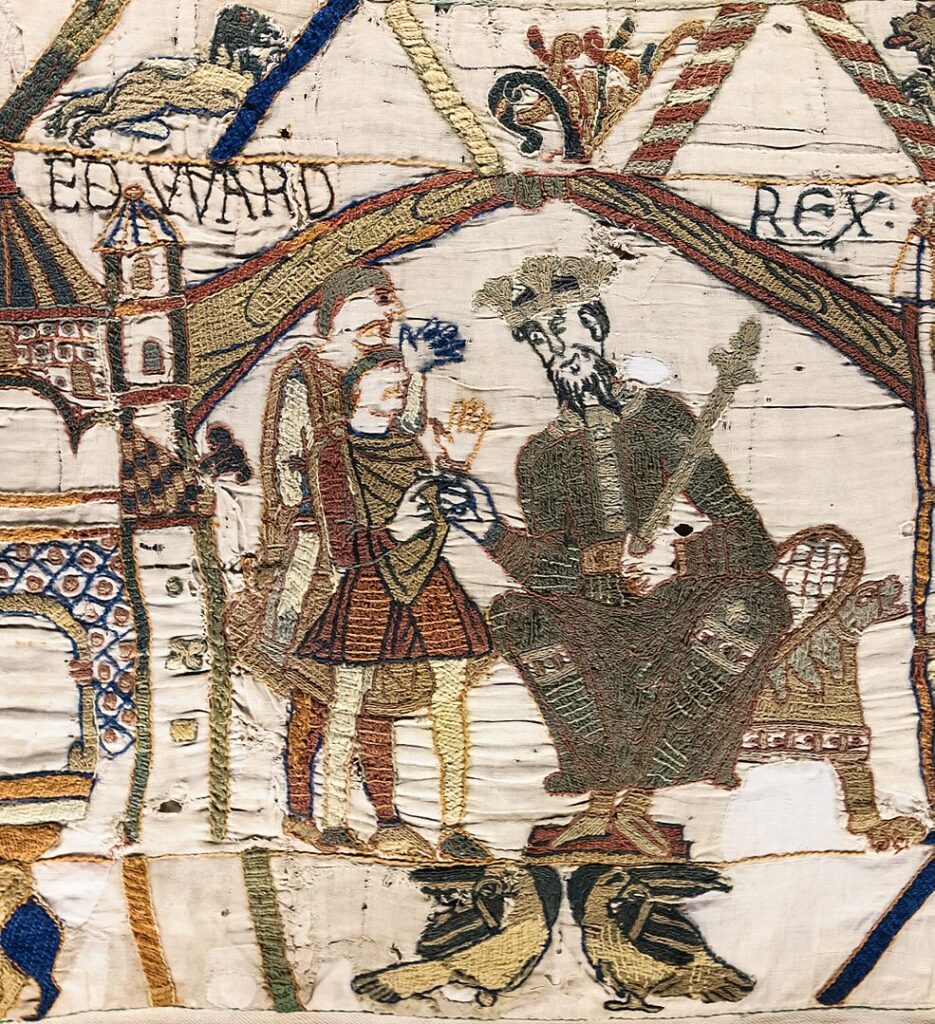
With Harthacnut gone, Emma’s sons by Aethelred were the only male heirs left. Edward, who had spent much of his life in Normandy, was called back and made king. On paper, this was Emma’s triumph; her eldest surviving son now wore the crown of England. In reality, her relationship with Edward was uneasy at best.
He had grown up apart from her, shaped by years in exile, and he distrusted her influence. In 1043, only a year after his coronation, Edward seized her lands and treasure at Winchester in a clear act of hostility. He later restored part of her property, but the message was unmistakable: Emma’s role in English politics was no longer welcome.
By the late 1040s, Emma faded from the political stage. She spent her last years in Winchester, the city that had so often been her base of power, and died there on March 6, 1052.
Where is Emma of Normandy Buried?
Emma of Normandy was first buried in the Old Minster at Winchester, but that church was demolished after the Norman Conquest to make way for the new cathedral on the orders of William the Conqueror. The bodies of kings, queens, and bishops buried there were taken up and placed into painted stone mortuary chests.

Emma’s remains were among them, along with those of Cnut, Harthacnut, and other Anglo-Saxon royals. The chests stood undisturbed for centuries until the English Civil War. In 1642, Parliamentarian soldiers stormed the cathedral, broke open the chests, and scattered the bones. Later, the fragments were collected and returned, but they were mixed together.
Today, Winchester Cathedral still holds six mortuary chests containing the remains of Emma and other rulers. Visitors can see them above the choir screen. Although her tomb no longer exists, Emma still rests among the kings she once stood beside in life.
The Encomium Emmae Reginae
Emma of Normandy is one of the few medieval queens who commissioned a book about herself. Around 1041 or 1042, while her son Harthacnut ruled, a monk from the abbey of Saint-Bertin in Flanders produced a work called the Encomium Emmae Reginae, “In Praise of Queen Emma.” It was part history, part propaganda, and entirely designed to put Emma and her children at the center of the English royal story.

The book tells of Cnut’s greatness and Emma’s importance as his queen. It praises her role in bringing stability to England and presents her children as the rightful heirs. What it doesn’t do is just as revealing. Emma’s first husband, Aethelred, is mentioned only briefly, and her stepson Harold Harefoot is written out almost entirely. The book paints over awkward realities to create a neat version of events where Emma’s line alone was legitimate.
The most famous part of the manuscript is the illustration at the front. It shows Emma seated on a throne, receiving the book itself while her sons Edward and Harthacnut stand behind her. It is a striking piece of image-making. Emma is not a background figure or a passive widow. She is placed at the center, the authority who binds together the Saxon, Danish, and Norman claims to England. In a period when women were usually written out of the official record, Emma made sure she wrote herself back in.
Emma of Normandy and William the Conqueror
Emma’s story doesn’t end with her own lifetime. Through her family ties, she became one of the key threads that wove England and Normandy together in the years before 1066.
She was the daughter of Richard I, Duke of Normandy, and the sister of Richard II. That made her the aunt of Robert I, Duke of Normandy. Robert’s son was William, later known as the Conqueror. In simple terms, Emma was William the Conqueror’s great-aunt.
This mattered because Emma’s children had sat on the English throne before him. Her son Edward the Confessor ruled from 1042 to 1066. When Edward died without an heir, William claimed that his family connection through Emma, combined with promises Edward had allegedly made, gave him the right to succeed.
Whether or not those promises were real, the bloodline connection was undeniable. Emma had tied Normandy and England together by marriage, and a generation later, her great-nephew used that link as one of his justifications for crossing the Channel with an army.

Emma of Normandy on Screen
Emma of Normandy has recently found new life on screen in Vikings: Valhalla, where German actress Laura Berlin portrays her. The show takes some creative liberties, but Berlin’s performance captures something true about Emma’s place in history. She portrays her as calm, calculating, and never easily rattled, a woman who survives by thinking several moves ahead.
What stands out is the balance between restraint and steel. Berlin’s Emma isn’t a warrior with a sword in hand, but she is just as dangerous in her own way. She reads the room, weighs her enemies, and protects her position with intelligence and patience. That kind of quiet strength is exactly what the real Emma must have relied on to endure through two marriages, rival sons, and endless battles for the English crown.
Love a good medieval story?
Join our readers and get tales of kings, queens, castles and ordinary medieval lives straight to your inbox.

Kylie Lang is a nationally syndicated travel journalist with bylines on the Associated Press Wire & more, a medieval history writer, and the founder and lead author of Tales of the Middle Ages (talesofthemiddleages.com). She holds a BA (Honours) in History from the University of Kent and is a member of the British Guild of Travel Writers.