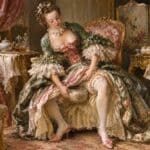
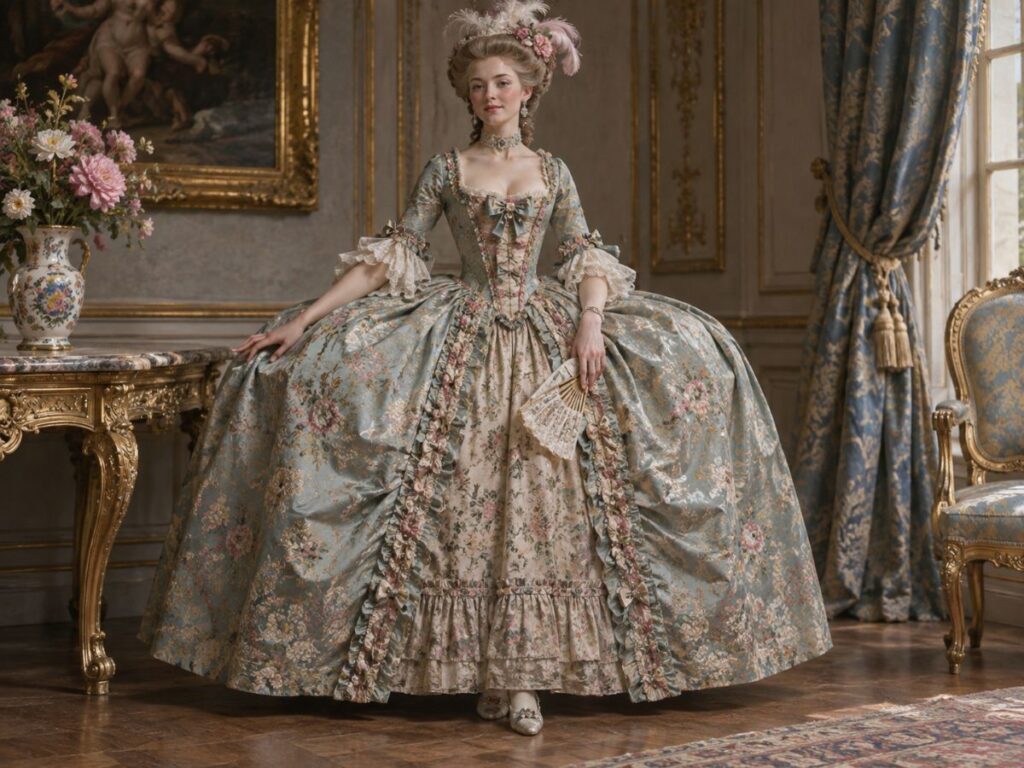
You must have seen those 18th-century court portraits of women in wide court dresses, the skirt stretched out 5 or 6 feet to either side and embroidered within an inch of its life. I can’t help but wonder: how on earth did a woman sit down in that?
When I think of our love for trackie bottoms and elasticated waists, the thought of donning one of those and being harnessed into it for hours on end fills me with horror. It’s like a form of torture.
Table of Contents
But women did it, and they had no choice, so the question remains: how did they do it?
How Did Women Sit in Wide Court Dresses?
The dress only looks impossible from the front. A pannier (also called paniers, side hoops, or in English court slang a ‘pair of bodies’) pushed the skirt out sideways at the hips and left the front and back comparatively flat.
No cage of bone ran round behind the thighs, as in the later Victorian crinoline. The structure sat at the sides, so when a woman lowered herself onto a stool, the hoops splayed left and right while her backside met the seat as normal.
At their most extreme, formal court panniers reached a total width of around 5 to 7 feet, which is why two women couldn’t pass through a single doorway or share a small couch at the same time.
That width applied only to the most formal occasions. Day dress used much smaller hip pads, and even at court the volume varied by rank, country and reign.
Furniture makers had to work around the problem, too. On the armchairs of the day, the armrest supports no longer sat directly above the legs. They were set further back so a woman’s hooped skirt had room to spread out when she sat down.
Doorways were another matter. In her widest court dress, a woman had to pass through a door sideways, which can’t have been easy to do with any grace.
And when none of that worked, the hoops themselves could be lifted, because by the 1760s a new generation of panniers was hinged.
The Hinged Panniers That Folded Up at the Hip
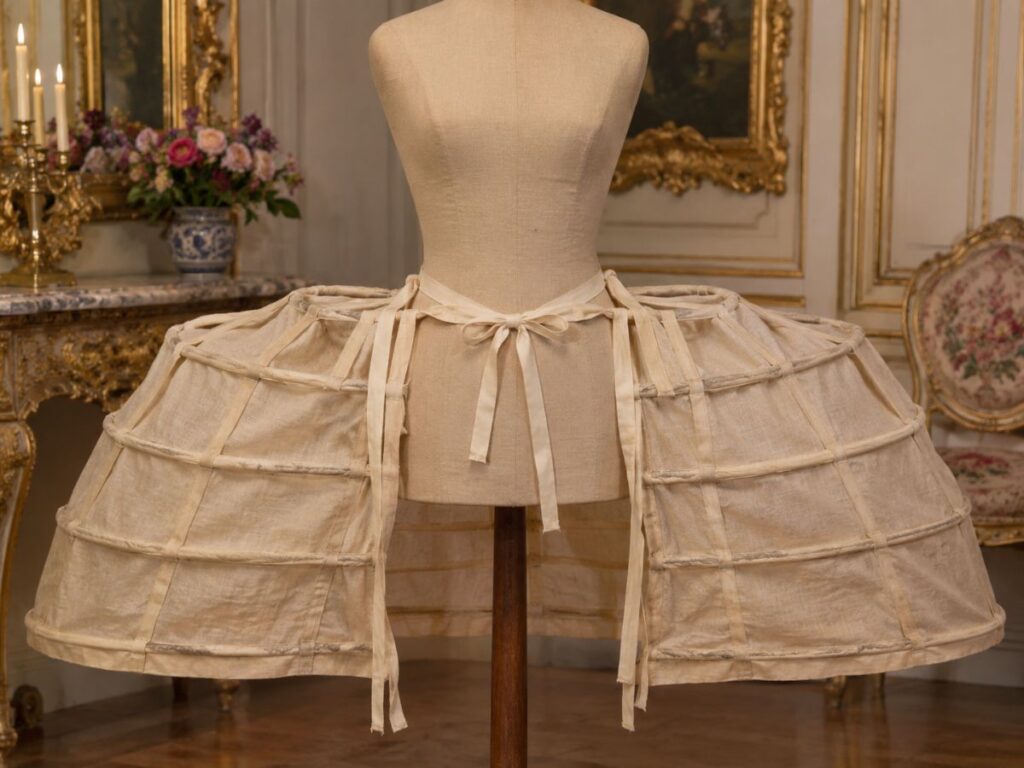
The best example of this sits in the Costume Institute at the Metropolitan Museum of Art in New York. It’s a pair of French panniers dated 1760 to 1770 (object 2008.297a, b), and each side has iron hinges at the waist that let the hoops lift straight up toward the body.
A woman could raise them with her forearms to pass through a narrow door, climb into a sedan chair, or lower herself into a seat without the structure fighting her.
The construction is lighter than you’d expect. Supple bent willow or whalebone wands were covered in linen and tape, then set into a waistband. The whole apparatus collapsed almost flat when you lifted it, which is why surviving examples tend to look, in storage, like a deflated birdcage.
The Met’s catalog note on the piece makes the point that carrying such undergarments with apparent ease was itself a learned marker of status; you weren’t supposed to look as though the thing was heavy, even when it was.
This is where the 18th-century court silhouette diverges sharply from the Victorian crinoline that replaced it a century later. The crinoline was a dome. The pannier was two half-domes clipped to the sides of a body.
Why the Chairs and Doors Were Built Different
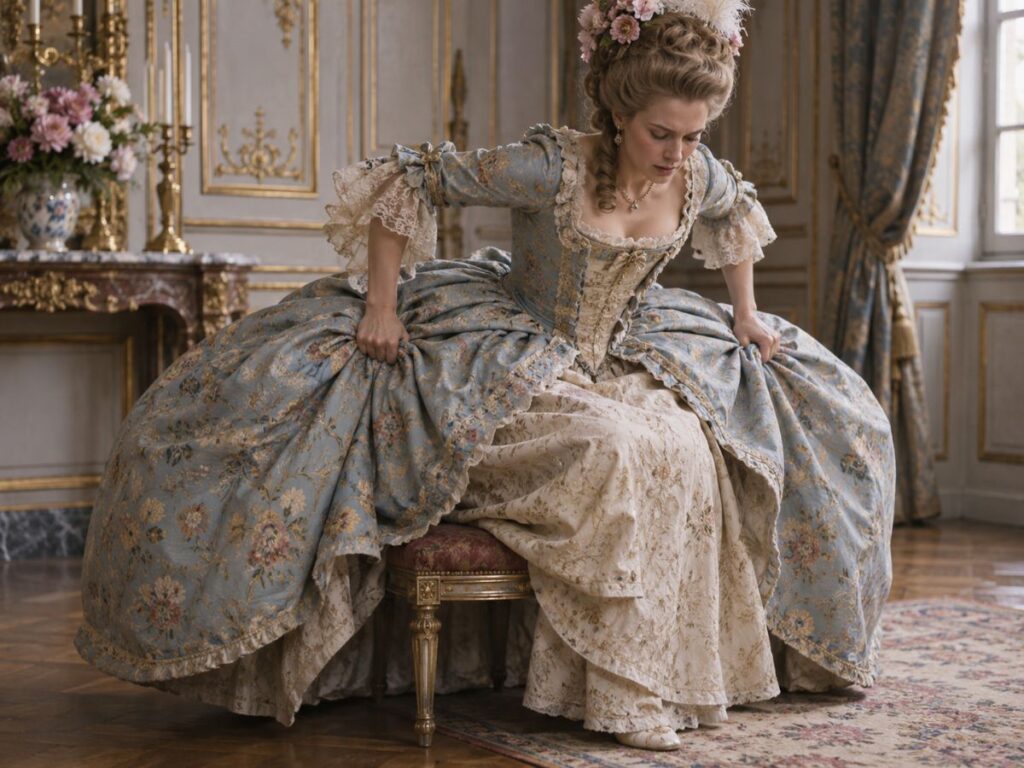
Armchairs (‘fauteuils’) were reserved by etiquette for the king and queen and a very few others, which I’ll come back to in a minute, but armchairs were also the one piece of furniture a woman in full panniers physically couldn’t use.
The arms would have jammed the hoops, or snapped them. An armless chair or a stool (a ‘tabouret’ in French) let the skirt fall over the sides and spread onto the floor while the woman sat down on the padded seat in the middle. All that just to sit down, what a palaver.
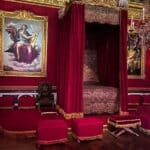
The doorways were the same. Anyone who has walked through the enfilades at Versailles will have noticed that the state rooms are strung together with tall, wide double doors that swing open as a pair.
The scale was partly about ceremony and sightlines; it was also about the fact that a woman in a court mantua or a robe à la française couldn’t get through a single-leaf door without turning sideways or lifting her hoops.
The Metropolitan Museum of Art’s British court dress of around 1750 (C.I.65.13.1a-c) shows the silhouette at its most extreme: barely wider than the body in profile, but held out from the front like a pair of sandwich boards.
You also had to know exactly how wide your own skirt was, because every other woman in the room was wearing one just as big.
Two women in full court dress couldn’t get through a doorway side by side, so somebody always had to wait. In a crowded antechamber at Versailles, with courtiers waiting to see the king, getting from one room to the next must have taken some careful timing and a lot of patience.
Hooked on the Middle Ages? Get more stories like this one in your inbox.
Did Women at Versailles Actually Sit at All?
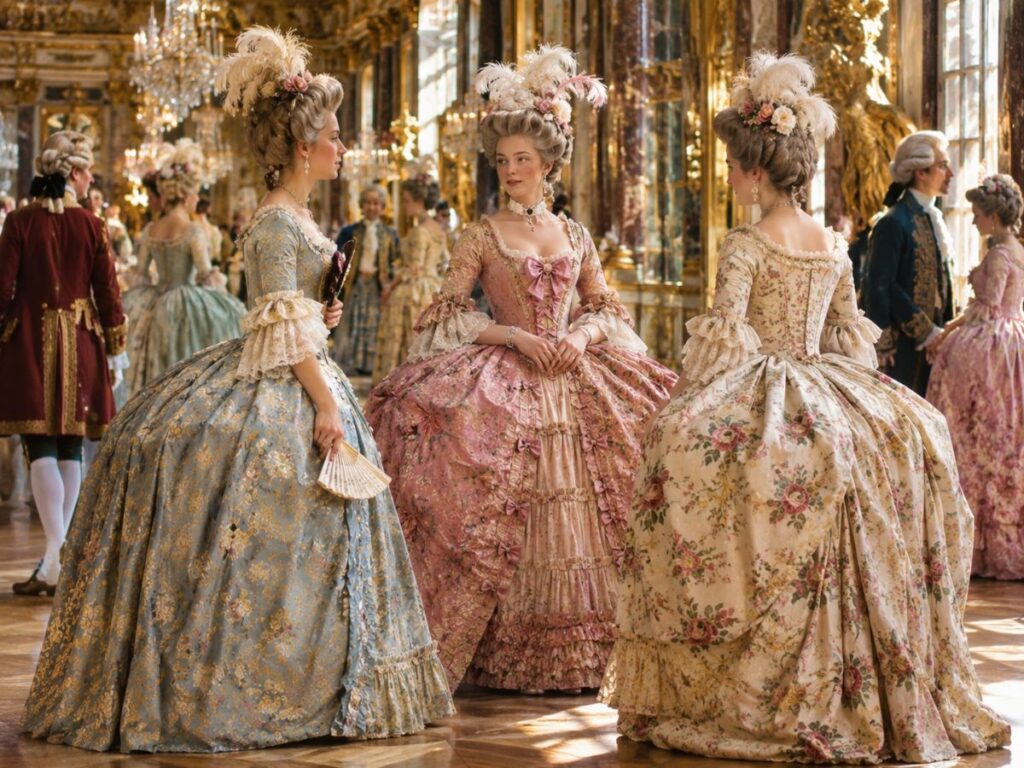
Most of them, most of the time, did not. The right to a seat in the monarch’s presence was one of the most jealously policed privileges at the French court, fixed by rank with a precision that reads today as faintly deranged.
Only the king and queen, and visiting crowned heads, took armchairs. The king’s children had chairs with backs but no arms. Duchesses were entitled to a stool, the famous ‘tabouret’, which is why being granted the tabouret was considered a promotion in its own right. Everyone else stood.
The English court ran on the same principle. A young woman presented at the Court of St James’s stood for hours in the antechamber waiting to be announced, because one never sat in the queen’s presence.
The dress was built to be stood in. Strapless stays, cut high at the armpit and boned stiff, held the shoulders back and the spine upright whether you wanted them there or not. If you have ever wondered how women kept the posture you see in the portraits, it was what was going on under the dress that made it possible.
A reception in the Grand Appartement could stretch to three or four hours. The ladies in attendance on the queen stood behind her in a loose semicircle, in full court dress, for the duration. Food was eaten standing, as was conversation, and if you fainted, you fainted standing until someone caught you.
The Lady Who Hid on the Floor Behind the Hoops
The best anecdote about all this comes from Jeanne-Louise-Henriette Campan, who served Marie Antoinette as First Lady of the Bedchamber and left a memoir of her years at Versailles.
Campan describes a long ceremony at which the Marquise de Clermont-Tonnerre, required by her rank to stand behind the queen throughout, finally gave out. She sat down on the floor.
The queen and the other ladies around her closed ranks and let the fence of their hoops form a screen, and the marquise stayed hidden down there, invisible to the room, until the ceremony ended.
The panniers were cumbersome, yes, but they were also cover. A circle of court ladies in full dress formed a visual wall that you could, at a pinch, disappear behind.
Campan also records the embroidery loophole. A lady was permitted to sit in the queen’s private apartment, as opposed to the state rooms, only if she was actively engaged in needlework. Some women took up embroidery for no reason other than to earn themselves a seat, which is one of those small bureaucratic workarounds that made 18th-century court life a little more bearable.
How Did Women Keep Their Posture?
The stays did most of the posture work. Strapless, high under the arms, boned with whalebone or cane and laced tight at the back, they held the torso in a rigid cone from mid-rib to hip.
You couldn’t slump, round your shoulders, or bend at the waist, because the waist didn’t bend. Andrew Bolton, Associate Curator at the Costume Institute, noted that women had to bend from the hips because the bottom of the waist didn’t move, reinforced by a busk that kept them more rigid.
Lowering yourself onto a stool hinged at the hips, with the back held straight and the chin up. Picking anything up from the floor was functionally impossible without help, which is one reason court ladies always had attendants within reach.
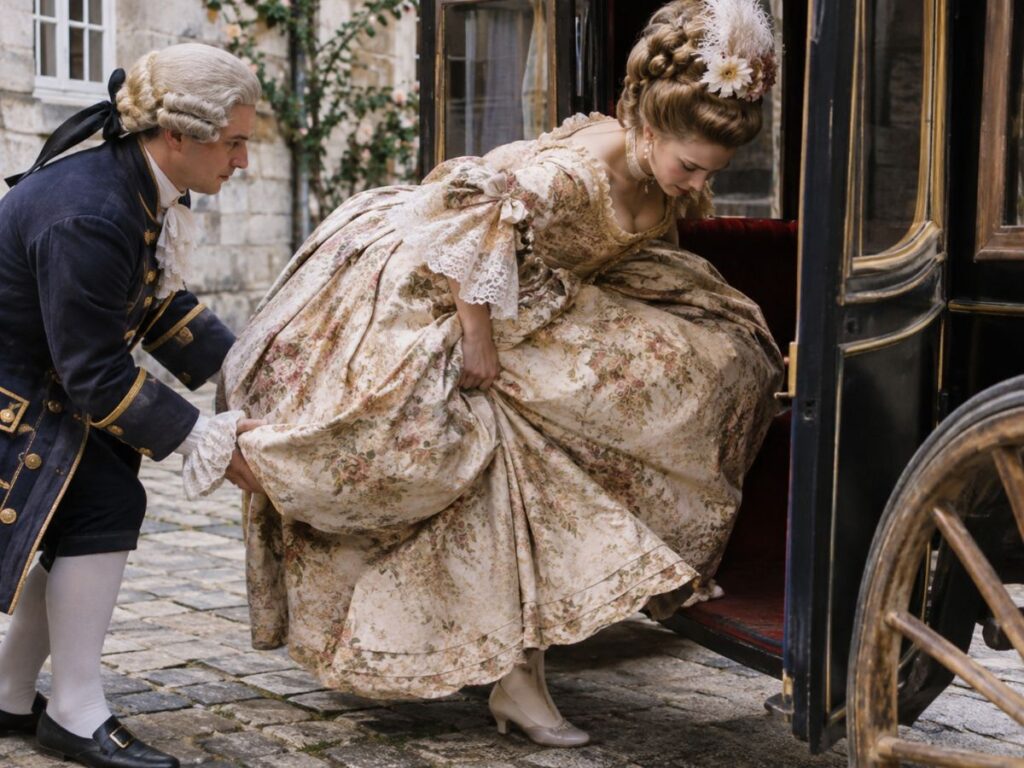
Getting into a carriage required lifting the hoops and folding the body forward from the hips in one motion, ideally without any part of the structure catching on the doorframe.
Looking light and graceful while wearing something ungovernable was a skill, and being seen to possess that skill was part of what court dress was for. A woman who fumbled her hoops in a doorway wouldn’t win any prizes, unlike a woman who glided through without seeming to notice the structure.
I thought it was hard putting on a pair of tight jeans, but I’d take those any day of the week over a dress with panniers.
Why Court Dress Stayed Wide When Everyday Fashion Moved On
By the 1780s, panniers were already an antique. Everyday fashion had moved toward narrower, softer silhouettes; the chemise à la reine was in vogue, and within a decade the French Revolution would sweep the whole apparatus of court dress away in France entirely.
But court dress itself, the clothing you were required to wear if you were presented to a monarch, held on long after fashion had moved on.
In England, Queen Charlotte kept the old rules of court dress in force well into the early 19th century, which produced the peculiar sight of young women presented at court in high Regency waists perched above full hooped skirts, because the hoops were still mandatory even as the rest of the dress had changed shape around them.
A court skirt held out 5 feet wide offered a flat embroidered canvas, often worked with silver and gold thread, sometimes with whole pictorial scenes running across the front panel. Flowers, landscapes, architectural fantasies, entire gardens stitched in silk.
You were quite literally wearing your wealth, and you needed the width to show it off. Narrow the skirt, and you lose the display surface.
The same logic ran through the social hierarchy around the dress. The ladies-in-waiting who served the queen knew exactly what each other’s gowns had cost, who had embroidered them, and how many months of work they represented.
Frequently Asked Questions
How did women sit down in wide court dresses?
Women sat down in wide court dresses by lowering themselves onto armless chairs that let the skirts spill over the sides, with the hinged panniers folding enough to allow it. Court panniers pushed the skirt sideways while the front and back stayed flat, so there was no solid frame behind the legs to fight. A stool or bench worked the same way. Many women simply stood instead.
Could panniers actually fold or collapse?
Panniers could fold and collapse, and some were built for it. The Metropolitan Museum of Art holds a rare French pannier dated 1760 to 1770 with metal hinges at the hips, so the hoops could be lifted for narrow doorways or to climb into a carriage. The structure was light willow or whalebone wands covered in linen, and open-bottomed styles packed nearly flat.
How wide were court panniers at their most extreme?
Court panniers at their most extreme made a skirt about 5 feet wide, and some went even further. One English court dress from the 1740s in the V&A was made for side hoops 5 feet across, and a court mantua at the National Museum of Scotland has a skirt nearly 2.5 meters wide, which is just over 8 feet.
Did women sit in the presence of the king and queen at Versailles?
Women did not freely sit in the presence of the king and queen at Versailles, because the right to a seat was fixed by rank. Only the king, the queen, and visiting monarchs took armchairs; the king’s children had armless chairs; duchesses and the very highest-ranking women were granted stools. Everyone below that rank remained standing, sometimes for hours at a stretch.
Why were court dresses made so wide in the first place?
Court dresses were made so wide to display a broad expanse of expensive embroidered silk and to signal the wearer’s rank and wealth. The flat front of the skirt worked like a canvas, sometimes carrying whole pictorial or floral scenes worked in thread. A wider dress needed more costly fabric and more labor, so the sheer size of the skirt advertised exactly how rich the woman wearing it was.
Love a good medieval story?
Join our readers and get tales of kings, queens, castles and ordinary medieval lives straight to your inbox.

Kylie Lang is a nationally syndicated travel journalist with bylines on the Associated Press Wire & more, a medieval history writer, and the founder and lead author of Tales of the Middle Ages (talesofthemiddleages.com). She holds a BA (Honours) in History from the University of Kent and is a member of the British Guild of Travel Writers.