If you grew up in England as I did, you’ll know the rhyme and have doubtless sung it at school. It’s usually that first line that sticks in your head: remember, remember, November 5, gunpowder, treason and plot.
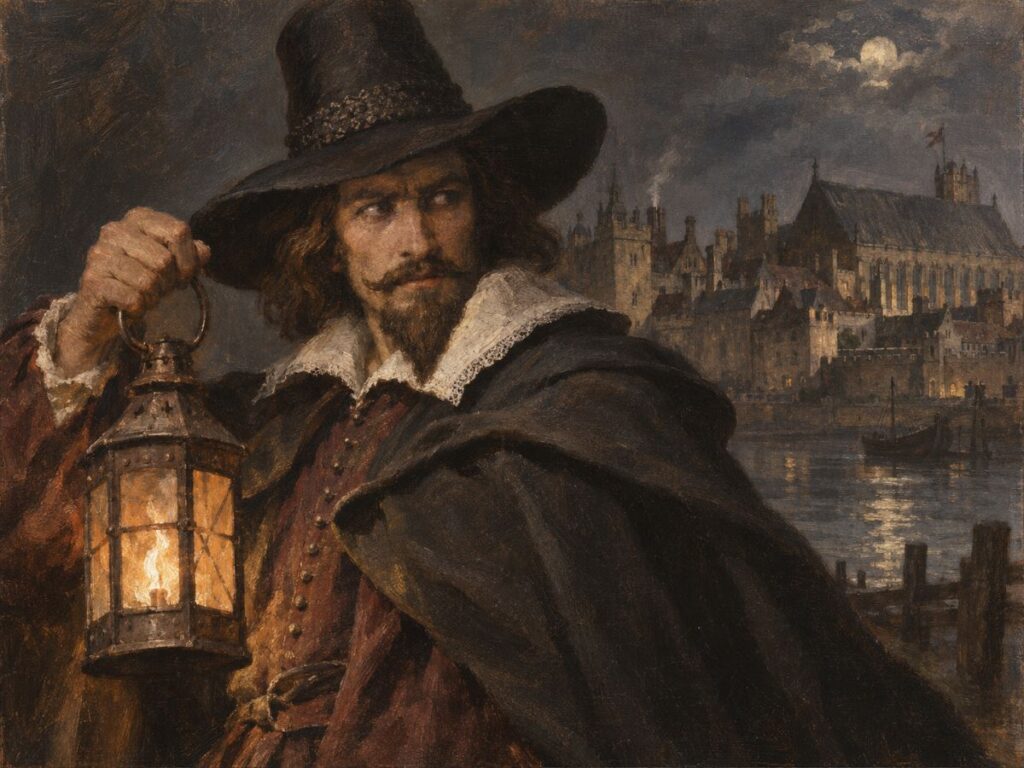
But as with so many of these rhymes, there’s a story behind it, and in this case quite a gory one from history. It involves a conspiracy, a cellar beneath the House of Lords, and a man called Guy Fawkes caught in the small hours of November 5, 1605, with a lantern in his hand and 36 barrels of gunpowder at his feet.
Table of Contents
The plot was meant to blow King James I, his heirs, and almost the whole Protestant ruling class of England into the sky in a single morning. It didn’t work. The rhyme is what the country wrote afterward, to make sure nobody forgot why.
What Are the Full Lyrics to the Guy Fawkes Rhyme?
If you haven’t heard the full rhyme, you’re in for a treat. It’s been sung and recited for generations on Bonfire Night:
Remember, remember, the 5th of November,
Gunpowder, treason and plot.
I see no reason
Why gunpowder treason
Should ever be forgot.
Guy Fawkes, Guy Fawkes, ’twas his intent
To blow up the King and the Parliament
Three score barrels of powder below
Poor old England to overthrow
By God’s providence he was catch’d
With a dark lantern and burning match
Holler boys, holler boys, let the bells ring
Holler boys, holler boys
God save the King!
Who Was Guy Fawkes and Why Did He Want to Blow Up Parliament?
Guy Fawkes was born on Stonegate in York in April 1570 and baptized on April 16 at St Michael le Belfrey, the church that sits right beside York Minster. His father, Edward, worked as a proctor and advocate in York’s church courts, so Guy grew up inside the Church of England, the official faith of Elizabeth I’s England.
When his father died, his mother married a Catholic, and the boy drifted into the faith of his stepfather’s family. By his twenties, he had sold the small estate he inherited and gone to the Low Countries to fight for Catholic Spain against the Protestant Dutch.
Fawkes left England for the Spanish Netherlands in the early 1590s and spent about 10 years fighting for Catholic Spain against the Dutch, much of it under the English exile Sir William Stanley, and by 1603 he’d been recommended for a captaincy.
He also started calling himself Guido, the Italian form of his name, and that’s the name he signed on his confession in November 1605, in a scrawl so shaky after the rack that it barely looks like the same man’s hand.
By the time he came back to England, he was in his mid-thirties, battle-hardened, devout, and willing to die for the restoration of the Catholic Church.
Under Elizabeth I, English Catholics had spent 40 years under penal laws that fined them for not attending Protestant services, barred them from the universities and the professions, and executed their priests as traitors.
When Elizabeth died in 1603, and James VI of Scotland became James I of England, Catholics hoped for relief. James was the son of the Catholic Mary, Queen of Scots, and his wife, Anne of Denmark, had converted. Instead, the recusancy fines were enforced more strictly than before.
By the spring of 1604, a small group of Catholic gentlemen decided that petitioning was finished and that the answer was to kill the king.
Hooked on the Middle Ages? Get more stories like this one in your inbox.
What Happened in the Gunpowder Plot of 1605?
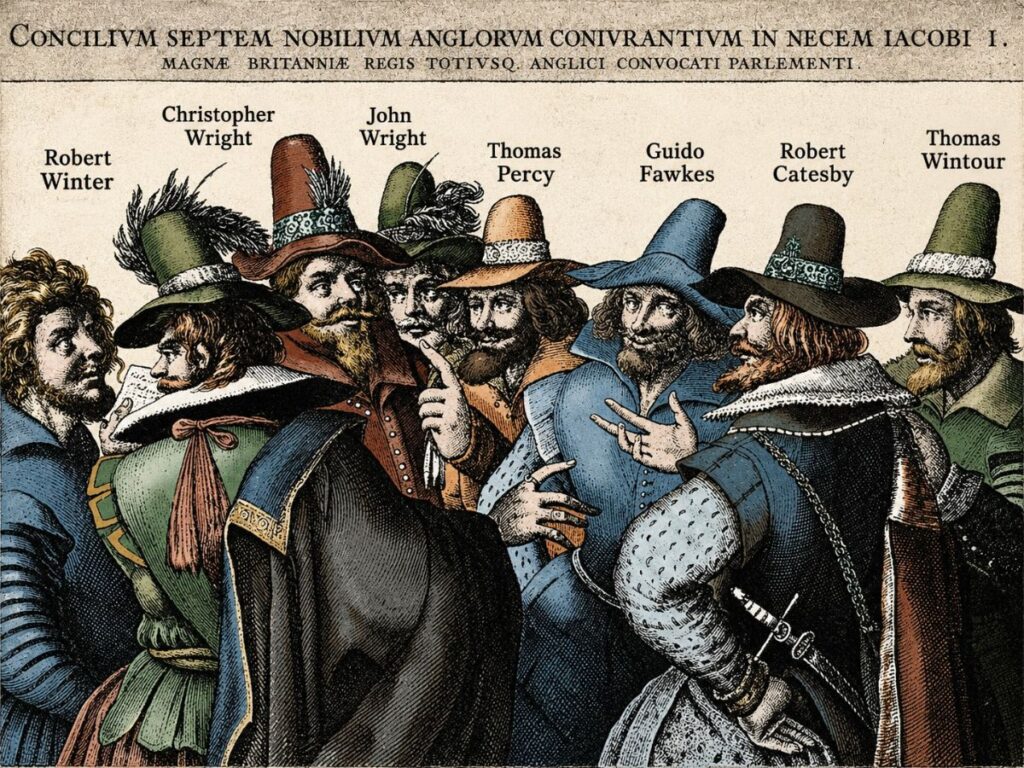
The leader wasn’t Guy Fawkes, but Robert Catesby, a charismatic Warwickshire gentleman whose father had been imprisoned for sheltering priests.
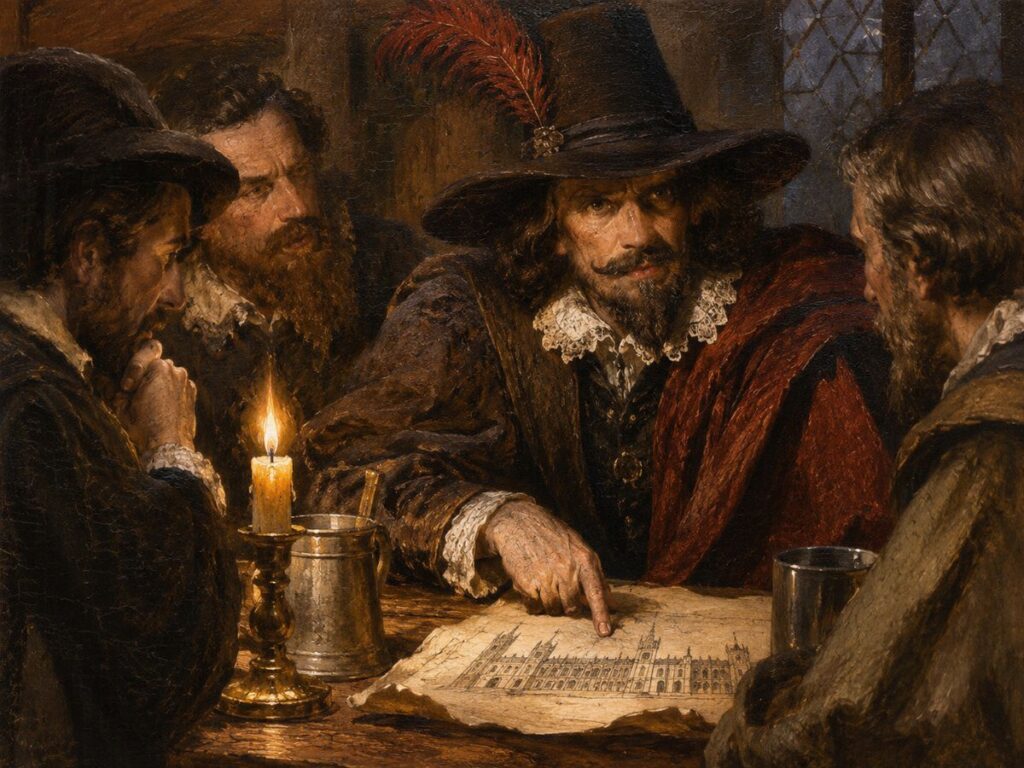
On May 20, 1604, Robert Catesby met 4 men at the Duck and Drake inn on the Strand in London: his cousin Thomas Wintour, John Wright, Thomas Percy, and Guy Fawkes. Wintour had brought Fawkes over from Flanders that spring, because Fawkes had spent more than a decade fighting for the Spanish army and knew how to handle gunpowder, which none of the others could claim.
They swore an oath of secrecy on a prayer book and heard Mass together to seal it.
The plan was to blow up the Palace of Westminster during the State Opening of Parliament, when the king, his eldest son Prince Henry, the Lords and the Commons would all be in one building.
In the chaos, the conspirators would ride into the Midlands, seize Princess Elizabeth, the king’s 9-year-old daughter, from her household at Coombe Abbey, and put her on the throne as a Catholic puppet queen.
They rented a house next to the Lords, began tunneling, then had a stroke of luck: a coal merchant’s lease on an undercroft directly beneath the Lords’ chamber came up, and Thomas Percy took it.
By the summer of 1605, they had rolled in and hidden 36 barrels of gunpowder under piles of firewood and iron bars. Fawkes was the one left to light the fuse.
The opening was postponed from the spring to November 5, 1605, because of plague. In the meantime, the group had expanded to 13, and that was the problem.
On the evening of October 26, an anonymous letter was delivered to William Parker, Lord Monteagle, a Catholic peer, warning him to stay away from Parliament because “they shall receive a terrible blow this Parliament and yet they shall not see who hurts them.” Monteagle took it straight to the Secretary of State, Robert Cecil.
Cecil sat on the information. A first search of the Palace on the afternoon of November 4 noted the suspicious pile of firewood and a tall servant hanging around, but did nothing. A second search was ordered for the small hours of November 5.
Sir Thomas Knyvett and a party of armed men came down into the undercroft just after midnight and found Fawkes there, booted and spurred, with a lantern, slow matches, and touchwood in his pockets. Behind the firewood were the barrels.
How Was Guy Fawkes Caught and What Happened to Him?
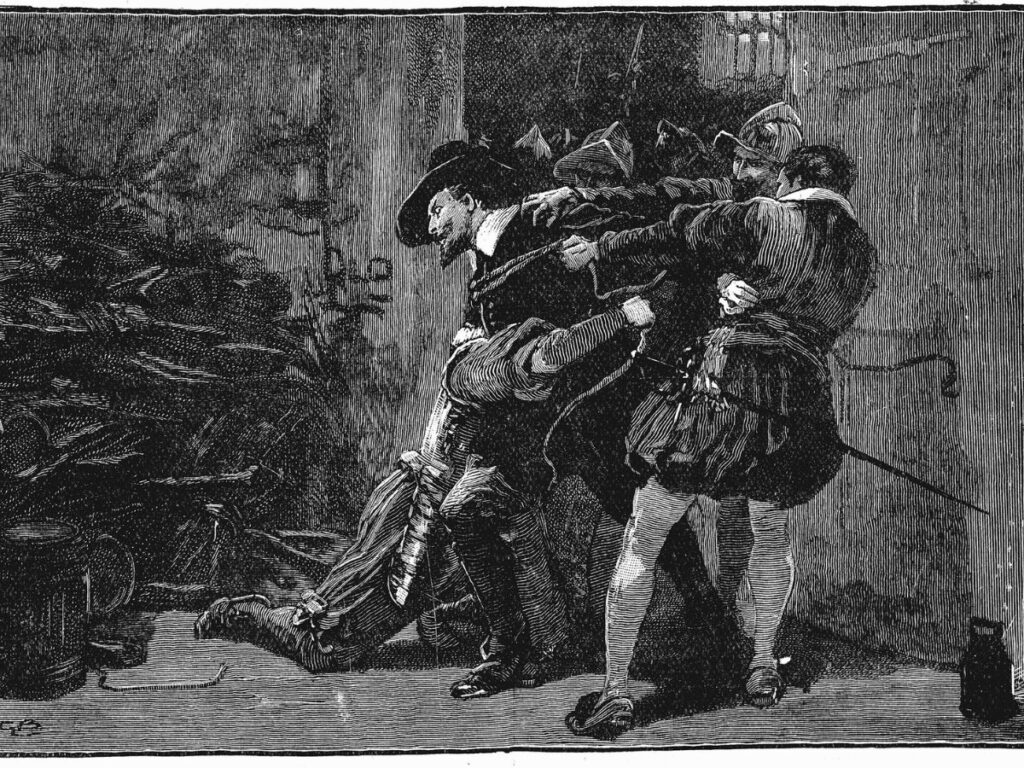
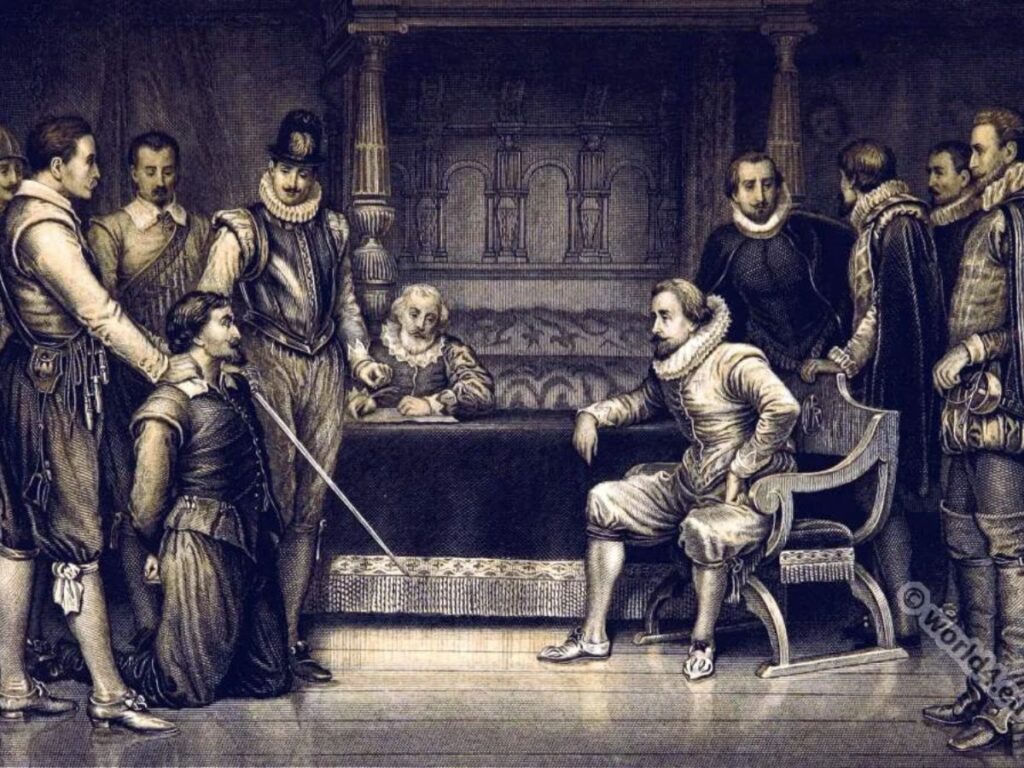
Fawkes gave his name as John Johnson and claimed to be Thomas Percy’s servant. They took him to the king’s bedchamber at Whitehall, where James I questioned him personally. Fawkes was insolent.
Asked why he had amassed so much gunpowder, he replied that he had meant to blow the Scottish king and his Scottish courtiers back to Scotland. Asked whether he regretted it, he said he regretted only that it hadn’t worked.
James authorized torture. On November 6, the king wrote a note specifying that “the gentler tortours are to be first used unto him, et sic per gradus ad ima tenditur,” and so by degrees proceeding to the worst.
Fawkes was held in the Tower of London and almost certainly stretched on the rack. His signature on his confession of November 8 is a famous document: a firm “Guido Fawkes” on the first page, and on the confession extracted two days later, after the rack had done its work, a shaky, half-formed “Guido” that trails off into nothing. The National Archives still hold both.
The other conspirators scattered into the Midlands. Catesby, the Wright brothers and Thomas Percy made a stand at Holbeche House in Staffordshire on November 8. A spark set off their damp gunpowder as they dried it in front of a fire, blinding some of them.
The sheriff’s men stormed the house. Catesby and Percy were killed by the same musket ball, and the survivors were taken back to London.
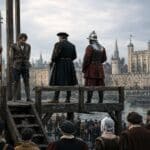
On January 30 and 31, 1606, the eight surviving plotters were hanged, drawn and quartered in two batches, the first at St Paul’s Churchyard and the second in Old Palace Yard at Westminster, directly opposite the building they had tried to destroy.
Fawkes was the last of 4 men to die in Old Palace Yard on January 31, 1606, so he had to stand and watch Thomas Wintour, Ambrose Rookwood and Robert Keyes go before him. The rack had left him so weak that the hangman had to help him up the ladder to the noose. Then he fell, or jumped, and broke his neck.
Nobody knows which, but I’m inclined to think he jumped, because it spared him the agony of being cut down alive and butchered in front of the crowd. The executioner quartered his body anyway, and his remains went to the “four corners of the kingdom” as a warning to anyone else who fancied blowing up a king.
Why Do We Still Celebrate Bonfire Night on November 5?
Within weeks of the arrests, Parliament passed the Observance of November 5 Act 1605, usually called the Thanksgiving Act. It required every parish church in England to hold a special service of thanksgiving on November 5 each year, for the deliverance of the king, the royal family and the realm from “the most traitorous and bloody intended massacre by gunpowder.”
The bonfires started that same night. Londoners lit fires in the streets on November 5, 1605, when word got out, and the custom stuck. By the later 17th century, effigies were being burned as well.
For a long time, it was the Pope who went on the fire, especially after the Gunpowder Treason Day sermons of the 1670s and 1680s whipped up anti-Catholic feeling during the Popish Plot scare.
Guy Fawkes himself didn’t become the standard effigy until well into the 18th century. Children would wheel a straw-stuffed “Guy” around the streets asking for a penny to buy fireworks, a custom that limped on into the late 20th century and has mostly died out now.
The rhyme itself seems to have grown up gradually in the 17th and 18th centuries, passed on by children and chapbooks rather than any single author. Nobody knows who wrote it. By the Victorian period, it was fixed in roughly the form we know, and in 1870 the Act was repealed, formally ending the religious service but doing nothing to dampen the fires.
Lewes in Sussex still holds the biggest celebration in England, with torchlit processions by rival bonfire societies and effigies of current villains alongside the traditional Pope and Guy.
Fawkes’s lantern survives and is held by the Ashmolean Museum in Oxford, given to the university in 1641.
Love a good medieval story?
Join our readers and get tales of kings, queens, castles and ordinary medieval lives straight to your inbox.

Kylie Lang is a nationally syndicated travel journalist with bylines on the Associated Press Wire & more, a medieval history writer, and the founder and lead author of Tales of the Middle Ages (talesofthemiddleages.com). She holds a BA (Honours) in History from the University of Kent and is a member of the British Guild of Travel Writers.
Related posts:
 The Twisted Origins of Classic Nursery Rhymes That Belong in a History Book, Not a Crib
 9 TV Shows Set in the Tudor Court To Watch This Fall That Will Have You Glued To Your Seat
 The Punishments for Treason in Tudor England, and Why Your Rank Decided How You Died
 The Explosive Story of King James I and Robert Carr, the Scandal That Rocked Stuart England