
There are royal scandals, and then there’s the story of King James I and Robert Carr. It has everything that grips a history lover’s curiosity: power, obsession, betrayal, and a relationship that pushed the boundaries of what a king could get away with in early 17th-century England. James, the first Stuart king of England and already a controversial figure, had an intense fascination with a handsome young man who had neither the education nor the experience to warrant such favor.
Letters survive in which James openly calls Carr his “sweet child” and “wife,” language that left contemporaries whispering and historians debating ever since. It was no secret that the king’s affection had political consequences, and soon the young Scot rose from obscurity to become one of the most powerful men in the kingdom.
Table of Contents
But power built on passion is a dangerous thing. Carr’s meteoric rise turned allies into enemies, and his influence over the king drew suspicion from every corner of court life. What began as an intoxicating relationship would spiral into jealousy, manipulation, and a scandal involving murder that left England’s royal court reeling.

Robert Carr’s Early Life
Robert Carr was born in 1584, into an old Scottish landowning family with estates near the English border. The Carrs had built their reputation on loyalty to the young King James VI, which kept them well regarded in court circles. But Robert himself didn’t stand out.
He spent most of his youth drifting around the edges of royal life, known more for his poor Latin than for any particular talent or ambition. His family’s influence eventually secured him a place in the household of the king’s treasurer, but it was hardly a position that promised greatness.
Everything began to shift in his late teens when he crossed paths with Thomas Overbury. Overbury was everything Robert was not: well-educated, quick-witted, and freshly graduated from Oxford. He had come north to Edinburgh to experience the Scottish court for himself, and the two young men quickly became inseparable.
Their closeness drew plenty of attention, and those who knew them best strongly suggested it was more than friendship. Many believed Robert and Thomas were lovers, a connection that would shape the course of both their lives in ways neither of them could have imagined.

How Carr Met King James
Robert’s relationship with Overbury might have faded into the background of history if not for a single accident in March 1607 that changed everything.
By then, Robert was 23 and had been part of the English court for four years. His master had moved south when James inherited the English and Irish thrones in 1603, bringing Robert with him. Life at court offered opportunity, but Robert still remained on the fringes of power. That all shifted during a jousting tournament attended by the king. Robert was thrown from his horse and broke his leg, an injury that would transform his future.
King James paid him a polite visit in the aftermath, but one visit soon turned into many. The king began stopping by Robert’s bedside every day, and it wasn’t long before the court started whispering about this unexpected new favorite.
By the end of the year, news of their growing closeness had spread far beyond Whitehall. Londoners wrote about it in their diaries and letters, referring to Robert as the latest “new comet” blazing across the royal sky.
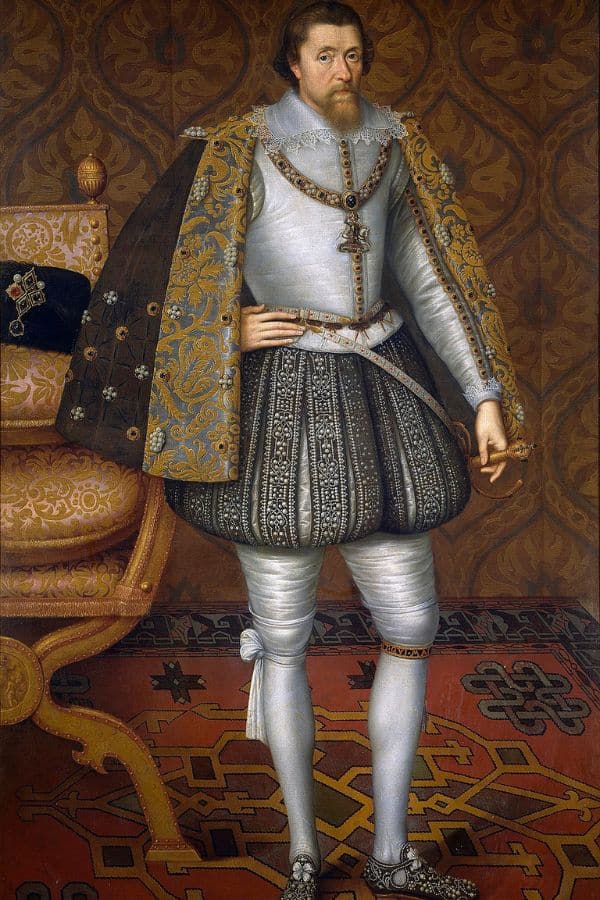
The Advantages of Being the King’s Favorite
James’s preference for male company was no secret to those who served him. Courtiers knew it well and often tried to exploit it, presenting attractive young men to the king in hopes of gaining influence through his affections.
James had particular tastes, too. Above all else, he despised bad breath, so much so that it became an unofficial requirement for anyone hoping to catch his eye. His chief minister, Sir Robert Cecil, once described a handsome young man as “an excellent good instrument to conserve his Majesty’s good opinions.”
The Howard faction went even further. The Countess of Suffolk reportedly supplied facial creams and mouthwash to the “choice young men, whom she daily curled and perfumed” before sending them toward the king. Among them were Sir James Hay, Sir Arthur Brett, and Sir William Monson, all eager courtiers carefully groomed to win royal favor.
But Robert Carr was different. He outshone every one of them, not only because of his good looks but because he came without the backing of any political faction. To James, that made him far more appealing. He was not a tool of courtly intrigue, at least not yet, and that gave their relationship a raw authenticity that others could not replicate.
Hooked on the Middle Ages? Get more stories like this one in your inbox.
A King Falls in Love With a Commoner
James was soon very clearly in love with Robert Carr and, as far as we can tell, the feelings were initially reciprocated. What made their relationship unusual to those that had come before was that Robert was the only one of James’s favorites who was never referred to as exceptionally handsome.
Robert was described as of average looks and medium height, with blond hair. More accurately, he was described that way in private. In public, the court all but fell over themselves with their acrobatic sycophancy, or sucking up as we’d say today.
With the King settling his bills, Robert discovered a love of jewelry and clothes. The style he wore on Monday had become the fashion by Tuesday. Irked that they had backed the wrong candidate, the Howards contemptuously referred to Robert as ‘the Scottish lad’ in their letters.
Robert loved his new wardrobe and the country estates deeded to him by the King. However, recognizing that he lacked the savage intelligence needed to triumph in the game of politics, Robert refused to participate in government. He contented himself with playing chess with James in the evenings, sharing his bed, and accompanying him on his many hunting trips to lodges in the country, some of which were renovated to suit Robert’s tastes.
James and Robert wore bejewelled miniatures of one another, encircled with diamonds and hanging on the kind of ribbon associated with courting couples. They took the King’s pet armadillo for walks in the countryside and returned to London for lavish Christmas celebrations.
Robert always remained respectful of James’s wife, Anna of Denmark, poor woman. A thankless position and not one I’d have wanted. James would later look back on these years as ones of real happiness, when a devoted Robert ‘held grip of me but out of mere love,’ rather than ambition.

Things Begin to Turn Sour
Five years was a long time for any royal favorite to stay in the king’s inner circle, but by 1612, politics finally crashed into the world James and Robert had built together. When Sir Robert Cecil died in May that year, his death left a gaping hole at the center of government. Rival factions immediately began scheming to claim the power he left behind, and Robert suddenly found himself in the middle of a dangerous new game.
Thomas Overbury, once Robert’s “bedfellow and minion,” saw a chance to make himself useful again and reentered Robert’s life. He urged his former lover to exploit the situation, to let the competing factions fight for his favor and use their desperation to his advantage. Robert listened.
With Overbury as his go-between, money started pouring in from ambitious men eager for royal appointments. Those who paid were rewarded with influence and titles. Those who didn’t were swiftly ignored, replaced by candidates with far less experience but much deeper pockets.
The corruption did not go unnoticed. Enemies began to circle, united by their resentment and their shared goal of removing Robert from power. What had begun as a love story had now turned into a dangerous struggle for survival at the heart of the Stuart court.
The Howards Woo Robert, and He Marries Their Daughter
The Howards had spent years mocking Robert behind his back, sneering at his Scottish accent and even his thinning hair. But as his influence grew, so did their ambition, and they decided it was better to win him over than ridicule him. Their plan centered on their daughter, Frances Howard, Countess of Essex, who was already married but began openly flirting with Robert under her family’s encouragement.
To tighten their hold on him, the Howards pushed for Frances to divorce her husband, Robert Devereux, Earl of Essex, the son of Elizabeth I’s once-favored courtier. The annulment hearings turned into a public spectacle, humiliating Devereux in the worst possible way.
The Howards painted him as sexually impotent, describing in crude detail what they called his “bad prick.” The scandal left Devereux furious and deeply humiliated, and he soon joined the growing number of powerful figures at court determined to bring Robert Carr down.
James accepted that even his favorites were expected to marry, just as he had. To prepare for Robert’s wedding to Frances at Whitehall Palace in 1613, he elevated him to Earl of Somerset, a title that marked the height of Robert’s power and influence.

The Fall of Overbury
But not everyone was celebrating. Overbury, furious at losing his grip on Robert, set out to undermine the new marriage by ridiculing Frances at every turn. Then he made a catastrophic mistake. Confident in his closeness to Robert, he began telling others at court that James hated him because Robert “loves me better than him.”
The insult managed to offend both the king and queen in one breath, and James responded with ruthless precision. Overbury was thrown into the Tower of London, where, still in his early thirties, he caught a fever and died.
Robert showed no public grief over the death of the man who had once been his closest companion. If anything, he seemed lighter, almost relieved, and with the encouragement of his new Howard allies, he turned mean-spirited and vindictive. Rivals were humiliated, those who refused to flatter him were punished with miserable lodgings, and his arrogance deepened. James watched this change with alarm.
Their relationship grew toxic, filled with bitter arguments. The king admitted that no one had spoken to him so cruelly since the tutor who had beaten him as a boy. Robert’s cruelty became relentless. He would even wait until James was asleep, then wake him to rant about his lack of generosity.
The Poison Scandal
Things came to a head when a former Tower of London employee came forward with damning information: Frances had bribed him, through a friend, to poison Thomas Overbury. The revelation sent shockwaves through the court. During his imprisonment, Overbury had attempted to blackmail Robert, threatening to reveal the “Secrets of all kinds” that had passed between them over their “nine years of love.”
Panic consumed Robert. He frantically tried to erase every trace of their relationship, destroying letters Overbury had written to their mutual friends. One observer noted that the threat of exposure had turned Robert’s former affection into “a malice or hatred, mixed with deep and bottomless fears.”
Whether he knew about Frances’s plan to have Overbury killed is still uncertain, but he did everything he could to hide the evidence. Only the testimony of the Tower employee and several of his colleagues uncovered the truth.
Those who had helped Frances carry out the murder were hanged. Frances herself was soon sent to the Tower, where she stood trial. Both she and Robert were found guilty, and even King James could do nothing to stop it.
There was too much evidence, too much public outrage. Crowds were gripped by the spectacle, disgusted yet enthralled, paying money to secure seats at the trials that exposed the sordid depths of the king’s court.
The Death Warrant That Nearly Was
James may not have been able to stop the trials, but he drew the line at sending Robert and Frances to their deaths. Despite intense pressure from every corner of his court, he refused to sign their death warrants. Instead, the disgraced couple spent years locked away in the Tower, their power gone and their reputations shattered.
Nine years later, as the king lay dying, he issued one final act of mercy. James pardoned them both, a gesture that revealed the complicated love that still lingered beneath the betrayal and scandal. Robert lived out his final two decades in obscurity, returning to the quiet edges of public life where he had once begun. He died in 1645 in his sixties, far removed from the heights of influence he had once known.
His story is one of meteoric rise and brutal fall, driven by love, ambition, and the fatal flaws that consumed them both. It remains one of the most extraordinary downfalls of James VI and I’s turbulent reign, a scandal that still fascinates four centuries later.

Love a good medieval story?
Join our readers and get tales of kings, queens, castles and ordinary medieval lives straight to your inbox.

Kylie Lang is a nationally syndicated travel journalist with bylines on the Associated Press Wire & more, a medieval history writer, and the founder and lead author of Tales of the Middle Ages (talesofthemiddleages.com). She holds a BA (Honours) in History from the University of Kent and is a member of the British Guild of Travel Writers.